
Premier League Clubs Begin First Season Under New Squad Cost Ratio (SCR) Financial Rules
The Premier League has officially replaced its Profitability and Sustainability Rules with a real-time spending cap, forcing clubs to adopt new squad-building strategies.

Eighty-five percent. That is the new magic number dictating every contract negotiation, transfer bid, and agent fee in English football. As the 2026-27 Premier League season kicks off, the deeply unpopular Profitability and Sustainability Rules (PSR) have been officially retired, replaced by a real-time spending cap known as the Squad Cost Ratio (SCR).[1][3]
Instead of measuring cumulative losses over a forgiving three-year rolling period, SCR ties a club's on-pitch spending directly to its current revenue. If you cannot afford your squad today, you are in breach today. The timeline shift removes the ability for clubs to kick the can down the road, forcing immediate operational efficiency.[1][6]
The core mechanic is straightforward but strict: clubs not competing in European competitions can spend a maximum of 85% of their football-related revenue on their squad. This numerator includes player wages, head coach salaries, transfer fee amortisation, and agent commissions.[1][3]
This 85% mark is designated as the "Green Threshold." If a club's spending pushes past this line but remains under 115%, they enter a buffer zone. Here, they face a financial levy—essentially a luxury tax payable to the league—but avoid the devastating sporting sanctions that defined the final years of PSR.[1][3][4]
However, breaching the 115% "Red Threshold" triggers automatic sporting penalties, starting with a six-point deduction and escalating by one point for every £6.5 million overspent. The system is monitored in real-time, with compliance tests conducted in-season rather than years after the fact.[2][3]
For the league's elite, the stakes are even higher. Clubs competing in the Champions League, Europa League, or Conference League must adhere to UEFA's stricter 70% squad cost limit, creating a dual-regulatory environment.[1][5][6]
This two-tiered system is intentionally designed to protect competitive balance. The established giants operate under a tighter percentage but possess massive global commercial revenues, while ambitious challengers get a 15% looser leash to try and bridge the financial gap.[1][4]
Because SCR includes net profit from player sales in the revenue denominator, the transfer market has taken on a new strategic dimension. Selling a homegrown player for £40 million directly adds £40 million to the revenue base, instantly creating £34 million in new spending headroom.[6][7]
Consequently, front offices are abandoning the old PSR survival tactics and adopting distinct, long-term squad-building models to navigate the new landscape. The era of unchecked spending is over, replaced by a system that forces every club to choose exactly how they want to build their future.[3][6]
Viewpoints in depth
Strategy A: The Player-Trading Headroom Model
Maximizing the SCR denominator by aggressively selling homegrown talent to fund new acquisitions.
For: Generates massive immediate spending power. Because academy graduates have zero book value, their entire transfer fee counts as pure profit, directly expanding the 85% revenue denominator. Selling one homegrown player for £40 million instantly creates £34 million in new squad cost allowance. Against: Highly volatile and emotionally taxing. It strips the squad of club-trained identity and relies on a constant, unpredictable pipeline of sellable youth. Evidence: Clubs like Aston Villa and Chelsea heavily utilized homegrown sales to navigate the final years of PSR, a tactic that translates directly into SCR headroom. Fits well when: A club possesses an elite Category 1 academy and a willingness to part with fan favorites to fund established stars. Does not fit when: A club relies on buying established, peak-age players who offer little to no resale value.
Strategy B: The Commercial Baseline Model
Capping total squad costs strictly against guaranteed broadcast and commercial income, ignoring player sales.
For: Total financial stability. It removes the desperation of accounting deadlines and ensures the club never has to sell a star player simply to balance the books. Squad costs are covered entirely by recurring revenue. Against: Severely limits the ability to make blockbuster £100 million signings unless the club first achieves significant commercial growth or Champions League qualification. Evidence: Arsenal's recent squad-building approach has tied wage structures directly to commercial and European revenue growth, avoiding the need for massive outgoings to fund incomings. Fits well when: A club has global commercial reach, a massive stadium, and guaranteed European football to inflate the baseline denominator. Does not fit when: A mid-table club is attempting to aggressively bridge the £100 million+ revenue gap to the established elite.
Key points
- The Premier League has officially replaced PSR with the Squad Cost Ratio (SCR) for the 2026-27 season.
- Domestic clubs are capped at spending 85% of their football-related revenue on squad costs, while European competitors face a stricter 70% UEFA limit.
- Breaching the 85% 'Green Threshold' incurs a financial levy, while exceeding the 115% 'Red Threshold' triggers automatic points deductions.
- The new system is monitored in real-time, forcing clubs to adopt either a player-trading headroom model or a commercial baseline strategy.
What we don’t know
- Whether the financial levies collected from clubs in the 85%-115% buffer zone will be redistributed to compliant clubs, and how that mechanism will work.
- How the new Independent Football Regulator (IFR) will interact with the Premier League's SCR enforcement.
- Domestic Challengers
- Clubs outside Europe who rely on the 85% limit and player trading to aggressively close the gap to the top.
- European Elite
- Top-tier clubs operating under UEFA's stricter 70% limit, relying on massive commercial revenues to maintain dominance.
Perspectives this story doesn't cover
- Lower-league clubs fearing inflated domestic transfer fees
- Match-going fans facing higher ticket prices to boost revenue
Sources
Source coverage
7 outlets
2 viewpoints surfaced







- [1]Premier League OfficialEuropean Elite
Squad Cost Ratio (SCR) Explained
Read on Premier League Official → - [2]The GuardianEuropean Elite
Premier League set to amend spending rules to give clubs more flexibility for transfers
Read on The Guardian → - [3]The EskDomestic Challengers
Premier League, Squad Cost Ratio (SCR) and Sustainability and Systemic Resilience (SSR)
Read on The Esk → - [4]ToffeeWebDomestic Challengers
What is Squad Cost Ratio (SCR)?
Read on ToffeeWeb → - [5]Mundo DeportivoEuropean Elite
Premier League clubs approve new Squad Cost Rules
Read on Mundo Deportivo → - [6]Backpage FCDomestic Challengers
What is the Squad Cost Ratio (SCR) rule in the Premier League?
Read on Backpage FC → - [7]AnkuraEuropean Elite
The Premier League is preparing for a major shake-up in its financial regulations
Read on Ankura →
More in Sports
See all →Eredivisie Title Race
Depleted PSV Eindhoven Hosts SC Heerenveen Following First Eredivisie Defeat
7 sources

Saudi Pro League
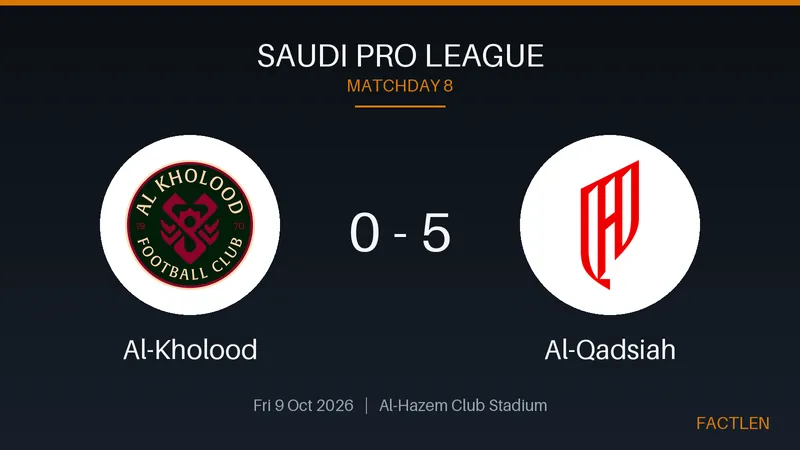
Al-Qadsiah Dismantles Al-Kholood 5-0 to Seize Top Spot in Saudi Pro League
6 sources
Pitch Geometry
Enforcing Law 14's 9.15-Metre Buffer: Why Soccer's Penalty Arc Extends Four Yards Beyond the Box
4 sources

Trade
Mikel Arteta Signs Arsenal Contract Extension Through 2030
6 sources

Comments
Every angle. Every day.
Get Sports stories with full source coverage and perspective breakdowns, free every day.