
OLED vs. Mini-LED Gaming Monitors: The 2026 Definitive Comparison
As display technology matures in 2026, the choice between OLED and Mini-LED gaming monitors comes down to a strict trade-off between perfect motion clarity and sustained peak brightness. This deep dive quantifies the strengths of both panels to help buyers match the right hardware to their room lighting and daily workflow.
By Factlen Editorial Team
- Dark-Room Purists
- Gamers who prioritize absolute contrast and motion clarity above all else.
- Mixed-Use Power Users
- Professionals who split their time between heavy productivity and high-end gaming.
- Cinematic HDR Enthusiasts
- Users who believe peak luminance is the key to realistic high-dynamic-range content.
What's not represented
- · Budget-conscious gamers who rely on traditional IPS panels
- · Console-exclusive players who prioritize television formats over desktop monitors
Why this matters
A high-end gaming monitor is a multi-year investment that dictates your daily visual experience. Choosing the wrong panel technology for your specific room lighting or workflow can result in severe eye strain, washed-out colors, or permanent hardware damage.
Key points
- OLED monitors offer infinite contrast and perfect black levels by turning off individual pixels.
- Mini-LED monitors deliver significantly higher peak brightness, making them ideal for sunlit rooms.
- OLED's 0.03ms response time provides unmatched motion clarity for competitive esports.
- Mini-LED panels are immune to burn-in, making them safer for productivity and static UI elements.
- OLEDs use an Auto Brightness Limiter (ABL) that dims the screen during bright full-screen scenes.
The high-end gaming monitor market in 2026 is defined by a fierce engineering rivalry between two flagship display technologies: OLED and Mini-LED. Unlike previous generations where budget dictated the choice, today’s buyers face a strict trade-off between two distinct paths of visual perfection. The decision no longer hinges on which panel is objectively better, but rather which technology's inherent compromises best align with a user's physical environment and daily workflow.[6]
At the core of this debate is a fundamental difference in how the screens generate light. OLED (Organic Light Emitting Diode) panels utilize self-emissive organic carbon-based pixels, meaning each individual pixel produces its own light and can turn off completely. Conversely, Mini-LED monitors rely on an inorganic Gallium Nitride backlight array positioned behind a traditional LCD layer. Instead of per-pixel control, Mini-LEDs use thousands of microscopic local dimming zones to control brightness across different areas of the screen.[2][6]
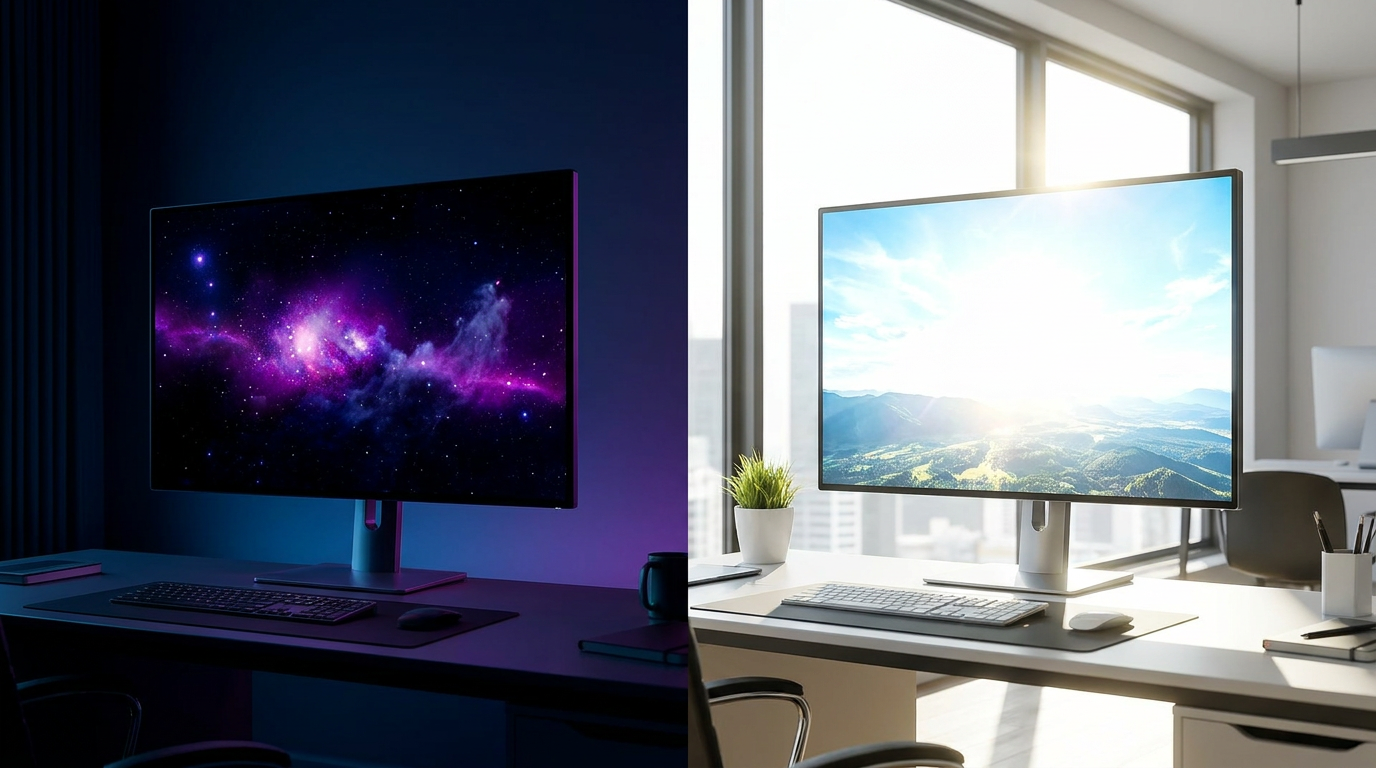
When evaluating absolute contrast and black levels, the argument heavily favors OLED technology. Because OLED pixels are self-emissive, they achieve an infinite contrast ratio. When a scene calls for darkness, the pixel simply powers down, emitting zero light. This creates a level of visual depth that is highly prized in story-driven, atmospheric games like space simulators or survival horror titles.[1][3]
The evidence for OLED's contrast dominance is clearly visible in dark-room testing. Independent display analysts confirm that OLED panels exhibit zero blooming or haloing—the distracting visual artifact where light bleeds into dark areas. A bright star against a pitch-black sky is rendered with pinpoint accuracy, providing an unmatched level of immersion for users playing in light-controlled environments.[1]

However, the argument against OLED centers on its strict brightness limitations. To protect the organic compounds from overheating and degrading, OLED monitors employ an Auto Brightness Limiter (ABL). While an OLED might hit 1,000 nits in a tiny specular highlight, the ABL aggressively dims the panel when a large portion of the screen becomes bright, such as a snow-covered landscape or a bright web browser.[4]
Conversely, the argument for Mini-LED rests on its sheer, sustained luminance. Free from the thermal constraints of organic pixels, modern Mini-LED monitors are built to push massive amounts of light. In 2026, flagship Mini-LED displays routinely hit peak HDR brightness levels between 2,000 and 5,000 nits, delivering a blindingly realistic HDR experience that OLED simply cannot match.[2][4]
The evidence supporting Mini-LED's brightness advantage is most apparent in real-world, bright-room usage. For users with floor-to-ceiling windows or brightly lit office spaces, OLED panels often appear washed out due to ambient glare. Mini-LED displays easily overpower environmental light, maintaining vibrant color volume and stark specular highlights regardless of the time of day.[2][5]

For motion clarity, the data points definitively to OLED. The self-emissive nature of the technology allows for near-instantaneous pixel state changes. Current OLED gaming monitors boast Gray-to-Gray (GtG) response times of roughly 0.03 milliseconds. This effectively eliminates motion blur, ensuring that fast-moving objects remain razor-sharp.[2][3]
The self-emissive nature of the technology allows for near-instantaneous pixel state changes.
The evidence for this motion advantage is heavily cited by competitive esports players. In fast-paced titles like Valorant or Counter-Strike 2, the 0.03ms response time translates to zero ghosting behind moving targets. Players report that tracking opponents during rapid camera pans is significantly easier on an OLED, providing a tangible mechanical advantage over traditional LCD panels.[3]
The argument against Mini-LED in competitive scenarios is rooted in the physical limitations of liquid crystals. Even on high-end 240Hz Mini-LED panels, the liquid crystals take time to shift states, typically resulting in response times between 1.0 and 5.0 milliseconds. While this is fast enough for 99% of casual players, the slight residual blur is noticeable to professionals accustomed to OLED's instant transitions.[3]
Regarding longevity, the argument against OLED focuses on the persistent risk of permanent burn-in. While 2026 models feature advanced software mitigations and Deuterium-stabilized pixels, the physical reality of organic degradation remains. Displaying static elements—like a game's heads-up display (HUD), a Windows taskbar, or video editing timelines—for thousands of hours will eventually cause those specific pixels to age faster than the rest of the screen.[2][5]

The evidence for Mini-LED's superior durability lies in its inorganic construction. Gallium Nitride LEDs do not suffer from differential aging. System integrators and workstation builders consistently recommend Mini-LED for mixed-use setups because users can leave static productivity applications open for eight-hour shifts without any anxiety about permanently damaging their expensive hardware.[2]
Furthermore, Mini-LEDs maintain a distinct advantage in text clarity. Many QD-OLED and WOLED panels use non-standard subpixel layouts (like triangular RGB or RWBG), which causes operating systems to render text with slight color fringing around the edges. Mini-LED monitors utilize standard RGB layouts, resulting in crisp, artifact-free text that is essential for programming and heavy reading.[1]
Ultimately, the choice requires a pragmatic assessment of how the monitor will be used. The market has bifurcated, offering distinct tools for distinct jobs. To finalize the decision, buyers must weigh their room lighting, their tolerance for burn-in risk, and their sensitivity to motion blur.[6]
OLED fits well when the monitor is placed in a light-controlled or dark room, where ambient glare is minimal. It is the definitive choice for gamers who prioritize cinematic immersion, perfect black levels, and the absolute highest tier of motion clarity for competitive shooters.[1][3]

OLED does not fit well when the display doubles as a full-time professional workstation. Users who spend eight hours a day staring at static spreadsheets, code editors, or bright web pages will likely trigger the panel's dimming algorithms and expose the screen to long-term burn-in risks.[2]
Mini-LED fits well when the setup is located in a brightly lit environment, such as a living room with large windows or a sunny home office. It is the ideal hybrid display for users who split their time evenly between HDR gaming and heavy productivity, offering peace of mind and blindingly bright highlights.[4][5]
Mini-LED does not fit well when the user is highly sensitive to visual artifacts in dark scenes. Even with 20,000 local dimming zones, slight blooming can still occur around bright objects on black backgrounds, which may distract purists looking for the flawless contrast of a self-emissive display.[1][4]
How we got here
2022
First mainstream QD-OLED gaming monitors launch, introducing quantum dot color to self-emissive panels.
2024
Mini-LED zone counts cross the 1,000-zone threshold in sub-$1,000 consumer displays.
2025
OLED manufacturers introduce Deuterium-stabilized pixels to significantly reduce burn-in risks.
2026
Flagship Mini-LEDs achieve 20,000+ dimming zones, virtually eliminating blooming in standard viewing conditions.
Viewpoints in depth
Dark-Room Purists
Gamers who prioritize absolute contrast and motion clarity above all else.
For this camp, the monitor is a window into another world, and any break in immersion is unacceptable. They argue that the infinite contrast of OLED—where a pixel can turn completely off to render true black—is the single most important metric for visual fidelity. Furthermore, competitive players in this group point to the 0.03ms response time as a tangible mechanical advantage, eliminating the motion blur that plagues even the fastest LCD panels during rapid camera movements.
Mixed-Use Power Users
Professionals who split their time between heavy productivity and high-end gaming.
This group views the monitor as a long-term workstation investment. They argue that OLED's burn-in risk, while reduced, remains a fundamental flaw for anyone displaying static taskbars, spreadsheets, or editing timelines for eight hours a day. They champion Mini-LED for its inorganic durability and superior text clarity, noting that standard RGB subpixel layouts render text much sharper than the fringing often seen on QD-OLED and WOLED panels.
Cinematic HDR Enthusiasts
Users who believe peak luminance is the key to realistic high-dynamic-range content.
For these enthusiasts, true HDR requires blinding highlights that mimic reality—the glare of a sun, the flash of an explosion, or the glint of a flashlight. They argue that OLED's 1,000-nit ceiling and aggressive Auto Brightness Limiter (ABL) artificially compress these moments. By contrast, they point to Mini-LEDs capable of sustaining 3,000 to 5,000 nits as the only technology capable of delivering the true 'punch' intended by HDR mastering.
What we don't know
- Whether future micro-LED technology will successfully combine the benefits of both panels at a consumer-friendly price.
- Exactly how many hours of static display are required to permanently burn-in the latest 2026 Deuterium OLED panels.
Key terms
- Auto Brightness Limiter (ABL)
- A software mechanism in OLED displays that automatically dims the screen when too much of the image is bright white, protecting the organic pixels from overheating.
- Local Dimming Zones
- Specific areas of a Mini-LED backlight that can independently dim or turn off to improve contrast and black levels on an LCD panel.
- GtG Response Time
- Gray-to-Gray response time measures how quickly a pixel can change from one shade of gray to another, dictating motion clarity.
- Burn-in
- Permanent image retention caused by uneven degradation of organic pixels, typically from displaying static elements like health bars or taskbars for thousands of hours.
Frequently asked
Does Mini-LED suffer from burn-in?
No. Mini-LED monitors use inorganic Gallium Nitride backlights that do not degrade unevenly when displaying static images, making them immune to the permanent burn-in associated with OLEDs.
Is OLED bright enough for a sunny room?
While modern OLEDs can reach 1,000 nits in small highlights, their full-screen brightness is aggressively limited by an Auto Brightness Limiter (ABL) to prevent overheating. They struggle to overcome direct sunlight compared to Mini-LEDs.
Which monitor is better for competitive esports?
OLED is generally preferred for competitive gaming because its near-instant 0.03ms response time eliminates motion blur and ghosting during fast-paced action.
What is blooming or haloing?
Blooming is a visual artifact on Mini-LED displays where light from a bright object spills into adjacent dark zones, creating a faint glow or halo around the object. OLEDs do not have this issue.
Sources
Source coverage
6 outlets
3 viewpoints surfaced






[1]RTINGSDark-Room Purists
Mini LED vs OLED Monitors: Which Panel Technology Is Better?
Read on RTINGS →[2]Ordinary TechMixed-Use Power Users
OLED vs RGB Mini LED: The 2025/2026 Workstation Guide
Read on Ordinary Tech →[3]KTC PlayDark-Room Purists
OLED vs Mini-LED Gaming Monitor: Which Should You Buy in 2026?
Read on KTC Play →[4]Pocket-LintCinematic HDR Enthusiasts
OLED vs Mini-LED: Which display tech is best for you?
Read on Pocket-Lint →[5]Supreme ComputersMixed-Use Power Users
IPS vs OLED vs Mini-LED Monitors Explained: Complete Buying Guide for 2026
Read on Supreme Computers →[6]Factlen Editorial Team
Synthesis by Factlen editorial team
Read on Factlen Editorial Team →

More in shopping
See all 5 stories →

Every angle. Every day.
Get shopping stories with full source coverage and perspective breakdowns delivered to your inbox.