
New Zealand's Black Foils to Make SailGP Return in Halifax Following Devastating Crash
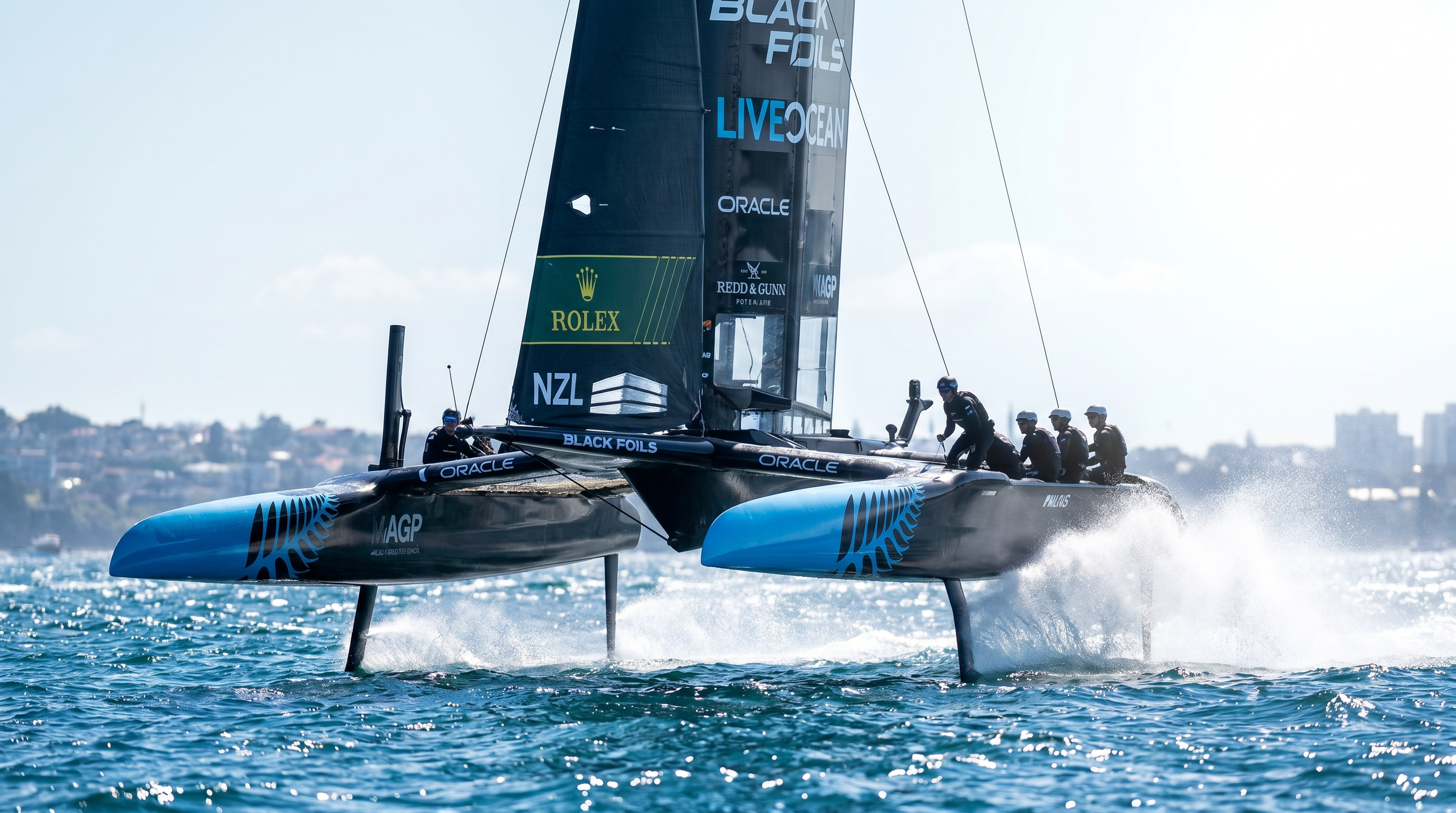
After a catastrophic collision in February that destroyed their F50 catamaran and left grinder Louis Sinclair with severe leg injuries, the New Zealand SailGP team is officially returning to the water. Armed with a newly built boat and a resilient crew, the Black Foils are targeting the Halifax Grand Prix for their comeback.
By Factlen Editorial Team
- The Black Foils Crew
- Focused on internal resilience, physical recovery, and the excitement of returning to competition.
- League Organizers & Engineers
- Focused on the logistical triumph of building a new F50 mid-season and managing safety protocols.
- Neutral Observers & Competitors
- Focused on the shock of the initial crash and the competitive impact of New Zealand's absence.
What's not represented
- · The French SailGP Team, who also suffered severe boat damage and minor injuries in the identical crash.
- · Independent marine safety experts analyzing the structural failure points of the F50 hulls during 100 kph collisions.
Why this matters
In a sport where high-speed crashes can end careers and sink seasons, the Black Foils' rapid rebuild of both their vessel and their crew's morale highlights the cutting-edge safety and logistics of modern foiling. Sinclair's positive prognosis and the team's return keep their championship hopes alive while showcasing the resilience required in extreme sailing.
Key points
- The New Zealand Black Foils will return to SailGP racing at the Halifax Grand Prix following a four-event absence.
- Grinder Louis Sinclair is making a strong recovery from compound fractures sustained during a high-speed collision with the French team in February.
- Former SailGP champion Stewart Dodson has joined the New Zealand crew to cover the grinder position while Sinclair rehabilitates.
- SailGP Technologies constructed a completely new F50 catamaran for the team after the original vessel was deemed unsalvageable.
After a harrowing four-event absence that tested the physical and emotional limits of the crew, New Zealand's Black Foils are officially returning to the SailGP starting line. The team will debut a brand-new F50 catamaran at the upcoming Halifax Grand Prix in Canada, marking their first competitive appearance since a devastating collision in February.[2]
The comeback represents a monumental logistical and medical triumph for the reigning champions. During the opening day of the ITM New Zealand Sail Grand Prix in Auckland, the Black Foils were involved in a catastrophic, high-speed crash with the French team.[3][4]
As the fleet charged toward the first mark at speeds approaching 90 to 100 kilometers per hour, the New Zealand vessel lost grip and slid sideways across the path of the French boat. The resulting impact destroyed both 50-foot foiling catamarans and sent shockwaves through the global sailing community.[3][5]

The human toll was severe. Black Foils grinder Louis Sinclair suffered compound fractures to both legs when the French hull rode over the New Zealand deck. Sinclair was immediately evacuated from the water by safety crews and rushed to Auckland Hospital for emergency surgery to pin his right leg.[3][4][5]
Despite the severity of the injuries, Sinclair’s recovery has become a rallying point for the entire New Zealand squad. After initial treatment, he relocated to his home in Antigua to continue rehabilitation. Medical staff have reported that Sinclair is responding exceptionally well to physical therapy, and they remain optimistic about his eventual return to top-level sailing.[1][4]
Black Foils Co-CEO and wing trimmer Blair Tuke noted that Sinclair’s demeanor in the immediate aftermath of the crash set the tone for the team's rebuild. "His calmness... through to his ongoing recovery has been special to see," Tuke said, adding that the grinder's resilience helped the crew unify during their forced time off the water.[1][4]
Black Foils Co-CEO and wing trimmer Blair Tuke noted that Sinclair’s demeanor in the immediate aftermath of the crash set the tone for the team's rebuild.
While Sinclair focuses on his recovery, the team needed a world-class replacement to handle the grueling physical demands of the grinder position. Enter Stewart Dodson, a seasoned SailGP athlete who previously won the Season 4 Championship with Spain's Los Gallos.[1][6]

Dodson, a native New Zealander who most recently raced with the Swiss team, will step in to cover Sinclair for the remainder of the 2026 season. Team leadership emphasized that bringing in an experienced hand like Dodson allows Sinclair to rehabilitate without any pressure to rush his return before his body is fully ready.[1][6]
Repairing the roster was only half the battle; the team also needed a boat. The structural damage to the original New Zealand F50, named Amokura, was so extensive that it could not be salvaged for the Kiwi team.[3][4]
Under SailGP’s strict post-incident repair protocols, the few salvageable components from the Black Foils' wreckage were actually transferred to the French team to help repair their vessel. Meanwhile, New Zealand was forced to wait for an entirely new multi-million-dollar catamaran to be constructed from scratch.[2][4]
Engineers at SailGP Technologies in Southampton, England, worked around the clock to build the replacement F50. The logistics of manufacturing the high-tech foiling yacht, commissioning it, and shipping it across the Atlantic to Halifax dictated the timeline for the team's return.[2][4]
SailGP CEO Russell Coutts acknowledged the psychological hurdle the team faces in getting back on the water after such a traumatic incident, noting that "it won't be easy for them to put those crashes behind them." Yet, the Black Foils have utilized their time ashore to refine their strategic playbook and integrate Dodson into their systems.[1][6]
The enforced four-event absence has mathematically punished the Black Foils, dropping them to the bottom of the 13-team Rolex SailGP Championship standings. However, the season is far from over.[2][5]

With seven events remaining on the 2026 calendar, starting with the high-stakes showdown in Halifax, New Zealand remains mathematically in contention for a spot in the season-ending Grand Final. For a team that has spent the last four months rebuilding broken bones and shattered carbon fiber, simply returning to the start line is a victory in itself.[1][2]
How we got here
Feb 14, 2026
The Black Foils and France collide at the Auckland SailGP; Louis Sinclair suffers compound fractures.
April 2026
Sinclair begins rehabilitation in Antigua while SailGP Technologies starts building a new F50 in Southampton.
May 2026
Stewart Dodson signs on to cover Sinclair's grinder role for the remainder of the season.
May 29, 2026
SailGP confirms the Black Foils will return to the starting line at the Halifax Grand Prix in June.
Viewpoints in depth
The Black Foils Crew
Focused on internal resilience, physical recovery, and the excitement of returning to competition.
For the New Zealand sailors, the narrative is entirely about overcoming adversity. Leadership has consistently praised Louis Sinclair's calm demeanor during the terrifying crash and his grueling rehabilitation process. By framing the incident not as a season-ending disaster but as a unifying challenge, the crew has maintained morale. The addition of Stewart Dodson is viewed as a seamless, high-performance stopgap that allows Sinclair to heal without the guilt of rushing back.
League Organizers & Engineers
Focused on the logistical triumph of building a new F50 mid-season and managing safety protocols.
From the perspective of SailGP Technologies and league executives, the Auckland crash was a massive stress test of their infrastructure. Building a brand-new, multi-million-dollar foiling catamaran in Southampton and shipping it to Halifax within four months is an engineering marvel. Organizers point to the strict post-incident protocols—where salvageable parts were shared to keep the fleet operational—as proof that the league's centralized manufacturing model works, even under extreme duress.
Neutral Observers & Competitors
Focused on the shock of the initial crash and the competitive impact of New Zealand's absence.
Rival teams and sailing analysts remain acutely aware of the dangers inherent in racing 50-foot catamarans at 100 kilometers per hour. The sheer violence of the Auckland collision served as a sobering reminder of the sport's physical risks. Competitively, the rest of the fleet has capitalized on New Zealand's four-event absence to rack up points, though many acknowledge that a rested, highly motivated Black Foils team with a brand-new boat could act as a dangerous spoiler in the second half of the season.
What we don't know
- The exact timeline for Louis Sinclair's return to competitive racing, though medical staff remain optimistic for the end of the season.
- How quickly the Black Foils will be able to calibrate and reach top speeds in their newly commissioned F50 catamaran.
Key terms
- F50 Catamaran
- A high-performance, one-design foiling catamaran used in SailGP, capable of reaching speeds near 100 km/h.
- Grinder
- The physically demanding crew position responsible for turning the winches that control the sails and generate hydraulic power.
- Foiling
- A sailing technique where hydrofoils lift the boat's hull out of the water, dramatically reducing drag and increasing speed.
Frequently asked
Will Louis Sinclair race in Halifax?
No, Sinclair is continuing his rehabilitation for compound fractures in his legs, though his medical team expects a full return to top-level sailing eventually.
Who is replacing Sinclair?
Stewart Dodson, a former SailGP champion with the Spanish team, has joined the Black Foils to cover the grinder position.
What happened to the original boat?
The original F50 was severely structurally damaged in the Auckland crash. Salvageable parts were used to repair the French boat, while New Zealand received a brand-new vessel built in Southampton.
Sources
Source coverage
6 outlets
3 viewpoints surfaced






[1]SailGP OfficialThe Black Foils Crew
Stewart Dodson joins the Black Foils as cover for injured Louis Sinclair
Read on SailGP Official →[2]Sail-WorldLeague Organizers & Engineers
SailGP: Black Foils return confirmed for Canada SailGP
Read on Sail-World →[3]Boating New ZealandNeutral Observers & Competitors
French team ruled out of Sydney as injured sailors continue recovery after Auckland SailGP crash
Read on Boating New Zealand →[4]Yachting New ZealandThe Black Foils Crew
2026 SailGP: Black Foils sidelined as rebuild begins following collision with France
Read on Yachting New Zealand →[5]AP NewsNeutral Observers & Competitors
Two sailors are injured after a crash between New Zealand and France at a SailGP race
Read on AP News →[6]Sail WebLeague Organizers & Engineers
Stewart Dodson to cover for injured Louis Sinclair
Read on Sail Web →

More in sports
See all 13 stories →Olympic Sustainability
How the LA 2028 Olympics Will Run Entirely on Existing Stadiums
0 sources

NBA Finals
New York Knicks Win 2026 NBA Finals, Ending 53-Year Championship Drought
0 sources

NBA Finals
New York Knicks Capture First NBA Championship Since 1973
0 sources

Hockey Strategy
How the PWHL's 'Jailbreak' and 'No Escape' Rules Are Rewriting Hockey Strategy
0 sources
Every angle. Every day.
Get sports stories with full source coverage and perspective breakdowns delivered to your inbox.