
NASA's Roman Space Telescope Coronagraph Captures First Light in Crucial Exoplanet Imaging Test
The Nancy Grace Roman Space Telescope successfully tested its starlight-blocking coronagraph on a star in the Large Magellanic Cloud. The milestone proves the instrument can achieve the extreme pointing stability required to directly image distant exoplanets.
By Sofia Matos

Inside the Coronagraph Commanding Center at Caltech's IPAC facility on September 22, engineers watched as NASA's Roman Space Telescope opened its secondary instrument to the cosmos. The spacecraft's coronagraph captured its first photons from a faint star in the Large Magellanic Cloud, marking a critical milestone for the mission.[1][2]
The initial image was intentionally noisy, as the instrument's detectors were kept at a warm 72 degrees Fahrenheit to prevent chemical contamination from sticking to the surfaces. Yet the bleary-eyed picture proved that cosmic light was successfully flowing through the complex optical system in the vacuum of space.[1]
"This observation confirms that the instrument can produce a focused image," said Vanessa Bailey, a Roman Coronagraph Instrument scientist at NASA's Jet Propulsion Laboratory. She described the milestone as a limited test that initiates a methodical calibration process of increasingly complex tasks.[1][2]
The coronagraph is a technology demonstration designed to solve one of the most difficult optical problems in modern astronomy. Host stars typically outshine their orbiting planets by a factor of a hundred million to ten billion, making direct observation nearly impossible with standard cameras.[3]
Blocking the stellar glare
Attempting to photograph an exoplanet directly is often compared to spotting a firefly hovering next to a coastal searchlight from miles away. Traditional exoplanet discoveries rely on indirect detection, such as measuring a star's gravitational wobble or the tiny dip in brightness when a planet passes in front.
Roman's coronagraph takes a direct approach by acting as a highly advanced set of tinted glasses. It uses a system of precisely engineered masks, prisms, and self-flexing mirrors to physically block the central glare of a target star, allowing the faint reflected light of surrounding planets to pass through.[1][3]
The instrument's deformable mirrors are the key to its unprecedented precision. These tiny components bend by fractions of a billionth of a meter in real time to correct minute optical aberrations, digging a "dark hole" around the star where faint planetary light can finally slip through to the detectors.[3]
To maintain that dark hole, the telescope must hold the target star perfectly centered behind the coronagraph's masks. Any wobble would immediately flood the sensitive detectors with starlight, washing out the faint glow of any surrounding planets and ruining the exposure.[1]
Aiming a laser at a dime
To ensure this extreme stability, Roman relies on a fine-guidance system that was rigorously tested between September 15 and 21. Engineers designated a small section of the telescope's primary 300-megapixel Wide Field Instrument to rapidly monitor specific guide stars whose positions are already known with high precision.
The fine-guidance system tracks these reference stars and feeds their positions to the attitude control system four times every second. This continuous feedback loop allows the observatory to correct tiny movements during deep space exposures that can last anywhere from a few minutes to several hours.[1]
The resulting stability is unprecedented for a space telescope. Roman's guidance system held the spacecraft steadier than one hundred-thousandth of a degree, a level of precision that NASA engineers equate to keeping a laser beam focused on a U.S. dime from 150 miles away.
"Every Roman observation relies on its ability to stay precisely pointed at the correct region of space long enough to collect an image," said Begoña Vila, Roman's guiding instrument systems lead at NASA's Goddard Space Flight Center. Without those rapid adjustments, Roman could not produce its sharpest possible images.
Cooling the detectors
Following the initial warm test, the engineering team allowed the coronagraph's detectors to cool toward their final operating temperatures. On September 27, the instrument conducted a second observation, this time targeting a dense stellar field in the Large Magellanic Cloud to verify its alignment.[3]
This follow-up test confirmed the system's pointing accuracy and sensitivity across a wider field of view. With the detectors cooled, the instrument resolved pinpoint stars with razor-sharp clarity, verifying that the active optics operate flawlessly in the harsh environment of deep space.
"We're all extremely pleased with how well things are working," said Alexandra Greenbaum, the coronagraph data management system lead at IPAC. She noted that these early tests build the foundation for eventually digging a dark hole on the sky and capturing actual planetary light.[2]
Over the coming months, the coronagraph will undergo increasingly complex calibrations as Roman continues its journey to the Sun-Earth Lagrange Point 2. The team will soon deploy the active deformable mirrors to clear diffraction speckles around known nearby stars, initiating true science verification runs.[2]
Paving the way for future observatories
While Roman's primary Wide Field Instrument will survey vast swaths of the universe to study dark energy, the coronagraph is strictly a technology demonstrator. It is not expected to discover new Earth-like worlds, but rather to photograph known, colder giant planets and dusty debris disks that previous telescopes could not see.[1]
The true value of the instrument lies in proving that active wavefront sensing and starlight suppression can work in space. Previous coronagraphs on telescopes like Hubble and James Webb lacked the active deformable mirrors needed to achieve a billion-to-one contrast ratio, limiting their ability to see planets close to their stars.[3]
If Roman's coronagraph performs as expected, its architecture will be scaled up for NASA's next-generation flagship mission, the Habitable Worlds Observatory. That future telescope will rely on similar starlight-blocking technology to actively search for biosignatures in the atmospheres of Earth-like exoplanets.
Key points
- The Roman Space Telescope's coronagraph captured its first cosmic light on September 22, observing a star in the Large Magellanic Cloud.
- The instrument uses active deformable mirrors to block a host star's glare, allowing the faint light of orbiting planets to become visible.
- Roman's fine-guidance system held the observatory steady to within 1/100,000th of a degree, equivalent to aiming a laser at a dime from 150 miles away.
- This technology demonstration lays the groundwork for future flagship missions designed to search for biosignatures on Earth-like exoplanets.
What we don’t know
- How well the coronagraph will perform when attempting to image actual exoplanets rather than just reference stars.
- Whether the deformable mirrors can maintain their billion-to-one contrast ratio over the entire duration of the mission.
- Exactly which known giant planets and dust disks the team will target first during the upcoming science verification runs.
How we got here
Sept 1, 2026
The coronagraph instrument woke up and began stretching its digital and mechanical components.
Sept 15–21, 2026
Engineers rigorously tested Roman's fine-guidance system using the primary Wide Field Instrument.
Sept 22, 2026
The coronagraph captured its first light from a faint star in the Large Magellanic Cloud with warm detectors.
Sept 27, 2026
A follow-up observation with cooled detectors confirmed pointing accuracy across a dense stellar field.
Early 2027
NASA anticipates releasing the telescope's first fully processed public science images.
- Mission Engineers
- Focused on the technical achievement of holding the telescope steady and the success of the deformable mirrors.
- Exoplanet Astronomers
- Focused on how this technology paves the way for direct imaging of Earth-like worlds.
- Astrophysics Community
- Focused on the broader implications of Roman's dual capabilities in surveying dark energy and testing exoplanet imaging.
Perspectives this story doesn't cover
- Future Habitable Worlds Observatory planners
Sources
Source coverage
3 outlets
3 viewpoints surfaced



- [1]NASA Jet Propulsion LaboratoryMission Engineers
NASA's Roman Team Snaps Test Coronagraph Image
Read on NASA Jet Propulsion Laboratory → - [2]CaltechExoplanet Astronomers
NASA's Roman Space Telescope Takes First Coronagraph Instrument Observation
Read on Caltech → - [3]SciTechDailyAstrophysics Community
NASA's Roman Telescope Opens Its 300-Megapixel Eye on the Universe
Read on SciTechDaily →

More in Science
See all →Navier-Stokes Proof
Mathematicians Criticize OpenAI's Navier-Stokes Proof as Incomprehensible Amid Plagiarism Row
5 sources
Mammography Data
Breast Cancer Overdiagnosis Rate Falls Below 5% in Re-Analysis of Major Mammography Trials
6 sources
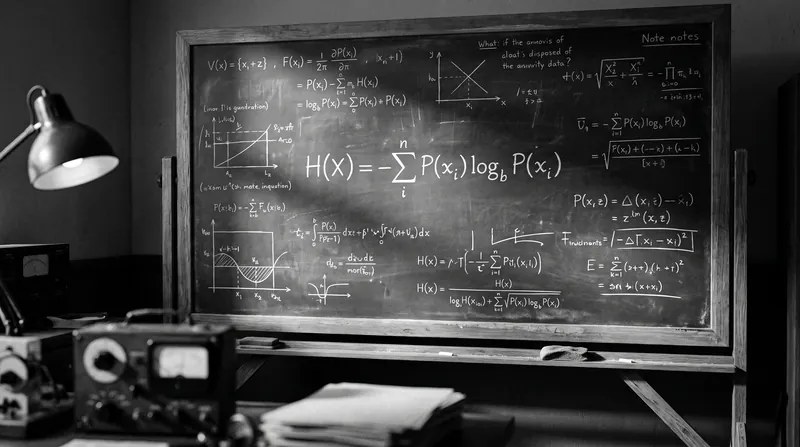
Information Theory
The H = -∑ p_i log_2 p_i Formula: How the Average Number of Bits Measures the Uncertainty of a Random Variable
6 sources
Number Theory
AI Models Shatter Human Records on the Twin Prime Conjecture
5 sources
Comments
Every angle. Every day.
Get Science stories with full source coverage and perspective breakdowns, free every day.