
NASA Partners With Relativity Space for 2028 Mars Weather Mission
NASA has selected Eric Schmidt-led Relativity Space to launch the Aeolus mission in 2028, aiming to provide the first daily global view of Martian weather. The public-private partnership marks a major shift toward using commercial delivery services for interplanetary science.
By Factlen Editorial Team
- NASA & Space Agencies
- Views commercial partnerships as a force multiplier that allows the government to focus on high-value science.
- Industry Skeptics
- Highlights the immense risk of entrusting a critical interplanetary mission to a startup that has never successfully reached orbit.
- Tech & Data Visionaries
- Views the mission primarily as a breakthrough for off-world computing and server-class AI processing in deep space.
- Commercial Space Advocates
- Sees this contract as the natural evolution of the space economy, extending the commercial delivery model to other planets.
What's not represented
- · Traditional aerospace prime contractors losing market share to startups
- · Planetary protection officers concerned about commercial spacecraft standards
Why this matters
Understanding Martian weather patterns is a critical prerequisite for safely landing future human missions on the Red Planet. By shifting the cost of rocket development to the private sector, NASA can launch vital scientific instruments more frequently and at a lower cost to taxpayers.
Key points
- NASA has partnered with Relativity Space to launch the Aeolus weather mission to Mars in 2028.
- The mission will provide the first daily, global view of Martian winds, temperatures, and dust storms.
- Relativity Space, led by former Google CEO Eric Schmidt, will provide the Terran R rocket and spacecraft.
- The spacecraft will also carry a 'Relay Data Center' to process AI models locally in Mars orbit.
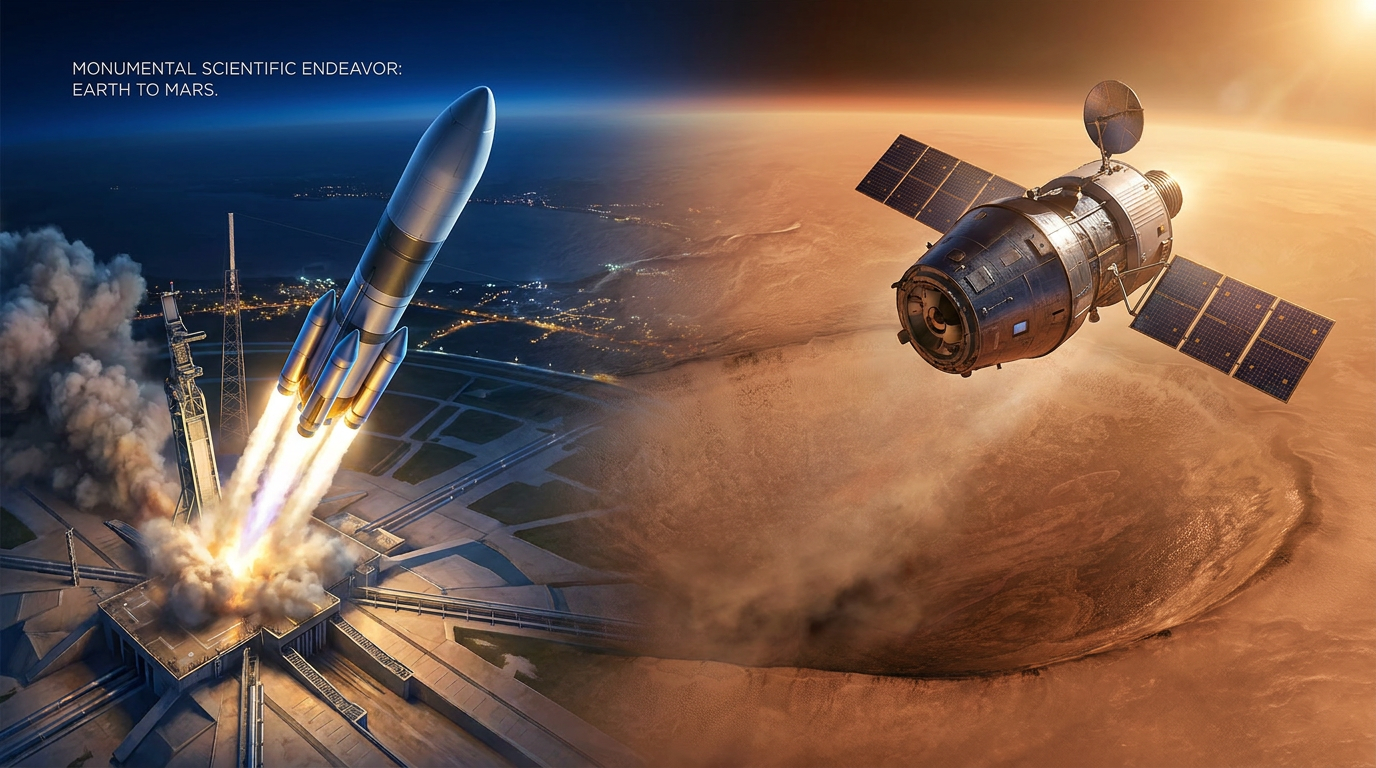
NASA has officially initiated a paradigm shift in how it conducts deep-space research, announcing a sweeping public-private partnership with Relativity Space to send a suite of weather instruments to Mars in 2028. The mission, dubbed Aeolus, represents a critical evolution in planetary science logistics. While the space agency has spent the last decade relying on private companies to ferry cargo to the International Space Station and deliver scientific gear to the lunar surface, treating an interplanetary transit to Mars as a commercial delivery service is a relatively untested frontier. Under the newly unveiled framework, NASA will act purely as the scientific architect and customer, while Relativity Space assumes the burden of providing the spacecraft, the launch vehicle, and the complex interplanetary flight operations required to reach the Red Planet.[1][2]
The core objective of the Aeolus mission is to illuminate a persistent blind spot in planetary science: the chaotic and unpredictable nature of Martian weather. For decades, orbiters and rovers have gathered localized or periodic data, but Aeolus is designed to provide the first integrated, daily, global view of Martian winds, temperatures, dust storms, and cloud formations. Researchers at the NASA Ames Research Center in California’s Silicon Valley are currently designing and building the specialized instruments that will make this possible. By continuously monitoring the atmosphere, scientists hope to map the seasonal behaviors that govern the planet's harsh environment, transitioning Martian meteorology from a series of snapshots into a fluid, predictable model.[3][4]
Understanding these atmospheric dynamics is not merely an academic exercise; it is a strict prerequisite for the future of human spaceflight. NASA Administrator Jared Isaacman, who announced the partnership, framed the collaboration as a necessary acceleration of the agency's long-term goals. Unpredictable dust storms and sudden shifts in wind shear pose existential threats to the entry, descent, and landing systems of incoming spacecraft. By generating detailed environmental knowledge, Aeolus will directly inform the engineering tolerances required for heavier robotic landers and, eventually, crewed habitats. Isaacman noted that pairing the agency's world-class instruments with commercial investment acts as a "force multiplier," reducing the time it takes to get essential safety data into the hands of mission planners.[2][3]
The scientific payload itself is a highly specialized suite of four complementary instruments, engineered to dissect the Martian atmosphere from the edge of space down to the regolith. The primary tool is the Doppler Wind and Temperature Sounder, or DWTS-Ozone, which will measure precise wind speeds and temperature profiles from the planet's surface up to an altitude of approximately 37 miles. This is paired with a Thermal Limb Sounder, an instrument tasked with capturing vertical temperature gradients and observing the formation and movement of water-ice clouds. Together, these two sensors will provide a three-dimensional map of the atmospheric currents that drive global dust events.[4][5]

Rounding out the payload are two instruments focused on the interaction between the atmosphere and the ground. The Surface Radiometric Sensor Package will measure the surface energy balance, tracking how sunlight is absorbed and radiated back into space, while also analyzing the physical properties of settling dust. Meanwhile, the Wide-Field Context Camera will capture comprehensive daily images of global atmospheric activity, providing visual confirmation of the data recorded by the other sensors. NASA has committed to supporting the science operations for at least one full Martian year—roughly 687 Earth days—and will develop a dedicated data-processing pipeline to convert the raw telemetry into ready-to-use models for the broader scientific community.[5]
The administrative mechanism enabling this mission is NASA’s first six-year reimbursable Space Act Agreement tailored specifically for Mars exploration. This legal framework provides a stable, predictable structure for sustained collaboration without the rigid constraints of traditional government procurement. Under the division of labor, NASA can dedicate its budget strictly to high-value scientific instrument development and data analysis, completely bypassing the multibillion-dollar financial burden of engineering a bespoke launch vehicle and deep-space bus. Relativity Space, in return, gains the ultimate proving ground: a high-profile, government-backed interplanetary journey that, if successful, will instantly elevate the company into the upper echelon of global aerospace contractors.[2][6]
The administrative mechanism enabling this mission is NASA’s first six-year reimbursable Space Act Agreement tailored specifically for Mars exploration.
However, the partnership carries an immense and undeniable technical risk, primarily because NASA is entrusting a flagship Mars payload to a company that has never successfully reached Earth orbit. Founded in 2015 by a pair of former engineers from SpaceX and Blue Origin, Relativity Space initially garnered industry attention for its radical manufacturing approach: using massive, AI-driven 3D printers to fabricate entire rockets from raw alloys in a matter of weeks. But the company’s first orbital attempt, the Terran 1 rocket, suffered a catastrophic second-stage engine failure mid-flight in March 2023, falling short of orbit and forcing a painful internal reckoning about the viability of small-lift launch vehicles.[6][7]
Following the Terran 1 failure, Relativity Space abandoned its small-rocket program entirely, pivoting its resources toward the Terran R—a much larger, medium-to-heavy lift reusable rocket designed to compete directly with SpaceX’s Falcon 9. The Terran R is still deep in the development phase and has yet to conduct a maiden flight, which is tentatively scheduled for late 2026. The 2028 Mars launch window imposes an unforgiving, aggressive timeline on the company. In less than four years, Relativity must finish developing a reusable orbital rocket, successfully test it, design and build a deep-space cruise vehicle capable of surviving the journey to Mars, and flawlessly integrate NASA’s delicate atmospheric instruments.[8][9]

The company’s ability to even attempt this timeline is largely due to the dramatic intervention of Eric Schmidt. The former Google chief executive and billionaire tech investor stepped in during a period of severe fundraising challenges for the aerospace startup. In March 2025, Schmidt acquired a controlling majority stake in Relativity Space and installed himself as chief executive officer. His vast financial resources stabilized the company, ensuring the Terran R program could continue without the constant threat of insolvency that plagues many space startups. Under Schmidt’s leadership, the company has aggressively expanded its ambitions beyond simple launch services, eyeing deep-space infrastructure as its primary growth vector.[4][6]
Schmidt’s vision for Relativity Space extends far beyond traditional aerospace engineering; he views the vacuum of space as the next logical frontier for massive computing infrastructure. When he took over the company, Schmidt explicitly stated his ambition to deploy data centers in orbit, arguing that off-world processing is essential for the future of space exploration. The Aeolus mission serves as the first literal manifestation of that goal. Alongside NASA’s weather instruments, Relativity’s spacecraft will carry what the company calls a "Relay Data Center." This proprietary payload represents a radical departure from standard deep-space probes, which typically rely on radiation-hardened, low-power processors that lag decades behind terrestrial commercial computing standards.[6]
The Relay Data Center is designed to bring server-class computing and mass storage directly to Mars orbit. By equipping the spacecraft with advanced processing power, the vehicle will be capable of running complex artificial intelligence models locally in deep space. Currently, Mars orbiters must beam massive volumes of raw data back to Earth over slow radio links, forcing scientists to wait hours or days to process the information. The Relay Data Center will allow the spacecraft to analyze the atmospheric data on the fly, identifying key weather anomalies and beaming only the most valuable, high-resolution insights back to Earth via high-bandwidth optical and radio links.[6]

Adding another layer of complexity to the mission is its unique funding structure. Relativity Space has noted that the Aeolus spacecraft is flying in part for a "philanthropic customer," widely believed within the industry to be Schmidt Sciences, the family foundation operated by the CEO. This arrangement makes the 2028 flight a fascinating hybrid of government science, private enterprise, and billionaire philanthropy. It also positions Relativity Space as a direct challenger to Elon Musk’s SpaceX. By attempting to leapfrog into interplanetary operations, Relativity is trying to prove its deep-space capabilities in a single, high-stakes mission, hoping to secure a foothold in the lucrative market for future off-world logistics.[3][7]
If the Aeolus mission launches on schedule and successfully reaches Mars, it will fundamentally rewrite the rules of planetary exploration. It will validate NASA’s calculated gamble that commercial startups can drastically lower the barrier to entry for deep-space science, allowing the agency to launch specialized instruments more frequently and at a fraction of historical costs. More importantly, the daily weather data beamed back by the orbiter will lay the vital meteorological groundwork required to safely land the next generation of heavy robotic explorers and, ultimately, the first human crews to walk on the Martian surface in the coming decades.[2][3]
How we got here
2015
Relativity Space is founded by former SpaceX and Blue Origin engineers to 3D-print rockets.
March 2023
The company's first rocket, Terran 1, fails to reach orbit due to a second-stage engine issue.
March 2025
Former Google CEO Eric Schmidt acquires a controlling stake in the company and becomes CEO.
June 2026
NASA announces the public-private partnership with Relativity Space for the Aeolus mission.
2028
Target launch window for the Aeolus mission to Mars.
Viewpoints in depth
NASA & Space Agencies
Viewing commercial partnerships as a force multiplier for deep-space science.
For NASA, the Aeolus mission represents the logical next step in its commercialization strategy. By utilizing Space Act Agreements, the agency avoids the multibillion-dollar sunk costs of developing bespoke launch vehicles and deep-space buses. Instead, NASA can focus its budget entirely on high-value scientific instruments and data analysis. Administrators argue this model will drastically increase the cadence of planetary science, allowing researchers to gather the critical environmental data needed for future human missions much faster than traditional government-led procurement would allow.
Industry Skeptics
Highlighting the immense risk of relying on an unproven aerospace startup.
Skeptics within the aerospace sector point out the glaring technical risks of entrusting a flagship Mars payload to Relativity Space. The company has never successfully reached Earth orbit, and its only launch attempt in 2023 ended in a mid-flight failure. Furthermore, the Terran R rocket slated to carry the mission is still under development. Critics argue that the aggressive 2028 timeline leaves almost no room for error, and relying on a startup to simultaneously master reusable orbital launch and interplanetary cruise operations is a massive gamble for NASA.
Tech & Data Visionaries
Focusing on the breakthrough of server-class computing in deep space.
For technologists and CEO Eric Schmidt, the rockets are merely the delivery mechanism for a larger goal: off-world computing infrastructure. This camp views the inclusion of the 'Relay Data Center' as the most revolutionary aspect of the mission. By placing server-class processing and AI capabilities in Mars orbit, spacecraft will no longer be bottlenecked by slow radio links to Earth. Visionaries argue that local data processing will exponentially increase the scientific yield of deep-space missions, paving the way for autonomous orbital networks.
What we don't know
- Whether the Terran R rocket will be completed and successfully tested in time for the 2028 Mars launch window.
- The exact financial value of the contract between NASA and Relativity Space.
- How the Relay Data Center will perform when exposed to the high-radiation environment of deep space.
Key terms
- Aeolus
- A NASA-developed suite of four scientific instruments designed to provide the first daily global view of Martian weather.
- Space Act Agreement
- A legal framework used by NASA to partner with commercial entities, allowing for flexible, reimbursable collaborations outside traditional government contracting.
- Entry, Descent, and Landing (EDL)
- The critical and highly dangerous phase of a spacecraft's journey where it enters a planet's atmosphere and attempts to land safely on the surface.
- Relay Data Center
- A concept championed by Relativity Space to place server-class computing and mass storage in orbit, allowing data to be processed locally in space.
Frequently asked
What will the Aeolus mission do at Mars?
It will provide the first daily, global observations of Martian winds, temperatures, dust, and clouds to help scientists understand the planet's weather patterns.
Why is NASA partnering with a private company for this?
NASA aims to lower costs and increase the frequency of deep-space missions by treating the transit to Mars as a commercial delivery service, similar to how it supplies the International Space Station.
Has Relativity Space ever flown to space before?
The company launched its first rocket, Terran 1, in March 2023, but it suffered a second-stage failure and did not reach orbit. They are currently developing a larger rocket called Terran R.
What role does Eric Schmidt play in the mission?
The former Google CEO acquired a controlling stake in Relativity Space in 2025, becoming its CEO and injecting capital to fund the development of the Terran R rocket and orbital data centers.
Sources
Source coverage
9 outlets
4 viewpoints surfaced









[1]The VergeNASA & Space Agencies
NASA selects Eric Schmidt's rocket company for a 2028 mission to Mars
Read on The Verge →[2]NASANASA & Space Agencies
NASA Announces Public-Private Partnership for Mars Mission
Read on NASA →[3]SpaceQCommercial Space Advocates
NASA strikes public-private partnership with Relativity Space for Mars weather mission
Read on SpaceQ →[4]EngadgetTech & Data Visionaries
NASA taps Relativity Space for 2028 Mars mission
Read on Engadget →[5]The Washington TimesCommercial Space Advocates
NASA announces public-private partnership to advance Mars atmospheric science
Read on The Washington Times →[6]The Next WebIndustry Skeptics
NASA picked Eric Schmidt's Relativity Space to fly to Mars. It has never reached orbit.
Read on The Next Web →[7]TechCrunchCommercial Space Advocates
NASA Picks Eric Schmidt's Rocket Company For Mars Mission
Read on TechCrunch →[8]The Indian ExpressTech & Data Visionaries
Relativity Space wins Nasa Mars contract under Eric Schmidt's leadership
Read on The Indian Express →[9]The American BazaarIndustry Skeptics
NASA selects Relativity Space for privately funded Mars science mission
Read on The American Bazaar →

More in technology
See all 5 stories →

Every angle. Every day.
Get technology stories with full source coverage and perspective breakdowns delivered to your inbox.