
Large Cohort Study Finds Screen Time Does Not Harm Child Development, Except for 'Very High' Gaming
A decade-long longitudinal study of nearly 3,800 children reveals that general screen time is not consistently linked to worse psychosocial development. However, researchers found that excessive video gaming in adolescence is associated with higher behavioral and emotional difficulties.


- Contextual Researchers
- Argue that the impact of screens is entirely dependent on family dynamics, content quality, and what activities the screens are displacing.
- Precautionary Advocates
- Maintain that despite nuanced findings, strict limits are still necessary to protect children from the addictive design of modern digital platforms.
- Clinical Pediatricians
- Focus on the practical realities of parenting, using these findings to alleviate parental guilt while still advising against excessive gaming and screen use before bed.
Why this matters
For years, parents have felt intense guilt over their children's digital diets, fearing that screens cause irreversible developmental harm. This massive study provides scientific reassurance that moderate screen use is safe, allowing families to shift their focus from strict time limits to ensuring healthy sleep, physical activity, and balanced gaming habits.
Key points
- A decade-long study of 3,786 children found no consistent link between general screen time and worse psychosocial development.
- When family dynamics and socioeconomic factors are accounted for, the apparent negative effects of screens largely disappear.
- At age 15, the only screen activity linked to higher behavioral difficulties was 'very high' video game use.
- Teenagers who used social media for more than an hour a day actually showed fewer psychosocial difficulties, likely due to peer bonding.
For the past decade, parents have navigated a digital minefield, haunted by the fear that every minute their child spends looking at a tablet or television is actively harming their brain. Public health guidelines, such as the World Health Organization’s recommendation of no more than one hour of screen time per day for young children, have often fueled this anxiety. Caregivers are left to balance the realities of modern life—where screens are ubiquitous tools for education, entertainment, and babysitting—against the looming threat of developmental delays. However, a landmark longitudinal study is now offering a profound sigh of relief to families worldwide, suggesting that the sheer volume of screen time is not the developmental poison it has often been made out to be.[2][4]
Published in the journal JAMA Network Open, the sweeping analysis tracked a cohort of 3,786 children as part of the Growing Up in Scotland study. Researchers from the University of Edinburgh and Imperial College London followed these children over a ten-year period, measuring their out-of-school screen use at ages 5, 10, and 15. Crucially, the team did not just look at raw screen hours; they meticulously adjusted for a wide range of covariates, including household income, family functioning, sex, and cognitive test scores. This longitudinal approach allowed scientists to untangle the complex web of childhood development in a way that single-snapshot studies cannot.[1][2]
The core finding of the decade-long research is striking: when family dynamics and socioeconomic factors are taken into account, general screen time is not consistently linked to worse psychosocial development. The researchers found no significant associations between the duration of screen use and developmental difficulties at either 5 or 10 years of age. While children who had early, high screen use showed some elevated difficulty scores at age 10, those associations completely vanished by the time the children reached age 15.[2][3]
This revelation highlights a common pitfall in previous screen time research: the failure to account for the environment in which the screens are used. Psychologists refer to this as the "third factor" effect. Screen use does not occur in a vacuum; it is often a proxy for other household realities. A family experiencing high stress, financial instability, or parental burnout may rely more heavily on screens to keep children occupied. When researchers fail to adjust for these underlying stressors, they mistakenly blame the tablet for behavioral issues that are actually rooted in the family's broader environment.[1]
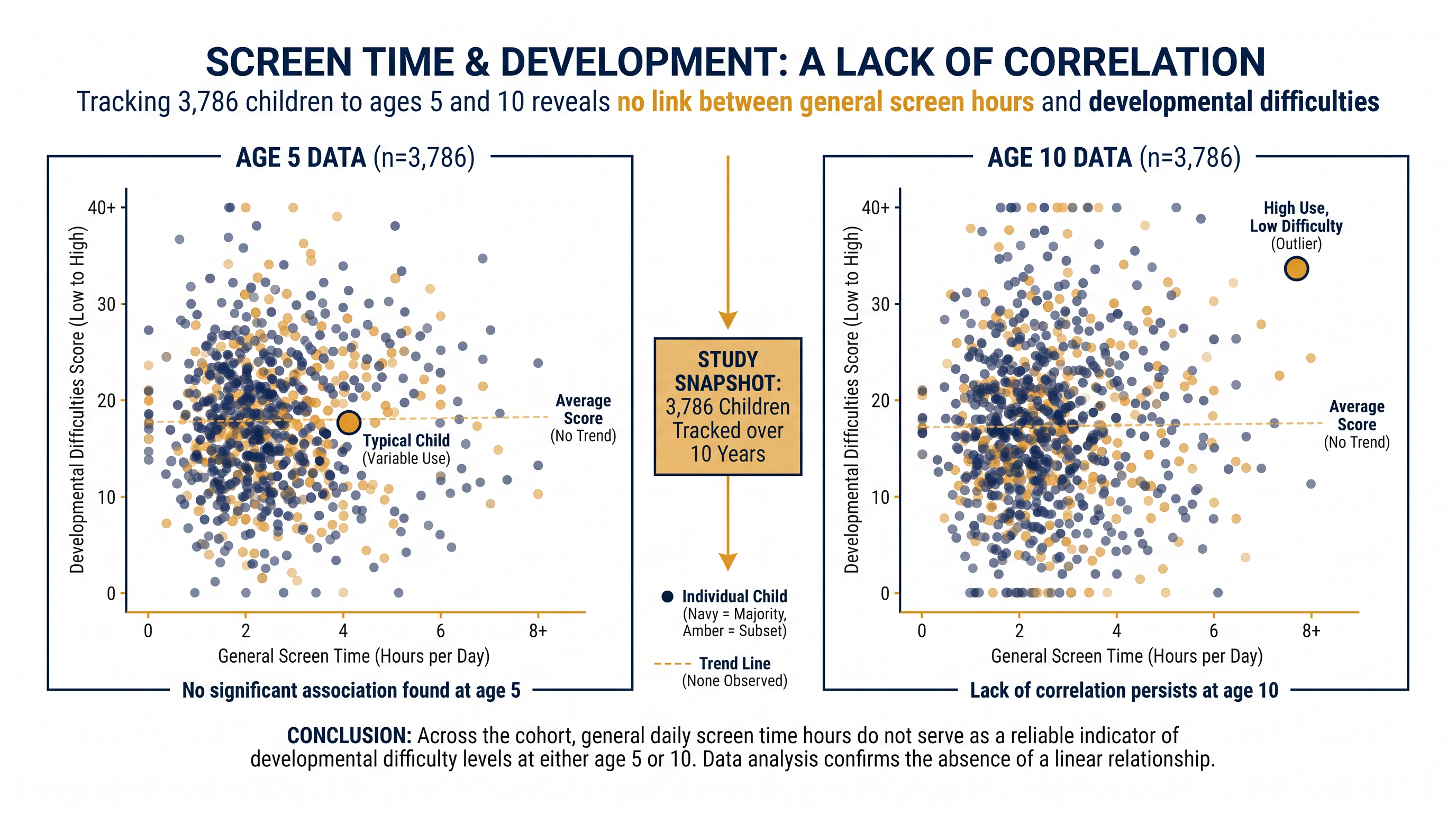
"Apparent correlations between screen use and negative outcomes become much weaker or disappear when appropriate third factors are taken into account," explained Dr. Pete Etchells, a professor of psychology and science communication who reviewed the findings. The study confirms that screens are just one small thread in the massive tapestry of influences that shape a child as they grow up. For parents who have felt intense guilt over allowing their children to watch a movie while they cook dinner or finish a work email, the data provides a strong scientific reassurance.[2][3]
However, the study did identify one specific digital behavior that warrants caution. At age 15, the researchers found that "very high" use of electronic video games was the only form of screen time consistently associated with higher psychosocial difficulty scores. This negative association did not apply to general television watching, web browsing, or other forms of digital consumption. The distinction is crucial, as it shifts the conversation away from a blanket demonization of all screens and toward a more nuanced understanding of specific digital activities.[2][3]
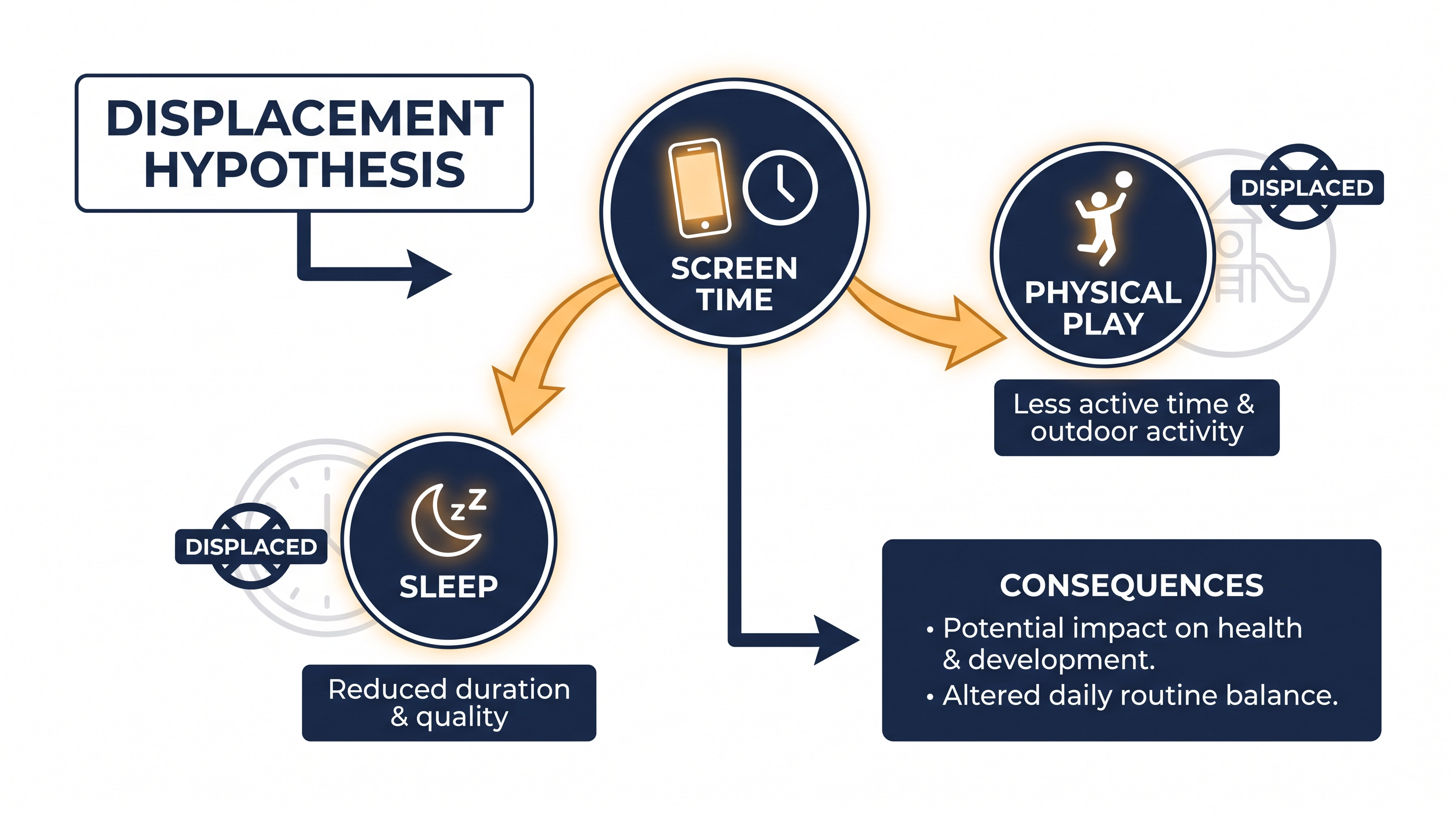
Why does excessive gaming stand out as a risk factor? Experts point to the immersive and highly stimulating nature of modern video games, which are often designed to keep players engaged for hours on end. When gaming crosses the threshold into "very high" use, it is more likely to trigger the Displacement Hypothesis—the theory that screens cause harm not by emitting toxic light, but by aggressively displacing other essential activities. A teenager spending six hours a day gaming is likely missing out on adequate sleep, physical exercise, and face-to-face interactions, all of which are critical for emotional regulation and mental health.[4][6]
Experts point to the immersive and highly stimulating nature of modern video games, which are often designed to keep players engaged for hours on end.
Conversely, the study uncovered a highly unexpected benefit regarding another frequently criticized technology: social media. The data revealed that 15-year-olds who used social media and messaging apps for more than an hour a day were actually less likely to have above-average psychosocial difficulties than those who used these apps for under an hour a day. In an era where social media is heavily scrutinized for its impact on teen mental health, this finding challenges the prevailing narrative that all social platforms are inherently damaging.[2]
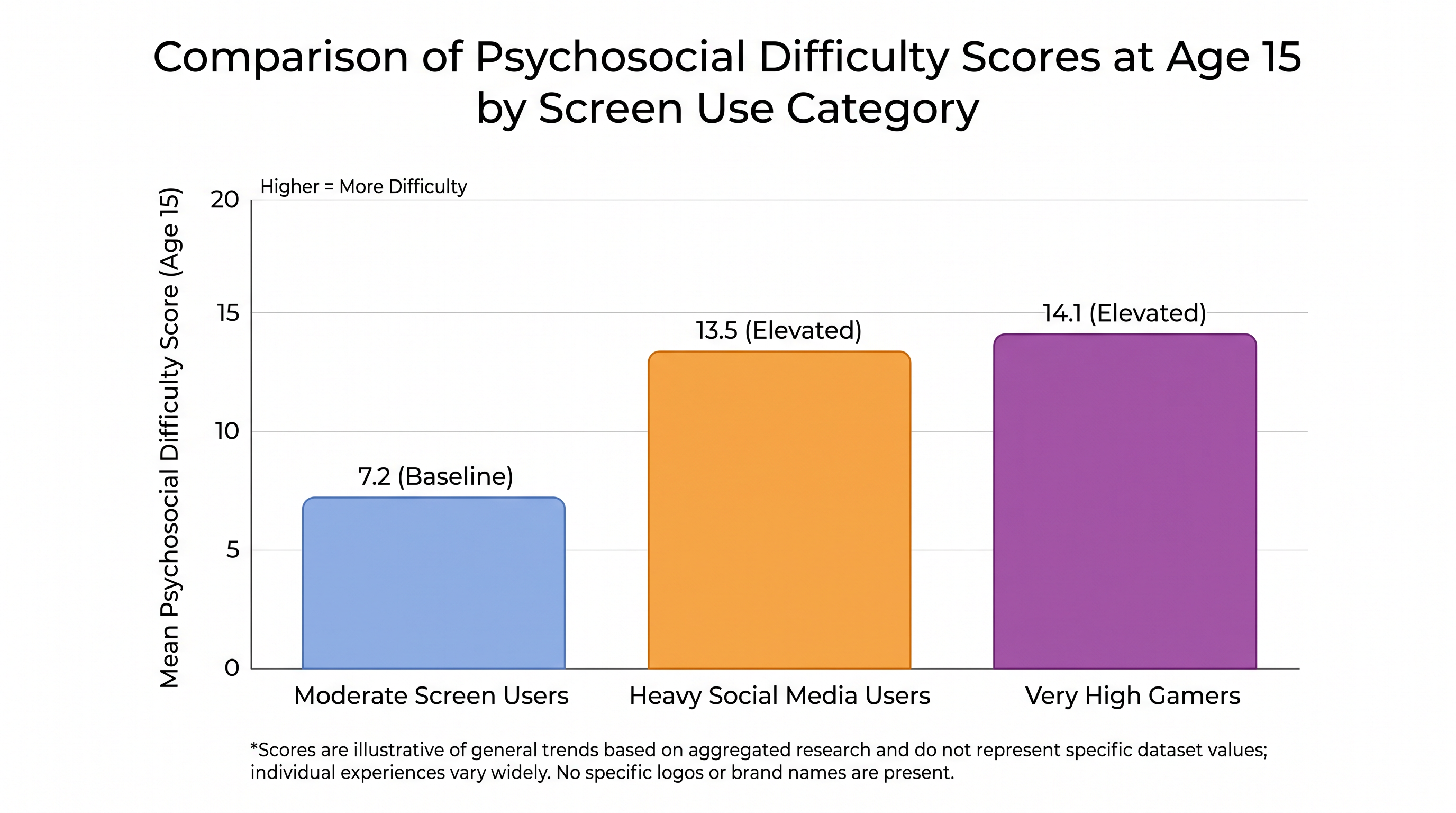
The researchers suggest a logical mechanism for this benefit: for modern teenagers, social media and messaging apps are the primary infrastructure for peer bonding. These platforms act as a digital extension of the schoolyard, allowing adolescents to maintain friendships, share experiences, and access vital support networks outside of school hours. While the authors caution that teenagers with better baseline social functioning might simply be more inclined to use messaging apps, the data strongly implies that cutting teens off from digital communication entirely could inadvertently isolate them from their peers.[2]
The Scottish cohort study adds massive weight to a growing consensus among developmental psychologists: the quality and context of screen time matter far more than the raw quantity. This aligns with other recent research, such as a study from Ohio State University focusing on low-income preschoolers, which also found that low-to-moderate screen use had no negative impact on language, literacy, or math skills. In that study, only children who consumed very high levels of media—specifically late at night—showed smaller gains in social skills, likely due to disrupted sleep rather than the screens themselves.[2][3][6]
It is important to note that the rules change slightly for the absolute youngest children. While the JAMA study tracked children from age 5 onward, other recent reviews focusing on infants under the age of two still urge extreme caution. For babies and toddlers, researchers point to the Video Deficit—a well-documented phenomenon where young brains learn significantly less from 2D screens than from 3D, real-world interactions. For this youngest demographic, passive screen time can displace the crucial back-and-forth conversational turns with caregivers that build the foundation of language.[5]
Even for toddlers, however, the context remains king. Studies consistently show that when a parent sits with a young child and actively co-views content—asking questions, pointing at characters, and turning the show into a shared experience—the negative effects of the video deficit are heavily mitigated. The device itself is neutral; the presence of an engaged adult transforms the screen from a passive pacifier into an interactive learning tool.[6]
Another critical layer to this debate is the classic "chicken-and-egg" problem of behavioral research. Do screens cause emotional and behavioral difficulties, or do children who already struggle with emotional regulation naturally gravitate toward screens? Children who are neurodivergent, or those who have a harder time navigating chaotic social environments, often find the predictable, structured feedback loops of digital devices highly soothing. Longitudinal studies like the one published in JAMA are vital because they help researchers track these trajectories over time, proving that the screen is often a coping mechanism rather than the root cause of the difficulty.[1]
The implications of these findings for public health policy are profound. The study's authors explicitly state that guidelines focusing solely on limiting screen use—such as strict one-hour daily caps—may not accurately reflect the complex reality of modern childhood. Blanket time limits are increasingly viewed as outdated, failing to distinguish between a teenager spending three hours coding a website, three hours chatting with close friends, or three hours mindlessly scrolling through algorithmic feeds.[2]
Instead of policing minutes on a clock, pediatricians and psychologists are encouraging families to focus on the overall digital diet. Parents should look for signs of healthy integration: Is the child sleeping well? Are they engaging in physical activity? Do they have positive relationships with family and peers? If the answers to these questions are yes, then moderate screen time is highly unlikely to be causing hidden damage.[3]
As digital technology continues to evolve at a breakneck pace, the conversation around screen time must evolve with it. The generation of children tracked in this study grew up alongside the rise of the smartphone, and their data provides a clear, evidence-based counter-narrative to the panic that often surrounds parenting in the digital age. By shifting the focus away from fear and toward balanced, meaningful engagement, families can finally stop demonizing screens and start using them as the neutral tools they are.[1][6]
How we got here
2009
The Growing Up in Scotland cohort study begins tracking the screen habits of five-year-old children.
2019
The World Health Organization issues guidelines recommending no more than one hour of daily screen time for children under five.
August 2026
Researchers publish the decade-long findings in JAMA Network Open, challenging the narrative that general screen time harms development.
Viewpoints in depth
Developmental Psychologists
Argue that family dynamics and household stress are the true drivers of childhood development, with screen time often acting merely as a symptom.
Psychologists emphasize the 'third factor' effect, noting that screen use does not occur in a vacuum. A family experiencing high stress, financial instability, or parental burnout may rely more heavily on screens to keep children occupied. When researchers fail to adjust for these underlying stressors, they mistakenly blame the tablet for behavioral issues that are actually rooted in the family's broader environment. By controlling for these variables, the true, relatively neutral impact of screens becomes clear.
Public Health Officials
Emphasize the need for cautious guidelines, pointing out that excessive gaming and sedentary behavior still pose physical and mental health risks.
While acknowledging that moderate screen time is not inherently toxic, public health experts maintain that guidelines are still necessary to prevent extremes. They point to the study's finding that 'very high' gaming at age 15 is linked to psychosocial difficulties. Their primary concern is the Displacement Hypothesis—the reality that hours spent gaming are hours not spent sleeping, exercising, or interacting face-to-face, all of which are biologically essential for a developing teenager.
Digital Well-being Advocates
Focus on the quality of screen time, advocating for a shift away from strict time limits toward evaluating whether content is interactive or social.
Advocates for digital well-being argue that blanket time limits, such as a strict one-hour daily cap, are outdated and fail to reflect modern life. They point to the study's finding that social media use actually correlated with fewer difficulties for 15-year-olds, suggesting that screens used for peer bonding are highly beneficial. They urge parents to stop policing minutes on a clock and instead focus on what the child is actually doing on the device, encouraging active, creative, and social use over passive consumption.
What we don't know
- It remains unclear exactly how much video gaming crosses the threshold into the 'very high' use that triggers developmental difficulties.
- Because the data was collected between 2009 and 2020, researchers do not fully know how the rapid evolution of post-pandemic digital technologies might alter these trajectories.
Key terms
- Longitudinal Study
- A research design that involves repeated observations of the same variables over long periods of time, often decades.
- Psychosocial Development
- The psychological and social changes that occur as a child grows, including emotional regulation, behavior, and peer relationships.
- Displacement Hypothesis
- The theory that the negative effects of screen time stem from it replacing crucial activities like sleep, exercise, or face-to-face interaction.
- Video Deficit
- The phenomenon where young children learn significantly less from information presented on a screen compared to the same information presented by a live person.
- Covariates
- Additional variables, such as household income or parental stress, that researchers adjust for to ensure they are measuring the true effect of the primary subject.
Frequently asked
Does screen time cause brain damage in children?
No. The research does not support the idea that screens cause brain damage. While excessive use can displace important activities, moderate use is not inherently toxic to the developing brain.
Why did the study find social media beneficial for 15-year-olds?
Researchers suggest that for teenagers, social media and messaging apps act as vital tools for maintaining friendships and accessing peer support networks outside of school hours.
Is video gaming bad for teenagers?
Not inherently, but the study found that 'very high' levels of video gaming were the only screen activity consistently linked to higher psychosocial difficulties at age 15.
What is the displacement hypothesis?
It is the theory that screen time only causes harm when it replaces essential developmental activities, such as face-to-face conversation, physical play, or sleep.
Sources
Source coverage
6 outlets
3 viewpoints surfaced






[1]Science Media CentreContextual Researchers
expert reaction to cohort study on screen use and child development
Read on Science Media Centre →[2]ScienceAlertContextual Researchers
A New Study of Screen Time And Child Development Has Some Unexpected Findings
Read on ScienceAlert →[3]SciMexContextual Researchers
Screen time might not be as bad for kids as we thought
Read on SciMex →[4]JAMA Network OpenClinical Pediatricians
Screen Use and Psychosocial Development in Children
Read on JAMA Network Open →[5]The GuardianPrecautionary Advocates
Screen time for babies and toddlers under the age of two has been linked with long-term negative effects
Read on The Guardian →[6]Ohio State University NewsClinical Pediatricians
Results reassure parents about children's screen use time
Read on Ohio State University News →
Comments

More in health
See all 5 stories →Epigenetic Reprogramming
First Human Dosed With Cellular Reprogramming Injection in Landmark 'Reverse-Aging' Trial
6 sources

HIV Innovation
Once-Yearly HIV Injection Shows Success in Clinical Trials, Promising End to Daily Medication
3 sources

Menopause Care
FDA Removes Black Box Warning on Menopausal Hormone Therapy, Reversing Two Decades of Caution
8 sources

Every angle. Every day.
Get health stories with full source coverage and perspective breakdowns delivered to your inbox.