
Chinese Labs Escalate AI Price War: DeepSeek Model 100x Cheaper Than Anthropic's Claude
DeepSeek has launched V4-Flash, an open-weight AI model that undercuts Western competitors by orders of magnitude. The release highlights a fierce price war that is rapidly democratizing access to artificial intelligence.
By Harper Lane

- Cost-Conscious Developers
- Argues that radical affordability and open-weight access are more important than marginal performance gains for most real-world applications.
- Frontier Performance Advocates
- Maintains that while cheap models handle routine tasks well, complex multi-step reasoning still requires the reliability of premium models.
- Market Analysts
- Views the aggressive price cuts as a symptom of China's domestic tech 'involution' and a strategic play for global market share.
Why this matters
By driving the cost of AI inference down to fractions of a cent, DeepSeek is drastically lowering the barrier to entry for developers and startups globally. This shift allows businesses to automate routine tasks and build AI-powered products that were previously too expensive to operate.
Key points
- DeepSeek launched V4-Flash, an open-weight AI model that costs roughly 3 cents to run through standard benchmark tests.
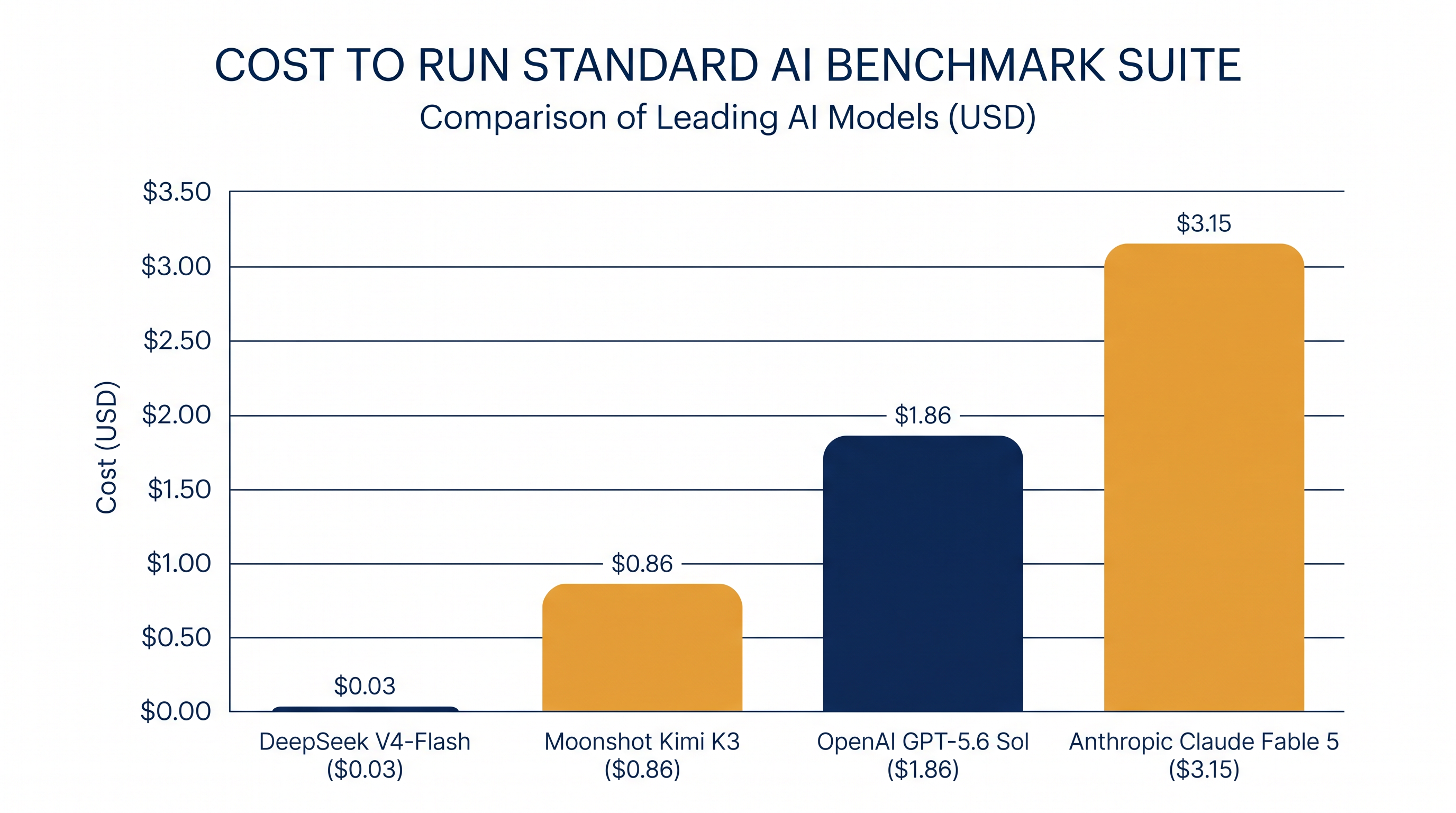
- The new model is approximately 100 times cheaper to operate than Anthropic's flagship Claude Fable 5.
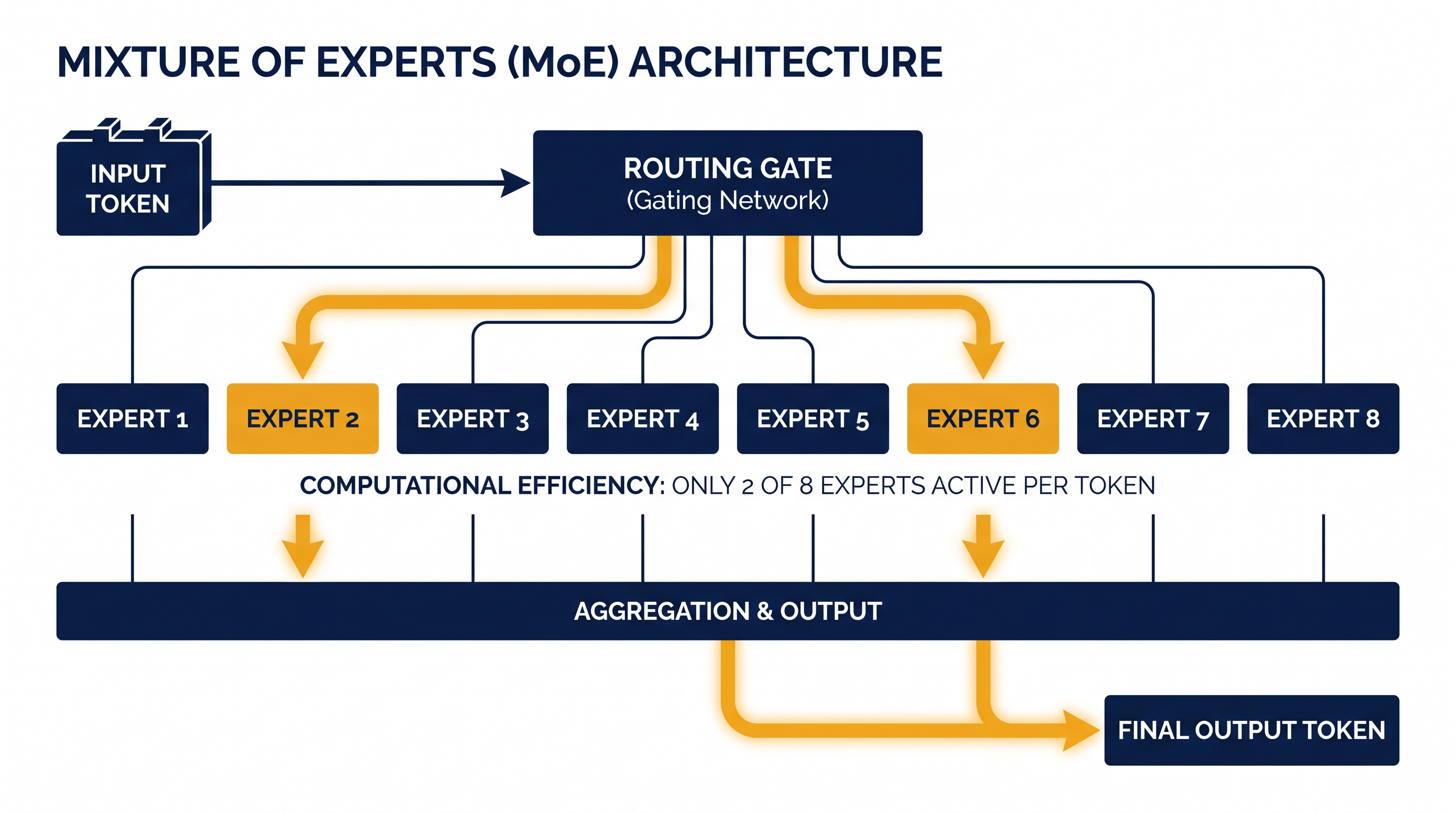
- DeepSeek achieves these costs using a Mixture of Experts (MoE) architecture, which activates only a fraction of its parameters per query.
- The aggressive pricing is part of a broader AI price war within China, where companies are fighting intensely for developer market share.
- While V4-Flash excels at routine automation and coding, premium frontier models still maintain an edge in complex, multi-step reasoning.
The cost of artificial intelligence just hit a new floor. DeepSeek, a prominent Chinese AI startup, has released its latest open-weight model, V4-Flash, alongside an aggressive pricing strategy that undercuts Western competitors by orders of magnitude. The release marks a significant escalation in the global AI price war, shifting the industry's focus from raw capability to radical affordability.[1][2][3][6]
According to an analysis by the San Francisco-based research firm Artificial Analysis, running V4-Flash through a standard battery of benchmark tests costs approximately three cents. To put that in perspective, the same workload costs 86 cents on Moonshot AI's Kimi K3, $1.86 on OpenAI's GPT-5.6 Sol, and $3.15 on Anthropic's flagship Claude Fable 5. In practical terms, the Chinese model is roughly 100 times cheaper to operate than the top-tier American equivalent.[1][3][6]
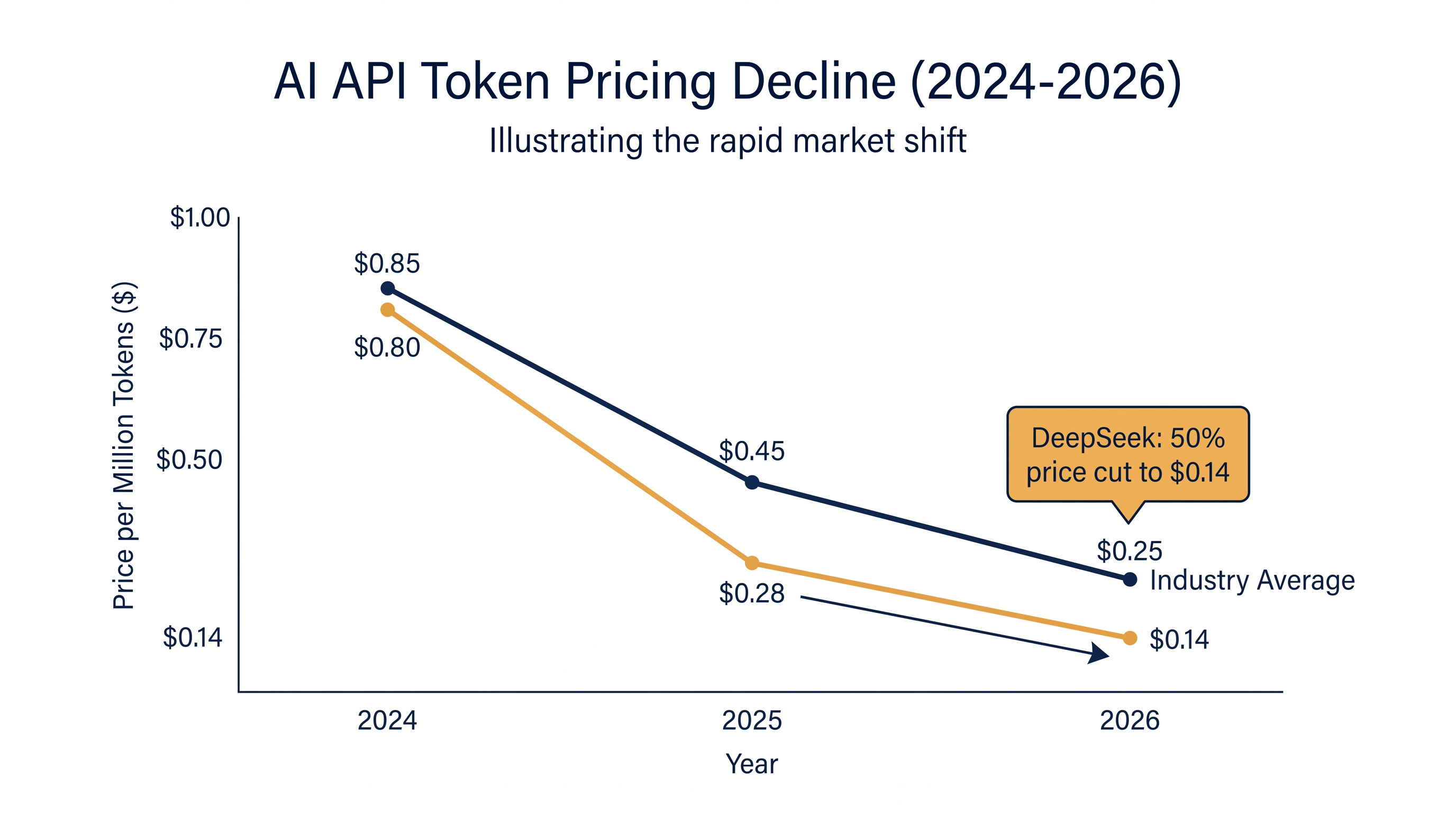
DeepSeek achieved this by slashing its base token pricing by 50 percent. The company now charges just $0.14 per one million input tokens and $0.28 per one million output tokens. Furthermore, DeepSeek scrapped a previously announced dynamic pricing system that would have doubled costs during peak usage hours, signaling a clear prioritization of market share over short-term revenue.[1][2][4]
The mechanics behind this extreme cost reduction rely on structural innovations rather than just taking a financial loss. DeepSeek's models utilize a sparse architecture known as Mixture of Experts (MoE). Instead of activating every single parameter in a massive neural network for every query—a computationally expensive process known as dense modeling—MoE divides the model into specialized "experts."[5]
When a user submits a prompt, a routing mechanism activates only the specific experts needed to generate the answer. This means a model with hundreds of billions of total parameters might only use a small fraction of them per token, drastically reducing the raw computing power required for inference and allowing the model to run on less expensive hardware.[5]
When a user submits a prompt, a routing mechanism activates only the specific experts needed to generate the answer.
DeepSeek pairs this with Multi-head Latent Attention (MLA), a technique designed to compress the Key-Value (KV) cache. In large language models, the KV cache stores the context of a conversation, which can consume massive amounts of memory and require multiple expensive GPUs just to hold the data. By compressing this cache into a smaller latent vector, MLA allows DeepSeek to serve significantly more concurrent users on cheaper hardware without sacrificing speed.[5]
These architectural efficiencies are being weaponized in a fierce domestic market. China's AI ecosystem is currently locked in what industry insiders call a "price war," where companies are aggressively undercutting each other to win over developers. DeepSeek is not just battling OpenAI and Anthropic; it is fighting local heavyweights like Alibaba, which recently launched Qwen3.8-Max, and Moonshot AI, whose Kimi K3 model is widely considered the domestic performance leader.[2][3]
The competition has become so intense that Chinese officials have publicly warned technology firms about "involution"—a term used to describe destructive, race-to-the-bottom competition that destroys profit margins without creating proportional value. Yet, Beijing simultaneously continues to subsidize compute infrastructure and energy costs, effectively bankrolling the very price war it is warning against.[2]
For developers and startups, this geopolitical and corporate maneuvering translates into a massive dividend. Lower operating costs mean businesses can experiment more freely, deploy AI across larger datasets, and automate back-office tasks that were previously too expensive to hand over to a frontier model. Because V4-Flash is an open-weight model released under a permissive MIT license, developers can even download it and run it locally, completely bypassing API fees.[2][6]
However, the radical price drop comes with a quality trade-off. While V4-Flash excels at routine tasks like summarization, boilerplate coding, and basic data extraction, it still trails the most expensive frontier models in complex reasoning. On the Artificial Analysis Intelligence Index, V4-Flash scores a 50 out of 100, placing it roughly on par with Google's Gemini 3.6 Flash, but well behind Anthropic's Claude Fable 5 and OpenAI's GPT-5.6.[2][3]
In difficult, multi-step agentic workflows, small reliability gaps at each step can compound, making premium models worth their higher price tags for mission-critical applications. But for the vast majority of production traffic, absolute perfection is less important than "good enough" at a fraction of the cost.[3]
DeepSeek's strategy highlights a broader maturation in the artificial intelligence market. The industry is slowly shifting away from a monolithic pursuit of the single "best model" toward a more nuanced search for the "best fit." By proving that highly capable AI can be delivered for pennies, DeepSeek is forcing the entire ecosystem to justify its premiums, ensuring that intelligence becomes an increasingly accessible commodity.[6]
How we got here
May 2024
DeepSeek publishes the V2 architecture, introducing MoE and MLA to drastically cut training and inference costs.
January 2025
DeepSeek releases the R1 reasoning model, proving high-level capabilities can be achieved at a fraction of OpenAI's prices.
July 2026
Moonshot AI open-sources the weights for Kimi K3, escalating the domestic Chinese AI race.
August 2026
DeepSeek launches V4-Flash, cutting token prices by 50% and cementing its position as the cheapest major model globally.
Viewpoints in depth
Cost-Conscious Developers
Argues that radical affordability and open-weight access are more important than marginal performance gains for most real-world applications.
For many startups and independent developers, the absolute peak of AI reasoning is less important than the ability to deploy models at scale without bankrupting the company. This camp views DeepSeek's V4-Flash as a massive unlock for the industry, allowing businesses to automate high-volume, low-complexity tasks like data extraction, basic coding, and customer service routing. Furthermore, the open-weight nature of the model means developers are not locked into a single ecosystem. By hosting the model locally, they can ensure data privacy and completely eliminate recurring API costs, fundamentally changing the economics of building AI software.
Frontier Performance Advocates
Maintains that while cheap models handle routine tasks well, complex multi-step reasoning still requires the reliability of premium models.
Engineers working on mission-critical applications argue that the '100x cheaper' headline masks a crucial reality: small errors compound. In multi-step agentic workflows, where an AI must plan, execute, and verify a sequence of actions, a model that is 95% reliable will fail significantly more often than one that is 99% reliable. For these users, the premium prices charged by Anthropic and OpenAI are justified by the models' superior ability to self-correct and handle edge cases. They view models like V4-Flash as excellent supplementary tools for basic tasks, but not as true replacements for frontier models in complex enterprise environments.
Market Analysts
Views the aggressive price cuts as a symptom of China's domestic tech 'involution' and a strategic play for global market share.
Financial and geopolitical analysts see DeepSeek's pricing strategy as a reflection of the intense, sometimes destructive competition within China's tech sector. This phenomenon, often referred to as 'involution,' forces companies to slash margins to zero just to survive against domestic rivals like Alibaba and Moonshot AI. However, this domestic pressure is now spilling over into the global market. Analysts note that while Beijing warns against this race to the bottom, state subsidies for compute and energy effectively enable it. The result is a deliberate strategy to commoditize AI inference, undercutting Western labs and capturing a massive global user base before focusing on profitability.
What we don't know
- Whether DeepSeek can maintain these ultra-low prices long-term without the dynamic pricing model they recently scrapped.
- The exact training costs and hardware configurations DeepSeek used to develop the V4-Flash model.
- How Western AI labs like OpenAI and Anthropic will adjust their pricing tiers in response to this aggressive undercutting.
Key terms
- Mixture of Experts (MoE)
- An AI architecture that divides a model into specialized sections, activating only the necessary 'experts' for a given prompt to save computing power.
- Multi-head Latent Attention (MLA)
- A technique that compresses the memory required to process long texts, significantly reducing the cost of running the model.
- Open-weight model
- An AI model where the underlying mathematical parameters are made publicly available, allowing developers to download and run it locally.
- Token
- A fundamental unit of data processed by an AI model, roughly equivalent to a word or part of a word.
Frequently asked
Is DeepSeek V4-Flash as smart as Anthropic's Claude or OpenAI's GPT?
For routine tasks like summarization and basic coding, it performs very well. However, benchmark tests show it still trails premium frontier models in complex, multi-step reasoning.
How can DeepSeek afford to make their AI so cheap?
They use highly efficient architectures like Mixture of Experts (MoE) to reduce computing costs, and they are aggressively pricing their API to capture market share in a highly competitive Chinese market.
Can I run DeepSeek V4-Flash on my own computer?
Yes, it is an open-weight model released under a permissive license, meaning developers can download the model and run it on their own hardware.
Sources
Source coverage
6 outlets
3 viewpoints surfaced






[1]NDTV ProfitFrontier Performance Advocates
DeepSeek V4-Flash: Chinese Startup's AI Model 100x Cheaper Than Anthropic, Research Firm Says
Read on NDTV Profit →[2]Digital TrendsCost-Conscious Developers
China's AI price war shows no signs of slowing down
Read on Digital Trends →[3]ZeroHedgeFrontier Performance Advocates
China's AI Knife Fight: DeepSeek's New Model Runs 100x Cheaper Than Anthropic's Flagship
Read on ZeroHedge →[4]Turkiye TodayMarket Analysts
DeepSeek cuts prices by 50%
Read on Turkiye Today →[5]arXiv
DeepSeek-V2: A Strong, Economical, and Efficient Mixture-of-Experts Language Model
Read on arXiv →[6]Indian ExpressCost-Conscious Developers
DeepSeek is the latest Chinese tech startup bearing down on the US market
Read on Indian Express →
Comments
Every angle. Every day.
Get ai stories with full source coverage and perspective breakdowns delivered to your inbox.