
PwC Data Reveals 56% Salary Premium for AI-Skilled Workers, Rewriting Negotiation Strategy
A comprehensive analysis of one billion job postings shows the wage premium for AI skills has doubled in a year, fundamentally shifting how professionals negotiate compensation.


- Corporate & HR Leaders
- Focuses on the massive productivity gains that justify the high cost of AI-fluent talent.
- Labor & Workforce Advocates
- Focuses on ensuring that AI productivity gains are shared equitably with workers rather than hoarded by capital.
- Economic Researchers
- Focuses on the structural macroeconomic shifts and the changing definition of entry-level work.
Why this matters
For professionals across all industries, acquiring and demonstrating AI fluency is now the single highest-leverage tool for increasing earning potential and career security.
Key points
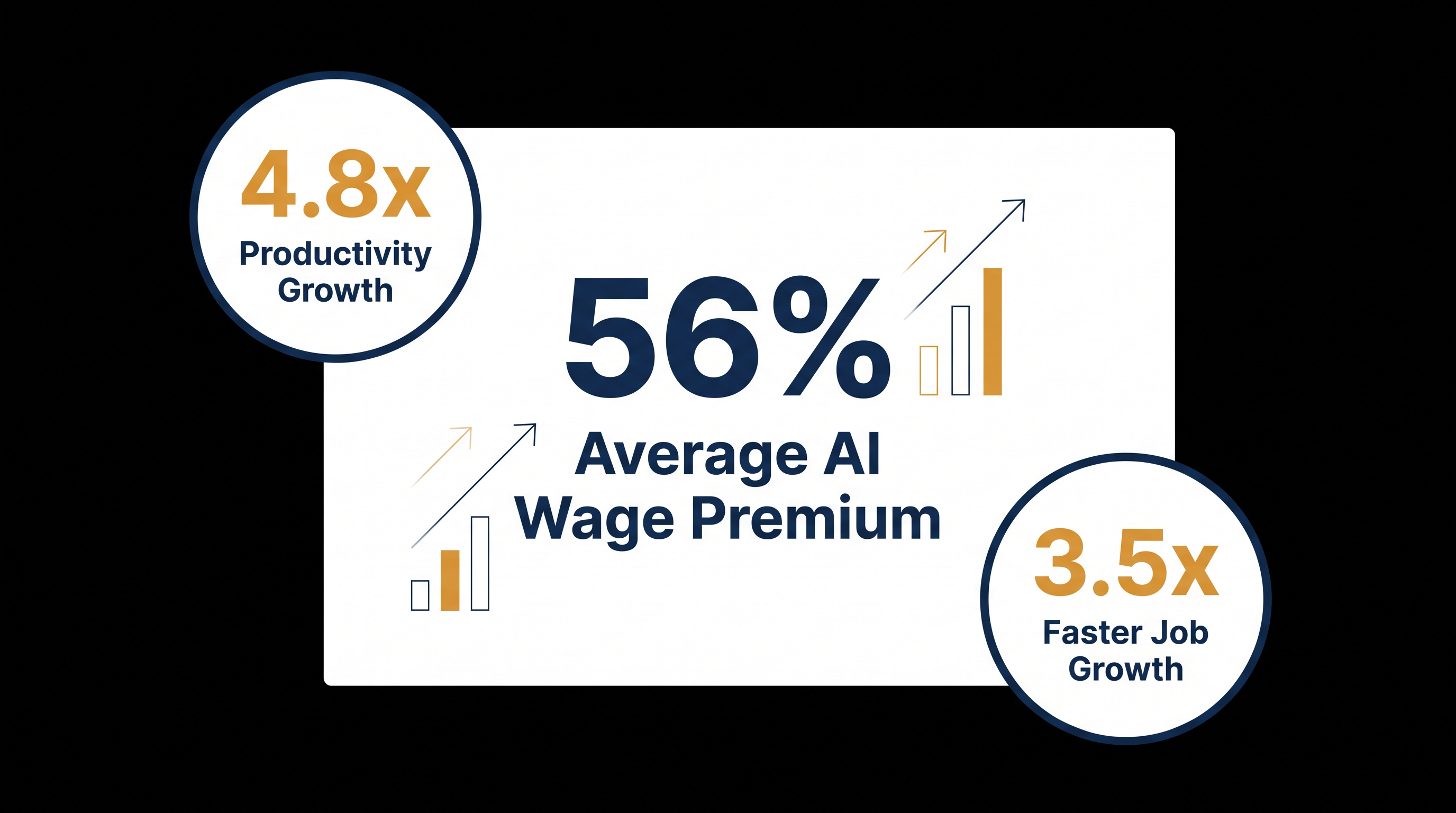
- Workers with AI skills are earning an average of 56% more than peers in identical roles without those skills.
- The wage premium has more than doubled in a single year, rising from 25% to 56%.
- AI-exposed sectors are seeing labor productivity grow 4.8 times faster than traditional industries.
- The premium applies heavily to non-technical roles like HR, marketing, and finance, not just software engineering.
- Employer demand for formal university degrees is dropping as companies shift toward skills-based hiring.
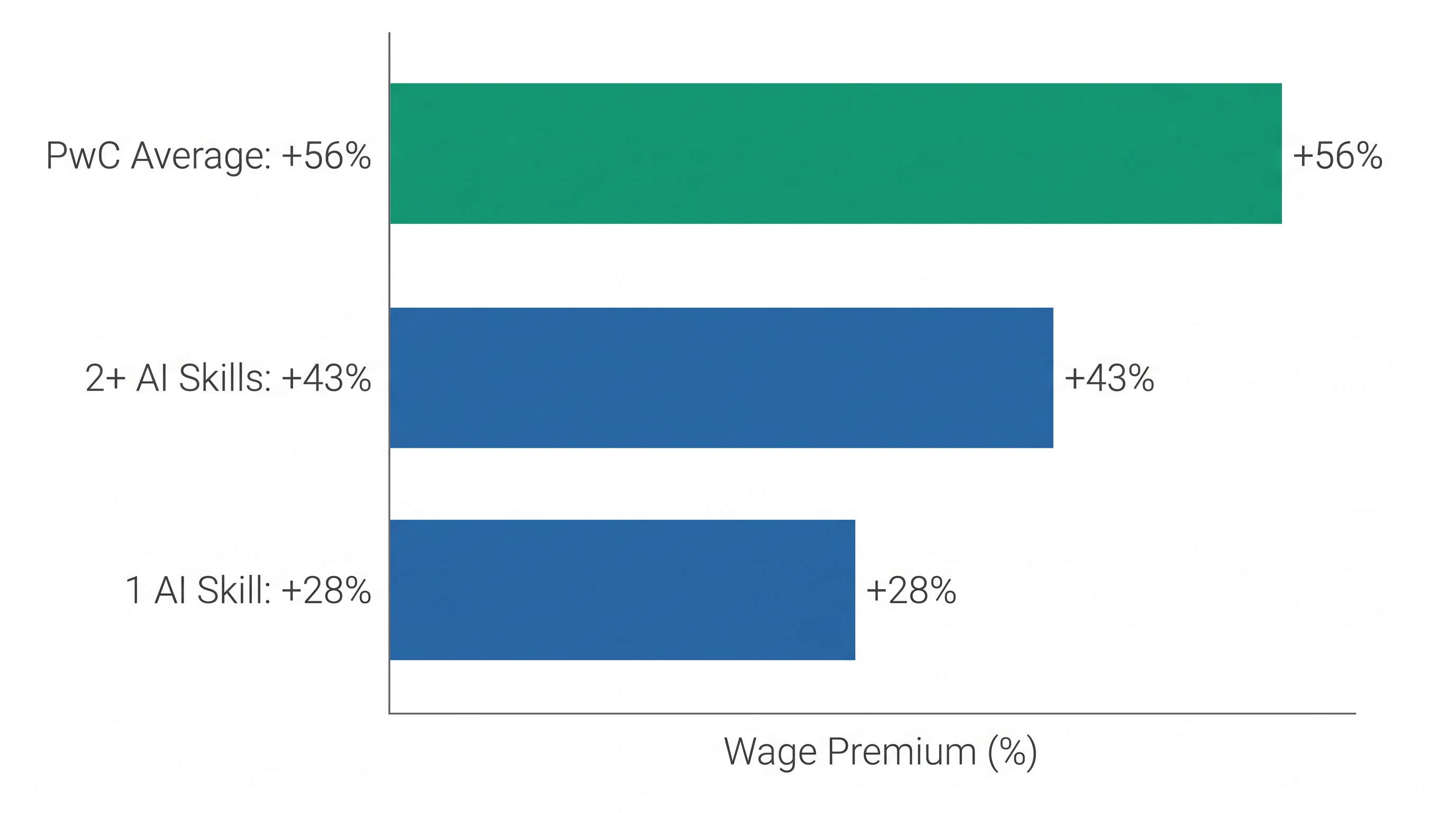
The compensation landscape is undergoing a seismic shift, and artificial intelligence sits at the epicenter. According to a sweeping new analysis by PwC, workers who possess AI-related skills are now commanding an average wage premium of 56% compared to peers in identical roles who lack those competencies. This figure represents one of the most dramatic skill-based salary divergences in modern labor history, transforming AI fluency from a niche technical advantage into a fundamental requirement for career mobility.
The scale of the data underscores the permanence of this trend. PwC's 2026 Global AI Jobs Barometer analyzed approximately one billion job advertisements across six continents, tracking the evolution of employer demands and compensation structures. The findings reveal that the AI wage premium has more than doubled in just twelve months, surging from 25% in the previous year to the current 56%. Rather than a temporary bubble, labor market analysts view this as a structural realignment in how corporate value is generated and rewarded.[2]
Crucially, this premium is no longer confined to traditional technology sectors or specialized machine learning engineers. The demand for AI proficiency has rapidly expanded into administrative, human resources, marketing, and financial roles. Staffing experts note that candidates applying for clerical or entry-level positions make themselves significantly more marketable—and expensive—when they can demonstrate practical experience with generative AI workflows. The ability to integrate AI into daily operations is now a baseline expectation for top-tier compensation across the corporate spectrum.[1]
The financial mechanics behind this wage gap are highly granular. Independent labor analytics firm Lightcast, which evaluated 1.3 billion job postings, found that demonstrating just a single practical AI skill yields an average salary premium of 28%, equivalent to roughly $18,000 annually at median income levels. For professionals who can combine two or more AI competencies—such as prompt engineering coupled with automated data analysis—that premium jumps to 43%.
Employers are willing to pay these unprecedented premiums because the return on investment is immediate and measurable. Sectors that are highly exposed to AI integration are experiencing labor productivity growth at 4.8 times the rate of less exposed industries. Furthermore, companies that successfully deploy AI-augmented workforces are seeing revenue per employee grow three times faster than their peers. When an AI-fluent employee can save a department dozens of hours a week in routine reporting or content generation, the 56% salary bump functions as a cost-saving measure rather than an expense.
This dynamic is creating what economists describe as a "two-track" labor market. Jobs that are "professionalized" or augmented by AI—where the technology handles basic tasks and leaves complex judgment to the human—are thriving, seeing massive wage growth and high demand. Conversely, roles that are "democratized" by AI, where the software takes over the complex analytical work entirely, are seeing slower wage growth and reduced hiring footprints.[3]
This dynamic is creating what economists describe as a "two-track" labor market.
One of the most surprising outcomes of this shift is the "seniorization" of entry-level work. Because AI tools can now instantly generate first drafts, write basic code, and compile standard reports, the traditional tasks assigned to junior employees are vanishing. In their place, employers are demanding that entry-level workers possess traditionally senior skills, such as strategic decision-making, cross-domain synthesis, and leadership. Junior roles highly exposed to AI are seven times more likely to require these advanced cognitive skills than they were just a few years ago.[3]
As the focus shifts to verifiable skills, traditional credentialing is losing its monopoly on career advancement. Employer demand for formal university degrees is declining across the board, but it is dropping fastest in AI-exposed occupations. The percentage of AI-augmented jobs requiring a degree fell by seven percentage points over the last five years. This transition toward skills-based hiring is opening lucrative pathways for self-taught professionals who can prove their AI competence through portfolios and practical assessments rather than diplomas.
Despite the clear financial incentives, a massive action gap remains in the workforce. While surveys indicate that 54% of knowledge workers recognize the critical importance of AI skills for their future careers, only about 4% are actively engaged in structured training or upskilling programs. This 50-point divide represents a profound opportunity for proactive employees. Those who take the initiative to master these tools are stepping into a labor market where demand vastly outpaces supply, giving them unprecedented leverage.[2]
Armed with this data, professionals are entirely rewriting their salary negotiation strategies. Career advisors recommend that employees track their out-of-pocket AI software spending and document the specific weekly hours saved through AI workflows. During performance reviews, workers are successfully anchoring their compensation requests to the 56% market premium, presenting their AI fluency not as a neat trick, but as a quantifiable multiplier of their output. Some are even negotiating dedicated AI stipends as part of their benefits packages.[1][2]
Labor unions and workforce advocates are also adapting to this new reality, working to ensure that the massive productivity gains generated by AI are shared equitably. Organizations like the Communications Workers of America have begun negotiating contracts that mandate advance notice of AI implementation and require companies to invest in worker retraining. These agreements are designed to guarantee that AI functions as a tool for employee augmentation and wage growth, rather than a mechanism for surveillance or uncompensated workload expansion.
There remains some uncertainty about the long-term trajectory of this wage premium. As AI tools become more intuitive, seamlessly integrated into standard enterprise software, and universally adopted, the distinct advantage of knowing how to use them may naturally compress. What is currently a specialized, high-paying skill could eventually become as mundane and expected as knowing how to use a spreadsheet or send an email, potentially flattening the 56% bump over the next decade.[3]
Yet, the ultimate paradox of the AI revolution is that it is making uniquely human traits more valuable than ever. Because AI excels at routine cognitive tasks, the skills that command the highest market value are those the technology cannot replicate: emotional intelligence, complex ethical judgment, empathy, and the ability to build genuine client trust. The professionals securing the largest compensation packages are those who pair technical AI fluency with deep, irreplaceable human insight.[3]
The 2026 labor market has definitively moved past the debate over whether AI is a passing trend. The 56% salary premium is now a structural feature of the global economy, rewarding those who adapt while penalizing complacency. For workers willing to embrace the transition, the current landscape offers a rare, highly lucrative window to redefine their career trajectories and secure their financial futures.[2]
How we got here
Late 2022
Generative AI enters the mainstream public consciousness, sparking initial fears of widespread job displacement.
2024
Early labor market data shows a 25% wage premium for workers possessing specialized AI skills.
2025
Major corporations begin seeing quantifiable productivity and revenue gains from AI-augmented departments.
Mid 2026
PwC's analysis of one billion job ads reveals the AI wage premium has more than doubled to 56%, fundamentally altering salary negotiations.
Viewpoints in depth
Corporate & HR Leaders
Focuses on the massive productivity gains that justify the high cost of AI-fluent talent.
For corporate executives and hiring managers, the 56% wage premium is not viewed as an inflated expense, but rather a highly efficient investment. Because AI-exposed sectors are seeing labor productivity grow nearly five times faster than traditional sectors, paying a premium for a worker who can automate routine tasks ultimately reduces overall departmental costs. HR leaders emphasize that they are not just paying for technical software skills, but for the strategic judgment required to deploy AI safely and effectively within enterprise environments.
Labor & Workforce Advocates
Focuses on ensuring that AI productivity gains are shared equitably with workers rather than hoarded by capital.
Labor unions and workforce advocates acknowledge the wage premiums available to highly skilled workers, but warn against the creation of a deeply unequal, two-track labor market. Their primary concern is that without negotiated protections, AI could be used to displace entry-level workers or increase surveillance. Advocates are pushing for collective bargaining agreements that mandate employer-funded AI retraining programs, ensuring that the existing workforce is augmented and shares in the financial upside of increased corporate revenue.
Economic Researchers
Focuses on the structural macroeconomic shifts and the changing definition of entry-level work.
Labor economists analyzing the billion-job dataset view the current landscape as a fundamental rewiring of human capital valuation. They highlight the paradox of 'seniorization'—where junior roles now require advanced strategic thinking because AI handles the basic execution. Researchers note that while the 56% premium is currently robust, historical technological adoption curves suggest this gap may eventually compress as AI fluency transitions from a specialized advantage to a universal baseline expectation.
What we don't know
- Whether the 56% wage premium will compress as AI tools become universally adopted and easier to use.
- How small and mid-sized businesses will compete for talent when enterprise corporations are paying massive AI premiums.
- The long-term impact on entry-level hiring volumes as junior roles are 'seniorized' by automation.
Key terms
- AI Wage Premium
- The percentage increase in salary that a worker with artificial intelligence skills commands over a peer in the exact same role without those skills.
- Augmented Roles
- Jobs where AI handles routine or basic tasks, allowing the human worker to focus on high-level strategy, judgment, and complex problem-solving.
- Democratized Roles
- Jobs where AI takes over the complex analytical or technical work entirely, lowering the barrier to entry but often depressing wage growth.
- Seniorization
- The trend of entry-level jobs requiring advanced skills—like leadership and strategic decision-making—because AI now performs the basic tasks traditionally assigned to juniors.
Frequently asked
Do I need to be a programmer to get the AI wage premium?
No. The premium applies heavily to non-technical roles like marketing, HR, and finance. Employers are paying for professionals who can integrate AI tools into their daily workflows to save time and boost output, not just those who can build the underlying models.
How much does knowing just one AI skill increase salary?
According to labor analytics firm Lightcast, having just one practical AI skill on your resume yields an average salary premium of 28%. Combining two or more AI skills pushes that premium to 43%.
Are employers still requiring college degrees for these roles?
Degree requirements are actually dropping. PwC data shows a 7 percentage point decline in formal degree requirements for AI-augmented jobs, as employers shift toward skills-based hiring and practical portfolios.
Will this wage premium last forever?
Economists are uncertain. While the premium is currently growing, it may eventually compress as AI tools become universally adopted and basic AI fluency becomes a standard expectation rather than a rare specialization.
Sources
Source coverage
3 outlets
3 viewpoints surfaced



[1]Staffing Industry AnalystsCorporate & HR Leaders
AI skills drive salary premiums up to 56%, accelerate hiring cycles
Read on Staffing Industry Analysts →[2]Robert WaltersCorporate & HR Leaders
The AI Wage Premium: Why Specialization Outpaces Job Titles
Read on Robert Walters →[3]World Economic ForumEconomic Researchers
The Future of Jobs Report 2026: The AI Transition
Read on World Economic Forum →
Comments
Every angle. Every day.
Get careers work stories with full source coverage and perspective breakdowns delivered to your inbox.