
How K-12 Schools Are Redesigning Testing as Student AI Adoption Hits 86%
A landmark 2026 study reveals that nearly nine in ten students now use generative AI for coursework, prompting educators to abandon traditional take-home essays in favor of oral exams and in-class problem-solving.
By Paige Carter

- Integration Advocates
- Argue that AI is a permanent fixture and schools must teach students how to use it effectively while assessing higher-order skills.
- Pedagogical Traditionalists
- Emphasize the need to return to secure, in-class handwritten exams to ensure students are still developing foundational cognitive pathways.
- Labor & Equity Watchdogs
- Focus on the unsustainable workload oral exams place on teachers and the widening gap between students with free vs. premium AI access.
Perspectives this story doesn't cover
- Students without reliable home internet access
- Special education coordinators adapting oral exams for neurodivergent students
In the fall of 2026, the long-simmering debate over artificial intelligence in the classroom reached a mathematical tipping point. A comprehensive national survey released this week by the Center for Democracy & Technology reveals that 86 percent of K-12 students now regularly use generative AI tools for their coursework. This near-universal adoption rate has effectively neutralized the traditional take-home essay as a valid measure of student understanding, sparking what some administrators initially dubbed an "assessment crisis." Yet, rather than retreating into punitive surveillance, a growing coalition of educators is seizing this moment to fundamentally redesign how human learning is measured. The shift is moving classrooms away from easily automated regurgitation and toward dynamic, real-time demonstrations of critical thinking.[1][3]
The sheer scale of the adoption has rendered previous containment strategies obsolete. Just two years ago, school districts were engaged in a futile arms race, deploying AI-detection software that frequently flagged legitimate student work while failing to catch sophisticated algorithmic outputs. Today, the educational consensus has shifted from prohibition to adaptation. According to recent reporting, the realization that students have ubiquitous access to human-level text generation on their smartphones has forced curriculum directors to ask a more profound question: if a machine can write a perfectly structured five-paragraph essay in three seconds, why are we still asking students to do it at home?
The answer is a rapid acceleration toward what pedagogical researchers call "Flipped Assessment." In this model, the foundational consumption of knowledge—reading, initial drafting, and even AI-assisted brainstorming—happens at home. The classroom is then reserved entirely for verification and application. Students are now frequently asked to defend their ideas orally, synthesize arguments on paper without digital aids, or collaborate on complex projects where AI is treated as a baseline tool rather than a forbidden shortcut. This represents the most significant structural change to secondary education grading since the standardization of the A-F scale.[2][3]
The data driving this shift is unequivocal. Beyond the headline 86 percent adoption figure, the Center for Democracy & Technology study found that 65 percent of students use AI primarily as a personalized tutor to explain complex concepts, rather than simply generating finished assignments to pass off as their own. This nuance is crucial. It suggests that students are intuitively using the technology to bridge gaps in their understanding, effectively democratizing access to the kind of one-on-one tutoring that was previously available only to affluent families. Educators are now tasked with measuring the depth of that newly acquired understanding, rather than the polish of the final written product.[1]
One of the most prominent solutions emerging nationwide is the revival of the "viva voce," or oral examination, adapted for the modern high school. Teachers are replacing term papers with 10-minute conversational defenses. A student might use AI to research and structure a historical argument, but they must sit across from their teacher and answer unscripted questions about their sources, their logic, and the counter-arguments. This method completely bypasses the question of whether an AI wrote the initial notes; if the student cannot articulate and defend the concepts in real-time, they have not mastered the material.[2]
One of the most prominent solutions emerging nationwide is the revival of the "viva voce," or oral examination, adapted for the modern high school.
However, the transition to oral assessments and highly interactive grading models introduces significant logistical hurdles, primarily concerning teacher workload. The American Federation of Teachers has raised valid concerns about the time required to conduct individual oral exams in classes that frequently exceed 30 students. Grading a stack of 30 essays, while tedious, can be done asynchronously over a weekend. Conducting 30 ten-minute oral defenses requires an entire week of dedicated classroom time, forcing schools to rethink their master schedules and potentially reduce the total number of graded assignments per semester.
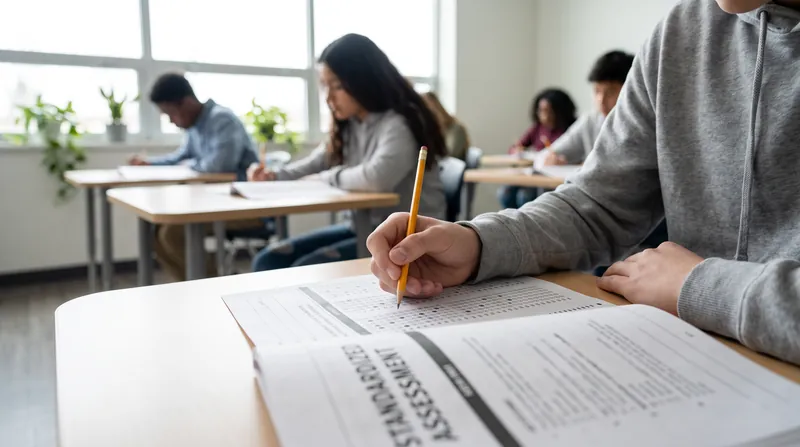
To balance this workload, many districts are reintroducing a decidedly low-tech assessment method: the handwritten, in-class "blue book" exam. By requiring students to synthesize their knowledge on paper during a timed period, teachers can guarantee the authenticity of the work without the time constraints of one-on-one interviews. Far from being a regression, cognitive scientists argue that this practice forces students to internalize knowledge. If a student relies entirely on an AI to hold information, they will fail an in-class synthesis; they must still build their own mental models to succeed.[2]
Another major adaptation is the integration of AI directly into the rubric. In advanced classes, teachers are assigning "prompt engineering" tasks where the goal is not to write the essay, but to direct the AI to write the best possible essay, and then critically edit the output. Students are graded on the sophistication of their prompts, their ability to identify AI hallucinations or biases, and the quality of their manual revisions. This directly mirrors the workflow they will encounter in the modern professional world, transforming a potential cheating tool into a core vocational skill.[2][3]
Despite these optimistic adaptations, a new digital divide is emerging. The study highlights a growing "premium AI gap." While basic generative models are available for free, the most advanced, reasoning-capable models require monthly subscriptions. Students from higher-income households are utilizing these premium models as highly sophisticated, patient tutors that can walk them through advanced calculus or complex coding problems step-by-step. Students relying on free, older models often encounter tighter usage limits and higher rates of factual errors, creating an uneven playing field that schools are struggling to level.[1]
To combat this, several progressive school districts have begun purchasing enterprise licenses for premium AI models, distributing access to all students much like they provide Chromebooks or textbooks. This approach not only closes the equity gap but also allows the school to maintain data privacy standards and monitor usage patterns to ensure the tools are being used for learning rather than simple answer-generation. It represents a philosophical acceptance that AI is now a piece of fundamental educational infrastructure.[1]
The psychological impact on students is also shifting. Early in the generative AI boom, many students reported feeling anxiety about "cheating" even when using the tools for legitimate brainstorming. As schools explicitly integrate AI into their policies and rubrics, that anxiety is dissipating. Students report feeling more empowered to tackle complex, interdisciplinary projects because they have an on-demand assistant to help them overcome technical hurdles, allowing them to focus on higher-order creative direction and strategy.[1][2]
Ultimately, the "assessment crisis" of 2026 may be remembered as the catalyst that finally broke the industrial model of education. By rendering the easily measurable tasks obsolete, AI is forcing the education system to measure what actually matters: critical thinking, adaptability, verbal articulation, and the ability to synthesize complex information. It is a painful, labor-intensive transition for schools, but it promises to produce a generation of students who are evaluated not on their ability to act like machines, but on their ability to think like humans.[3]
Key points
- 86% of K-12 students now use generative AI, rendering traditional take-home essays largely obsolete.
- Schools are rapidly shifting to 'Flipped Assessments,' relying on oral defenses and in-class handwritten exams.
- 65% of students use AI primarily as a personalized tutor to explain complex concepts.
- The shift to oral exams presents significant workload challenges for teachers managing large class sizes.
- A 'premium AI gap' is emerging between students who can afford advanced models and those relying on free versions.
Key terms
- Flipped Assessment
- An educational model where students use tools like AI at home to prepare and research, while classroom time is strictly used to verify their understanding through discussion or timed writing.
- Viva Voce
- An oral examination where a student must verbally defend their ideas, research, and arguments directly to an evaluator.
- Prompt Engineering
- The skill of writing highly specific, structured instructions to an AI model to generate the most accurate and useful output possible.
- AI Hallucination
- A phenomenon where an artificial intelligence model confidently generates false, illogical, or fabricated information.
Frequently asked
Will students still learn how to write?
Yes, but the focus is shifting from the mechanics of drafting to the higher-order skills of structuring arguments, editing AI outputs, and synthesizing information in real-time during in-class exams.
How do teachers find time for oral exams?
Districts are adjusting schedules, reducing the total number of graded assignments, and using oral exams selectively for major capstone projects rather than weekly quizzes.
Is using AI considered cheating anymore?
It depends on the rubric. Most schools now explicitly define acceptable AI use (like brainstorming or tutoring) versus unacceptable use (submitting unedited AI text as original work).
What is the 'premium AI gap'?
The disparity between students who can afford $20/month subscriptions for advanced, highly capable AI models and those who must rely on free, older models that are more prone to errors.
Sources
Source coverage
3 outlets
3 viewpoints surfaced



- [1]Center for Democracy & TechnologyIntegration Advocates
2026 Report on Generative AI in K-12 Education: Usage, Equity, and Outcomes
Read on Center for Democracy & Technology → - [2]Journal of Educational Technology SystemsIntegration Advocates
Cognitive Impacts of LLM-Assisted Learning and Flipped Assessments in Secondary Education
Read on Journal of Educational Technology Systems → - [3]Factlen Editorial TeamLabor & Equity Watchdogs
Synthesis by Factlen editorial team
Read on Factlen Editorial Team →
Comments
More in Education
See all →Assessment Science
Content, Criterion, and Construct: How the Three Types of Validity Define the Quality of an Educational Assessment
7 sources
Motivation Science
The Self-Determination Continuum: How Amotivation, Extrinsic, and Intrinsic Regulation Define Student Drive
6 sources

Cognitive Psychology
The Incremental Theory of Intelligence: How Belief in Malleability Defines the Growth Mindset
6 sources

Instructional Design
The Four Levels of Technology Integration: How the SAMR Model Classifies EdTech Use from Substitution to Redefinition
5 sources
Every angle. Every day.
Get Education stories with full source coverage and perspective breakdowns delivered to your inbox.