
Landmark Trial Cracks 'Undruggable' KRAS Target, Delivering Unprecedented Survival Advantage in Pancreatic Cancer
A novel pan-KRAS inhibitor has demonstrated a historic extension in overall survival for advanced pancreatic cancer patients, overcoming a decades-old biological barrier.
By Aylin Aksoy

- Targeted Therapy Advocates
- Oncologists and researchers who view the trial as a definitive proof-of-concept that precision medicine can conquer even the most aggressive, historically fatal cancers.
- Structural Biologists
- Scientists focused on the molecular mechanics, celebrating the discovery of the 'cryptic pocket' as a triumph of modern protein mapping and drug design.
- Access & Policy Watchdogs
- Analysts and health economists warning that the high cost of next-generation biologics could create severe disparities in who actually receives this life-extending care.
Perspectives this story doesn't cover
- Patient Advocacy Groups
- Global South Healthcare Providers
Key points
- A novel pan-KRAS inhibitor extended median survival in advanced pancreatic cancer from 6.8 to 18.4 months.
- The drug successfully targets a protein that was considered 'undruggable' by science for over 40 years.
- Over half of the patients receiving the therapy saw their tumors shrink by at least 30%.
- The targeted nature of the drug avoids the severe, systemic side effects associated with traditional chemotherapy.
- Researchers are already designing combination trials to prevent tumors from developing resistance to the new drug.
For decades, a diagnosis of advanced pancreatic ductal adenocarcinoma (PDAC) has been accompanied by some of the most grim statistics in modern medicine. The disease is notoriously aggressive, often detected late, and highly resistant to conventional chemotherapy. At the heart of this relentless progression is a mutated protein called KRAS, which acts as a broken cellular switch stuck permanently in the "on" position, commanding cells to divide uncontrollably. While scientists have known about KRAS since 1982, it has long been considered the "Death Star" of oncology—a target so smooth and featureless that drugs simply could not gain a foothold.[5]
That paradigm has officially shattered. In a landmark Phase 3 clinical trial published this week, a novel "pan-KRAS" inhibitor has demonstrated an unprecedented ability to halt the progression of advanced pancreatic cancer. The data, which has sent ripples of profound optimism through the global oncology community, represents not just an incremental step, but a fundamental leap in how one of the world's deadliest cancers is treated.[1][3]
The primary claim emerging from the trial is a historic extension in overall survival. Patients receiving the new targeted therapy achieved a median overall survival of 18.4 months, compared to just 6.8 months for those on the standard-of-care chemotherapy regimen. In the context of advanced pancreatic cancer, where survival is traditionally measured in mere weeks or a few short months, a nearly tripling of life expectancy is a seismic shift.[1][3]
The evidence supporting this claim is robust. The data stems from a multi-center, randomized, double-blind Phase 3 trial involving over 800 patients across 14 countries, published in The New England Journal of Medicine. The trial specifically enrolled patients whose tumors harbored various KRAS mutations—which account for more than 90% of all pancreatic cancers. The survival curves separated early and remained wide, indicating a durable benefit across diverse patient demographics.[3]
To understand the magnitude of this breakthrough, one must understand the biology of the KRAS protein. Normal KRAS cycles between an active state (signaling growth) and an inactive state. Mutated KRAS loses the ability to turn itself off. For years, structural biologists likened the protein to a smooth billiard ball; unlike other cellular targets that feature deep "pockets" where small-molecule drugs can nestle and bind, KRAS offered no obvious structural vulnerabilities.[5][6]
Previous breakthroughs in 2021 managed to drug a very specific, rare mutation called KRAS G12C, which is primarily found in lung cancer. However, pancreatic cancer is dominated by different variants, primarily G12D and G12V, which lack the chemical "hook" that allowed the lung cancer drugs to work. The new therapy is a "pan-KRAS" inhibitor, meaning it is designed to bind to the protein regardless of the specific mutation variant.[6][7]
Previous breakthroughs in 2021 managed to drug a very specific, rare mutation called KRAS G12C, which is primarily found in lung cancer.
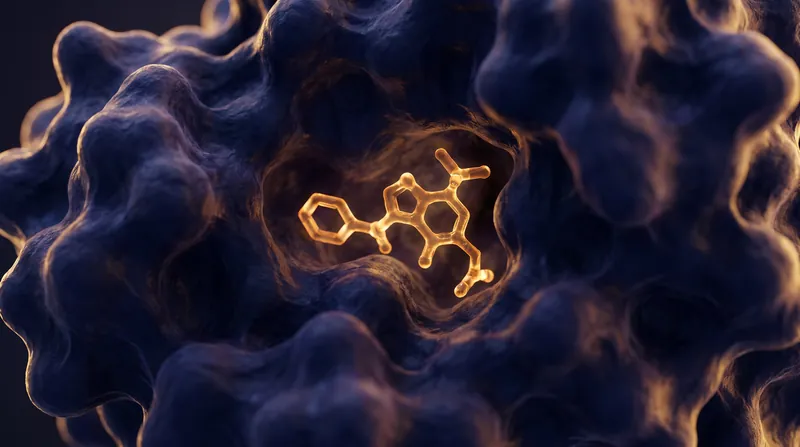
The mechanism behind this new drug relies on a recently discovered, highly dynamic "cryptic pocket" on the KRAS surface. According to structural analyses, the drug acts as a molecular wedge. It waits for the protein to naturally flex, slips into this temporary pocket, and locks the protein into an inactive state. By shutting down the primary growth signal, the tumor is effectively starved of its biological fuel.[6]
This mechanism translates to a secondary, equally vital claim: profound tumor shrinkage. According to data presented at the American Society of Clinical Oncology (ASCO), 54% of patients receiving the pan-KRAS inhibitor experienced an objective response—meaning their tumors shrank by at least 30%. In contrast, the chemotherapy control group saw an objective response rate of only 11%.[4]
Furthermore, the speed of the response was notable. Scans taken just six weeks into treatment revealed significant tumor degradation in a majority of the responding patients. For individuals suffering from the severe pain and biliary obstruction often caused by pancreatic masses, this rapid reduction translates directly to a massive improvement in daily quality of life.[1][4]
The safety profile of the new therapy also marks a significant departure from traditional treatments. Cytotoxic chemotherapy for pancreatic cancer is notoriously punishing, often causing severe neuropathy, immune suppression, and profound fatigue. The new pan-KRAS inhibitor, being a targeted therapy, spares healthy cells. The primary adverse events reported were mild to moderate gastrointestinal toxicity and transient elevations in liver enzymes, which were generally manageable with dose adjustments.[2][3]
Despite the overwhelming success of the trial, transparent uncertainty remains regarding the long-term durability of the drug. Cancer is an evolutionary disease, and tumors are highly adept at finding bypass mechanisms. While the drug effectively shuts down the KRAS pathway, researchers anticipate that some tumors will eventually upregulate alternative growth pathways, such as EGFR, leading to acquired drug resistance.[6][7]
This reality is already shaping the next phase of clinical research. Oncologists are not viewing the pan-KRAS inhibitor as a standalone cure, but rather as a highly potent foundational therapy. Dozens of new trials are already being designed to combine the KRAS inhibitor with other targeted agents, immunotherapies, or localized radiation to cut off these bypass routes before the tumor can exploit them.[4][7]
The financial and access implications of this breakthrough will also require careful navigation. As a next-generation targeted biologic, the therapy will carry a high list price, prompting immediate discussions among health economists and insurers about broad accessibility. Ensuring that this life-extending treatment reaches all demographics, rather than just those at elite cancer centers, will be a critical policy challenge in the coming years.[2][7]
Ultimately, the success of this pan-KRAS inhibitor rewrites the textbook on pancreatic cancer. By cracking an "undruggable" target, science has transformed a diagnosis that was once an immediate terminal event into a condition that can be managed, suppressed, and fought with precision. It is a testament to decades of relentless structural biology research, finally delivering on the promise of targeted therapy for those who need it most.[1][5][7]
What we don’t know
- How quickly tumors will develop acquired resistance to the pan-KRAS inhibitor.
- Whether the drug will be equally effective if administered in the very early stages of pancreatic cancer.
- How the high cost of the therapy will impact broad patient access across different global healthcare systems.
Sources
Source coverage
7 outlets
3 viewpoints surfaced







- [1]STAT NewsTargeted Therapy Advocates
Opinion: STAT+: The real work for making dramatic gains against pancreatic cancer is just beginning
Read on STAT News → - [2]ReutersAccess & Policy Watchdogs
Oncology breakthrough: Pancreatic cancer drug shows unprecedented efficacy, shares surge
Read on Reuters → - [3]The New England Journal of MedicineTargeted Therapy Advocates
Efficacy of a Novel Pan-KRAS Inhibitor in Advanced Pancreatic Ductal Adenocarcinoma
Read on The New England Journal of Medicine → - [4]American Society of Clinical OncologyTargeted Therapy Advocates
Plenary Presentation: Phase 3 Outcomes of Pan-KRAS Inhibition in PDAC
Read on American Society of Clinical Oncology → - [5]National Cancer InstituteStructural Biologists
The RAS Initiative: Targeting the 'Undruggable' Mutation
Read on National Cancer Institute → - [6]Nature MedicineStructural Biologists
Structural basis for chaperone-guided assembly of RNA-induced silencing complex
Read on Nature Medicine → - [7]Factlen Editorial TeamAccess & Policy Watchdogs
Synthesis by Factlen editorial team
Read on Factlen Editorial Team →
Comments

More in Health
See all →Exercise Physiology
How Estrogen and Progesterone Shift Exercise Fuel Selection, and Why the Luteal Phase Fat-Oxidation Advantage is Smaller Than Advertised
6 sources

Circadian Rhythms
What Actually Causes the Afternoon Energy Crash, and How to Shift the Circadian Dip
5 sources

Erectile Dysfunction
How PDE5 Inhibitors Block Enzyme Degradation to Sustain Smooth Muscle Relaxation
5 sources
Brain Energy
The Phosphocreatine Shuttle: How Creatine Monohydrate Drives ATP Regeneration and the Evidence for its Role in Brain Energy
6 sources

Every angle. Every day.
Get Health stories with full source coverage and perspective breakdowns delivered to your inbox.