
Japan's Defense White Paper Names China 'Greatest Strategic Challenge,' Commits to Self-Reliance
Tokyo's latest defense strategy outlines a generational shift toward military self-reliance, emphasizing counterstrike capabilities and defense industry revitalization to counter Beijing's regional influence.

- Japanese Defense Establishment
- Argues that the severe security environment necessitates a robust, self-reliant defense industry and counterstrike capabilities to deter aggression.
- Chinese State Leadership
- Views Tokyo's actions as a dangerous revival of neo-militarism, arguing that Japan is fabricating external threats to dismantle its pacifist constitution.
- Regional Security Analysts
- Emphasize the structural shift in the Indo-Pacific balance of power, noting that Japan's rearmament fundamentally alters deterrence dynamics but risks triggering an arms race.
At a glance
- Japan's 2026 Defense White Paper designates China as the country's 'greatest strategic challenge.'
- The document outlines a shift toward military self-reliance, framing defense manufacturing as a driver of economic growth.
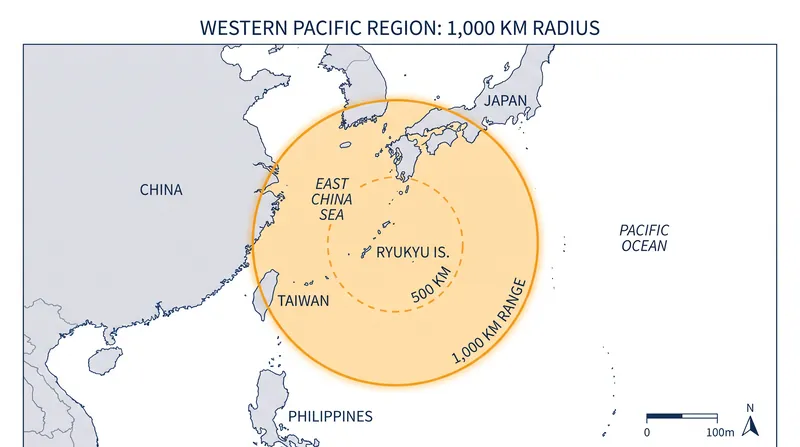
- Japan has deployed upgraded Type 25 missiles with a 1,000-kilometer range, operationalizing its counterstrike capabilities.
- The white paper emphasizes integrating commercial technology, artificial intelligence, and unmanned systems into national defense.
- China's Defense Ministry condemned the report, accusing Japan of fabricating threats to justify neo-militarism.
Why it matters now
Japan is fundamentally altering the post-World War II security architecture of the Indo-Pacific. By explicitly tying its economic growth to defense manufacturing and deploying long-range counterstrike weapons, Tokyo is signaling a permanent departure from its pacifist posture in response to China's military expansion.
For decades, the global economy has relied on a specific division of labor in East Asia: Japan served as a pacifist economic engine, while the United States provided the regional security umbrella. That architecture is now being fundamentally dismantled. As supply chains reorient and military budgets swell, the transformation of the world's fourth-largest economy into a rearmed, defense-industrial power alters the risk calculus for international commerce, regional diplomacy, and the likelihood of conflict in the Pacific.[8]
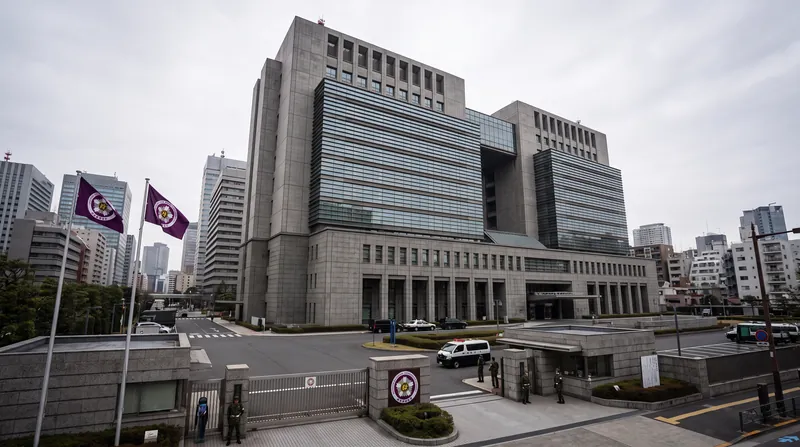
The blueprint for this transformation was formalized on August 4, 2026, when Japan's Ministry of Defense released its annual Defense White Paper. The 600-page document explicitly designates China as the "greatest strategic challenge" to Japan and the international community, retaining language that has defined Tokyo's security posture in recent years. However, the 2026 iteration moves beyond threat assessment to outline a comprehensive overhaul of the nation's military-industrial base, committing to unprecedented levels of self-reliance.[1][2][3][4]
The document's presentation offers a striking contrast to its contents. The white paper features a brightly colored, manga-style cover by illustrator Hitomi Kariya, depicting smiling youth in a futuristic cityscape. Yet behind this benign aesthetic lies a hardline security agenda that prioritizes the acquisition of long-range counterstrike capabilities, the rapid expansion of unmanned systems, and the deep integration of commercial technology into military applications.[2][4][7]
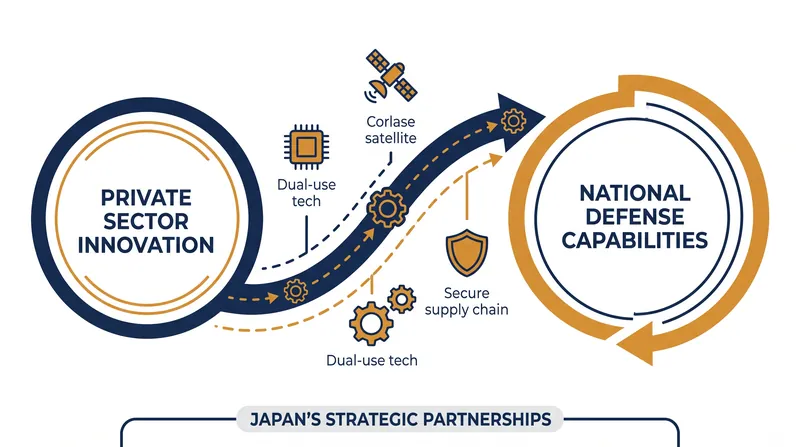
At the core of this strategic shift is a new economic mechanism. Tokyo is no longer treating military expansion solely as a security necessity; it is actively framing defense manufacturing as an engine for national economic growth. The white paper warns that the continued downsizing of domestic defense contractors threatens the stable supply of equipment for the Self-Defense Forces. In response, the government is pushing to revitalize its industrial base, encouraging private technology firms and startups to enter the defense sector to drive innovation in artificial intelligence and autonomous systems.[1][3][4][5][6]
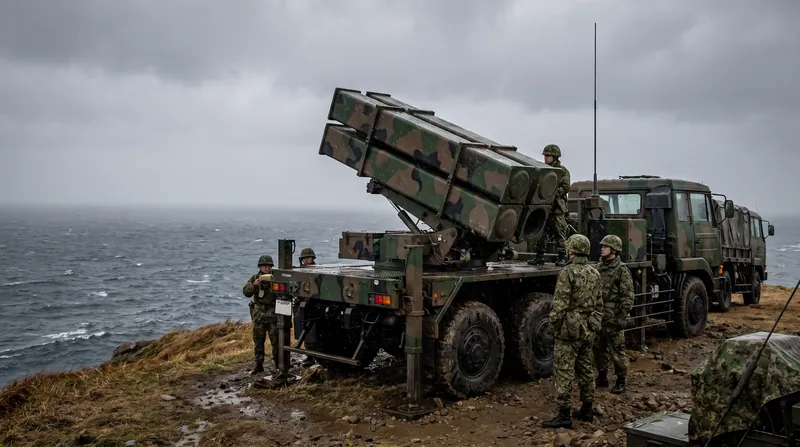
The physical manifestation of this policy is already altering the regional military balance. In early 2026, Japan deployed upgraded Type 25 land-based anti-ship missiles in Kumamoto Prefecture on the southern island of Kyushu. Boasting an estimated range of 1,000 kilometers, these weapons provide Tokyo with true stand-off deterrence and the ability to strike enemy bases—a capability that stretches the boundaries of its post-World War II "exclusively defense-oriented" constitutional framework.[2][6]
The white paper details plans to further expand these counterstrike capabilities by developing air- and ship-launched variants of the Type 25, alongside research into hypersonic glide vehicles. This hardware is intended to form what the Ministry of Defense terms a Synchronized, Hybrid, Integrated and Enhanced Littoral Defense network by 2027, relying heavily on a new fleet of low-cost, unmanned vehicles operating across air, surface, and underwater domains.[1][2][6]
Financing this architectural overhaul requires historic capital mobilization. Tokyo's military budget has surged to a record 9.04 trillion yen, placing the country on an accelerated trajectory to meet the NATO standard of spending 2 percent of its gross domestic product on defense. Despite this historic increase, the white paper notes a stark asymmetry: Beijing's defense budget remains roughly 4.6 times larger than Tokyo's, following three decades of continuous, opaque military expansion.[1][7]
Financing this architectural overhaul requires historic capital mobilization.
The Taiwan Strait remains the geopolitical flashpoint driving much of this calculus. The white paper explicitly links peace and stability across the strait to Japan's own national security, noting the intensifying pace of Chinese military activities, including aircraft carrier operations in the Pacific and unusually close approaches by fighter jets. Tokyo's explicit framing of Taiwan as a vital security interest has previously triggered economic retaliation from Beijing, including restrictions on dual-use exports and rare earth minerals.[2][3][7]
Beijing's reaction to the 2026 document was immediate and severe. China's Ministry of National Defense fiercely condemned the white paper, with spokesperson Chen Xi accusing Japan of fabricating a "China threat" to justify its own neo-militarist ambitions. Chinese officials characterized Japan as a "powder keg" for the Asia-Pacific region, arguing that Tokyo's deployment of long-range missiles and its push to become a war-capable nation pose a grave challenge to the post-war international order.[3][5][6]
China's Foreign Ministry echoed these condemnations, lodging official diplomatic representations with Tokyo. Spokesperson Lin Jian stated that the white paper grossly interferes in China's internal affairs by commenting on Taiwan, reiterating that the island's status is an inalienable domestic matter. Chinese state media further criticized the document as a political smokescreen designed to manipulate Japanese public opinion and dismantle the country's pacifist constitution.[5][6]
While China dominates the threat assessment, the white paper also addresses a broader matrix of regional instability. It classifies North Korea as an "imminent threat," pointing to Pyongyang's rapid advances in hypersonic weapons and expanded naval capabilities. Furthermore, the document highlights the deepening strategic and military coordination between Beijing and Moscow, citing joint bomber flights and naval patrols near Japanese territory as deliberate demonstration activities.[3][8]
To manage this complex threat environment, Japan is aggressively expanding its network of security partnerships. The white paper emphasizes the U.S.-Japan alliance as the cornerstone of its defense strategy, while highlighting deepening cooperation with Australia—including the export of Mogami-class frigates—and the joint development of a next-generation fighter jet with Britain and Italy. These moves signal a willingness to engage in collective defense and intelligence sharing far beyond Japan's traditional diplomatic parameters.[1][3][8]
Despite the clear strategic direction, significant uncertainties remain regarding execution. It is unclear whether Japan's domestic defense industry, long insulated from global competition, can scale rapidly enough to meet the government's ambitious 2027 readiness targets. Additionally, integrating commercial startups into the highly classified military procurement system presents bureaucratic hurdles that the Ministry of Defense has yet to fully resolve.[1][4]
Ultimately, the 2026 Defense White Paper codifies a structural reality: the era of Japanese strategic passivity has ended. By fusing economic policy with military modernization and deploying offensive strike capabilities, Tokyo is attempting to construct a deterrence architecture capable of managing a generational rivalry in the Indo-Pacific. Whether this posture stabilizes the region or accelerates a destabilizing arms race will define the security environment of East Asia for decades to come.[2][8]
Terms to know
- Defense White Paper
- An annual government report detailing Japan's official security assessments, military posture, and defense procurement strategies.
- Counterstrike capability
- The military capacity to hit enemy bases and command nodes from long distances to prevent an imminent attack, a significant shift for Japan's traditionally defensive forces.
- Type 25 missile
- An upgraded Japanese land-based anti-ship and land-attack missile with an estimated range of 1,000 kilometers, recently deployed in Kyushu.
- Exclusively defense-oriented policy
- Japan's post-World War II constitutional principle restricting its military strictly to self-defense, which is currently being reinterpreted to allow for long-range strike weapons.
- Stand-off deterrence
- A military strategy relying on weapons that can be launched from outside the range of enemy defenses, reducing risk to the attacking forces.
The backstory
Late 2022
Japan revises its National Security Strategy, breaking with post-war taboos by officially endorsing the acquisition of counterstrike capabilities.
2023–2025
Tokyo steadily increases its defense budget and initiates structural reforms to revitalize its domestic defense industry.
March 2026
Japan deploys upgraded Type 25 land-based anti-ship missiles in Kumamoto Prefecture, operationalizing its new long-range strike doctrine.
July 2026
The Japanese Self-Defense Forces conduct their first test-firing of U.S.-made Tomahawk cruise missiles from a naval destroyer.
August 4, 2026
The Ministry of Defense releases the 2026 Defense White Paper, codifying China as the 'greatest strategic challenge' and committing to deep military-industrial integration.
Different angles
Japanese Defense Establishment
Argues that the severe security environment necessitates a robust, self-reliant defense industry and counterstrike capabilities to deter aggression.
For Japanese defense planners, the 2026 white paper is a pragmatic response to an undeniable shift in the regional balance of power. Officials point to China's defense budget, which is nearly five times larger than Japan's, and the increasing frequency of joint Chinese-Russian military operations near Japanese airspace. In this view, the post-war model of relying entirely on the United States for offensive deterrence is no longer viable. The establishment argues that acquiring counterstrike capabilities and revitalizing the domestic defense industry are necessary steps to ensure Japan can independently disrupt invasions and secure its own supply chains in a crisis.
Chinese State Leadership
Views Tokyo's actions as a dangerous revival of neo-militarism, arguing that Japan is fabricating external threats to dismantle its pacifist constitution.
Beijing interprets Japan's strategic shift not as defensive prudence, but as a deliberate and provocative escalation. Chinese defense officials argue that Tokyo is using the 'China threat' narrative as a convenient political smokescreen to break free from the constraints of its pacifist constitution. By deploying 1,000-kilometer range missiles and explicitly linking its security to the Taiwan Strait, China contends that Japan is grossly interfering in its internal affairs and threatening the post-war international order. State media frequently highlights the historical echoes of Japan's military-industrial integration, warning that Tokyo is once again becoming a destabilizing force in the Asia-Pacific.
Regional Security Analysts
Emphasize the structural shift in the Indo-Pacific balance of power, noting that Japan's rearmament fundamentally alters deterrence dynamics but risks triggering an arms race.
Independent security analysts view the white paper as the codification of a generational shift in East Asian geopolitics. They note that Japan's decision to fuse economic policy with military modernization—treating defense manufacturing as a growth engine—ensures that rearmament will be a permanent, structural feature of the Japanese state. While this enhanced deterrence may complicate Beijing's strategic calculus and reassure regional partners like Australia, analysts warn of a classic security dilemma. As Japan sheds its operational constraints to feel more secure, Beijing interprets these moves as offensive preparations, potentially accelerating a regional arms race that leaves all parties less secure.
Still unresolved
- Whether Japan's domestic defense industry can scale production quickly enough to meet the government's ambitious 2027 readiness targets.
- How effectively the Ministry of Defense will be able to integrate commercial startups and civilian technology into its highly classified procurement system.
- The extent to which China will escalate its economic retaliation against Japan in response to the deployment of long-range counterstrike missiles.
Questions readers ask
What is Japan's Defense White Paper?
It is an annual document published by the Ministry of Defense that outlines the government's official assessment of regional security threats and details its strategic priorities and procurement plans for the coming year.
Why is the 2026 white paper significant?
It explicitly frames defense manufacturing as an engine for economic growth and details the deployment of long-range counterstrike missiles, marking a structural shift away from Japan's post-war pacifist posture.
How did China respond to the document?
Beijing fiercely condemned the white paper, with state officials calling Japan a 'powder keg' and accusing Tokyo of fabricating a 'China threat' to justify neo-militarist expansion.
What are counterstrike capabilities?
They are long-range weapons, such as the 1,000-kilometer range Type 25 missile, that allow a military to strike enemy launch sites and bases from a distance, rather than only intercepting incoming attacks.
Sources
Source coverage
8 outlets
3 viewpoints surfaced








[1]Defense NewsJapanese Defense Establishment
Japan's 2026 Defense White Paper notes China presents 'the greatest strategic challenge'
Read on Defense News →[2]The StandardRegional Security Analysts
Japan's Ministry of Defense releases annual Defense of Japan 2026 white paper
Read on The Standard →[3]Anadolu AgencyJapanese Defense Establishment
Japan's annual defense report urges government to strengthen defense industry
Read on Anadolu Agency →[4]Eurasia ReviewJapanese Defense Establishment
Japan's 2026 Defense White Paper Signals Major Shift Toward Integrating Commercial Technology
Read on Eurasia Review →[5]China DailyChinese State Leadership
China deplores Japan's defense white paper
Read on China Daily →[6]CCTVChinese State Leadership
Japan's Defense Ministry releases 'Defense of Japan 2026' white paper
Read on CCTV →[7]Storm MediaRegional Security Analysts
Japan's Defense White Paper 2026: China Greatest Strategic Challenge
Read on Storm Media →[8]Delhi Policy GroupRegional Security Analysts
Japan's 2026 Defense White Paper
Read on Delhi Policy Group →
Comments

Every angle. Every day.
Get defense security stories with full source coverage and perspective breakdowns delivered to your inbox.