
Israeli Forces Capture Beaufort Castle in Deepest Lebanon Incursion in 26 Years
Israeli troops crossed the Litani River and seized the historic Beaufort Castle in southern Lebanon, marking a significant escalation in the ongoing conflict.
By Factlen Editorial Team
- Tactical Security Buffer
- Israel must establish a deep physical presence to prevent cross-border attacks.
- Sovereignty Violation
- The invasion is an illegal occupation and collective punishment of Lebanon.
- Diplomatic Collapse
- The escalation represents a total failure of international ceasefire enforcement.
What's not represented
- · Lebanese civilians from the Nabatieh region who have lost their homes and livelihoods to the expanding combat zone.
- · Rank-and-file Hezbollah fighters operating in the rugged terrain of the Wadi al-Saluki area.
- · UNIFIL peacekeepers stationed in southern Lebanon who are caught in the crossfire of the advancing forces.
Why this matters
The capture of Beaufort Castle marks Israel's deepest military incursion into Lebanon since 2000, signaling a shift from border skirmishes to a prolonged territorial occupation. The move shatters a fragile U.S.-brokered ceasefire, displaces over a million civilians, and threatens to ignite a wider regional war.
Key points
- Israeli forces captured the 12th-century Beaufort Castle, marking their deepest push into Lebanon since 2000.
- Defense Minister Israel Katz stated troops will remain at the fortress to enforce a new security zone.
- The advance shatters a nominal U.S.-brokered ceasefire and has displaced an estimated 1.2 million Lebanese civilians.
- France convened an emergency UN Security Council meeting to condemn the "unacceptable" deep occupation.
- The IDF is reportedly pushing further north toward the Zahrani River, beyond the Litani River boundary.
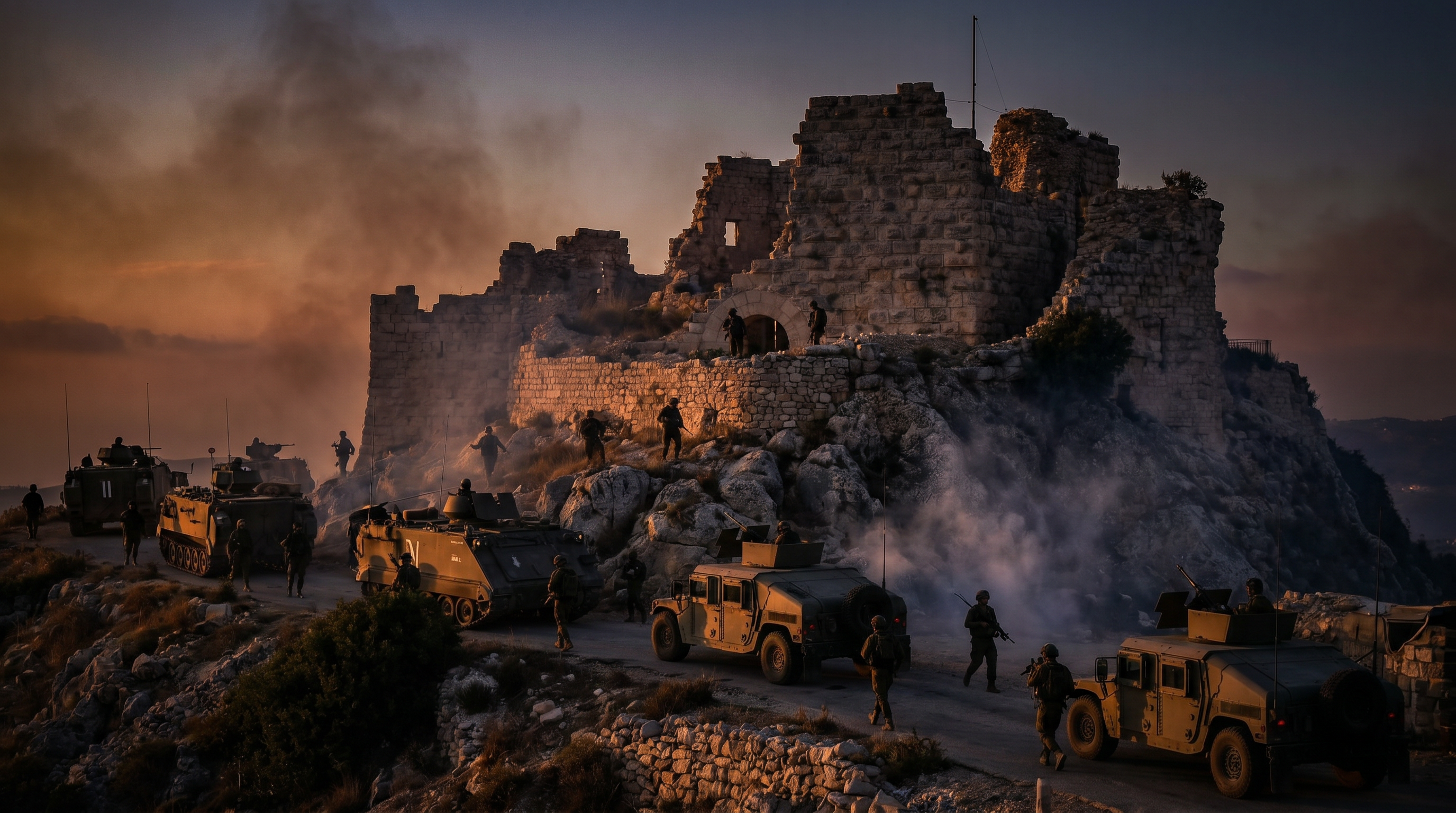
In a dramatic escalation of the ongoing conflict, Israeli forces have captured the historic Beaufort Castle in southern Lebanon, marking the military's deepest territorial incursion into the country in 26 years. Soldiers from the elite Golani Infantry Brigade raised the Israeli flag over the 12th-century Crusader fortress after days of intense fighting and heavy airstrikes in the surrounding villages. The seizure of the mountaintop stronghold, which overlooks the Litani River valley, represents a major tactical and symbolic milestone in Israel's rapidly expanding ground offensive, fundamentally altering the battlefield dynamics in the region.[1][2][5]
The capture effectively shatters a nominal, U.S.-brokered ceasefire that had briefly paused major hostilities in the region. Despite the diplomatic framework, the Israel Defense Forces (IDF) have surged ground troops across the border under the cover of artillery fire and white phosphorus smoke screens. The advance pushes Israeli control well beyond the immediate border region, signaling a definitive shift from localized skirmishes to a broader territorial occupation aimed at systematically dismantling Hezbollah's military infrastructure and establishing a new operational reality on the ground.[3][4][6][7]
Beaufort Castle, known in Arabic as Qalaat al-Shaqif, holds profound historical and strategic significance. Built nearly 900 years ago, the stone fortress sits on a sheer cliff offering sweeping panoramic views of both southern Lebanon and the Galilee region of northern Israel. For centuries, empires and modern militaries alike have fought to control the site because of the unparalleled surveillance and defensive advantages it provides over the surrounding valleys, river crossings, and vital supply routes that connect the southern border to the Lebanese interior.[1][3][5]
The modern history of the castle is deeply intertwined with the Arab-Israeli conflict. Israeli forces previously captured Beaufort in 1982 during the First Lebanon War, expelling fighters from the Palestine Liberation Organization after a fierce battle. The IDF subsequently used the fortress as a heavily fortified military base and observation post for 18 years. The Israeli occupation of the site only ended in May 2000—exactly 26 years ago—when troops abruptly withdrew from southern Lebanon, detonating portions of the castle's infrastructure as they left to prevent its immediate use by militant groups.[2][4][5][6]

The sight of the Israeli flag flying over Beaufort once again has sent shockwaves through Lebanese society, reviving painful memories of the prolonged, 18-year occupation. Local officials and residents in the nearby town of Arnoun described the capture as a devastating psychological blow to a population already weary from months of war. Military analysts note that raising the flag over a site widely considered impregnable is a calculated move by the IDF, intended to project absolute dominance and demoralize Hezbollah fighters who had utilized the rugged terrain for defense.[1][6][7]
The strategic implications of the advance extend far beyond the castle walls. Having consolidated control over territory up to the Litani River, Israeli forces are reportedly pushing even deeper into Lebanon. Military officials indicate that troops are now advancing toward the Zahrani River, located approximately six miles north of the Litani. This northward thrust threatens to encircle Nabatieh, a major city that serves as both a vital economic hub and a cultural heartland for southern Lebanon, potentially trapping thousands of civilians and fighters in a tightening military cordon.[1][3][4]
The strategic implications of the advance extend far beyond the castle walls.
Israeli leadership has been explicit about their long-term intentions for the newly captured territory. Defense Minister Israel Katz announced that the military plans to maintain an extended presence in the region. "Our brave soldiers have captured the Beaufort once again—and they will remain there as part of the security zone in Lebanon," Katz stated following the operation. Prime Minister Benjamin Netanyahu echoed this sentiment, framing the capture as a "decisive breakthrough" necessary to permanently protect northern Israeli communities from the persistent threat of Hezbollah rocket fire and border incursions.[2][4][5]
The humanitarian toll of the expanding offensive has been catastrophic and continues to mount daily. The Lebanese Ministry of Public Health reports that the relentless aerial bombardment and ground clashes have leveled entire villages across the south, destroying homes, hospitals, and critical infrastructure. The widespread destruction and sweeping evacuation orders issued by the IDF have effectively turned the entirety of southern Lebanon into an active combat zone. As a result, an estimated 1.2 million Lebanese civilians have been displaced, fleeing north toward Beirut in gridlocked traffic to escape the advancing forces.[1][2][6][7]

The Lebanese government has reacted with profound outrage to the deepening incursion. In a national address, Prime Minister Nawaf Salam vehemently condemned the invasion, demanding an immediate ceasefire and the total withdrawal of Israeli troops from Lebanese soil. Salam accused Israel of enacting a "scorched earth policy" and collective punishment against the civilian population. He warned that the expropriation of Lebanese land would not bring long-term security to Israel, but would instead permanently fracture any hopes for regional stability and deepen the generational divide between the two nations.[1][5]
The international community has also expressed profound alarm over the collapse of the ceasefire and the unprecedented scale of the Israeli advance. France swiftly requested an emergency meeting of the United Nations Security Council to address the escalating crisis. French Foreign Minister Jean-Noël Barrot condemned the operation in stark terms, stating that "nothing can justify the prolongation of Israeli military operations in Lebanon and its increasingly deep occupation of Lebanese territory," urging immediate international intervention to halt the march toward a wider war.[5][6]
During the emergency UN Security Council session, diplomats warned that the conflict is rapidly spiraling out of control. Representatives drew grim parallels between the widespread destruction in southern Lebanon and the devastation previously seen in the Gaza Strip, cautioning against a repeat of such humanitarian disasters. The United Nations Interim Force in Lebanon (UNIFIL), which has lost several peacekeepers to the crossfire in recent months, reported extensive Israeli military activity and intense clashes with non-state armed groups throughout their designated area of operations, highlighting the complete breakdown of international peacekeeping frameworks.[1][7]

Hezbollah, despite suffering significant infrastructural damage and leadership losses, continues to mount fierce resistance against the advancing Israeli columns. The militant group has utilized the complex topography of the Wadi al-Saluki area and the Beaufort Ridge to launch sophisticated ambushes and anti-tank guided missile attacks against IDF armor. However, the loss of the high ground at Beaufort severely compromises their tactical positioning, limiting their ability to monitor IDF movements and coordinate layered defenses in the Litani River valley, forcing them to rely on increasingly desperate asymmetric warfare tactics.[2][3][4][5][7]
The escalation in Lebanon poses a severe threat to broader geopolitical negotiations across the Middle East. The intense fighting complicates delicate, parallel diplomatic efforts by the United States to de-escalate tensions with Iran and prevent a direct confrontation. Tehran has consistently maintained that any comprehensive regional agreement must include a complete cessation of hostilities in Lebanon. With Israel now signaling its intent to establish a permanent security buffer and ignoring international calls for restraint, the prospect of a diplomatic off-ramp appears increasingly remote, leaving mediators scrambling for leverage.[3][4][7]
As Israeli forces dig in at Beaufort Castle and prepare for further advances toward the Zahrani River, the Middle East faces a precarious and volatile new reality. The re-establishment of an Israeli occupation zone in southern Lebanon after a 26-year absence fundamentally alters the security architecture of the Levant, erasing decades of fragile border agreements. With diplomatic channels paralyzed, humanitarian crises compounding, and military operations expanding unchecked, the region braces for a protracted and devastating phase of the conflict that threatens to engulf neighboring states.[1][2][3][4][5][7]
How we got here
1139
Crusaders capture the site and begin constructing the modern stone fortress of Beaufort Castle.
1982
Israeli forces capture the castle from the PLO during the First Lebanon War.
May 2000
Israel withdraws from southern Lebanon, detonating parts of the castle upon departure.
Late 2024
Israel launches a new ground offensive into southern Lebanon targeting Hezbollah infrastructure.
April 2026
A fragile U.S.-brokered ceasefire temporarily pauses major hostilities in the region.
May 2026
Israeli forces shatter the truce, capturing Beaufort Castle and pushing toward the Zahrani River.
Viewpoints in depth
Israeli Defense Establishment
Views the capture as a necessary tactical step to dismantle Hezbollah infrastructure and protect northern Israel.
For Israeli military planners, the deep incursion and the seizure of Beaufort Castle are driven by absolute tactical necessity. The high ground provides unparalleled surveillance over the Litani River valley, effectively blinding Hezbollah's forward observation posts. Defense officials argue that relying on diplomatic frameworks like UN Resolution 1701 has failed to prevent rocket fire into northern Israel. Consequently, establishing a physical, military-enforced 'security zone' deep inside Lebanese territory is viewed as the only reliable method to ensure the safe return of displaced Israeli citizens to their border communities.
Lebanese Government
Views the incursion as an illegal occupation and collective punishment that violates national sovereignty.
Lebanese officials view the expanding Israeli offensive as a catastrophic violation of international law and national sovereignty. Prime Minister Nawaf Salam and other leaders argue that the operation is less about security and more about enacting a 'scorched earth policy' that renders southern Lebanon uninhabitable. They point to the leveling of civilian infrastructure and the displacement of 1.2 million people as evidence of collective punishment. For Beirut, the raising of the Israeli flag over a historic national landmark is a deliberate humiliation designed to fracture the country, rather than a legitimate counter-terrorism operation.
International Diplomats
Fear the escalation destroys ceasefire frameworks and risks a broader regional war involving Iran.
The international diplomatic community, particularly France and the United Nations, views the deep incursion with profound alarm. Diplomats argue that shattering the nominal U.S.-brokered ceasefire removes the last remaining guardrails preventing a full-scale regional war. There is deep concern that Israel's intent to maintain a prolonged presence in Lebanon will force Iran to intervene more directly to support Hezbollah, thereby derailing parallel U.S.-Iran de-escalation talks. Furthermore, the UN fears that the complete disregard for peacekeeping boundaries sets a dangerous precedent for international conflict resolution.
What we don't know
- How far north the Israeli military ultimately intends to advance beyond the Litani River.
- Whether Hezbollah retains the command structure and munitions to mount a sustained counter-offensive.
- How Iran will respond to the collapse of the ceasefire and the establishment of a new Israeli security zone in Lebanon.
Key terms
- Beaufort Castle (Qalaat al-Shaqif)
- A 12th-century Crusader fortress in southern Lebanon renowned for its strategic vantage point over the Litani River and northern Israel.
- Litani River
- A major waterway in southern Lebanon historically used as a geographical benchmark for buffer zones and UN security resolutions.
- Zahrani River
- A river located approximately six miles north of the Litani River, marking the current reported trajectory of the Israeli military advance.
- Golani Brigade
- An elite infantry brigade of the Israel Defense Forces heavily involved in major conflicts, including the 1982 and 2026 captures of Beaufort.
- UNIFIL
- The United Nations Interim Force in Lebanon, a peacekeeping mission established to monitor the border and confirm military withdrawals.
- White Phosphorus
- An incendiary munition used by militaries to create smoke screens, which is highly controversial due to its severe toxic and burning effects.
Frequently asked
Why is Beaufort Castle strategically important?
Sitting on a high cliff, it provides a sweeping panoramic view of the Litani River valley, southern Lebanon, and northern Israel, making it an ideal surveillance and defensive position.
Has Israel controlled this castle before?
Yes. Israeli forces captured it from the PLO in 1982 and used it as a military base during their 18-year occupation of southern Lebanon, withdrawing in May 2000.
What does this mean for the recent ceasefire?
The deep incursion effectively shatters the nominal U.S.-brokered ceasefire that had been in place, complicating broader diplomatic efforts to stabilize the Middle East.
How many people have been displaced by the fighting?
The expanding Israeli offensive and widespread destruction of villages have displaced an estimated 1.2 million people in Lebanon, who are fleeing north to escape the combat zone.
Sources
Source coverage
7 outlets
3 viewpoints surfaced







[1]Reuters
Israel troops capture Beaufort Castle in southern Lebanon push against Hezbollah
Read on Reuters →[2]The Times of Israel
Between Beaufort and Beirut, Israel faces narrowing options against Hezbollah
Read on The Times of Israel →[3]PBS NewsHour
Israeli troops seize strategic castle in Lebanon during deepest incursion in decades
Read on PBS NewsHour →[4]The New Arab
Israel seizes Lebanon's historic and strategic Beaufort Castle
Read on The New Arab →[5]CBC News
Why the seizing of Lebanon's Beaufort Castle handed Iran leverage in peace talks
Read on CBC News →[6]Alhurra
Israel's Return to Beaufort Castle Revives Ghosts of Lebanon War
Read on Alhurra →[7]Arab News
What Israel's capture of a medieval castle says about the challenge of breaking Lebanon's cycle of conflict
Read on Arab News →


Every angle. Every day.
Get news politics stories with full source coverage and perspective breakdowns delivered to your inbox.