
Investment Surge Validates Next-Gen Sustainable Materials: Wood, Hempcrete, and Mycelium Move from Lab to Mainstream Construction
Driven by tightening building codes and massive venture capital influxes, bio-based materials like cross-laminated timber, hempcrete, and fungal mycelium are rapidly replacing concrete and steel in commercial construction.
By Lan Xu

When most people hear the phrase "sustainable building materials," they tend to picture experimental eco-lodges, fragile temporary pavilions, or well-intentioned but impractical hippie concepts. The prevailing assumption has long been that bio-based materials—whether derived from hemp, fungi, or engineered wood—are simply too niche, too structurally weak, or too prohibitively expensive for serious, large-scale architecture. For decades, the construction industry treated these organic alternatives as fascinating laboratory curiosities rather than viable substitutes for the concrete and steel that define modern skylines.[3]
That perception is now entirely outdated. Driven by tightening international building codes and a massive influx of venture capital, next-generation materials have decisively moved out of the laboratory and into commercial supply chains. We are currently witnessing the rapid maturation of a multi-billion-dollar bio-economy. Engineered wood, hemp-lime composites, and fungal root networks are being actively specified by leading architectural firms for mid-rise commercial buildings, university campuses, and residential developments. The investment surge validates what researchers have long argued: bio-based construction is not a compromise on performance, but a technological upgrade.[3]
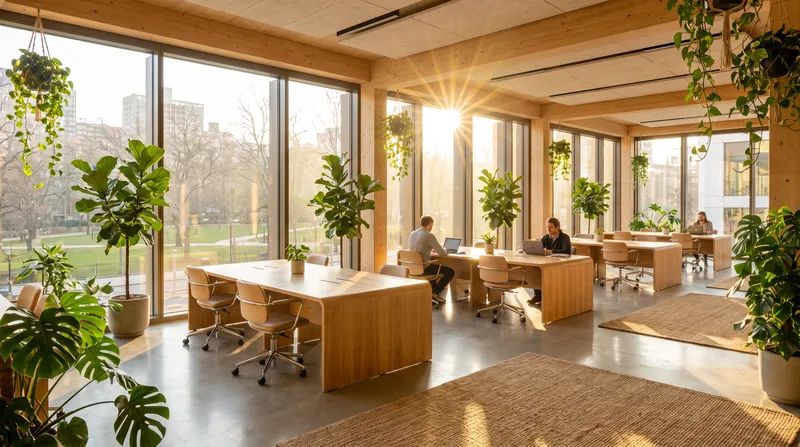
For the homeowner or office worker, this material shift is immediately palpable. Imagine walking into a space where the exposed timber overhead radiates a tactile warmth, the walls naturally regulate the room's humidity, and the acoustic insulation inside those walls was grown from agricultural waste rather than manufactured from petroleum. This is the new standard of biophilic design. It writes toward the human senses, creating environments that feel inherently calming and grounded, while simultaneously satisfying the rigorous economic demands of institutional developers.
The undisputed heavy lifter of this architectural revolution is mass timber, and specifically Cross-Laminated Timber (CLT). Unlike traditional dimensional lumber used in light-frame housing, CLT is engineered by gluing multiple layers of wood at right angles to one another. This cross-hatching technique neutralizes the natural tendency of wood to warp or split, creating massive, load-bearing structural panels that rival the tensile strength of steel and the compressive strength of concrete, all at a fraction of the weight.[1]
The financial trajectory of mass timber underscores its mainstream acceptance. The global mass timber construction market, valued at $1.8 billion in 2025, is projected to reach $6.8 billion by 2034, expanding at a compound annual growth rate of over 14 percent. This explosive growth is visible in landmark projects like Princeton University's Hobson College and various commercial developments across North America. Developers are utilizing prefabricated timber components to cut on-site construction times by up to 25 percent, accelerating occupancy and revenue generation while significantly reducing the building's embodied carbon footprint.[1]
While mass timber provides the robust structural skeleton of these new developments, a material known as hempcrete is fundamentally redefining the building envelope. Hempcrete is a bio-composite created by mixing the woody, porous inner core of the hemp plant—known as the hurd or shiv—with a lime-based binder and water.
When cast into modular blocks, formed into prefabricated panels, or sprayed directly into wall cavities on-site, the mixture cures into a rigid, monolithic substance. Though it cannot support the heavy structural loads of a multi-story building on its own, it serves as an exceptional, carbon-sequestering infill and insulation layer that wraps the building in a breathable skin.[2]
The resulting material is lightweight, highly fire-resistant, and uniquely breathable. Unlike synthetic foam insulation that traps moisture and requires complex vapor barriers, hempcrete acts as a dynamic thermal mass. It continuously absorbs and releases ambient moisture, naturally regulating indoor humidity levels. For residents, this translates to fewer drafts, a drastic reduction in mold risk, less reliance on mechanical HVAC systems, and a living space that feels consistently fresh and comfortable year-round.[2]
The financial sector has recognized the value of this performance. The global hempcrete market is currently expanding at a compound annual growth rate of over 12 percent, driven largely by the international push for carbon-negative construction. Because the fast-growing hemp plant sequesters large amounts of carbon dioxide during its cultivation, a finished hempcrete wall actually locks away more greenhouse gas than was emitted during its harvesting and production. This biogenic carbon storage makes it a highly attractive asset for developers aiming to meet stringent net-zero building targets.[2]
Perhaps the most futuristic of these next-generation materials is mycelium—the dense, vegetative root network of fungi. By feeding agricultural waste products, such as sawdust, straw, or paper industry residues, to engineered fungal strains inside a mold, manufacturers can literally "grow" building components. Over a period of several days, the mycelium digests the organic matter and binds it into a solid, lightweight mass. Once the desired shape is achieved, the material is heat-treated to halt the growth process, resulting in fully inert, biodegradable insulation panels and interior acoustic boards.
This biofabrication process is no longer confined to design exhibitions. In mid-2026, the UK-based biotechnology firm Mykor raised £4 million to scale its mycelium production platform, backed by an astonishing £338 million in commercial offtake agreements from European contractors. Their prefabricated partition walls offer the same acoustic and thermal performance as traditional polystyrene insulation, but they utilize 90 percent less water and 40 percent less electricity to produce. Crucially, at the end of the building's lifecycle, these panels can be safely composted rather than sent to a landfill.
Despite the undeniable momentum, the transition to bio-based materials is not without its friction points. Both mycelium composites and hempcrete are generally non-load-bearing, meaning they must be paired with a structural frame of timber or steel. Furthermore, navigating complex fire classification standards remains a persistent hurdle. While independent studies show that mycelium exhibits lower peak heat release rates than synthetic foams, and hempcrete is naturally flame-retardant, standardized testing protocols in many regulatory jurisdictions have yet to fully adapt to these novel bio-based innovations, occasionally slowing their deployment in high-rise applications.[2]
Ultimately, the investment surge validating wood, hempcrete, and mycelium represents a fundamental rethinking of how we construct our habitats. By transforming agricultural waste into high-performance architecture and leveraging the natural carbon-storing capabilities of plants and fungi, the construction industry is proving that sustainability and economic viability are no longer mutually exclusive. As these materials move firmly from the laboratory to the mainstream, they suggest that the most advanced building technology available to us might just be nature itself.[3]
Where opinion splits
Bio-Material Innovators
Advocates for a regenerative approach to the built environment.
For biotechnology firms and material scientists, the goal is to completely decouple the construction industry from extractive, petroleum-based supply chains. By utilizing fast-growing crops like hemp and leveraging the natural binding properties of fungal mycelium, these innovators argue that buildings can actively heal the environment rather than harm it. Their focus is on proving that bio-fabricated materials can match or exceed the acoustic, thermal, and fire-resistant properties of synthetic alternatives without the associated ecological toll.
Commercial Developers
Focuses on the operational efficiencies and financial returns of mass timber.
While commercial developers are increasingly sensitive to embodied carbon targets, their primary motivation remains economic viability. Mass timber and prefabricated bio-panels offer a compelling financial argument: they drastically reduce on-site labor requirements and compress construction schedules by up to 25 percent. Furthermore, buildings featuring exposed timber and natural materials consistently command higher leasing premiums and attract tenants eager to meet their own corporate sustainability goals, making the upfront investment highly lucrative.
Regulatory Bodies
Prioritizes rigorous safety testing before rewriting foundational building codes.
Building code officials and regulatory bodies are generally supportive of decarbonization efforts, but they operate under a mandate of absolute public safety. While the International Building Code has recently expanded to allow taller mass timber structures, regulators require exhaustive, long-term testing for fire resistance, structural load capacity, and moisture degradation before uniformly classifying newer materials like mycelium and hempcrete for high-rise applications. Their cautious approach occasionally frustrates innovators but ensures that the transition to bio-based construction does not compromise structural integrity.
- Bio-Material Innovators
- Argue that construction must shift from an extractive industry to a regenerative one, utilizing fast-growing crops and fungi to sequester carbon.
- Commercial Developers
- Focus on the economic benefits of prefabrication, faster construction times, and higher tenant leasing premiums associated with sustainable buildings.
- Factlen Editorial Analysis
- Synthesizes the market data to demonstrate that bio-based materials are now economically viable alternatives to traditional concrete and steel.
Sources
Source coverage
3 outlets
3 viewpoints surfaced



- [1]Persistence Market ResearchCommercial Developers
Mass Timber Construction Market Size and Trend Analysis
Read on Persistence Market Research → - [2]Strategic Market ResearchBio-Material Innovators
Global Hempcrete Market is set to grow at a 27.1% CAGR
Read on Strategic Market Research → - [3]Factlen Editorial TeamFactlen Editorial Analysis
Synthesis by Factlen editorial team
Read on Factlen Editorial Team →
More in Lifestyle
See all →Lighting Design
The 3:1 Ratio: How Accent Lighting Must Exceed Ambient Light to Create Visual Depth and Focal Points
5 sources
Neuroaesthetics
Measuring the Brain's Response to Interior Design: How Neuroaesthetics is Replacing Intuition with Biological Data
3 sources
Circadian Health
The Science of Circadian Lighting: How Color Temperature and Intensity Shape Sleep and Stress in the Home
11 sources
Interior Standards
BIFMA's LEVEL Certification Aligns with LEED and WELL, Unifying Healthy Interior Standards
2 sources
Comments
Every angle. Every day.
Get Lifestyle stories with full source coverage and perspective breakdowns, free every day.