
How Circadian Lighting Uses Color and Intensity to Sync With the Brain's Master Clock
Modern interior lighting often disrupts our biological clocks by blurring the line between day and night. By strategically layering color temperatures and managing light intensity, circadian design aligns indoor environments with our natural rhythms to improve focus, mood, and sleep.
By Irina Belova

Share this story
In short
- Circadian lighting design aligns indoor illumination with the body's natural 24-hour biological clock.
- Cool, bright light (5000K–6500K) in the morning stimulates alertness and focus.
- Warm, dim light (2700K–3000K) in the evening promotes melatonin production and prepares the body for sleep.
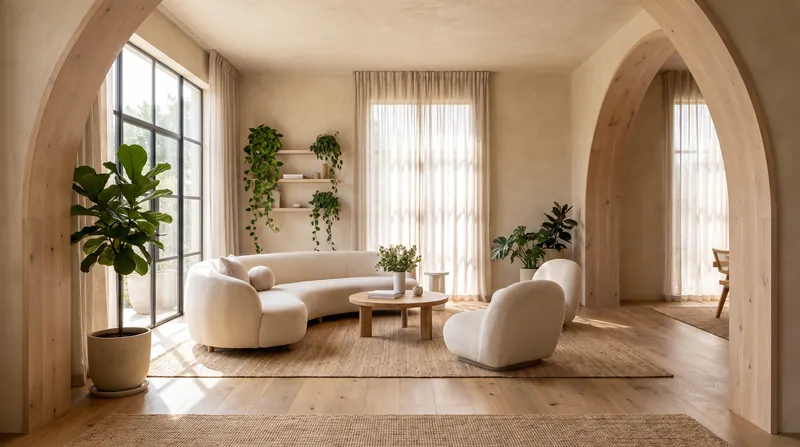
You walk into a beautifully designed, perfectly illuminated modern home in the evening, yet your body feels inexplicably wired and restless. The tension lies in a fundamental disconnect: spaces that are visually stunning are often biologically confusing. We crave bright, airy rooms to feel awake and productive, but our evolutionary biology requires encroaching darkness and warm, fire-like hues to trigger the onset of sleep. Resolving this tension is the core of circadian lighting design, an approach that transforms illumination from a static fixture into a dynamic rhythm.[1][4]
For decades, interior lighting was judged solely on its ability to help us see tasks clearly and render colors accurately. But light also exerts a profound, non-visual influence on our brains and bodies. The eye contains intrinsically photosensitive retinal ganglion cells (ipRGCs) that detect blue-rich light and signal the brain's master clock to suppress melatonin and boost alertness. When we spend our days in dimly lit offices and our evenings under bright, cool-toned LEDs, we scramble these ancient biological signals.[3][6]
This chronic mismatch creates what chronobiologists call "social jet lag." Research indicates that a vast majority of average day-working people experience some level of circadian desynchrony simply because their indoor daytime light levels and nighttime light levels are too similar. The near-term consequences are a lack of energy during the day and poor sleep at night, while long-term effects can include metabolic and cognitive disruptions. To combat this, circadian lighting aims to mimic the intensity, color, and timing of nature's sleep and wake cycle.[2][10]
The first hour after waking sets the biological tone for your entire day. Ideally, your home's lighting should mimic the gradual rise of the sun, brightening gently and shifting toward cooler tones that stimulate focus and clarity. In the morning, light should be bright and cool-toned, typically between 5000K and 6500K on the Kelvin scale. This crisp, blue-white illumination provides a strong daytime signal to the brain, enhancing alertness and preparing the body for active tasks.[1][3][5]
To achieve true biological activation, color temperature must be paired with sufficient intensity. Major building frameworks, such as the WELL Building Standard, emphasize the importance of vertical illumination—the light that actually reaches the eye, rather than just the light hitting a desk.
These standards recommend a daytime target of around 250 Equivalent Melanopic Lux (EML) to properly anchor the circadian rhythm. Factlen's editorial analysis of leading industry standards reveals a clear consensus: whether measured in EML or vertical lux, a threshold of approximately 250 lux at eye level is critical for daytime biological activation.[4][7][9]
As the afternoon wanes, the sensory experience of the home should fundamentally shift. The crisp daylight tones must give way to a softer, more relaxing atmosphere. Circadian design dictates that color temperatures should drop to warmer tones, between 2700K and 3000K, resembling the golden hour of sunset. This transition reduces blue light exposure, allowing the body to naturally begin the production of melatonin and signaling that the active day is concluding.[1][6]
The nighttime environment requires an even more dramatic reduction in light. While daytime design focuses on achieving high thresholds, evening design is about embracing darkness. Experts recommend keeping evening light exposure below a melanopic equivalent of 10 lux in the hours leading up to bedtime, and dropping it below 1 lux in the sleep environment. A room can be technically perfectly lit for visual tasks and still throw a person off rhythm if it remains as bright in the evening as it was at noon.[4][11]
The physical colors of your interior spaces also interact heavily with your lighting choices to shape your mood. Studies have shown that the combination of wall color and light temperature significantly alters visual perception and emotional state. For instance, cool white light in a blue room can increase the perceived brightness and attractiveness of the space, while warm light in a red room has been shown to elevate tension and anger levels. Lighting designers must balance these elements to create environments that are both biologically supportive and emotionally comfortable.[8]
Implementing these principles no longer requires manual intervention. The most transformative advancement in modern interiors is the integration of color-tunable LED lighting systems. Platforms from manufacturers like Lutron and Ketra can automatically shift the tone and intensity of light throughout the day, operating as an intuitive extension of the body's natural rhythm. This seamless integration represents a new form of quiet luxury—technology that enhances well-being without drawing attention to itself.[5]
However, the science of circadian lighting is not without its skeptics. Some neuroscientists caution against reducing complex biological processes to a single lux number. They argue that rigid standards often fail to account for individual physiological factors, such as the natural yellowing of the eye's lens with age, or a person's prior light exposure history throughout the day. A prescribed morning exposure cannot entirely undo the damage of staring at a blue-enriched tablet screen late at night.[6]
Ultimately, circadian lighting is not a universal cure-all, nor does it replace the need for good sleep hygiene and a sensible daily routine. But by deliberately planning biologically effective light components, we can transform our homes from static boxes into dynamic environments. When we align our interior spaces with the natural rhythms of the sun, we create homes that truly nurture both the mind and the body, allowing us to live, work, and rest better.[1][4]
How we did this
- Method
- Comparison across lighting standards to establish a unified baseline for circadian-effective illumination.
- What we found
- Despite using different measurement frameworks (Equivalent Melanopic Lux versus vertical illuminance), both major building and engineering standards converge on ~250 lux at the eye level as the critical threshold for daytime circadian activation.
- What we worked from
- WELL Standard daytime threshold: 250 Equivalent Melanopic Lux — WELL Certified
- IES proposed morning exposure: 254 lux of vertical illumination — Illuminating Engineering Society
- Limits of this analysis
- These thresholds are based on controlled environments and do not account for individual variations in age, lens yellowing, or prior photic history.
Definitions
- Circadian Rhythm
- The body's internal 24-hour clock that regulates sleep, wakefulness, and various metabolic processes based on environmental cues.
- Correlated Color Temperature (CCT)
- A metric measured in Kelvin (K) that describes the color appearance of light, ranging from warm (orange/yellow) to cool (blue/white).
- Equivalent Melanopic Lux (EML)
- A measurement that quantifies how much a light source stimulates the eye's non-visual receptors to affect the circadian cycle.
- Social Jet Lag
- The biological confusion and fatigue caused when a person's internal clock is out of sync with their daily social and work schedules.
- Tunable White Lighting
- LED technology that allows the color temperature and intensity of a light fixture to be adjusted dynamically throughout the day.
Questions & answers
What is the best color temperature for a home office?
For daytime focus and alertness, a cooler color temperature between 4000K and 5000K is ideal. This mimics natural daylight and provides a strong signal to the brain to remain active.
How does bright evening light affect my sleep?
Exposure to bright, cool-toned light in the evening suppresses the brain's production of melatonin, delaying the onset of sleep and disrupting your natural circadian rhythm.
Do I need an expensive smart system for circadian lighting?
No. While automated systems are convenient, you can achieve similar results by using bright, cool-toned overhead lights during the day and switching to dim, warm-toned table lamps in the evening.
Analysis by camp
Lighting Designers
Focus on integrating circadian principles seamlessly into aesthetic and architectural goals.
For design professionals, circadian lighting is not just a biological necessity but a tool for elevating the sensory experience of a space. They emphasize that a room can be technically perfectly lit for biological metrics but still fail if it lacks visual comfort or architectural calm. By utilizing tunable LED systems and automated shading, designers aim to create environments where the transition from energizing daylight to restorative evening light feels entirely natural, enhancing both the luxury and the habitability of the home without drawing attention to the technology itself.
Building Standard Advocates
Emphasize measurable, standardized thresholds to ensure spaces actively support human health.
Proponents of frameworks like the WELL Building Standard argue that subjective comfort is not enough to guarantee biological health. They advocate for strict, quantifiable metrics—such as Equivalent Melanopic Lux (EML)—to ensure that occupants receive the precise intensity and spectrum of light required to anchor their circadian rhythms. From this perspective, the built environment has a measurable responsibility to mitigate the effects of 'social jet lag' by providing clear, distinct daytime and nighttime lighting signals.
Neuroscientists
Caution against oversimplifying complex biological processes into rigid lighting metrics.
While supportive of the shift toward human-centric lighting, many chronobiologists warn that current standards may be overly prescriptive. They point out that reducing circadian health to a single lux target ignores critical individual variables, such as the natural yellowing of the eye's lens with age, which alters light absorption. Furthermore, they argue that a perfectly calibrated morning light exposure cannot fully compensate for poor behavioral habits, such as late-night screen use, emphasizing that lighting design must be paired with sensible daily routines.
- Lighting Designers
- Focus on integrating circadian principles seamlessly into aesthetic and architectural goals.
- Building Standard Advocates
- Emphasize measurable, standardized thresholds to ensure spaces actively support human health.
- Neuroscientists
- Caution against oversimplifying complex biological processes into rigid lighting metrics.
Perspectives this story doesn't cover
- Shift Workers
- Renters and Low-Income Households
Sources
Source coverage
11 outlets
3 viewpoints surfaced









- [1]L'azure LightingLighting Designers
Circadian Lighting Design: Translating Science into Architecture
Read on L'azure Lighting → - [2]CPLBuilding Standard Advocates
Science and Design Come Together to Create a Healthy Interior Environment
Read on CPL → - [3]BIOS LightingBuilding Standard Advocates
Circadian Lighting Design Made Simple
Read on BIOS Lighting → - [4]Studio De SchutterLighting Designers
Circadian lighting and daylight analysis in lighting design
Read on Studio De Schutter → - [5]Sesshu DesignLighting Designers
Light That Heals. How Circadian Lighting Design Elevates Luxury Living
Read on Sesshu Design → - [6]Illuminating Engineering SocietyNeuroscientists
Circadian Lighting: a Neuroscientist's Perspective
Read on Illuminating Engineering Society → - [7]WELL CertifiedBuilding Standard Advocates
WELL Building Standard - Light Concept
Read on WELL Certified → - [8]National Institutes of HealthNeuroscientists
The simultaneous effects of warm/cool white light on visual perception and mood
Read on National Institutes of Health → - [9]Factlen Editorial Team
Synthesis by Factlen editorial team
Read on Factlen Editorial Team → - [10]Illuminating Engineering SocietyNeuroscientists
A Circadian Prescription
Read on Illuminating Engineering Society → - [11]Illuminating Engineering SocietyNeuroscientists
The need for guidance
Read on Illuminating Engineering Society →
More in Lifestyle
See all →Architectural Layouts
Why the 'Broken Plan' is Replacing the Open Concept Home
4 sources
Color Trends
Paint Brands Reject Gray Minimalism With Earthy 2027 Colors of the Year
8 sources
Lighting Design
The 3:1 Ratio: How Accent Lighting Must Exceed Ambient Light to Create Visual Depth and Focal Points
5 sources
Neuroaesthetics
Measuring the Brain's Response to Interior Design: How Neuroaesthetics is Replacing Intuition with Biological Data
3 sources
Comments
Every angle. Every day.
Get Lifestyle stories with full source coverage and perspective breakdowns, free every day.