
Intel Shares Surge After Trump Announces Apple Will Manufacture Chips in the U.S.
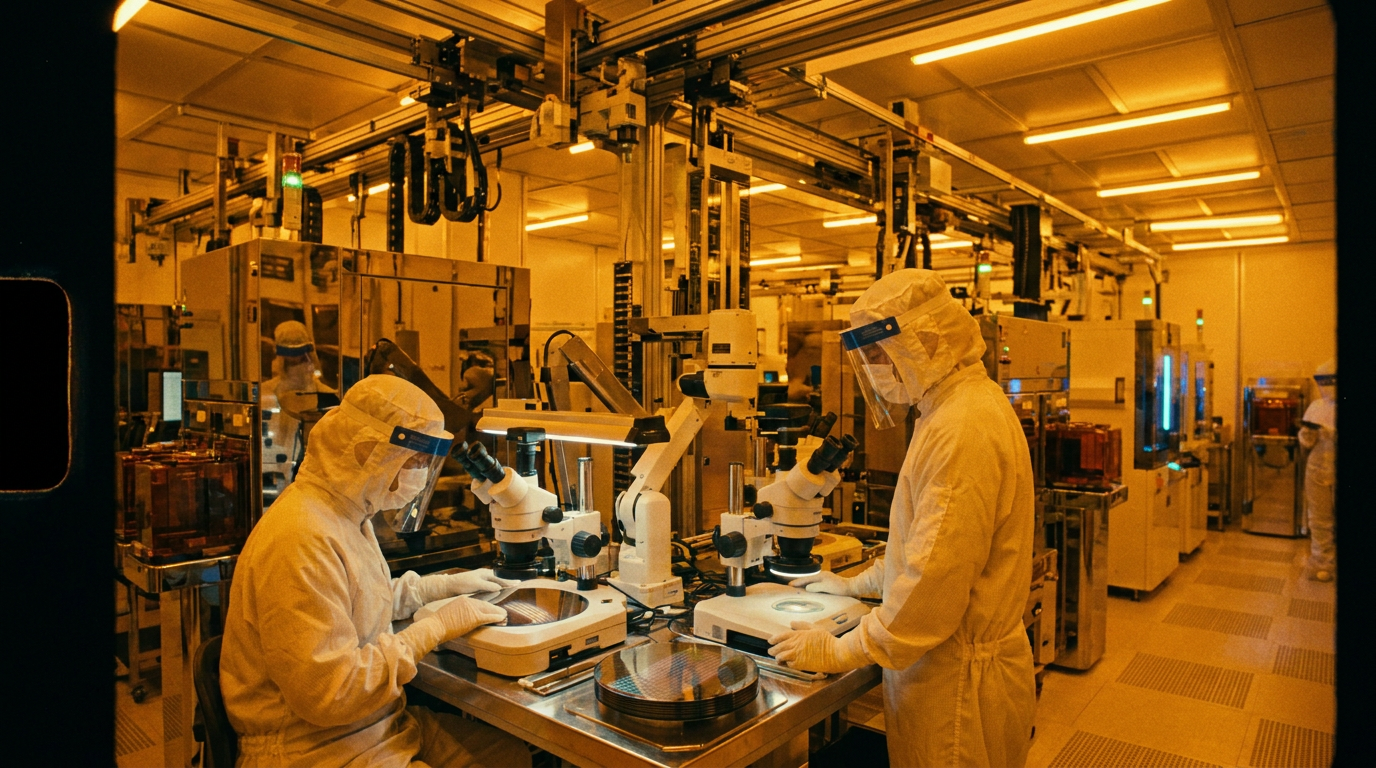
Apple has agreed to partner with Intel to design and manufacture semiconductors in the United States, diversifying its supply chain away from Taiwan. The announcement sent Intel shares soaring as the company secures a marquee customer for its struggling foundry business.
By Factlen Editorial Team
- Supply Chain Analysts
- Focuses on Apple's need to diversify away from TSMC due to AI capacity constraints and geopolitical risks.
- Semiconductor Investors
- Focuses on the financial validation of Intel's foundry strategy, the resulting stock rally, and future yield execution risks.
- Domestic Manufacturing Advocates
- Focuses on U.S. sovereignty, government intervention, and the strategic importance of the CHIPS Act equity stake.
What's not represented
- · Taiwanese Government Officials
- · TSMC Executives
Why this matters
For years, the global tech economy has relied on a single chokepoint in Taiwan for its most advanced microchips. Apple’s move to manufacture domestically not only secures its own product pipeline against AI-driven shortages, but provides a massive lifeline to America's flagship semiconductor manufacturer.
Key points
- Apple has agreed to design and manufacture some of its semiconductors with Intel in the United States.
- Intel shares surged 9% in premarket trading following the announcement.
- The deal helps Apple diversify its supply chain away from Taiwan's TSMC, which is currently strained by AI chip demand.
- Analysts expect Intel to produce older or lower-end M-series and A-series chips, not Apple's flagship processors.
- The partnership validates Intel CEO Lip-Bu Tan's strategy to build a competitive third-party foundry business.
- The U.S. government played a highly active role in brokering the deal to secure domestic semiconductor infrastructure.
In a major shift for the global semiconductor supply chain, Apple has agreed to partner with Intel to design and manufacture chips in the United States. The arrangement was announced late Wednesday by U.S. President Donald Trump, who stated on Truth Social that he had intervened to support Intel's domestic production efforts.[1][2]
The market reaction was immediate and decisive. Intel shares surged as much as 9% in premarket trading on Thursday, injecting much-needed momentum into the company's stock. Apple shares also saw a modest bump of 0.6%, reflecting investor optimism about the tech giant's supply chain resilience.[1][3][6]
While neither company has issued a formal press release confirming the exact terms, the announcement corroborates reports from May 2026 that the two tech behemoths had reached a preliminary agreement. Those initial reports followed more than a year of intensive, high-level negotiations facilitated in part by the U.S. Department of Commerce.[3][4][8]
For Apple, the partnership solves a growing arithmetic problem. The company currently relies almost exclusively on Taiwan Semiconductor Manufacturing Co. (TSMC) for its custom silicon. However, TSMC is facing unprecedented capacity pressure from artificial intelligence giants like Nvidia and AMD, who are aggressively competing for the same advanced manufacturing lines.[2][7]

That bottleneck has already begun to impact Apple's bottom line. During a recent earnings call, CEO Tim Cook acknowledged that supply constraints had limited iPhone production, specifically citing difficulties in securing enough advanced chips from TSMC. By bringing Intel into the fold, Apple can spread its manufacturing requirements across multiple suppliers and geographies.[3][8]
That bottleneck has already begun to impact Apple's bottom line.
Industry analysts caution that Intel will not immediately take over Apple's most cutting-edge designs. Wedbush Securities anticipates that the initial production runs will focus on older or lower-end processors, such as mature M-series chips for the iPad and MacBook Air, or processors for non-Pro iPhone models.[4][6]
Apple's flagship 2-nanometer designs—expected to power the upcoming iPhone 18 Pro range—will almost certainly remain with TSMC for the foreseeable future. Intel has only recently entered risk production for its next-generation 18A-P process, meaning full-scale commercial manufacturing for Apple likely will not commence until mid-2027 at the earliest.[4][7]
Despite the delayed timeline, landing Apple as a foundry customer is a monumental validation for Intel CEO Lip-Bu Tan. Since taking the helm last year, Tan has bet the company's future on transforming Intel from a traditional integrated device manufacturer into a third-party foundry capable of competing with TSMC and Samsung.[2][5]

Intel's foundry division has historically struggled to convince outside designers that its manufacturing yields and reliability could match its Taiwanese rival. Securing a notoriously demanding client like Apple provides a marquee validation that could attract other fabless chipmakers to Intel's facilities.[6][7]
The deal also highlights the extraordinary, increasingly interventionist role the U.S. government is playing in the semiconductor industry. Last year, Washington converted $8.9 billion in unpaid CHIPS and Science Act grants into a roughly 10% equity stake in Intel, effectively making the federal government a major shareholder.[3][5][7]
This equity position marks a significant departure from traditional U.S. industrial policy, treating advanced logic foundries as critical national infrastructure. Administration officials, including Commerce Secretary Howard Lutnick, reportedly held repeated meetings with Apple executives to encourage the partnership and secure domestic capacity.[5][8]

Beyond the immediate financial windfall for Intel, the agreement signals a structural fracture in the single-supplier foundry model that has dominated the tech sector for a decade. As the AI boom continues to consume global chipmaking capacity, even the world's most valuable consumer electronics company has realized it can no longer afford to put all its silicon in one basket.[7][8]
How we got here
2024-2025
The U.S. government passes the CHIPS Act and eventually takes a 10% equity stake in Intel to bolster domestic manufacturing.
May 2026
Reports emerge that Apple and Intel have reached a preliminary agreement after more than a year of negotiations.
June 16, 2026
Intel announces its next-generation 18A-P process node has entered risk production.
June 18, 2026
President Trump publicly announces the Apple-Intel partnership, sending Intel shares up 9%.
Mid-2027
Earliest expected date for Intel to reach full-scale commercial chip production for Apple.
Viewpoints in depth
Supply Chain Analysts
Apple is mitigating its exposure to a single geographic chokepoint.
Analysts emphasize that Apple's reliance on TSMC has become a liability in the AI era. With Nvidia and AMD consuming vast amounts of advanced packaging capacity, Apple has faced tightening allocation windows. By shifting lower-end chip production to Intel, Apple frees up TSMC's cutting-edge nodes for its flagship devices while insulating itself from potential geopolitical disruptions in the Taiwan Strait.
Semiconductor Investors
The partnership validates Intel's costly foundry turnaround strategy.
For Wall Street, the exact volume of chips Intel produces for Apple matters less than the reputational win. Intel's foundry division has burned through billions of dollars struggling to attract external clients. Investors view Apple's rigorous quality standards as the ultimate seal of approval for Intel's new 18A-P manufacturing process, potentially opening the floodgates for other fabless chipmakers to sign on.
Domestic Manufacturing Advocates
The deal proves that aggressive U.S. industrial policy can successfully onshore critical tech.
Proponents of the U.S. government's interventionist approach point to this deal as a major victory for national security. By converting CHIPS Act grants into a direct equity stake in Intel and actively brokering introductions with Apple executives, Washington has demonstrated a willingness to treat semiconductor manufacturing as critical infrastructure rather than a purely free-market enterprise.
What we don't know
- The exact financial value and volume commitments of the Apple-Intel contract.
- Which specific Apple devices will be the first to feature Intel-manufactured silicon.
- Whether Intel can achieve the high manufacturing yields required to make the partnership profitable.
Key terms
- Foundry
- A manufacturing facility that builds semiconductor chips designed by other companies.
- Fabless
- A company that designs microchips but outsources the actual physical manufacturing to a third-party foundry.
- Risk Production
- An early stage of semiconductor manufacturing where a new process is tested with real designs, though yields are not yet high enough for commercial sale.
- Process Node
- A specific generation of semiconductor manufacturing technology, often denoted by nanometer measurements or specific branding like '18A'.
Frequently asked
Will Intel make the chips for the next iPhone?
No. Analysts expect Intel to manufacture older or lower-end processors, while Apple's flagship 2-nanometer chips will continue to be made by TSMC.
Why does Apple need another chip manufacturer?
Apple's primary supplier, TSMC, is facing massive demand from AI companies like Nvidia, making it harder for Apple to secure enough manufacturing capacity.
Does the U.S. government own part of Intel?
Yes. Last year, the U.S. government converted $8.9 billion in unpaid CHIPS Act grants into a roughly 10% equity stake in the company.
Sources
Source coverage
8 outlets
3 viewpoints surfaced








[1]MarketWatchSemiconductor Investors
Intel shares rally as Trump says company will build chips for Apple in the U.S.
Read on MarketWatch →[2]QuartzDomestic Manufacturing Advocates
Trump said Apple agreed to work with Intel on chip design and production
Read on Quartz →[3]MacRumorsSupply Chain Analysts
Apple has agreed to work with Intel to manufacture some of its chips in the United States
Read on MacRumors →[4]AppleInsiderSupply Chain Analysts
Intel's stock has risen after Trump announced that the company will make chips for Apple
Read on AppleInsider →[5]EE TimesDomestic Manufacturing Advocates
An Apple-Intel partnership could be transformative for Intel
Read on EE Times →[6]Yahoo FinanceSemiconductor Investors
Intel Corp shares jumped about 8% in early trade
Read on Yahoo Finance →[7]Investing.comSemiconductor Investors
Foundry Concentration Risk Finally Gets Priced In
Read on Investing.com →[8]Supply Chain DigitalSupply Chain Analysts
Apple is Expanding its Supply Chain With Intel Partnership
Read on Supply Chain Digital →

More in finance
See all 5 stories →


Every angle. Every day.
Get finance stories with full source coverage and perspective breakdowns delivered to your inbox.