
Indian Prodigy Praggnanandhaa Wins Norway Chess 2026, Securing First Major Classical Title
Twenty-year-old grandmaster Rameshbabu Praggnanandhaa claimed the Norway Chess 2026 title following an unprecedented four-game classical winning streak. Kazakhstan's Bibisara Assaubayeva won the parallel women's tournament with a round to spare.
By Factlen Editorial Team
- Format Innovators
- Advocates for the Norway Chess scoring system who believe it saves classical chess from draw-heavy stagnation.
- Classical Purists
- Traditionalists who appreciate fighting chess but remain skeptical of mixing classical and blitz time controls.
- The New Guard
- The younger generation of super-grandmasters who thrive in high-pressure, decisive environments.
Why this matters
Praggnanandhaa's victory marks his definitive arrival as a top-tier classical tournament winner, proving he can dominate the world's best in the most demanding time controls. His unprecedented comeback also validates the tournament's anti-draw scoring system, which is actively reshaping how elite chess is played.
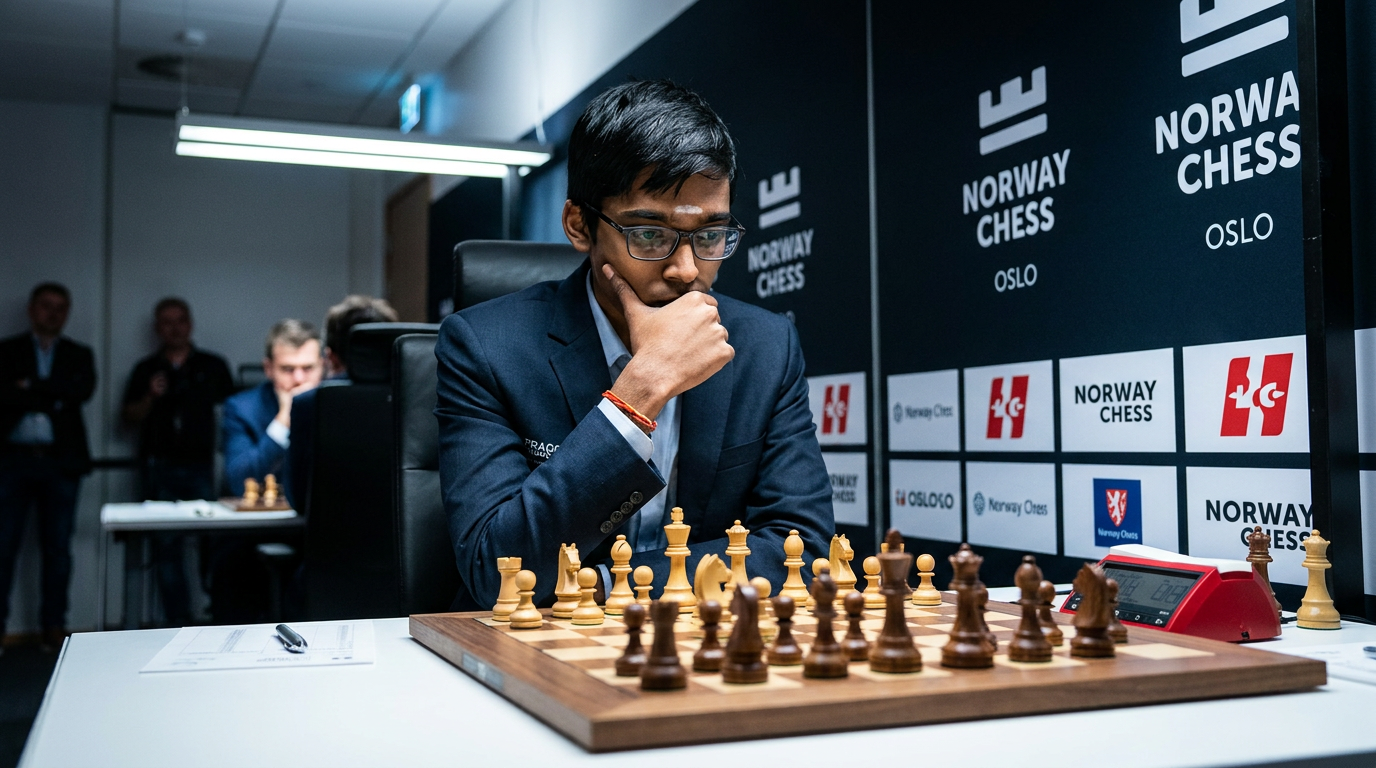
Twenty-year-old Indian grandmaster Rameshbabu Praggnanandhaa has captured the 2026 Norway Chess title, securing his first major classical super-tournament victory in historic fashion. Competing in Oslo against a six-player field that included the reigning world champion and the world number one, Praggnanandhaa delivered a performance that stunned the chess world. He clinched the title by defeating Germany's Vincent Keymer with the white pieces in a must-win final round, capping off an unprecedented late-tournament surge.[1][2][4]
The stakes entering the final day were mathematically precise but psychologically daunting. American grandmaster Wesley So held the sole lead, meaning Praggnanandhaa, trailing by half a point, had to play for a win on demand. When So drew his classical game against France's Alireza Firouzja, the door opened for the Indian prodigy. Praggnanandhaa capitalized, grinding down Keymer in a complex endgame to secure the full three points awarded for a classical victory, leapfrogging So in the final standings to finish with 18 points to So's 17.[1][3][4]
What makes the victory historic is not just the final game, but the streak that preceded it. At the elite level of classical chess, where draws are the most common outcome and defensive technique is nearly flawless, stringing together multiple wins is exceptionally rare. Praggnanandhaa ended the tournament with four consecutive classical victories—a feat Wesley So described as bordering on the "impossible." The streak was the ultimate display of resilience, coming immediately after Praggnanandhaa suffered back-to-back losses in rounds five and six.[1][2][6]
The mechanics of Praggnanandhaa's comeback are deeply tied to the unique format of Norway Chess. Unlike traditional tournaments that award one point for a win and half a point for a draw, the Oslo event heavily incentivizes decisive classical games. A classical win is worth three points. If a classical game is drawn, the players immediately contest an "Armageddon" tiebreaker—a faster game where White gets more time but Black wins the match if the game ends in a draw. The winner of the Armageddon receives 1.5 points, while the loser gets 1 point.[3][5]

This high-stakes scoring system fundamentally alters tournament strategy. A player who draws a classical game and wins the Armageddon earns only half the points of a player who wins outright in classical time controls. Wesley So played a brilliant tournament, leading for most of the event and winning crucial Armageddon tiebreakers. However, Praggnanandhaa's uncompromising approach—drawing only two of his ten classical games—mathematically overpowered So's steadier performance. The Indian grandmaster's willingness to embrace risk yielded the maximum three-point rewards when he needed them most.[2][3][5]
This high-stakes scoring system fundamentally alters tournament strategy.
The defining subplot of Praggnanandhaa's campaign was his head-to-head dominance over Magnus Carlsen. The former world champion and current world number one struggled throughout the event, suffering four classical defeats. Two of those losses came at the hands of Praggnanandhaa, who completed a rare classical double over the Norwegian star. Carlsen, who ultimately finished fourth, expressed awe at the youngster's final-round clutch performance, calling the four-game streak "pretty insane" and praising Praggnanandhaa as an "incredible fighter."[1][3]

While the Open section came down to the final hours, the parallel Norway Chess Women tournament was a masterclass in front-running. Kazakhstan's Bibisara Assaubayeva dominated the six-player field, securing the title with a full round to spare. Assaubayeva's stellar performance peaked in the penultimate round, where she drew her classical game against Anna Muzychuk and mathematically eliminated the rest of the field, rendering the final day a coronation.[1][3][4]
Assaubayeva finished with 16.5 points, fending off a late charge from China's Zhu Jiner, who secured second place with 16 points after a final-round classical victory over India's Humpy Koneru. Reigning Women's World Champion Ju Wenjun managed to hand Assaubayeva her only classical defeat in the final round, but the damage was already done. The parallel structure of the event, featuring equal prize funds of 1,690,000 NOK (approximately $182,000) for both the Open and Women's sections, continues to set an industry standard for gender parity in elite chess.[1][3][5]

For Praggnanandhaa, the victory in Oslo represents a massive leap forward in his career trajectory. The uncompromising result added 15.2 points to his live rating, elevating him to 11th in the world rankings. More importantly, it serves as a powerful psychological rebound following a difficult campaign at the Candidates Tournament earlier in the year, where he finished in a tie for sixth place. Winning a super-tournament of this caliber proves he possesses the stamina and nerve required to win the sport's highest honors.[2][5]
The 2026 edition of Norway Chess also highlights a broader generational shift sweeping through the game. With Praggnanandhaa taking the title, 22-year-old Firouzja finishing third, and 20-year-old World Champion Gukesh Dommaraju continuing to shape the elite landscape, the "new guard" is no longer just knocking on the door—they are actively rearranging the furniture. The older generation, represented by Carlsen and So, remains formidable, but the sheer calculating power and fearless energy of the players born in the 2000s are increasingly dictating the terms of engagement.[1][2][6]
As the chess world digests the results from Oslo, the debate over tournament formats will likely intensify. The Norway Chess model, with its severe penalties for draws and mandatory Armageddon deciders, successfully manufactured exactly the kind of dramatic, decisive final round that organizers crave. Whether this 3-point system will be adopted by other major events remains an open question, but Praggnanandhaa's spectacular four-game streak has provided its strongest proof of concept yet.[1][3]
Viewpoints in depth
Format Innovators
Advocates for the Norway Chess scoring system argue it saves classical chess from draw-heavy stagnation.
Supporters of the 3-point classical win and mandatory Armageddon tiebreaks point to Praggnanandhaa's victory as the ultimate proof of concept. In a traditional scoring system, Wesley So's steady, undefeated classical run might have been enough to secure the title. However, the Norway Chess format mathematically forces players to take risks. Innovators argue this system eliminates the 'grandmaster draw'—where players agree to a quick, bloodless tie to conserve energy—and guarantees decisive, entertaining outcomes for spectators in every single round.
Classical Purists
Traditionalists appreciate the fighting chess but remain skeptical of mixing time controls.
While purists celebrate Praggnanandhaa's four-game classical winning streak as a triumph of pure chess skill, some remain uneasy about the Armageddon mechanic. From this perspective, classical chess and blitz/rapid chess are fundamentally different disciplines. Awarding tournament points based on a 10-minute Armageddon game after a 4-hour classical struggle is seen by some as an artificial gimmick that distorts the purity of the classical standings, even if it successfully incentivizes risk-taking.
The New Guard
The younger generation of super-grandmasters is thriving in high-pressure, decisive environments.
For players in their early 20s like Praggnanandhaa, Firouzja, and Gukesh, the modern era's demand for universal excellence across all time controls is simply the baseline. Having grown up playing thousands of online blitz games alongside their classical training, this generation seamlessly transitions between deep classical calculation and the frantic intuition required for Armageddon tiebreaks. Their success in Oslo underscores a shift where psychological resilience and stamina are just as critical as opening preparation.
What we don't know
- Whether the 3-point classical scoring system will be adopted by other major super-tournaments like the Grand Chess Tour.
- How Praggnanandhaa's massive rating boost and form will translate to the upcoming World Chess Olympiad.
Sources
Source coverage
6 outlets
3 viewpoints surfaced






[1]Chess.comThe New Guard
Praggnanandhaa Wins Norway Chess With Stunning 4-Game Winning Streak
Read on Chess.com →[2]ChessBaseClassical Purists
Praggnanandhaa Rameshbabu won the fourteenth edition of Norway Chess
Read on ChessBase →[3]FIDEFormat Innovators
Norway Chess 2026: Praggnanandhaa R and Bibisara Assaubayeva win titles
Read on FIDE →[4]Norway ChessFormat Innovators
Praggnanandhaa wins Norway Chess 2026 after final-round classical victory
Read on Norway Chess →[5]Wikipedia
Norway Chess 2026
Read on Wikipedia →[6]ChessBase IndiaThe New Guard
Praggnanandhaa goes all out against Keymer to win Norway Chess 2026
Read on ChessBase India →
More in sports
See all 14 stories →Standings
Champions Chess Tour Standings: Duda and Lazavik Chase Carlsen as Esports World Cup Roster Takes Shape
7 sources
Injury
The Comeback Trail: Teague-Neeld and Sinclair Headline Crucial Injury Returns Across Global Netball
7 sources
Standings
Championship Picture: Manchester Thunder Claim NSL Crown as SSN and ANZ Premiership Reach Do-or-Die Stages
6 sources

Injury
AFL Injury Update: Brisbane's Cavalry Nears Return as Hawthorn Manages Mid-Season Setbacks
7 sources

Every angle. Every day.
Get sports stories with full source coverage and perspective breakdowns delivered to your inbox.