
How Women's Sports Franchises Became Billion-Dollar Assets in 2026
Driven by a $2.2 billion media deal and record attendance, WNBA and NWSL franchise valuations have tripled in under two years, transforming the leagues into premium institutional investments.
By Factlen Editorial Team
- Institutional Investors
- Focuses on the high revenue multiples, real estate plays, and the massive basis arbitrage yielding 10x returns.
- Sports Valuation Analysts
- Tracks the raw enterprise value growth and the structural advantages of NBA-arena cross-selling.
- Player Advocates & Growth Analysts
- Celebrates the commercial success while highlighting the looming labor tension over equitable revenue sharing.
What's not represented
- · Fans priced out of the new premium-arena experience.
- · Independent owners without NBA or MLS cross-selling advantages.
Why this matters
The financial explosion of women's sports proves the sector is no longer a 'cause-based' charity but a high-yield asset class. This influx of institutional capital guarantees long-term stability for the leagues, while setting the stage for a historic labor battle over how billions in new revenue will be shared with the athletes.
Key points
- WNBA expansion fees have skyrocketed from $50 million to $250 million in under three years.
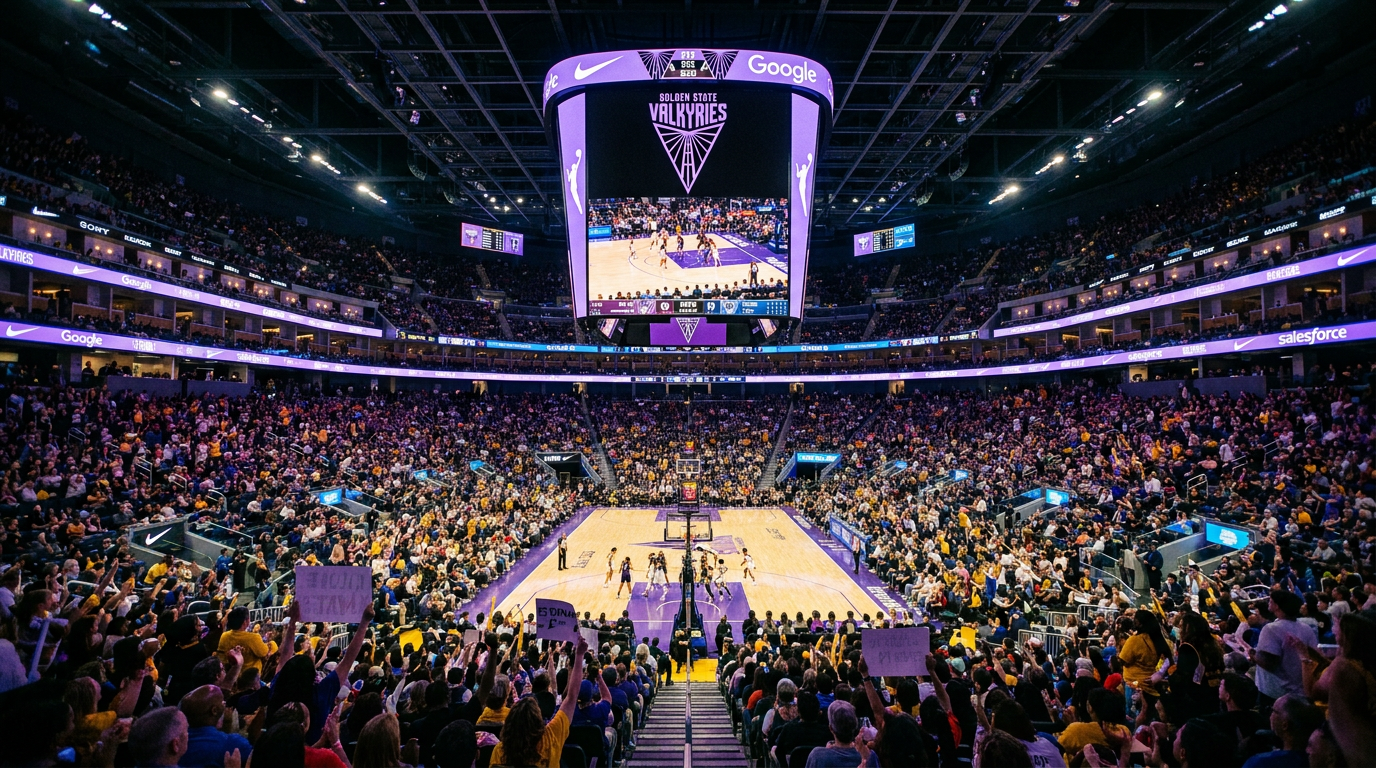
- The Golden State Valkyries are the most valuable women's franchise at $850 million.
- NWSL teams are trading at an 11.1x revenue multiple, outpacing the NHL and MLB.
- Players are demanding a larger share of revenue as franchise values approach $1 billion.
The era of 'cause-based' investment in women's professional sports has officially ended. In its place is a ruthless, high-yield institutional land grab. By the midpoint of 2026, the financial architecture of both the Women's National Basketball Association (WNBA) and the National Women's Soccer League (NWSL) has been completely rewritten, transforming franchises from passion projects into premium asset classes. The sheer velocity of this capital influx has stunned even the most bullish sports economists, with valuations tripling and quadrupling in less than two years. Private equity firms, billionaire family offices, and sovereign wealth adjacent funds are no longer asking if women's sports are viable; they are aggressively outbidding each other for a finite number of franchise licenses. This is no longer a story about social progress or equity—it is a story about cold, hard basis arbitrage and the race to mint the first billion-dollar women's sports franchise.[1][4]
The most glaring evidence of this shift sits in San Francisco, where the Golden State Valkyries have shattered the ceiling for women's sports valuations. According to recent financial models, the Valkyries are now valued at a staggering $850 million in just their second season of existence. This figure is driven by a league-record $78 million in revenue during their 2025 debut, fueled by more than 10,000 season ticket holders and an aggressive corporate sponsorship strategy that leveraged their NBA sister-team's infrastructure. The New York Liberty follow closely behind at $600 million, while the Indiana Fever sit at $560 million. Across the board, WNBA valuations jumped 59% year-over-year, with the average franchise now worth $427 million. The bottom of the league has been pulled up alongside the top; even the lowest-valued franchises are now clearing the $280 million mark, completely erasing the era of the sub-$100 million WNBA team.[3][6]
To understand the sheer scale of this appreciation, one only needs to look at the WNBA's expansion fees. When the Valkyries were awarded a franchise, the ownership group paid a $50 million entry fee—a number that seemed ambitious at the time. By the time Portland secured its 2026 expansion team, the price had jumped to $125 million. Now, the league has locked in three future franchises—Cleveland, Detroit, and Philadelphia, slated to debut between 2028 and 2030—at a record-breaking $250 million each. That represents a 400% increase in the cost of admission in under three years. For the legacy owners who bought into the league for $10 million a decade ago, these expansion fees represent an unprecedented windfall, as the $750 million from the three new teams flows directly to the existing owners as a capital distribution.[2]

This explosion is not based on speculative hype, but on hard, contracted revenue. The primary engine behind the WNBA's surge is its new 11-year, $2.2 billion broadcast and streaming package with Disney, Amazon Prime Video, and NBCUniversal, which officially kicks in for the 2026 season. This media rights deal guarantees that teams will receive at least $6 million annually from national media and sponsorship distributions, double what they received in 2025. When combined with the massive spike in live attendance—driven by a generational influx of superstar talent—the financial floor of the league has been permanently raised. Broadcasters are no longer hiding games on secondary channels; they are placing them in prime-time broadcast windows because the viewership numbers demand it.[4][6]
Furthermore, the most valuable WNBA franchises are leveraging a specific structural advantage: shared infrastructure. Teams like the Valkyries and the Liberty play in NBA-owned arenas—the Chase Center and Barclays Center, respectively—and share ownership with their NBA counterparts. This allows ownership groups to cross-sell premium hospitality and sponsorships at scale, drastically reducing overhead while maximizing corporate partnerships. An advertiser looking to buy courtside signage for the Golden State Warriors is now pitched a bundled package that includes the Valkyries, instantly elevating the WNBA team's commercial floor. This synergy is why the WNBA's highest valuations are heavily concentrated among franchises that operate within this dual-tenant NBA model.[5]
A parallel, equally dramatic financial boom is unfolding on the pitch. The NWSL, which kicked off its 2026 season with record-breaking attendance, has seen its 14 active franchises reach a collective valuation of $2.6 billion. The average NWSL club is now worth approximately $200 million, representing a 49% increase from just last year. Unlike the WNBA, which relies heavily on NBA infrastructure, the NWSL's growth is being driven by independent ownership groups building bespoke soccer-specific assets. The league has successfully transitioned from a scrappy startup playing in undersized college stadiums to a premier entertainment product capable of selling out NFL-sized venues.[1][4]
A parallel, equally dramatic financial boom is unfolding on the pitch.
At the top of the soccer pyramid sits Angel City FC, valued at $340 million. The Los Angeles-based club, backed by a sprawling syndicate of celebrity and institutional investors, generated $38 million in revenue last year. Right behind them is the Kansas City Current at $325 million, a valuation directly tied to their historic investment in CPKC Stadium, the first purpose-built stadium for a women's professional sports team in the United States. Four other clubs—Bay FC, San Diego Wave FC, the Washington Spirit, and the Portland Thorns—have all crossed the $200 million threshold. The gap between the top and bottom of the league is widening, but the overall tide is lifting every franchise.[1]

What makes the NWSL's financial profile so fascinating to Wall Street is its revenue multiple. Top NWSL clubs are currently trading at between eight and ten times their trailing revenue. The league's average value of $200 million is 11.1 times the trailing year's average revenue. This multiple outpaces the NFL (10.7x), the NHL (8.9x), and Major League Baseball (7x), indicating that institutional buyers are aggressively pricing in future growth rather than current cash flow. Investors are looking at the trajectory of women's soccer globally and betting that the NWSL will become the undisputed premier league of the sport, commanding media rights fees that dwarf their current contracts.[1]
This dynamic has created a massive 'basis arbitrage' for early investors. Ownership groups that bought into the NWSL or WNBA prior to 2023 are seeing paper returns that defy traditional private equity models. Franchises that were purchased for $10 million to $15 million just five years ago are now being transacted at nine-figure valuations, rewarding the pioneers who underwrote the leagues when structural losses were the norm. For family offices and institutional funds, buying a women's sports team is now viewed as one of the few remaining 'value plays' in professional sports, offering a growth curve that mature men's leagues simply cannot match.[4][5]
The demographic makeup of the ownership groups is also driving cultural relevance, which in turn drives enterprise value. Unlike the single-majority owner model standard in men's sports, women's leagues have embraced sprawling, diverse syndicates. Nearly 40% of WNBA teams now feature a celebrity investor, a strategy that transforms the franchise into a lifestyle brand and opens doors to non-endemic corporate sponsors who want proximity to that cultural heat. When a hip-hop artist or Hollywood actor sits courtside as an owner, it signals to advertisers that the product is a premium cultural asset, not just a sporting event.[4]

However, this influx of capital introduces a profound layer of uncertainty regarding labor relations. As franchise valuations approach the billion-dollar mark, the athletes driving the product are demanding a structural recalibration of how revenues are shared. Under the current framework, WNBA players receive between 20% and 25% of basketball-related income, a stark contrast to the NBA's roughly 50% revenue-sharing model. The optics of owners cashing $250 million expansion fee checks while the average player salary hovers around $150,000 has created a volatile labor environment.[4][6]
With the WNBA's collective bargaining agreement looming, the league faces a high-stakes negotiation. Multiple franchises turned operating profits in 2025, and the salary cap has jumped from $1.5 million to $7 million, but the players' union is acutely aware of the capital flowing into the ownership suites. The tension between legacy owners looking to recoup a decade of early losses and players demanding equitable partnership will define the next era of the sport. A work stoppage would be catastrophic during this period of hyper-growth, giving the players immense leverage.[2][6]

For the NWSL, the horizon is equally lucrative but similarly complex. The league is already looking ahead to its next round of domestic media negotiations, armed with the leverage of the 2031 FIFA Women's World Cup, which will be hosted on US soil. Investors are pricing in the inevitable mainstream surge that accompanies a domestic World Cup, betting that the current $240 million media package will look like a bargain by the end of the decade. The race to build soccer-specific stadiums is accelerating, as owners realize that controlling their own real estate is the final key to unlocking maximum enterprise value.[4]
Ultimately, the 2026 financial data proves that women's sports have permanently exited the 'start-up' phase. The infrastructure is built, the media rights are locked, and the institutional capital has arrived. The race is no longer about survival; it is a sprint to see which franchise will become the first to officially cross the $1 billion threshold—a milestone that is now a matter of when, not if. For the athletes, the fans, and the investors, the stakes have never been higher, and the returns have never been more real.[4][5]
How we got here
2020
Angel City FC is founded with a valuation of roughly $100 million, signaling a new era of celebrity-backed investment.
Early 2023
Toronto pays $150 million for an NWSL expansion franchise, resetting the soccer market.
Late 2024
The WNBA signs a landmark 11-year, $2.2 billion media rights deal.
2025
The Golden State Valkyries debut, generating a record $78 million in revenue in their first season.
June 2026
The WNBA announces three new expansion teams at a record $250 million entry fee each.
Viewpoints in depth
Institutional Capital
Focuses on the revenue multiples, real estate plays, and the 10x returns.
For private equity firms and billionaire family offices, women's sports franchises represent a rare 'basis arbitrage' opportunity. Because the leagues operated at a structural loss for decades, early entry prices were artificially depressed. Now that the WNBA and NWSL have proven they can draw massive live audiences and secure billion-dollar media rights, institutional capital is flooding the zone. These investors are willing to pay 11x revenue multiples because they believe the growth curve is still in its infancy, especially with catalysts like the 2031 US-hosted Women's World Cup on the horizon.
Labor Unions & Players
Focuses on the disparity in revenue sharing and the demand for a new collective bargaining agreement.
While owners celebrate skyrocketing valuations and nine-figure expansion fees, the athletes driving the product are demanding a structural recalibration. WNBA players currently receive roughly 20% to 25% of basketball-related income, compared to the ~50% split enjoyed by their NBA counterparts. The players' union argues that the era of subsidizing the league's growth through artificially low salaries is over. With the collective bargaining agreement looming, players are preparing to leverage their unprecedented cultural relevance to secure a true financial partnership.
Legacy Ownership
Focuses on the years of operating at a loss and the justification for keeping the expansion fee windfalls.
Legacy owners who bought into the WNBA and NWSL a decade ago argue that the current financial windfall is the rightful reward for years of underwriting structural losses. When the leagues were struggling to secure national television broadcasts or fill small college arenas, these owners kept the lights on. From their perspective, the $250 million expansion fees flowing in as capital distributions are not a surplus to be immediately shared, but a necessary return on a high-risk investment that took years to mature.
What we don't know
- How the upcoming WNBA collective bargaining agreement will restructure revenue sharing between owners and players.
- Whether the aggressive 11x revenue multiples in the NWSL can be sustained if media rights don't jump significantly in the next cycle.
- How the influx of private equity will alter the fan experience and ticket pricing across both leagues.
Key terms
- Revenue Multiple
- A financial metric that compares a company's enterprise value to its annual revenue, used by investors to gauge future growth expectations.
- Basis Arbitrage
- The financial advantage gained by early investors who bought franchises at low valuations before the market rapidly appreciated.
- Basketball-Related Income (BRI)
- The total pool of revenue generated by the league (tickets, media, sponsorships) that is split between owners and players.
- Capital Distribution
- A direct payout to existing franchise owners, such as when a new ownership group pays an expansion fee to join the league.
Frequently asked
Why are WNBA expansion fees suddenly so high?
The fees jumped to $250 million because new owners are buying into a guaranteed $2.2 billion media rights deal and proven attendance surges, drastically lowering the investment risk.
Which women's sports team is the most valuable?
As of 2026, the Golden State Valkyries of the WNBA lead at $850 million, while Angel City FC leads the NWSL at $340 million.
Do the players get a share of the expansion fees?
No. Expansion fees flow directly to the existing team owners as a capital distribution, which is a major point of contention for the players' union.
Why are NWSL teams valued higher than their revenue suggests?
Investors are paying a high 'revenue multiple' (around 11x) because they are pricing in massive future growth, particularly with the 2031 World Cup coming to the US.
Sources
Source coverage
6 outlets
3 viewpoints surfaced






[1]ForbesInstitutional Investors
The NWSL's Most Valuable Teams 2026
Read on Forbes →[2]Front Office SportsInstitutional Investors
WNBA's High-Stakes Expansion
Read on Front Office Sports →[3]SporticoSports Valuation Analysts
2026 WNBA Valuations: Golden State Valkyries Top List
Read on Sportico →[4]SportsProPlayer Advocates & Growth Analysts
NWSL 2026 Commercial Guide: Financial data and analysis
Read on SportsPro →[5]CNBCInstitutional Investors
WNBA team valuations breakdown
Read on CNBC →[6]Just Women's SportsPlayer Advocates & Growth Analysts
2026 WNBA valuations jumped 59% with teams now averaging $427 million
Read on Just Women's Sports →

More in sports
See all 12 stories →Injury
NHL Offseason Injury Report: Laine Cleared to Return, Terry Undergoes Successful Surgery
6 sources

NWSL Growth
NWSL Hijacks Men's World Cup Attention With Nationwide 'Summer of Soccer' Tour
6 sources

Standings
Mid-Season Ice Hockey Standings: Newcastle Northstars and Skycity Stampede Dominate Down Under
8 sources

Injury
Global Baseball Injury Report: Astros' Pitching Cavalry Nears Return as NPB Stars Make Impactful Comebacks
6 sources

Every angle. Every day.
Get sports stories with full source coverage and perspective breakdowns delivered to your inbox.