
How the 'Library of Things' is Rewriting the Rules of Ownership
Community hubs that lend out tools, electronics, and camping gear are saving residents money while drastically reducing environmental waste.
By Factlen Editorial Team
- Circular Economy Advocates
- Focuses on the environmental necessity of reducing manufacturing and waste through shared resources.
- Community Organizers
- Values the social cohesion, skill-sharing, and neighborhood resilience that physical sharing hubs create.
- Municipal Planners
- Views the model as an essential evolution of civic infrastructure that provides equitable access to resources.
What's not represented
- · Traditional hardware retailers
- · Tool manufacturers
Why this matters
By shifting the focus from individual ownership to community access, the 'Library of Things' model saves families hundreds of dollars a year while drastically reducing the environmental footprint of manufacturing rarely used goods.
Key points
- Libraries of Things lend out infrequently used items like power tools, camping gear, and appliances.
- The model saves residents money by providing access over ownership.
- Sharing goods significantly reduces the carbon emissions and waste associated with manufacturing new products.
- Many hubs host repair cafes and workshops, fostering neighborhood connections and skill-sharing.
- Municipal library systems are increasingly adopting the model as permanent civic infrastructure.
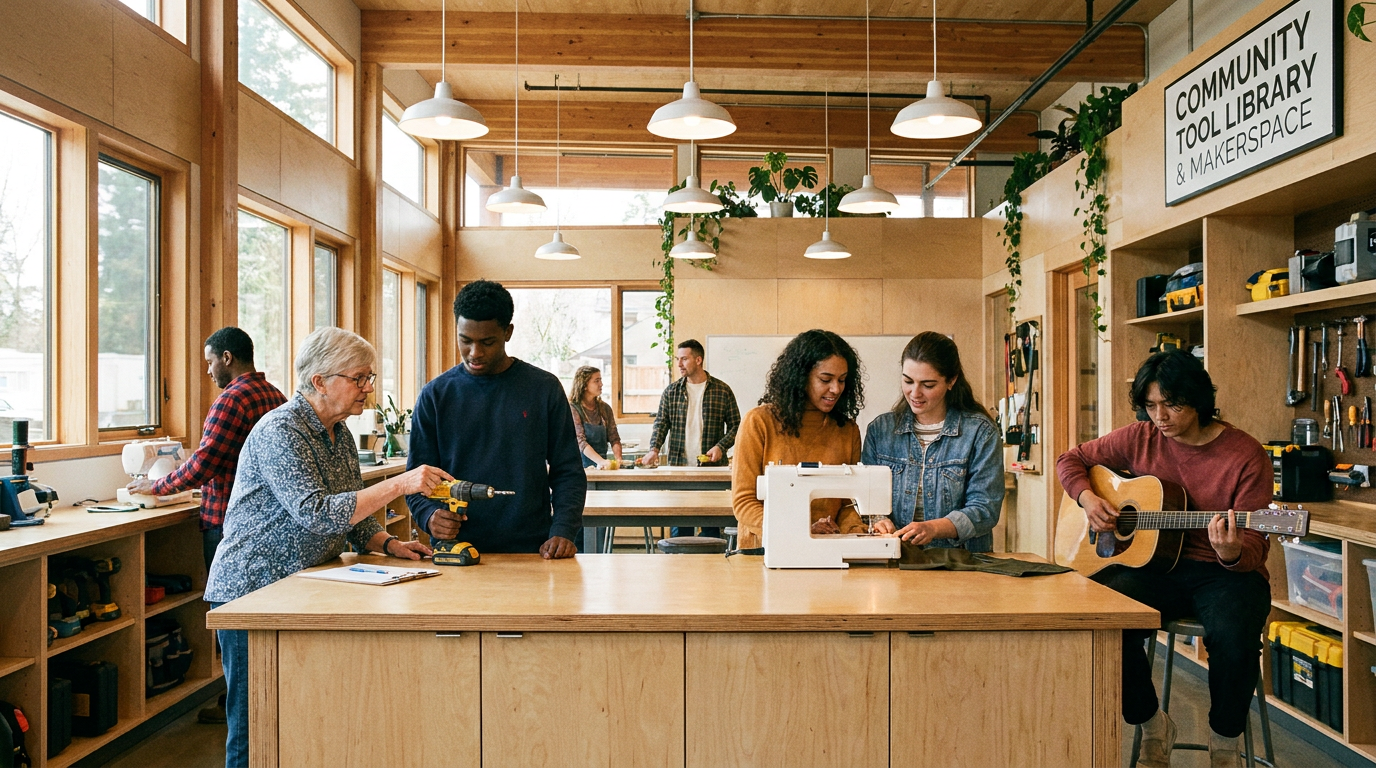
The average power drill is used for just 13 minutes over its entire lifespan. Yet, millions of garages and utility closets house one, sitting dormant for months or years between brief moments of utility. This paradox of modern overconsumption—where households purchase expensive, resource-intensive items for single-use projects—has fueled a quiet but rapidly expanding revolution in neighborhoods worldwide. Enter the "Library of Things," a community-driven model that challenges the necessity of individual ownership by offering shared access to everyday items. By treating power tools, camping gear, and kitchen appliances like library books, these hubs are fundamentally rethinking how communities consume goods.[3][8]
At its core, a Library of Things (LoT) operates on a simple premise: access over excess. Instead of browsing shelves for novels, members browse catalogs for pressure washers, sewing machines, hedge trimmers, and PA systems. The concept itself is not entirely new—the Berkeley Public Library launched a tool lending program as early as 1979—but the modern iteration has evolved into a sophisticated network of sharing hubs. Today's libraries offer everything from thermal imaging cameras for detecting home drafts to specialized baking pans and musical instruments, allowing residents to tackle home improvement projects or explore new hobbies without the financial burden of purchasing equipment outright.[8]
While many of these libraries began as grassroots, volunteer-run initiatives operating out of shipping containers or community center basements, the model is increasingly being formalized by municipal governments. Traditional public library systems are recognizing that lending "things" aligns perfectly with their mandate to provide equitable access to resources. In 2025 and 2026, major library networks, such as the Indianapolis Public Library, launched extensive pilot programs to integrate non-traditional items into their branches, complete with online reservation portals and inter-branch delivery systems. This institutional support is helping the sharing economy transition from a niche environmental movement into standard civic infrastructure.[5][8]
The economic argument for these sharing hubs is immediate and highly localized. In an era of persistent cost-of-living pressures, purchasing high-quality tools or specialized electronics is prohibitive for many families. By paying a sliding-scale annual membership fee—or borrowing for free through a municipal library—residents can save hundreds of dollars a year. A 2025 impact report from a single pilot program in Charlton Kings, UK, revealed that 482 item loans saved local residents over £53,000 compared to the cost of buying those items new. Similarly, a tool library in Sydney, Australia, reported saving its members an average of $500 each in its first year of operation.[3][4]

Beyond personal savings, the Library of Things is a practical application of the "circular economy"—an economic system aimed at eliminating waste by keeping existing materials in circulation. Every time a community member borrows a carpet cleaner instead of buying one, the environmental footprint of manufacturing, packaging, and shipping a new product is entirely bypassed. This reduction in demand for raw materials directly translates to lower greenhouse gas emissions and less strain on municipal waste management systems when cheap, rarely used products inevitably break and are discarded.[2][8]
The environmental dividends of this model are increasingly well-documented. A study analyzing a Library of Things in a small Finnish municipality found that the service avoided over 5,700 kilograms of carbon dioxide equivalent emissions in just 14 months of operation. On a larger scale, a UK-based network operating across 17 sites reported that their sharing model prevented approximately 140 tonnes of waste and 400 tonnes of emissions in a single year. By focusing their inventory on "greatest hits"—high-impact, resource-intensive items that people genuinely need but rarely use—these organizations are maximizing their climate impact while minimizing overhead.[1][2]

The environmental dividends of this model are increasingly well-documented.
Yet, the organizers behind these hubs often emphasize that the physical items are secondary to the social infrastructure they build. Libraries of Things serve as natural gathering points that foster neighborhood connections and combat social isolation. Many tool libraries host "repair cafes" and skill-sharing workshops where experienced volunteers teach residents how to fix broken electronics, mend clothing, or safely operate power tools. This collaborative environment builds community resilience and pride; internal surveys from UK sharing hubs indicate that 65% of users feel better connected to their neighborhood as a direct result of participating in the library.[1][6]
Despite their clear benefits, scaling a Library of Things presents unique logistical hurdles that traditional book libraries do not face. Books are uniform, easily stacked, and require virtually no maintenance between checkouts. "Things," by contrast, are awkwardly shaped, feature multiple detachable parts, and require rigorous safety checks. Human-computer interaction researchers studying these collections note that managing non-uniform inventory requires entirely new cataloging systems. Volunteers and staff must routinely clean mechanical parts, sharpen blades, and conduct electrical "test and tag" safety certifications to ensure that a borrowed power saw or drill is safe for the next user.[3][7]

To overcome these operational bottlenecks, the sharing economy is increasingly turning to technology. Specialized inventory management software allows users to browse real-time availability, sign digital liability waivers, and reserve items from their smartphones. Furthermore, some networks are deploying self-service smart lockers in accessible locations like shopping centers and transit hubs. These lockers allow residents to pick up and drop off heavy equipment 24/7, bypassing the limited operating hours of volunteer-run storefronts and dramatically increasing the convenience of borrowing over buying.[1][8]
As the Library of Things movement matures, it offers a compelling blueprint for sustainable urban living. By decoupling access from ownership, these community hubs prove that a high quality of life does not require endless individual consumption. Whether funded by municipal grants, integrated into traditional library branches, or sustained by dedicated local volunteers, the expansion of the sharing economy represents a profound shift in civic values. In a world grappling with resource depletion and economic strain, the simple act of borrowing a drill from a neighbor is becoming a powerful tool for systemic change.[8]
How we got here
1979
The Berkeley Public Library opens one of the first modern Tool Lending Libraries in the United States.
2014
The 'Library of Things' movement gains formal traction in Europe, with dedicated hubs testing the sharing model.
2021
Post-pandemic community rebuilding sparks a surge in local tool libraries and mutual aid networks.
2025–2026
Major municipal library systems begin formalizing non-traditional lending pilot programs into their permanent strategic plans.
Viewpoints in depth
Circular Economy Advocates
Focuses on the environmental necessity of reducing manufacturing and waste through shared resources.
This camp argues that the current model of individual consumption is ecologically unsustainable. By tracking metrics like avoided greenhouse gas emissions and diverted landfill waste, they demonstrate that sharing physical goods is a highly effective climate intervention. Their primary goal is to shift consumer behavior away from default purchasing, proving that borrowing high-impact items is better for the planet.
Community Organizers
Values the social cohesion, skill-sharing, and neighborhood resilience that physical sharing hubs create.
For grassroots organizers, the tools themselves are secondary to the human connections they facilitate. They view Libraries of Things as vital civic spaces that combat social isolation and empower residents. By hosting repair cafes and volunteer-led workshops, this camp emphasizes mutual aid, teaching people how to maintain their homes and belongings while building trust among neighbors.
Municipal Planners
Views the model as an essential evolution of civic infrastructure that provides equitable access to resources.
City officials and public library directors approach the sharing economy as a matter of equity and public service. They argue that just as communities provide free access to information via books and internet, they should provide access to the physical tools necessary for a high quality of life. This perspective focuses on formalizing the model, securing long-term funding, and integrating lending lockers into existing municipal spaces.
What we don't know
- Whether the sharing model will eventually disrupt traditional retail sales of hardware and electronics.
- How long-term funding will be secured for independent libraries once initial grant money runs out.
Key terms
- Library of Things (LoT)
- A community-based lending service that offers non-traditional items like tools, electronics, and camping gear instead of books.
- Circular Economy
- An economic system aimed at eliminating waste and the continual use of resources by sharing, repairing, and recycling existing materials.
- Sharing Economy
- A peer-to-peer model where individuals share access to goods and services, often facilitated by community hubs or digital platforms.
- Test and Tag
- A safety procedure where electrical equipment is visually inspected and electrically tested to ensure it is safe for public use.
Frequently asked
Do I have to pay to use a Library of Things?
Models vary. Some are entirely free and integrated into public libraries, while independent tool libraries often charge a small, sliding-scale annual membership fee to cover maintenance and space costs.
What happens if an item breaks while I am using it?
Most libraries expect normal wear and tear and have volunteer 'fixers' to repair items. Borrowers are typically only charged if an item is lost or intentionally damaged.
How do these libraries clean and maintain the items?
Items are inspected upon return. Electrical items undergo routine safety testing, and volunteers or staff clean and maintain mechanical parts before the next checkout.
Sources
Source coverage
8 outlets
3 viewpoints surfaced







[1]Circular OnlineCircular Economy Advocates
What Library of Things has taught us about behaviour change
Read on Circular Online →[2]MDPI SustainabilityCircular Economy Advocates
Environmental Impacts of a Library of Things
Read on MDPI Sustainability →[3]1 Million WomenCommunity Organizers
How I set up the Inner West Tool Library with my community
Read on 1 Million Women →[4]Charlton Kings Parish CouncilMunicipal Planners
Library of Things Impact Report 2025
Read on Charlton Kings Parish Council →[5]Indianapolis Public LibraryMunicipal Planners
Library of Things Pilot Program
Read on Indianapolis Public Library →[6]The Tool LibraryCommunity Organizers
Building a new economy in Western New York
Read on The Tool Library →[7]Queen's University HCIMunicipal Planners
Libraries of Things: Understanding the Challenges of Tangible Collections
Read on Queen's University HCI →[8]Factlen Editorial TeamMunicipal Planners
Synthesis by Factlen editorial team
Read on Factlen Editorial Team →

Every angle. Every day.
Get community stories with full source coverage and perspective breakdowns delivered to your inbox.