
How SpaceX Pulled Off the Largest IPO in History and Rewrote Wall Street's Rules
Elon Musk's aerospace giant raised a record-shattering $75 billion in its public market debut, bypassing traditional pricing models and allocating an unprecedented share to everyday retail investors.
By Factlen Editorial Team
- Retail Investors
- Applaud the unconventional IPO structure that finally granted everyday traders access to a highly anticipated tech debut at the ground floor.
- Index Fund Managers
- Focused on the mechanical challenges of absorbing a $1.77 trillion mega-cap company into passive tracking portfolios on an accelerated timeline.
- Space Economy Analysts
- View the massive capital injection as the necessary fuel to achieve unprecedented engineering milestones like Mars colonization.
- Institutional Underwriters
- Express caution over the bypassing of traditional price-discovery mechanisms and the loss of standard lock-up protections.
What's not represented
- · Traditional Investment Banks who lost out on standard underwriting fees and pricing leverage.
- · Competitors in the aerospace sector facing a newly capitalized, $1.77 trillion rival.
Why this matters
This massive liquidity event not only secures the capital needed for interplanetary exploration, but it sets a new precedent for how mega-cap private companies can dictate terms to Wall Street, potentially opening the door for more retail-friendly public offerings.
Key points
- SpaceX raised a record-breaking $75 billion in its IPO, valuing the company at $1.77 trillion.
- The company bypassed Wall Street norms by setting a fixed $135 share price rather than using a price-discovery range.
- An unprecedented 20% to 30% of the initial shares were allocated to everyday retail investors.
- Shares popped 19.3% on the first day of trading, closing at roughly $161.
- The massive valuation officially made founder Elon Musk the world's first trillionaire.
- The capital will fund capital-intensive projects like Mars colonization and space-based AI data centers.
On June 12, 2026, Space Exploration Technologies Corp. executed the most anticipated financial event of the decade. Trading under the ticker symbol SPCX, Elon Musk’s aerospace juggernaut made its debut on the Nasdaq. The event was not just a milestone for commercial spaceflight; it was a tectonic shift for global financial markets.[2][3]
SpaceX raised a staggering $75 billion by selling 555.6 million shares. To put that figure into perspective, it is nearly three times larger than the previous global record holder—Saudi Aramco’s $26 billion public debut in 2019.[2][6]
At its initial offering price, the company was valued at $1.77 trillion. This instantly catapulted SpaceX into the upper echelon of the world’s most valuable corporations, ranking it ahead of legacy titans like Broadcom and Tesla on its very first day of trading.[3]

But the sheer size of the offering is only half the story. Wall Street is buzzing because SpaceX fundamentally rewrote the rules of how a company goes public. Traditionally, investment banks conduct a "roadshow," pitching institutional investors to gauge demand and discover an optimal price range before finalizing the offering.[5]
SpaceX bypassed this price-discovery dance entirely. The company simply declared a fixed price of $135 per share. It was a "take it or leave it" proposition that stripped traditional underwriters of their usual leverage and demonstrated the immense pricing power held by the world's most coveted private company.[5]
The second major departure from Wall Street norms was who actually got to buy the stock at that $135 price. Historically, the lucrative initial shares of a hot IPO are reserved almost exclusively for institutional clients, hedge funds, and ultra-wealthy insiders. Everyday buyers are usually forced to wait until the stock begins trading on the open market, often at a steep premium.[5]
Musk’s team flipped this script, allocating an unprecedented 20% to 30% of the offering directly to retail investors. Brokerages like Robinhood saw record-breaking traffic as mom-and-pop investors placed over $100 billion in orders, eager to own a piece of the commercial space race.[1][3][4][5]
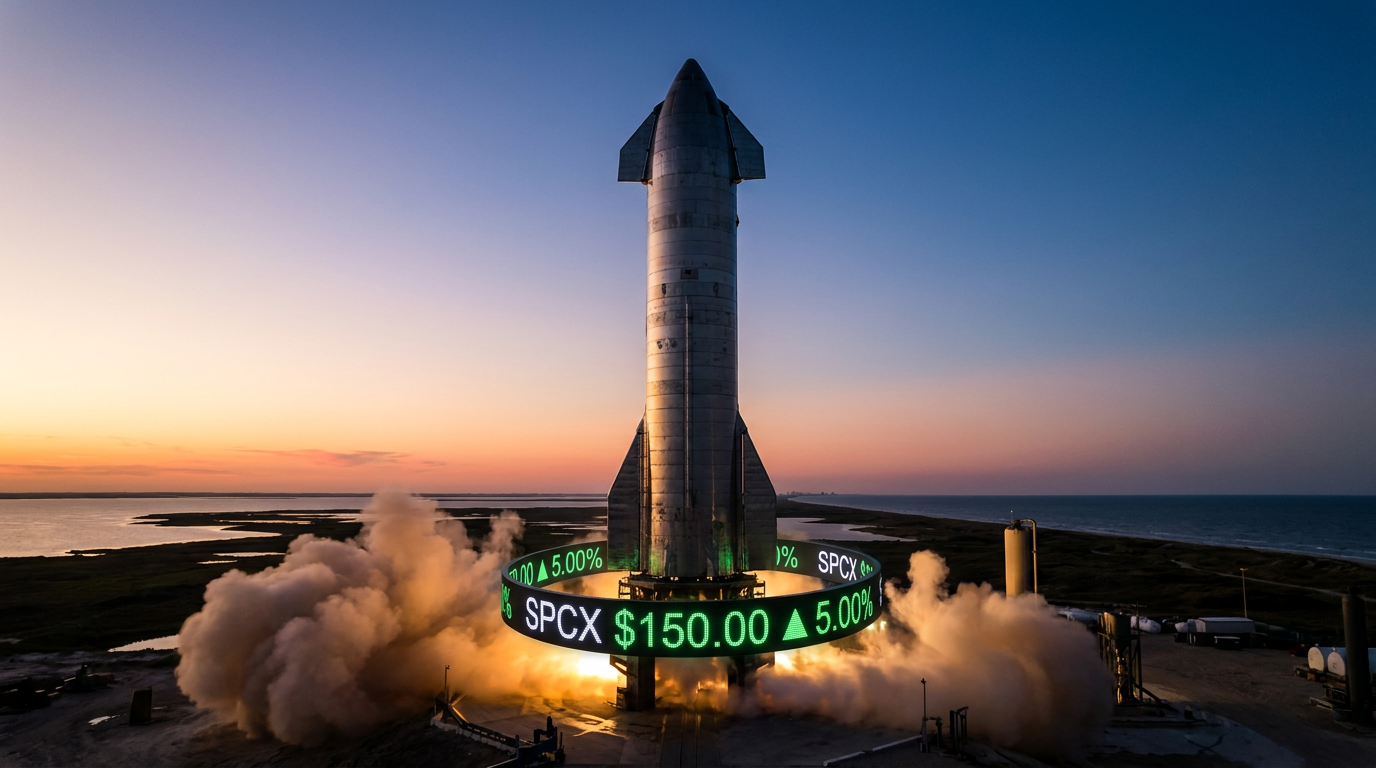
The strategy worked flawlessly. When SPCX officially opened for trading just before noon, it debuted at $150—an 11% premium over the offering price. By the closing bell, shares had climbed to roughly $161, marking a 19.3% first-day jump.[1][2]

When SPCX officially opened for trading just before noon, it debuted at $150—an 11% premium over the offering price.
Market analysts refer to this as the "sweet spot" of IPO pricing. The stock popped enough to reward early buyers for taking the risk, but it did not skyrocket so wildly that SpaceX executives felt they had left billions of dollars on the table.[1]
The ripple effects of this mega-listing are already forcing structural changes across the financial ecosystem. Because of SpaceX’s massive valuation, index providers are scrambling to adapt. Nasdaq actually altered its rules to allow SpaceX "fast entry" into the Nasdaq 100 index within just 15 trading days.[5][6]
This accelerated timeline creates a unique supply-and-demand dynamic. Passive index funds and ETFs that track the Nasdaq 100 will be contractually obligated to buy billions of dollars worth of SPCX shares to accurately reflect the index, virtually guaranteeing a massive wave of institutional buying pressure in the coming weeks.[6]

For the employees of SpaceX, the IPO represents a life-changing liquidity event. Thousands of current and former engineers, technicians, and staff who held equity in the private company are now millionaires on paper, rewarding years of grueling work on reusable rockets and satellite constellations.[7]
The debut also triggered a historic wealth milestone for the company’s founder. With his 42% equity stake and majority voting control, the $1.77 trillion valuation officially pushed Elon Musk’s net worth past the $1 trillion mark, making him the world's first trillionaire.[2][3]
Yet, the most important question for the broader venture capital and tech ecosystem is what SpaceX plans to do with its $75 billion war chest. The company is not resting on its laurels; it is embarking on some of the most capital-intensive engineering projects in human history.[2]

A significant portion of the funds will accelerate the development of Starship, the fully reusable super-heavy lift launch vehicle designed to eventually carry humans to Mars. Musk has explicitly tied the company's long-term success to establishing a self-sustaining colony of at least one million people on the Red Planet.[2]
Beyond interplanetary travel, SpaceX is aggressively expanding its Starlink satellite internet constellation. The company is also reportedly exploring the deployment of solar-powered data centers in orbit, a moonshot initiative aimed at supporting the massive computational demands of artificial intelligence without straining Earth's power grids.[2][5]
Despite the triumphant debut, the company faces genuine hurdles. Morningstar analysts have cautioned that SpaceX must now justify its astronomical valuation with consistent execution. Furthermore, early pre-IPO investors and insiders will be permitted to start selling portions of their shares later this summer, which could introduce volatility.[4]
Ultimately, the SpaceX IPO serves as a masterclass in late-stage venture capital exits. By dictating its own terms, prioritizing retail investors, and successfully raising $75 billion, SpaceX has provided a new blueprint for other highly anticipated mega-unicorns—like OpenAI and Anthropic—as they eye their own public market debuts.[2][6]
How we got here
April 2026
SpaceX confidentially submits a draft registration statement to the SEC, signaling its intent to go public.
May 2026
The SEC publicly discloses SpaceX's S-1 filing, revealing the company's massive $75 billion fundraising target.
June 3, 2026
SpaceX bypasses the traditional Wall Street roadshow, publicly setting a fixed IPO price of $135 per share.
June 11, 2026
Retail investors place over $100 billion in orders, heavily oversubscribing the offering.
June 12, 2026
SpaceX officially debuts on the Nasdaq under the ticker SPCX, with shares jumping 19% on the first day.
Viewpoints in depth
Retail Investors' View
Celebrating unprecedented access to a mega-cap tech debut.
For decades, everyday investors have been locked out of the most lucrative phase of a tech company's growth, forced to buy shares only after institutional insiders have already captured the 'IPO pop.' Retail advocates view SpaceX's decision to allocate up to 30% of its offering to mom-and-pop brokerages as a democratizing watershed moment. By bypassing the traditional Wall Street gatekeepers, SpaceX allowed regular traders to participate in the wealth generation of a $1.77 trillion debut from day one.
Index Fund Managers' View
Grappling with the mechanical shock of absorbing a massive new asset.
For the professionals who manage passive ETFs and mutual funds, the SpaceX IPO is a logistical headache. Because Nasdaq altered its rules to allow SpaceX 'fast entry' into its indices, funds that track the Nasdaq 100 are contractually obligated to buy billions of dollars of SPCX stock almost immediately. These managers warn that this forced buying creates a severe supply-and-demand imbalance, meaning the stock's early price movements may be driven more by mechanical index replication than by the company's actual financial fundamentals.
Space Economy Analysts' View
Focused on the unprecedented capital unlocked for deep-space engineering.
Industry analysts see the $75 billion raise not just as a financial milestone, but as the necessary fuel for human expansion into the solar system. Developing fully reusable super-heavy rockets like Starship and deploying orbital infrastructure requires capital on a scale that private markets can no longer sustain. By successfully tapping the public markets, analysts argue SpaceX has secured the financial runway needed to attempt its most ambitious, high-risk moonshots without facing immediate insolvency.
What we don't know
- How the stock will perform once the initial lock-up periods expire and early insiders begin selling their shares later this summer.
- Whether SpaceX's core moonshot projects, such as orbital data centers and Mars colonization, will ever achieve commercial profitability.
- If other highly valued private AI companies will successfully replicate SpaceX's unconventional, retail-heavy IPO strategy.
Key terms
- Initial Public Offering (IPO)
- The process by which a private company offers shares of its stock to the public for the first time, allowing it to raise capital from everyday investors.
- Roadshow
- A series of presentations made by a company's management to institutional investors to drum up interest and determine the optimal price for an upcoming IPO.
- Retail Investor
- An individual, non-professional investor who buys and sells securities for their personal account, rather than on behalf of an institution.
- Passive Index Fund
- A mutual fund or ETF designed to automatically track the components of a financial market index, such as the Nasdaq 100, rather than relying on a manager to pick stocks.
- Float
- The number of a company's shares that are actually available for the public to buy and sell on the open market.
Frequently asked
Why did SpaceX decide to go public now?
The company requires massive amounts of capital to fund its next-generation projects, including Starship development, Mars colonization efforts, and space-based AI data centers.
What was the starting price for SpaceX stock?
SpaceX bypassed traditional price discovery and set a fixed IPO price of $135 per share.
Did retail investors get to participate in the IPO?
Yes, in a rare move, SpaceX allocated between 20% and 30% of its initial shares directly to everyday retail investors through brokerages.
Does Elon Musk still control SpaceX?
Yes. Despite selling shares to the public, Musk retains roughly 42% equity and holds a special class of shares that gives him majority voting control.
Sources
Source coverage
7 outlets
4 viewpoints surfaced







[1]MarketWatchRetail Investors
How Elon Musk nailed the SpaceX IPO: 'I'm not sure that this could have gone much better'
Read on MarketWatch →[2]CBS NewsSpace Economy Analysts
SpaceX stock soars 19% on first day of trading following record-breaking $75 billion IPO
Read on CBS News →[3]ForbesSpace Economy Analysts
SpaceX IPO Timeline: How Elon Musk Became The World's First Trillionaire
Read on Forbes →[4]MorningstarInstitutional Underwriters
SpaceX Jumps 19% In Debut, but Hurdles Lie Ahead
Read on Morningstar →[5]CNARetail Investors
How SpaceX's IPO breaks from Wall Street norms
Read on CNA →[6]CME GroupIndex Fund Managers
The SpaceX IPO: A historic watershed moment
Read on CME Group →[7]Zacks Investment ResearchSpace Economy Analysts
SpaceX IPO 2026 Guide: Price Predictions, Dates, and Everything You Need to Know
Read on Zacks Investment Research →
Every angle. Every day.
Get finance stories with full source coverage and perspective breakdowns delivered to your inbox.