
How Next-Generation Geothermal Energy is Unlocking 24/7 Clean Power
By borrowing horizontal drilling techniques from the oil and gas industry, enhanced geothermal systems (EGS) are tapping into the Earth's limitless subsurface heat, promising a massive new source of carbon-free baseload electricity.
By Factlen Editorial Team
- Geothermal Developers
- Focus on rapid commercialization, leveraging oil and gas tech to scale clean baseload power.
- Grid Operators
- Value EGS for its firm, 24/7 reliability to balance intermittent wind and solar.
- Energy Researchers
- Analyze the long-term grid impact, cost curves, and deployment potential of next-gen geothermal.
- Oil & Gas Transitioners
- View EGS as a lifeline to repurpose their drilling expertise, workforce, and equipment for the clean energy transition.
What's not represented
- · Local communities living near proposed EGS drilling sites who may have concerns about water usage and construction noise.
- · Battery storage manufacturers, whose market share could be impacted if firm geothermal power reduces the need for grid-scale batteries.
Why this matters
Enhanced Geothermal Systems (EGS) solve the biggest vulnerability of renewable energy: intermittency. By providing 24/7 carbon-free baseload power, this technology could seamlessly replace coal and gas plants while utilizing the existing workforce and drilling expertise of the fossil fuel industry.
Key points
- Enhanced Geothermal Systems (EGS) use horizontal drilling and hydraulic fracturing to create man-made geothermal reservoirs in hot, dry rock.
- Unlike solar and wind, EGS provides firm, 24/7 baseload power, making it a critical asset for grid stability.
- Fervo Energy's Cape Station in Utah is set to become the world's first commercial-scale EGS plant, delivering 100 MW by 2026.
- The Department of Energy estimates that next-generation geothermal could supply up to 90 gigawatts of U.S. electricity by 2050.
- The technology seamlessly repurposes the drilling expertise, equipment, and workforce of the traditional oil and gas industry.
The holy grail of the clean energy transition is "firm" power—electricity that flows 24 hours a day, regardless of whether the sun is shining or the wind is blowing. As the world races to decarbonize, grid operators have increasingly worried about the intermittency of solar and wind, especially as power-hungry artificial intelligence data centers drive an unprecedented surge in electricity demand.[6]
For decades, geothermal energy offered a tantalizing solution: tapping into the virtually limitless heat of the Earth's core to generate continuous, carbon-free electricity. However, traditional geothermal plants were geographically constrained. They required a rare natural trifecta of underground heat, fluid, and permeable rock, limiting their deployment to geologically active regions like Iceland or the tectonic fault lines of California and Nevada.[2][3][5]
Now, a breakthrough technology known as Enhanced Geothermal Systems (EGS) is rewriting the map. By borrowing advanced drilling techniques from the oil and gas industry, engineers are no longer hunting for natural hot springs. Instead, they are creating man-made geothermal reservoirs wherever the subterranean rock is hot enough.[1][4]
The mechanism behind EGS is an elegant feat of extreme engineering. Developers drill thousands of feet underground into hot, dry, and impermeable rock—often solid granite. They then inject high-pressure water to create a network of tiny, millimeter-thick fractures, a process known as hydraulic stimulation.[2][5]

Once the rock is fractured, a continuous loop is established. Cold water is pumped down an "injection well," where it seeps through the newly created fissures, absorbing the intense heat of the surrounding rock. The superheated fluid is then drawn up through a separate "production well" to the surface, where it flashes to steam and spins a turbine to generate electricity.[5]
The true game-changer for EGS has been the adaptation of horizontal drilling. Instead of merely drilling straight down—which exposes only a small section of the wellbore to the hottest rock—companies can now turn the drill bit 90 degrees and bore horizontally for miles. This exposes a massive surface area of hot rock to the circulating water, exponentially increasing the amount of heat that can be extracted.[1][8]
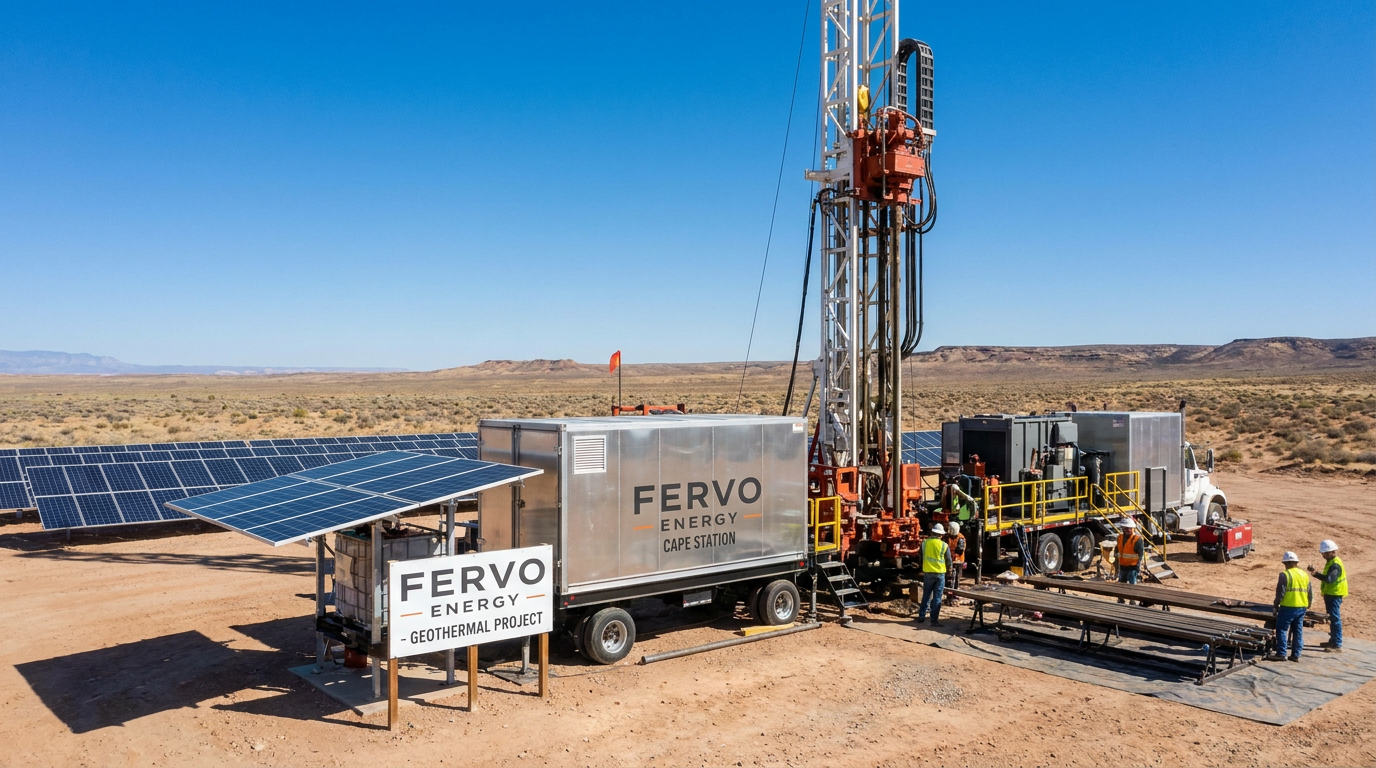
At the forefront of this commercialization race is Fervo Energy, a Houston-based startup that recently secured nearly $900 million in combined venture and project financing. Fervo is currently constructing Cape Station in Beaver County, Utah, which is poised to become the world's first large-scale commercial EGS power plant.[1][7]
Fervo is currently constructing Cape Station in Beaver County, Utah, which is poised to become the world's first large-scale commercial EGS power plant.
Cape Station is advancing rapidly. The project's initial 100-megawatt phase is scheduled to begin delivering power to the grid in 2026, with an expansion to 400 megawatts slated for 2028. To put that in perspective, 400 megawatts of continuous baseload power is enough to supply hundreds of thousands of homes, operating with a reliability that intermittent renewables cannot match.[1][3][7]
The rapid maturation of EGS technology owes much to the U.S. Department of Energy's Frontier Observatory for Research in Geothermal Energy (FORGE) in Utah. Operating as a dedicated field laboratory, FORGE allowed researchers to test and de-risk the exact tools needed to survive extreme subsurface environments, such as polycrystalline diamond compact (PDC) drill bits and fiber-optic sensors.[8]
Thanks to these shared learnings, the industry is riding a steep learning curve. Drilling speeds in hard, hot rock have improved by roughly 500 percent over the past three years. Just as the cost of solar panels plummeted over the last decade, the cost of deploying EGS is expected to fall dramatically as developers gain operational experience.[4][8]
The U.S. Department of Energy has launched the "Enhanced Geothermal Shot," an ambitious initiative aiming to slash the cost of EGS by 90 percent—down to $45 per megawatt-hour by 2035. At that price point, next-generation geothermal would be highly competitive with both fossil fuels and other clean energy sources.[2][6]

If these cost reductions are realized, the scale of deployment could be staggering. A comprehensive DOE "Liftoff" report, alongside independent modeling from Princeton University, estimates that EGS could provide 90 gigawatts or more of power in the United States by 2050.[4][6]
That 90-gigawatt figure represents a twentyfold increase from today's geothermal capacity, equating to roughly 20 percent of the nation's total electricity generation. Crucially, Princeton's analysis demonstrates that EGS could be deployed far beyond the West Coast, bringing firm clean power to states east of the Mississippi River that have historically lacked high-quality geothermal resources.[4][6]
Beyond its reliability, EGS boasts a remarkably small environmental footprint. A geothermal plant requires a fraction of the surface land needed for a sprawling solar array or wind farm. Furthermore, modern closed-loop designs capture and recirculate the water used in the system, minimizing water consumption—a critical feature in the arid Western states where the first plants are being built.[1][5]

Challenges do remain. Drilling miles underground is inherently capital-intensive, and first-of-a-kind infrastructure projects carry significant financial risk. Additionally, the hydraulic stimulation process can cause induced seismicity—micro-earthquakes. However, developers utilize advanced seismic monitoring protocols to ensure any tremors remain well below the threshold of human perception or structural damage.[2][6][8]
The rise of enhanced geothermal systems presents a poetic irony in the energy transition. The exact drilling innovations, workforce expertise, and supply chains that fueled the shale oil and gas boom are now being seamlessly repurposed to unlock a virtually limitless supply of carbon-free energy beneath our feet.[1][2]
How we got here
2019
The DOE launches the GeoVision report, identifying massive untapped geothermal potential across the United States.
Nov 2023
Fervo Energy successfully brings its 3.5 MW Project Red pilot online in Nevada, proving the viability of commercial EGS.
Mar 2024
The DOE releases its 'Liftoff' report, projecting up to 90 GW of next-generation geothermal capacity by 2050.
Late 2025
Fervo secures nearly $900 million in combined venture and project financing to accelerate construction of Cape Station.
Jun 2026
Fervo's Cape Station Phase 1 is scheduled to come online, delivering the first commercial-scale EGS power to the grid.
Viewpoints in depth
Geothermal Developers
Startups and investors pushing to rapidly scale man-made geothermal reservoirs.
Companies like Fervo Energy argue that the technology risk of EGS has largely been retired. By utilizing off-the-shelf equipment and techniques perfected by the shale oil boom, they believe they can bypass the decades of R&D typically required for new energy technologies. Their primary focus is now on securing project financing, navigating the permitting process, and driving down the levelized cost of energy through repeated, scaled deployments.
Grid Operators
Utilities and grid managers desperate for reliable, carbon-free baseload power.
For grid operators, the appeal of EGS lies entirely in its capacity factor. While wind and solar are cheap, their intermittency requires massive investments in battery storage or natural gas peaker plants to maintain grid stability. Utilities view next-generation geothermal as the missing puzzle piece—a clean energy source that dispatches power 24 hours a day, providing the firm foundation needed to support the explosive energy demands of AI data centers and widespread electrification.
Oil & Gas Transitioners
Fossil fuel veterans looking to pivot their expertise into the renewable sector.
The oil and gas industry sees EGS as a natural evolution rather than a threat. The core competencies required to build a geothermal plant—subsurface modeling, horizontal drilling, hydraulic fracturing, and wellbore casing—are identical to those used in petroleum extraction. Industry advocates argue that EGS offers a seamless transition for the existing fossil fuel workforce, allowing roughnecks and petroleum engineers to apply their exact skill sets to the production of zero-carbon energy.
What we don't know
- How quickly the levelized cost of energy (LCOE) for EGS will actually fall from its current premium to the DOE's $45/MWh target.
- Whether the permitting process for drilling deep geothermal wells can be streamlined to match the rapid deployment timelines of solar and wind.
- The long-term thermal degradation rate of man-made reservoirs—specifically, how many decades a fractured rock formation can sustain optimal heat transfer before cooling.
Key terms
- Enhanced Geothermal Systems (EGS)
- A technology that creates man-made geothermal reservoirs by injecting fluid into hot, dry rock to create permeability.
- Baseload Power
- The minimum amount of electric power needed to be supplied to the electrical grid at any given time, requiring 24/7 reliability.
- Permeability
- The ability of a rock formation to allow fluids, such as water or steam, to pass through its pores and fractures.
- Horizontal Drilling
- A drilling technique where the wellbore is turned 90 degrees to run parallel to the rock layer, exposing more surface area.
- Induced Seismicity
- Minor, typically imperceptible earthquakes caused by human activities such as the high-pressure fluid injection used in EGS.
Frequently asked
What is the difference between conventional and enhanced geothermal?
Conventional geothermal relies on naturally occurring hot springs and permeable rock. Enhanced geothermal (EGS) uses drilling and fluid injection to create man-made reservoirs in hot, dry rock where natural fluids don't exist.
Does fracturing rock for geothermal energy cause earthquakes?
The high-pressure fluid injection can cause micro-earthquakes, known as induced seismicity. However, developers use strict seismic monitoring to ensure these tremors remain well below the threshold that humans can feel.
How much water do enhanced geothermal systems use?
While initial fracturing requires water, modern EGS plants use closed-loop systems that capture and recirculate the fluid, resulting in minimal ongoing water loss compared to traditional power plants.
Can EGS power plants be built anywhere?
While EGS greatly expands the geographic potential of geothermal, it still requires drilling into rock that is sufficiently hot. Deep drilling technology is making it possible to reach these temperatures in many more regions, including the eastern United States.
Sources
Source coverage
8 outlets
4 viewpoints surfaced








[1]Canary MediaGeothermal Developers
Fervo nabs $462M to complete massive next-gen geothermal project
Read on Canary Media →[2]U.S. Department of EnergyEnergy Researchers
Enhanced Geothermal Systems (EGS)
Read on U.S. Department of Energy →[3]U.S. Energy Information AdministrationGrid Operators
The first large-scale commercial enhanced geothermal system power generator in the United States is under construction
Read on U.S. Energy Information Administration →[4]Princeton UniversityEnergy Researchers
Princeton analysis: Enhanced geothermal could supply 20% of US electricity by 2050
Read on Princeton University →[5]MIT Climate PortalEnergy Researchers
Geothermal Energy
Read on MIT Climate Portal →[6]ThinkGeoEnergyGrid Operators
DOE report: Pathways to Commercial Liftoff: Next-Generation Geothermal Power
Read on ThinkGeoEnergy →[7]Carbon CreditsGeothermal Developers
Fervo Energy Secures $421M for Cape Station Geothermal Project
Read on Carbon Credits →[8]Utah FORGEEnergy Researchers
Utah FORGE: Advancing Enhanced Geothermal Systems
Read on Utah FORGE →

Every angle. Every day.
Get guides stories with full source coverage and perspective breakdowns delivered to your inbox.