
How Los Angeles Plans to Host the First 'No-Build' Olympic Games
LA28 is attempting a radical shift in Olympic history by relying entirely on existing venues and public transit, aiming to eliminate the 'white elephant' stadiums that have plagued past host cities.
By Factlen Editorial Team
- LA28 Organizers
- Argue that the no-build, transit-first model is a historic opportunity to host a sustainable Games that leaves a positive legacy without incurring massive debt.
- Urban Planners & Architects
- View the Games as a catalyst to accelerate much-needed public transit infrastructure and pioneer modular, reusable architectural design.
- Community & Environmental Advocates
- Support the overall sustainability goals but remain critical of temporary venue construction in public parks and the bypassing of state environmental reviews.
What's not represented
- · Local small business owners near the venues
- · Daily commuters who rely on the LA Metro system
Why this matters
By eliminating the need for massive new stadium construction, Los Angeles is pioneering a sustainable, financially viable blueprint that could save the Olympic movement from its escalating debt crisis.
Key points
- LA28 will be the first modern Olympic Games to construct zero new permanent venues, relying entirely on existing arenas.
- Organizers are planning a 'transit-first' event, heavily discouraging private car use in favor of an expanded Metro system and shuttle buses.
- Temporary, modular structures will be used for sports lacking existing facilities, which will be dismantled post-Games.
- Environmental advocates support the lack of permanent construction but criticize the use of public parks for temporary venues.
For decades, the honor of hosting the Olympic Games has come with a staggering hidden cost: the "white elephant." From the abandoned baseball stadiums of Athens to the decaying aquatic centers in Rio de Janeiro, host cities have routinely spent billions constructing monumental venues that fall into disrepair the moment the closing ceremonies end.[1][8]
The 2028 Summer Olympics in Los Angeles are attempting to rewrite that script. In a striking departure from the modern Olympic model, LA28 organizers have pledged to host a "no-build" Games. The strategy relies entirely on "radical reuse," meaning the city will not construct a single new permanent venue for the event.[1][7]
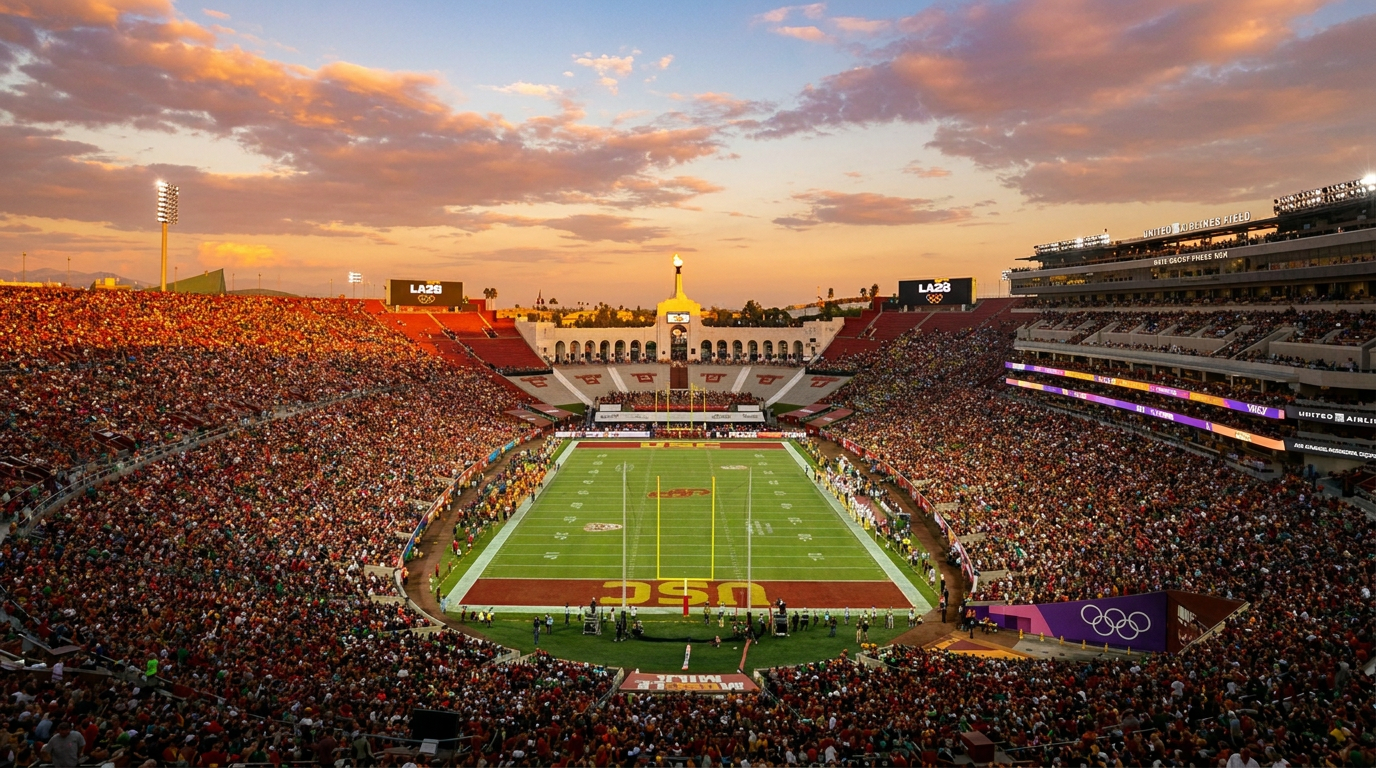
Instead, Los Angeles will leverage its massive existing inventory of professional sports arenas, university facilities, and historic stadiums. The Los Angeles Memorial Coliseum, which hosted the Games in 1932 and 1984, will once again take center stage, while modern marvels like SoFi Stadium and Crypto.com Arena will host major events.[1][5]

Where existing architecture falls short, the city will turn to modular, temporary infrastructure. Sports like cricket will be played in purpose-built temporary facilities, and temporary aquatic centers will be installed inside existing arenas. Once the Games conclude, these structures will be dismantled, leaving a vastly reduced environmental footprint.[1][4]
This approach is the cornerstone of LA28's recently unveiled Impact and Sustainability Plan. By avoiding the massive carbon emissions associated with pouring concrete and erecting steel for permanent stadiums, organizers hope to stage the most environmentally responsible mega-event in history.[3][7]

But the "no-build" promise is only half of the LA28 riddle. The city is also attempting something arguably more audacious: a "transit-first" or "no-car" Olympics in a metropolis globally infamous for its car dependency and sprawling freeways.[1][2]
Organizers have stated that spectators will be strongly discouraged from driving to events, with parking near venues severely limited or eliminated entirely. Instead, the estimated 15 million visitors will be expected to navigate the region using public transit, park-and-ride systems, and a massive fleet of shuttle buses.[1][6]
Organizers have stated that spectators will be strongly discouraged from driving to events, with parking near venues severely limited or eliminated entirely.
To make this possible, Los Angeles has been racing to expand its Metro system under the "28 by '28" initiative, a plan launched by former Mayor Eric Garcetti to accelerate 28 major transit projects ahead of the Games.[2][5]
Progress has been mixed but substantial. The city has successfully completed the Regional Connector, linking light rail lines through downtown, and opened the K Line. However, other crucial links, such as the D Line subway extension and the LAX automated people mover, have faced delays and budget pressures.[2][5]

Despite the skepticism surrounding LA's transit capacity, there is historical precedent for success. During the 1984 Olympics, the city implemented a robust traffic management plan, utilizing hundreds of shuttle buses and temporary one-way streets. Angelenos largely complied with requests to avoid driving, resulting in surprisingly clear freeways during the two-week event.[6]
Beyond infrastructure, the LA28 sustainability plan includes a "Resilient by Nature" initiative, which focuses on wildfire resilience, ocean protection, and urban cooling. A Community Resilience Fund will also launch to provide grants to local environmental nonprofits, aiming to leave a positive ecological legacy.[3][7]
Not everyone is convinced that the "no-build" model is entirely frictionless. Environmental and community advocates have raised concerns about the footprint of the temporary venues. To build these structures, LA28 will need to commandeer public green spaces, such as the Sepulveda Basin Recreation Park, temporarily reducing park access for local residents.[8]
Furthermore, the California state legislature passed a bill exempting these temporary Olympic venues from the California Environmental Quality Act (CEQA). While this prevents bureaucratic delays, critics argue it bypasses crucial environmental reviews and community input processes that protect local neighborhoods.[8]
Despite these localized concerns, the architectural and urban planning communities are largely embracing the LA28 model as a necessary evolution. University design studios are already exploring how the temporary modules—such as seating bays and modular pools—can be redistributed across Los Angeles as permanent community wellness resources after the Games.[4]

Ultimately, the stakes for LA28 extend far beyond Southern California. The International Olympic Committee has struggled in recent years to find cities willing to take on the crushing debt of hosting the Games, with numerous metropolises withdrawing their bids due to public opposition.[6][8]
If Los Angeles can successfully pull off a "no-build," transit-driven Olympics, it will prove that a city does not need to bankrupt itself or pave over its neighborhoods to host the world. It could provide a sustainable, financially viable blueprint that saves the Olympic movement for generations to come.[1][8]
How we got here
1932 & 1984
Los Angeles hosts the Summer Olympics, utilizing existing infrastructure like the Memorial Coliseum.
2017
The IOC awards the 2028 Summer Olympics to Los Angeles after the city pivots from its 2024 bid.
2018
Los Angeles launches the '28 by 28' initiative to accelerate major transit projects ahead of the Games.
August 2025
LA28 organizers officially unveil their Impact and Sustainability Plan, cementing the 'no-build' and 'transit-first' pledges.
Viewpoints in depth
LA28 Organizers
A vision for a debt-free, sustainable Olympic legacy.
For LA28 leadership, the 'no-build' and 'transit-first' pledges are about proving that the Olympic Games can be a responsible civic undertaking rather than a financial burden. By utilizing Los Angeles's unparalleled density of world-class sports facilities, organizers argue they can redirect funds that would normally go toward concrete and steel into community investments. Initiatives like the $160 million PlayLA youth sports program and the Community Resilience Fund are cited as evidence that the Games will uplift local neighborhoods long after the closing ceremonies.
Urban Planners & Architects
Using the Games to accelerate transit and pioneer modular design.
Architects and transit advocates see the 2028 Olympics as a powerful forcing function. The '28 by 28' initiative, while facing delays, has successfully secured funding and political will to expand the Metro system at a pace that would otherwise be impossible. Furthermore, university design studios and architectural firms are embracing 'radical reuse' as a new paradigm for mega-events. They argue that designing modular, temporary venues that can be disassembled and redistributed as community wellness centers represents the future of sustainable urban design.
Community & Environmental Advocates
Concerns over park access and bypassed environmental regulations.
While generally supportive of avoiding new permanent stadiums, local watchdog groups point out that 'temporary' construction still carries an environmental cost. Building modular venues requires commandeering public green spaces, such as the Sepulveda Basin Recreation Park, which restricts access for residents in park-deficient neighborhoods. Additionally, advocates are highly critical of the state legislature's decision to exempt these temporary Olympic sites from the California Environmental Quality Act (CEQA), arguing that expediency should not come at the expense of community input and environmental oversight.
What we don't know
- Whether the Los Angeles Metro system will have the capacity to handle the massive influx of 15 million visitors without significant delays.
- Exactly how much public park space will be temporarily closed to residents to accommodate modular venue construction.
- If the 'no-build' model will actually convince other global cities to resume bidding for future Olympic Games.
Key terms
- White Elephant
- A massive, expensive infrastructure project (like an Olympic stadium) that becomes costly to maintain and goes unused after the event.
- Radical Reuse
- The LA28 strategy of adapting existing arenas and university facilities rather than constructing new permanent buildings.
- CEQA
- The California Environmental Quality Act, a state law requiring environmental impact reviews for construction projects, which temporary Olympic venues have been exempted from.
- 28 by '28
- A Los Angeles initiative to complete 28 major transit and infrastructure projects before the 2028 Games.
Frequently asked
Will there be any new buildings for the 2028 Olympics?
No new permanent venues will be built. The city will use existing stadiums and construct temporary structures for certain sports that will be dismantled afterward.
How will people get to the venues if they can't drive?
Organizers are planning a 'transit-first' system relying on an expanded Metro rail network, park-and-ride systems, and a massive fleet of shuttle buses.
Where will the athletes stay?
Instead of building a new Olympic Village, athletes will be housed in existing dormitories at the University of California, Los Angeles (UCLA).
Sources
Source coverage
8 outlets
3 viewpoints surfaced








[1]New AtlasUrban Planners & Architects
The riddle of the LA Olympics: No cars, no new venues
Read on New Atlas →[2]Los Angeles TimesCommunity & Environmental Advocates
Can L.A. actually pull off a 'car-free Olympics'?
Read on Los Angeles Times →[3]PatchLA28 Organizers
LA28 Unveils Impact And Sustainability Plan For Summer Olympics
Read on Patch →[4]DezeenUrban Planners & Architects
Proposal for aquatic sports centre among projects from University of Southern California
Read on Dezeen →[5]Wikipedia
2028 Summer Olympics
Read on Wikipedia →[6]LA32 GamesUrban Planners & Architects
The 'No Car' Olympics LA28
Read on LA32 Games →[7]News.azLA28 Organizers
LA28 Olympics branded as 'no-build' and 'transit first' in sustainability plan
Read on News.az →[8]Factlen Editorial TeamCommunity & Environmental Advocates
Synthesis by Factlen editorial team
Read on Factlen Editorial Team →

More in sports
See all 328 stories →Pro Volleyball Boom
The $100M Turf War Building America's First Sustainable Pro Volleyball Ecosystem
6 sources
Adaptive Gaming
How Adaptive Tech and Modular Design Are Leveling the Esports Playing Field
7 sources

Sports Tech
How Artificial Intelligence is Revolutionizing Soccer Scouting and Player Recruitment
8 sources

Fighter Safety
How Impact-Sensing Smart Gloves Are Changing the Science of Boxing Safety
7 sources
Every angle. Every day.
Get sports stories with full source coverage and perspective breakdowns delivered to your inbox.