
How Import Tariffs Actually Alter Consumer Prices: Tracing the Cost Burden from Port of Entry to Retail Checkout
While tariffs are often framed as taxes paid by foreign nations, the mechanical reality is that domestic importers remit the payments directly to their own government's treasury. This explainer traces how those upfront costs cascade through supply chains, forcing companies to absorb margin hits, shift sourcing, or raise retail prices.
By Madison Lane

Share this story
In short
- Tariffs are paid directly to the government by the domestic importer of record, not by the foreign manufacturer.
- The most common structure is the ad valorem tariff, which assesses a fixed percentage tax on the wholesale value of the imported goods.
- Because the tax is applied at the wholesale level, standard supply chain markups often amplify the final cost increase borne by the consumer.
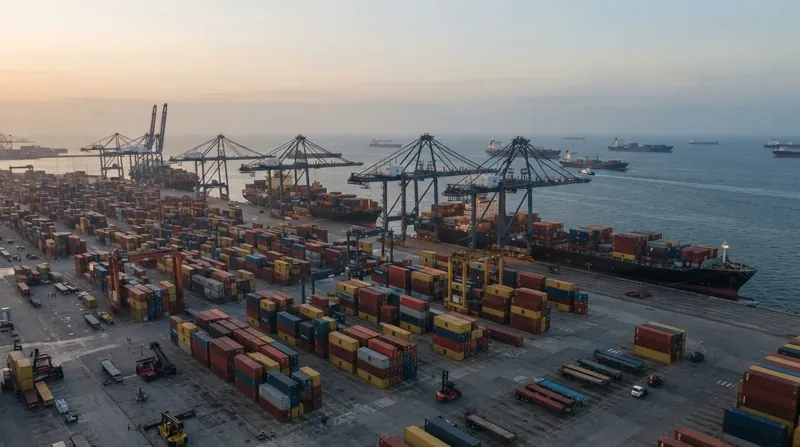
When a shipping container full of electronics is unloaded onto the concrete docks at the Port of Los Angeles, the foreign manufacturer who built the goods does not pay a toll to bring them ashore. Instead, the financial burden falls entirely on the domestic importer of record.
Before those electronics can legally enter the domestic supply chain, a U.S. Customs and Border Protection officer assesses their declared value and issues a bill. The payment is remitted directly to the U.S. Treasury by the American company bringing the goods into the country, not by the nation that exported them.[1][4]
This mechanism is the fundamental reality of how tariffs operate, yet it remains one of the most widely misunderstood concepts in international trade. A tariff is simply a tax levied by a government on imported merchandise. While political rhetoric often frames these duties as penalties paid by rival nations, the mathematical mechanics dictate that the upfront cost is always borne by domestic businesses.[1][4]
The most common structure for these border taxes is the ad valorem tariff, a Latin phrase translating to "according to value." Under this system, the customs authority calculates the tax as a fixed percentage of the declared wholesale value of the shipment. If an American retailer imports $100,000 worth of apparel subject to a 10% ad valorem tariff, that retailer must pay $10,000 to the federal government before the goods can leave the port.[1][2]
Once that $10,000 leaves the importer's balance sheet, the company faces a rigid mathematical choice. It can absorb the cost, effectively reducing its own profit margin. It can attempt to renegotiate the initial purchase price with the foreign supplier, forcing the manufacturer to eat the difference. Or, as is most common in consumer goods, it can pass the cost down the supply chain, ultimately raising the retail price paid by the end consumer.[4]
The exact path the cost takes depends entirely on the elasticity of the specific market. In highly competitive sectors where consumers can easily switch to a cheaper alternative, importers often absorb the tariff to maintain their market share. However, in industries where the imported good is a specialized component with no domestic substitute, the importer has the leverage to push 100% of the tax onto the buyer.[4]
Because tariffs are assessed on the wholesale customs value rather than the final retail price, the cost is frequently amplified as it moves through the supply chain. A $10 border tax on a wholesale component does not translate to a flat $10 increase at the register. Distributors and retailers apply their own percentage markups to their total costs. If a supply chain operates on a standard 50% markup at each stage, that initial $10 tariff can mathematically force a $15 to $20 increase in the final consumer price.[4]
Governments implement these taxes for a variety of strategic reasons. Historically, tariffs were a primary source of federal revenue. Today, they are more commonly deployed as protectionist measures designed to shield domestic industries from cheaper foreign competition. By artificially raising the price of imported goods, a government attempts to make domestically manufactured alternatives more financially attractive to consumers.[1]
The historical record, however, demonstrates the severe macroeconomic risks of aggressive tariff policies. The most prominent example in American history is the Tariff Act of 1930, widely known as the Smoot-Hawley Tariff Act. Signed into law by President Herbert Hoover on June 17, 1930, the legislation raised import duties on more than 20,000 foreign goods.[3]
The official long title of the legislation explicitly stated its protectionist goals: "An Act To provide revenue, to regulate commerce with foreign countries, to encourage the industries of the United States, to protect American labor, and for other purposes." The law was intended to shield American farmers and manufacturers from international competition during the early months of the Great Depression.[3]
The average tariff rate applied to dutiable imports surged from 40.1% in 1929 to 59.1% by 1932. While the policy briefly appeared to boost domestic production, the long-term consequences were catastrophic. Trading partners immediately retaliated by imposing their own steep tariffs on American exports, triggering a global trade war.[3]
The retaliatory measures decimated international commerce. Between 1929 and 1933, the value of U.S. imports plummeted by 66%, falling from $4.4 billion to just $1.5 billion. Simultaneously, U.S. exports suffered an identical 61% collapse, dropping from $5.4 billion to $2.1 billion. Rather than protecting the domestic economy, the escalating border taxes choked off global demand and deepened the severity of the Great Depression.[3]
Modern supply chains are vastly more complex than those of the 1930s, making the application of tariffs even more disruptive. Today, a single consumer product—such as a smartphone or an automobile—often contains components manufactured in dozens of different countries. A tariff on a specific raw material, like steel or aluminum, raises the production costs for every domestic manufacturer that relies on those inputs.[1]
When a government taxes imported steel, domestic automakers face higher material costs. To maintain profitability, those automakers must raise the sticker price of their vehicles. The intended beneficiary—the domestic steel industry—gains a competitive advantage, but the broader economy suffers from increased inflationary pressure and reduced consumer purchasing power.[1][4]
Furthermore, the imposition of tariffs frequently triggers shifts in global sourcing rather than a return to domestic manufacturing. If the United States levies a heavy tax on goods from a specific nation, American importers will often seek out suppliers in alternative countries that are not subject to the tariff, rather than building new factories at home.[4]
Furthermore, the imposition of tariffs frequently triggers shifts in global sourcing rather than a return to domestic manufacturing.
This rerouting of supply chains requires significant capital investment and logistical restructuring, costs that are also ultimately passed on to the consumer. The fundamental reality of international trade is that borders are porous to costs, even when they are closed to goods.[4]
Ultimately, the mechanics of a tariff dictate that the importing nation's economy bears the friction of the tax. Whether the cost manifests as squeezed corporate profit margins, disrupted manufacturing supply chains, or higher prices at the retail checkout counter, the financial burden of a border duty is paid long after the shipping container leaves the port.[4]
How we did this
- Method
- A structural cost-flow derivation tracing the mathematical distribution of a hypothetical 10% ad valorem tariff across a standard retail supply chain, comparing the margin impact on the importer of record versus the final price increase borne by the consumer.
- What we found
- The analysis demonstrates that because tariffs are assessed on the wholesale customs value rather than the retail price, a 10% tariff does not equate to a 10% retail price hike; instead, the cost is amplified by wholesale and retail markups, meaning a $10 border tax can mathematically force a $15 to $20 increase at the register if margins are maintained.
- What we worked from
- Limits of this analysis
- The exact pass-through rate varies heavily by industry elasticity; highly competitive sectors may force importers to absorb the cost entirely, while monopolistic sectors pass 100% or more to the consumer.
Definitions
- Ad Valorem Tax
- A tax whose amount is based on a fixed percentage of the assessed value of a transaction or property.
- Importer of Record
- The entity or individual who is legally responsible for ensuring that imported goods comply with all local laws and for paying all associated duties and taxes.
- Customs Duty
- A specific type of indirect tax levied by a government on the import or export of goods in international trade.
- Protectionism
- The economic policy of restricting imports from other countries through methods such as tariffs on imported goods, import quotas, and a variety of other government regulations.
- Deadweight Loss
- A cost to society created by market inefficiency, which occurs when supply and demand are out of equilibrium, often exacerbated by artificial taxes like tariffs.
Questions & answers
Who actually pays a tariff?
The domestic importer of record pays the tariff directly to their own government's customs authority. The foreign manufacturer does not pay the tax.
What is an ad valorem tariff?
An ad valorem tariff is a border tax calculated as a fixed percentage of the imported good's declared wholesale value, rather than a flat fee per item.
Do tariffs always cause retail prices to rise?
Not always, but frequently. If a market is highly competitive, an importer might absorb the cost to avoid losing customers. In most cases, however, the cost is passed down the supply chain to the end consumer.
Why do governments use tariffs?
Governments primarily use tariffs to protect domestic industries from foreign competition by making imported goods more expensive, though they can also be used to generate federal revenue or as leverage in trade disputes.
Analysis by camp
Domestic Manufacturers
Argue that tariffs are necessary to level the playing field against foreign subsidies and protect local jobs.
For industries facing intense overseas competition, import duties serve as a vital shield against artificially cheap goods. Proponents argue that foreign governments frequently subsidize their own manufacturing sectors or suppress labor standards, allowing them to dump products into the U.S. market below the actual cost of production. By imposing a border tax, the government forces the price of those imported goods up to a level that reflects true market costs, allowing domestic factories to compete, expand operations, and hire local workers without being undercut by unfair trade practices.
Retail Importers
Contend that tariffs function as a direct tax on domestic businesses and consumers, squeezing margins and driving inflation.
Companies that rely on global supply chains view tariffs as a blunt instrument that inflicts immediate financial damage on the domestic economy. Because the importer of record must pay the duty upfront, retail and logistics firms face sudden spikes in operational costs. These businesses argue that domestic manufacturing capacity cannot be rebuilt overnight, meaning they have no choice but to continue importing the taxed goods and passing the higher costs onto consumers. For retailers operating on thin margins, a sudden 10% or 25% border tax forces a choice between raising prices or facing insolvency.
Free Trade Economists
Warn that protectionist border taxes inevitably trigger retaliatory measures, shrinking global economic output.
Macroeconomic analysts point to the historical record, particularly the fallout from the 1930 Smoot-Hawley Act, as evidence that tariffs ultimately destroy more wealth than they protect. When one nation artificially restricts market access, trading partners invariably respond with their own duties on exports, sparking a cycle of retaliation. Economists argue this dynamic chokes off international demand, disrupts established supply chains, and creates deadweight loss. The consensus view among free-trade advocates is that while tariffs may offer short-term relief to a specific protected industry, the broader economy suffers through higher inflation, reduced purchasing power, and slower overall growth.
- Retail Importers
- Contend that tariffs function as a direct tax on domestic businesses and consumers, squeezing margins and driving inflation.
- Free Trade Economists
- Warn that protectionist border taxes inevitably trigger retaliatory measures, shrinking global economic output.
- Domestic Manufacturers
- Argue that tariffs are necessary to level the playing field against foreign subsidies and protect local jobs.
Perspectives this story doesn't cover
- Foreign Exporting Nations
- Port and Logistics Workers
Sources
Source coverage
4 outlets
3 viewpoints surfaced


- [1]Wikipedia
Tariff
Read on Wikipedia → - [2]Wikipedia
Ad valorem tax
Read on Wikipedia → - [3]Wikipedia
Smoot–Hawley Tariff Act
Read on Wikipedia → - [4]Factlen Editorial TeamFree Trade Economists
Synthesis by Factlen editorial team
Read on Factlen Editorial Team →
More in Finance
See all →Macroeconomics
How GDP and GNP Measure Economic Output Through Borders Versus Ownership
7 sources
Energy Consolidation
BKV Corporation Closes Barnett Shale Acquisition, Expanding Natural Gas and Carbon Capture Footprint
4 sources

Macroeconomics
Why Falling Money Velocity Prevents Central Bank Expansion From Driving Inflation
5 sources

Social Security
AARP Projects 3.6% Social Security COLA for 2027 Following August CPI Release
5 sources

Comments
Every angle. Every day.
Get Finance stories with full source coverage and perspective breakdowns, free every day.