
How Humanoid Robots Finally Moved From Viral Videos to the Factory Floor
Driven by breakthroughs in Vision-Language-Action models and reinforcement learning, fully electric humanoid robots have transitioned from research labs to commercial deployments at major automakers and logistics hubs.
By Tariq Nasser

Two years ago, humanoid robots were mostly known for viral videos of parkour or carefully choreographed dances. Today, they are clocking in for shifts. Across the globe, fully electric, AI-driven humanoids have quietly transitioned from research novelties to commercial deployments, moving totes in logistics centers and handling parts on automotive assembly lines.
The numbers reflect a massive industrial pivot. The global robotics market has surged to an estimated $38 billion in 2026, fueled by a sharp year-over-year increase in venture capital investment. Major players like Boston Dynamics, Figure AI, Apptronik, and Agility Robotics have all moved units into active customer pilots or structured lease programs, signaling that the technology is finally ready for the real world.
"The progress is real, and the direction is clear," notes industry analysis from RobotLAB. In 2025, the sector crossed the threshold from impressive demonstrations to actual purchase orders and maintenance contracts. Today, there are at least twelve commercial humanoid platforms available for purchase or lease, up from just three in 2024.
To understand how humanoids finally bridged the gap to real-world utility, one must look under the hood at the hardware evolution. For years, the most capable bipedal robots relied on hydraulic systems—powerful, but heavy, loud, and prone to messy fluid leaks. The 2026 generation is almost entirely electric.[2]
Boston Dynamics made headlines when it retired its iconic hydraulic Atlas in favor of a sleek, fully electric model designed specifically for enterprise deployment. These modern electric actuators—the motors and joints that translate digital commands into physical movement—offer smoother, quieter, and more precise motion control without the maintenance overhead of hydraulics.[1][2]
Modular design has also become a standard feature. Apptronik’s Apollo robot, currently in trials at Mercedes-Benz, was engineered with field serviceability in mind. Its joints can be swapped out directly on the factory floor without sending the entire unit back to the manufacturer, a crucial factor for companies calculating total cost of ownership and operational uptime.[2]
But the true catalyst for the 2026 humanoid boom isn't mechanical; it's cognitive. The hardware has been waiting for the software to catch up, and the arrival of Vision-Language-Action (VLA) models provided the missing link that allowed robots to understand their environments.
VLA models integrate visual perception, natural language processing, and physical action into a single trainable neural network. Instead of hard-coding a robot to move its arm exactly fourteen inches to the left, operators can now give natural-language instructions like, "Pick up the defective gear and place it in the red bin," and the robot translates that intent into physical motion.
This cognitive leap is supported by advanced perception systems. Humanoids now rely on specialized stereo vision cameras, often mounted in the head and wrists, to build real-time 3D maps of their surroundings. This spatial awareness allows them to navigate dynamic environments built for humans, rather than requiring factories to be expensively redesigned around the robots.
Training these AI brains requires massive amounts of data, which is where Reinforcement Learning (RL) enters the picture. RL is an AI training method where a virtual robot learns through trial and error, receiving mathematical "rewards" for successful actions and "penalties" for failures, gradually optimizing its behavior over millions of iterations.
Because training a physical robot through millions of trial-and-error cycles would result in broken hardware, companies like Figure AI conduct this training in hyper-realistic physics simulators. Thousands of virtual humanoids run in parallel, experiencing varied terrains, slips, and shoves, compressing years of learning into a few hours of compute time.
The breakthrough is "sim-to-real" transfer. By slightly randomizing the physics in the simulation—a technique called domain randomization—the AI policy becomes robust enough to be downloaded directly into a physical robot. Figure AI reports that its walking policies now transfer "zero-shot" to real hardware, meaning the robot can walk perfectly on its first try without additional real-world tuning.
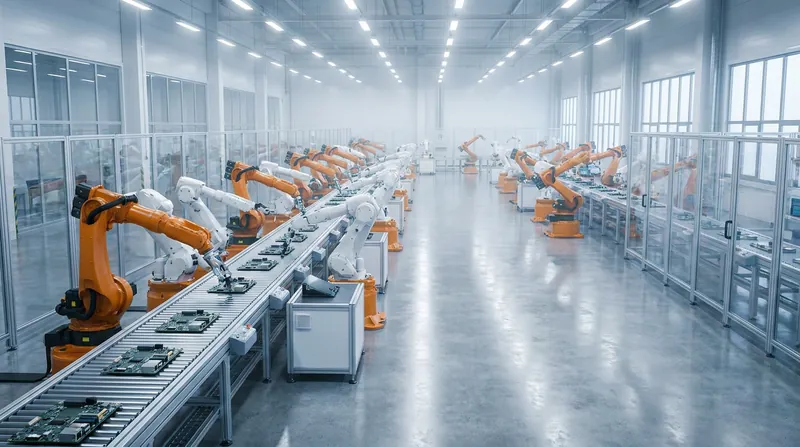
This combination of electric hardware and VLA software has unlocked immediate use cases in logistics and manufacturing. Agility Robotics’ Digit has already moved more than 100,000 totes at a GXO Logistics facility and is operating under a commercial agreement at a Toyota plant. Figure’s robots have completed pilots at BMW, and Boston Dynamics' electric Atlas production is fully allocated to Hyundai and Google DeepMind.[1][2]
The tasks they perform are highly structured: transferring components between workstations, loading machines, and moving containers. Manufacturers are intentionally starting with predictable, repetitive physical labor to establish safety and reliability before expanding the robots' responsibilities to more complex assembly tasks.
While American companies have largely focused on high-end capability and AI integration, China has rapidly scaled production to drive down costs. Chinese manufacturers accounted for roughly 85% of global humanoid shipments last year, supported by massive state investment and a robust local supply chain.
Companies like AgiBot and Unitree are shipping thousands of units, dwarfing the volume of their Western competitors. Unitree’s G1 humanoid is priced around $16,000—an order of magnitude cheaper than many US models. Analysts project China's humanoid sales will more than double this year, finding buyers in state-owned power plants and data centers.[1]
Despite the rapid progress, the industry remains transparent about current limitations. The software autonomy gap is still the primary constraint. While humanoids can execute specific tasks autonomously, they still struggle with edge cases and often rely on human teleoperation—remote control—when encountering unfamiliar situations or complex manipulation challenges.[1]
Battery life is another hurdle. Most commercial humanoids currently operate for four to five hours per charge. While swappable battery packs mitigate this issue on factory floors, the energy density required for a full twelve-hour shift without interruption remains an ongoing engineering challenge.[2]
For now, the consensus among robotics experts is clear: humanoids are legitimately useful today in tightly scoped industrial settings, but they are still years away from autonomously folding laundry in consumer homes. The 2026 milestone is not the arrival of artificial general intelligence, but rather the moment humanoid robots finally put on a hard hat and went to work.[1]
Key points
- Humanoid robots have officially moved from research demonstrations to commercial pilots at major companies like BMW, Mercedes, and Amazon.
- The industry has shifted away from heavy hydraulic systems to quieter, more precise fully electric actuators.
- Vision-Language-Action (VLA) models now allow robots to understand and execute natural-language commands.
- Robots are trained in hyper-realistic physics simulations using Reinforcement Learning, transferring their skills 'zero-shot' to the real world.
What we don’t know
- When Vision-Language-Action models will become reliable enough to completely eliminate the need for human teleoperation in edge cases.
- How quickly battery technology will advance to allow humanoids to work a full 12-hour factory shift without requiring a battery swap.
- The long-term impact on the industrial workforce once humanoids scale from thousands of units to millions.
How we got here
2021
Hyundai acquires Boston Dynamics, signaling a major automotive interest in advanced dynamic robotics.
2024
Boston Dynamics retires its iconic hydraulic Atlas, pivoting to a fully electric model designed for enterprise use.
2025
Vision-Language-Action (VLA) models see widespread adoption, allowing robots to process natural language commands.
Early 2026
Multiple robotics firms, including Figure AI and Apptronik, launch active commercial pilots on automotive assembly lines.
- Industrial Manufacturers
- Focuses on the immediate ROI, reliability, and labor-saving potential of humanoids.
- AI & Robotics Researchers
- Focuses on the underlying software breakthroughs and the remaining autonomy gaps.
- Chinese Scale Manufacturers
- Focuses on mass production, supply chain dominance, and aggressive cost reduction.
- Industry Skeptics
- Cautions that the hype outpaces reality, pointing to teleoperation crutches and battery limits.
Perspectives this story doesn't cover
- Labor Unions
- Factory Floor Workers
- Regulatory and Safety Agencies
Sources
Source coverage
2 outlets
4 viewpoints surfaced


- [1]Mehul ChourasiaIndustry Skeptics
The Truth About Humanoid Robots in 2026
Read on Mehul Chourasia → - [2]EVSTIndustry Skeptics
Top 8 Humanoid Robot Companies to Watch in 2026
Read on EVST →
More in Technology
See all →Humanoid Robotics
Figure AI Deploys 1,000 Humanoid Robots as Tesla Begins Optimus Production Ramp-Up
7 sources
Home Automation
Weave Robotics Unveils $8,000 Home Robot, Undercutting Humanoid Competitors
3 sources
Embodied AI
Chinese Embodied AI Firm X Square Robot Hits $2.8B Valuation with Backing from Major Tech Giants
7 sources
Industrial Automation
How China's Unprecedented Factory Robotics Boom is Rewiring Global Manufacturing
4 sources
Comments
Every angle. Every day.
Get Technology stories with full source coverage and perspective breakdowns, free every day.