
How AI is Finally Reading the Lost Library of Herculaneum at Scale
Advanced machine learning models and high-resolution CT scans are now automating the digital unwrapping of the Herculaneum scrolls, recovering lost classical literature without touching the fragile artifacts.
By Factlen Editorial Team
- Papyrologists and Classicists
- Focused on the historical and literary value of the recovered texts.
- Computer Scientists
- Focused on the algorithmic challenges of segmentation and ink detection.
- Archaeological Preservationists
- Focused on protecting the physical integrity of the artifacts.
What's not represented
- · The Italian Ministry of Culture (managing the physical site and access to the artifacts)
- · Modern residents of Ercolano (living above the unexcavated portions of the ancient villa)
Why this matters
For centuries, the greatest barrier to understanding the ancient world was the physical destruction of its texts. By successfully automating the digital recovery of the Herculaneum scrolls, AI is not just solving an archaeological puzzle—it is unlocking a time capsule that could restore thousands of lost works of classical philosophy, history, and literature to humanity.
Key points
- Advanced 3D CT scans and machine learning are allowing researchers to read the carbonized Herculaneum scrolls without physically opening them.
- By early 2026, the Vesuvius Challenge successfully automated the digital unwrapping of nearly 70% of a single scroll.
- AI models detect the presence of ink by recognizing microscopic textural changes on the papyrus surface, rather than relying on density.
- A recently deciphered scroll revealed the exact burial location of the philosopher Plato, proving the historical value of the texts.
- The project is now focused on scaling the technology to read the remaining 600 unopened scrolls in the collection.
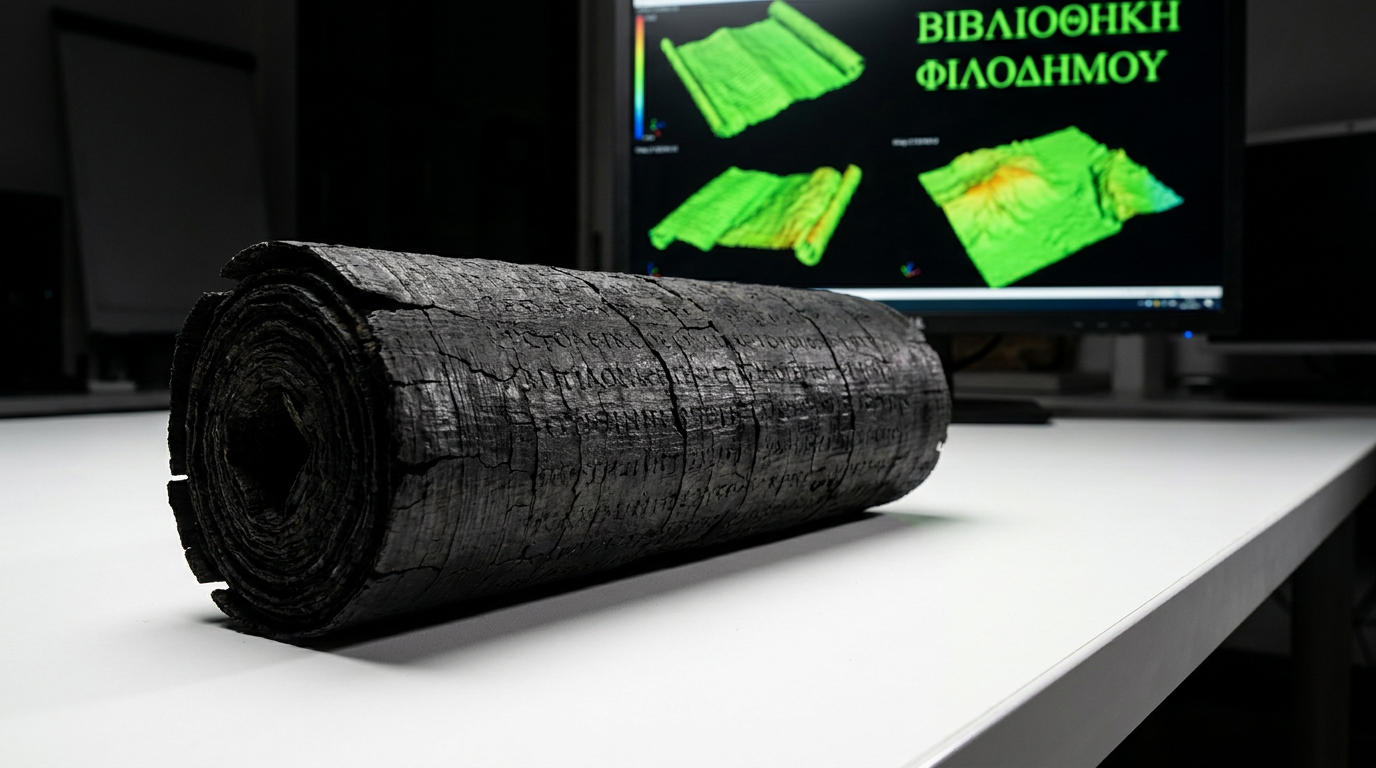
In AD 79, the eruption of Mount Vesuvius unleashed a torrent of superheated gas and ash that buried the Roman towns of Pompeii and Herculaneum. While Pompeii is famous for its frozen human figures, Herculaneum holds a different kind of treasure: the Villa of the Papyri. Beneath 60 feet of volcanic mud, archaeologists in the 18th century discovered the only intact library to survive from classical antiquity.[1][8]
The library contained over 800 papyrus scrolls, but the intense heat of the eruption had flash-fried them into brittle, carbonized lumps resembling briquettes of charcoal. For more than 250 years, these scrolls represented one of archaeology's most agonizing paradoxes. The texts were right there, yet utterly inaccessible. Early attempts to physically unroll them proved disastrous, causing the fragile layers to shatter into dust and destroying whatever text they held.[3][5]
Today, that paradox is finally being resolved. Through a convergence of high-energy particle physics and advanced machine learning, an international coalition of researchers and technologists is reading the scrolls without ever opening them. The initiative, known as the Vesuvius Challenge, has transformed a centuries-old archaeological puzzle into a modern computer vision problem, and by mid-2026, the project has reached a critical inflection point: automation.[1][2]
The breakthrough relies on a technique called "virtual unwrapping," pioneered by computer scientist Brent Seales. The process begins at a particle accelerator, where the carbonized scrolls are bombarded with X-rays to create 3D computed tomography (CT) scans at a staggering resolution of 2 micrometers—roughly one-fiftieth the width of a human hair. These scans map the internal geometry of the scroll in billions of three-dimensional pixels, known as voxels.[3][7]

However, seeing the shape of the papyrus was only half the battle. The Romans wrote with a carbon-based ink made of soot and water. Because the ink and the charred papyrus have nearly identical densities, the letters do not show up on standard X-rays. To the human eye, the digital surface of the unwrapped scroll appears completely blank.[3][8]
This is where artificial intelligence entered the equation. In 2023, the Vesuvius Challenge offered massive cash prizes to anyone who could train a machine learning model to detect the ink. Researchers discovered that while the ink didn't change the density of the papyrus, it did subtly alter its physical texture. The ink sat on top of the papyrus fibers, creating microscopic ridges. AI models were trained to recognize this specific topographical signature, suddenly illuminating hidden Greek letters across the digital void.[1][7]
By early 2026, the technology had matured from a proof-of-concept into a scalable pipeline. The initial models required painstaking manual effort to trace the crumpled, fused layers of papyrus within the 3D scans—a process known as segmentation. It could take months to map a few square centimeters. But recent algorithmic leaps have largely automated this process, allowing computers to untangle the virtual geometry with minimal human intervention.[2][8]
By early 2026, the technology had matured from a proof-of-concept into a scalable pipeline.
The results of this automation are staggering. In early 2026, the Vesuvius Challenge announced that nearly 70% of a single scroll, designated PHerc. 172, had been digitally unwrapped. This marked a monumental shift: the technology was no longer just recovering isolated paragraphs, but entire continuous texts. The bottleneck had officially moved from detecting the ink to simply processing the massive terabytes of data.[1][8]

The stakes of this endeavor are difficult to overstate. The scrolls deciphered so far have predominantly contained works of Epicurean philosophy, including texts by Philodemus of Gadara, the resident philosopher of the villa. But the library's contents are already rewriting historical consensus and providing granular details about the lives of antiquity's greatest thinkers.[4][6]
In 2024, researchers using similar infrared and scanning methodologies on a partially opened Herculaneum scroll made a stunning announcement. The text, a "History of the Academy," revealed the exact burial location of the philosopher Plato—in a private garden near a shrine to the Muses within his Athenian academy. Furthermore, the text revealed that Plato had been sold into slavery much earlier in his life than historians previously believed.[4][5]
Discoveries of this magnitude highlight the tantalizing potential of the remaining unopened scrolls. Classicists estimate that up to 99% of ancient Greek and Roman literature has been lost to time. The Herculaneum library could hold missing dialogues of Aristotle, lost plays by Aeschylus and Sophocles, or early histories of the Roman Republic.[6][8]
To accelerate the recovery, the Vesuvius Challenge launched a new Kaggle competition in early 2026, challenging data scientists to build even better auto-segmentation models. The goal is to handle the most severely damaged sections of the scrolls, where the papyrus layers are tightly compressed, torn, or fused together by the volcanic heat.[2][8]

A primary concern within the scientific community is the risk of AI "hallucination"—the possibility that the machine learning models might invent letters that aren't there. To mitigate this, the Vesuvius Challenge employs strict evidentiary protocols. Multiple independent AI models, built by different teams using different architectures, must produce the exact same Greek characters from the raw CT data. If the models agree, the ink is considered verified.[1][3]
Furthermore, the models are constrained by the physical topology of the scroll. The AI cannot simply guess a word based on linguistic context, as a large language model might. It is strictly a computer vision task, identifying the physical presence of ink based solely on the geometric data of the voxels.[2][7]
The success of the Vesuvius Challenge is establishing a new paradigm for archaeology. Non-destructive analysis is becoming the gold standard, proving that artifacts do not need to be physically manipulated to yield their secrets. This approach preserves the physical integrity of the scrolls for future generations, who will undoubtedly possess even more advanced scanning technologies.[3][8]
As 2026 progresses, the focus is shifting toward "unwrapping at scale." With generalist AI models now capable of reading across multiple scrolls without needing to be retrained for each specific author's handwriting, the pace of discovery is accelerating exponentially. The ancient world is speaking again, and for the first time in two millennia, we finally have the tools to listen.[1][8]

How we got here
AD 79
Mount Vesuvius erupts, burying the Villa of the Papyri in Herculaneum and carbonizing its library.
1750
Farmworkers digging a well discover the buried villa and the blackened scrolls.
2015
Computer scientist Brent Seales pioneers virtual unwrapping techniques on the En-Gedi scroll.
March 2023
The Vesuvius Challenge launches, offering prize money to anyone who can use machine learning to read the scrolls.
April 2024
Researchers announce that a deciphered scroll reveals the exact burial location of the philosopher Plato.
Early 2026
The project reaches a major milestone, successfully automating the digital unwrapping of nearly 70% of a single scroll.
Viewpoints in depth
Papyrologists and Classicists
Focused on the historical and literary value of the recovered texts.
For scholars of antiquity, the technology is merely a means to an end. Their primary concern is the rigorous, peer-reviewed translation of the Greek and Latin texts. They caution against rushing the interpretation of AI-generated character maps, noting that ancient texts often lack spaces or punctuation and require deep contextual knowledge to translate accurately. This camp is highly motivated by the prospect of recovering lost works that could fundamentally alter our understanding of classical philosophy and history.
Computer Scientists
Focused on the algorithmic challenges of segmentation and ink detection.
The machine learning community views the scrolls as one of the ultimate computer vision challenges. Their focus is on building generalist models that can handle the extreme noise, compression, and topological distortion of the 3D scans without hallucinating data. For this camp, the breakthrough isn't just reading a single scroll, but developing an automated, scalable pipeline that can be applied to any tightly wrapped, damaged manuscript globally.
Archaeological Preservationists
Focused on protecting the physical integrity of the artifacts.
Preservationists champion the Vesuvius Challenge because it represents the gold standard of non-destructive archaeology. After centuries of well-intentioned but disastrous attempts to physically peel the scrolls apart—which destroyed countless layers—this camp advocates for leaving the remaining physical scrolls entirely untouched. They argue that as scanning technology improves, even the most fused and damaged scrolls will eventually be readable digitally.
What we don't know
- Whether the remaining unread scrolls contain lost masterpieces of classical literature or primarily more Epicurean philosophy.
- How many more scrolls remain buried in the unexcavated lower levels of the Villa of the Papyri.
- Whether the auto-segmentation models can successfully untangle the most severely crushed and fused sections of the papyri.
Key terms
- Virtual Unwrapping
- The process of using 3D CT scans and software to digitally flatten and read a rolled or folded object without physically touching it.
- Segmentation
- In computer vision, the task of tracing and separating the individual, tangled layers of papyrus within a 3D scan.
- Voxel
- A 3D pixel; the smallest distinguishable box of volume in a CT scan, used to map the internal structure of the scrolls.
- Epicureanism
- An ancient Greek philosophical system emphasizing that the goal of life is happiness achieved through the absence of pain and fear.
Frequently asked
Why can't archaeologists just unroll the scrolls?
The scrolls were carbonized by the extreme heat of Mount Vesuvius. They are incredibly brittle and will shatter into dust if physically manipulated.
How does the AI detect the ink?
The AI is trained to detect microscopic differences in the physical texture and thickness of the papyrus caused by the application of the carbon-based ink, rather than relying on density.
What kind of texts are inside the scrolls?
Most of the scrolls opened so far contain Epicurean philosophy written in Greek, but scholars hope the remaining library contains lost works of history, poetry, and drama.
Could the AI be making up the letters?
To prevent hallucination, researchers require multiple independent AI models to produce the exact same Greek characters from the raw geometric data before verifying the text.
Sources
Source coverage
8 outlets
3 viewpoints surfaced







[1]Vesuvius ChallengeComputer Scientists
Resurrect an ancient library from the ashes of a volcano
Read on Vesuvius Challenge →[2]KaggleComputer Scientists
Vesuvius Challenge - Ink Detection
Read on Kaggle →[3]Understanding AIComputer Scientists
How AI is reading the Herculaneum scrolls
Read on Understanding AI →[4]Smithsonian MagazinePapyrologists and Classicists
Newly Deciphered Papyrus Scroll Reveals Location of Plato's Grave
Read on Smithsonian Magazine →[5]National Endowment for the HumanitiesPapyrologists and Classicists
Newly Deciphered Papyrus Scroll Reveals Location of Plato's Grave
Read on National Endowment for the Humanities →[6]University of PisaPapyrologists and Classicists
The GreekSchools Project: New discoveries from Herculaneum papyri
Read on University of Pisa →[7]NatureComputer Scientists
AI reads text from ancient Herculaneum scroll for the first time
Read on Nature →[8]Factlen Editorial TeamArchaeological Preservationists
Synthesis by Factlen editorial team
Read on Factlen Editorial Team →
More in science
See all 5 stories →Neurolinguistics
How the Human Brain Builds a Sentence, Neuron by Neuron
6 sources
Autoimmune Therapy
Stem Cell Transplant Banishes Severe Autoimmune Disease for 15 Years in Landmark Medical First
6 sources

Stem Cell Therapy
Stem Cells Banish Severe Autoimmune Disease for 15 Years in Landmark Trial
6 sources
Every angle. Every day.
Get science stories with full source coverage and perspective breakdowns delivered to your inbox.