
How Acupuncture Actually Works: The Neuroanatomy of an Ancient Practice
Advanced neuroimaging and cellular mapping are finally revealing how acupuncture rewires pain networks and reduces inflammation, moving the ancient practice from alternative therapy to evidence-based medicine.
By Factlen Editorial Team
- Neuroscientists & Clinical Researchers
- Focuses on mapping the exact neural pathways, neurotransmitters, and connective tissue responses that explain acupuncture's clinical effects.
- Health Policy Analysts
- Evaluates the cost-effectiveness, insurance coverage, and integration of acupuncture into standard medical care protocols.
- Integrative Medicine Advocates
- Views acupuncture as a crucial, evidence-based tool to reduce reliance on pharmaceuticals and manage conditions holistically.
What's not represented
- · Patients who are non-responders to treatment
- · Pharmaceutical industry representatives
Why this matters
For decades, patients seeking relief from chronic pain had to choose between highly addictive opioids or treatments dismissed as pseudoscience. Understanding the proven neurological mechanisms behind acupuncture empowers patients to access safe, insurance-covered, and effective non-pharmacological care.
Key points
- Acupuncture works by stimulating specific deep-tissue nerve fibers that send high-speed signals to the brain.
- The practice activates the vagal-adrenal axis, prompting the body to release powerful anti-inflammatory chemicals.
- Twisting the needles stretches connective tissue cells, triggering a localized release of natural pain-relievers.
- Regular sessions can permanently rewire how the brain processes pain, leading to long-term relief.
- Medicare and major commercial insurers increasingly cover the treatment as a safe alternative to opioids.
For millennia, Traditional Chinese Medicine has relied on acupuncture to treat pain and illness, explaining its efficacy through the flow of 'qi' along invisible meridians. To Western medicine, this conceptual framework sounded like mysticism. For decades, the practice was largely dismissed by the conventional medical establishment as an elaborate placebo—a theatrical ritual that made patients feel better simply because they expected to. Skeptics argued that without a clear biological mechanism, inserting tiny needles into the skin could not possibly influence systemic disease or chronic pain. The divide between Eastern tradition and Western evidence-based medicine seemed insurmountable, leaving acupuncture relegated to the fringes of alternative care.[6]
But in recent years, the narrative has dramatically shifted. Armed with functional magnetic resonance imaging, cellular mapping, and advanced neuroanatomy, scientists are finally translating the ancient practice into the language of modern biology. Acupuncture, it turns out, is not magic. It is a highly specific method of hacking the body's nervous system. By tracking the exact physiological changes that occur the moment a needle pierces the skin, researchers are proving that the practice triggers a cascade of measurable, verifiable biological events. This synthesis of ancient observation and modern neuroscience is rapidly transforming how the medical establishment views pain management and systemic inflammation.[1][6]
The turning point in understanding acupuncture's mechanism came from a landmark study led by neuroscientists at Harvard Medical School and published in the journal Nature. The researchers sought to answer one of the most fundamental questions in the field: why does inserting a needle in a specific spot on the leg affect the rest of the body, while inserting it in the abdomen does nothing? For centuries, acupuncturists have relied on detailed maps of 'acupoints' without knowing exactly why those specific coordinates mattered. The Harvard team hypothesized that the answer lay hidden in the deep neuroanatomy of the fascial tissue.[1]
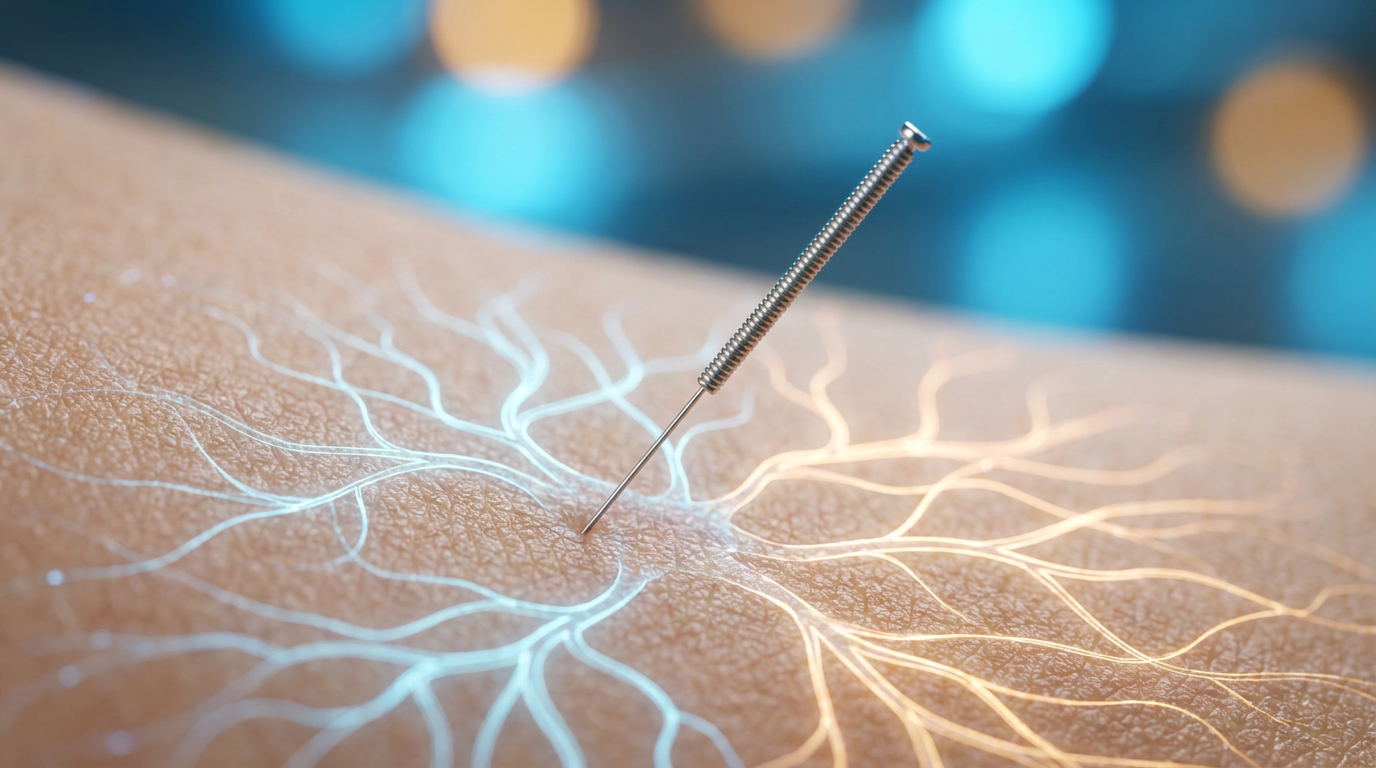
The Harvard team discovered a specific subset of neurons—known as PROKR2-Cre-expressing nerve fibers—that are densely packed in the deep fascia of the hindlimb but virtually absent in the abdomen. When an acupuncture needle stimulates these specific fibers in the leg, it sends a high-speed electrical signal up the spinal cord directly to the brain. This discovery was revolutionary because it provided a concrete, anatomical basis for the ancient maps. The researchers proved that acupoints are not arbitrary mystical nodes; they are precise anatomical locations where specific nerve bundles are most accessible to mechanical stimulation.[1]
This high-speed signal activates the vagal-adrenal axis, a critical neural pathway where the brain's vagus nerve commands the adrenal glands to release dopamine and other potent anti-inflammatory chemicals. In laboratory models, this precise neural circuit was shown to successfully tame 'cytokine storms'—the runaway, hyperactive immune responses that drive severe systemic inflammation. Cytokine storms can be triggered by severe infections, cancer treatments, or sepsis, and they carry a devastating fatality rate of 15 to 30 percent. By proving that a needle in the leg could halt a systemic immune crisis, the researchers demonstrated the profound power of targeted neuromodulation.[1]

'Based on this nerve fiber distribution, we can almost precisely predict where electrical stimulation will be effective and where it will not be,' noted Dr. Qiufu Ma, the lead investigator at Harvard. This finding provided the first concrete, neuroanatomical explanation for 'acupoint selectivity.' It proved that the ancient maps of acupoints correspond directly to hidden clusters of deep-tissue nerve endings. The research effectively bridged the gap between Eastern and Western medicine, showing that traditional practitioners had successfully mapped the body's peripheral nervous system centuries before the invention of the microscope.[1]
Beyond regulating systemic inflammation, the most common and heavily researched application for acupuncture is the treatment of chronic pain. Here, the biological mechanisms are multifaceted, beginning the exact moment the needle enters the tissue. At the local level, the physical insertion and manipulation of the needle triggers a cellular process called mechanotransduction. This is the mechanism by which the body converts a mechanical stimulus—like pressure or stretching—into a chemical signal, initiating a localized healing response in the surrounding muscle and fascia.[2]
When an acupuncturist twists or manipulates a needle, the connective tissue actually winds around the microscopic imperfections on the metal shaft. Research published in the Proceedings of the National Academy of Sciences demonstrated that this mechanical pull physically stretches the fibroblasts—the primary cells that make up connective tissue. This stretching causes the cells' internal cytoskeletons to rapidly remodel. This localized tissue stretch triggers the release of adenosine, a natural pain-relieving and anti-inflammatory chemical, directly into the surrounding muscle, providing immediate, localized relief.[2]
Simultaneously, the peripheral nervous system carries the pain-relief signal from the needle site up to the brain, prompting the central nervous system to release endorphins and enkephalins—the body's powerful endogenous opioids. But the effects go much deeper than a temporary chemical rush. Advanced brain-imaging studies reveal that regular, repeated acupuncture sessions can actually reshape how the somatosensory cortex communicates with other regions of the brain that regulate pain, stress, and emotion. This structural rewiring of the brain is known as neuroplasticity.[2]
But the effects go much deeper than a temporary chemical rush.
This neuroplasticity helps explain why the benefits of acupuncture can significantly outlast the treatment itself. A major meta-analysis published in The Journal of Pain pooled data from nearly 21,000 patients suffering from osteoarthritis, migraines, and chronic back, neck, and shoulder pain. The comprehensive review found that the pain relief from true acupuncture persisted for at least a year, and in some cases up to two years, after the final session. By fundamentally altering how the brain processes pain signals, acupuncture provides long-term relief that temporary pharmaceutical interventions simply cannot match.[1][2]

To enhance these neurological effects and provide more consistent results, many modern practitioners utilize electroacupuncture. By attaching small clips to the inserted needles and running a mild, controlled electrical current between them, practitioners can deliver precise, continuous stimulation to the underlying nerve fibers. This modern adaptation of the ancient technique allows for highly standardized treatments, removing some of the variability associated with manual needle manipulation. It maximizes the activation of the targeted neural pathways, ensuring that the signal reaching the brain is strong enough to trigger the desired release of neurotransmitters and anti-inflammatory agents.[1]
Different frequencies of electrical stimulation produce distinctly different chemical responses within the central nervous system. Low-frequency electroacupuncture, typically around 2 hertz, builds a gradual, long-lasting analgesic effect by triggering specific opioid receptors in the brain and spinal cord. In contrast, high-frequency stimulation, around 100 hertz, produces a rapid but shorter-lasting block of pain signals in the spinal cord, acting more like a localized anesthetic. By adjusting these frequencies, practitioners can tailor the treatment to address either acute, sharp pain or dull, chronic aches.[2]
Despite these measurable physiological changes, the 'placebo question' has historically haunted acupuncture research. Because it is impossible to blind an acupuncturist to the treatment they are providing, scientists had to develop 'sham' acupuncture to serve as a control group in clinical trials. Sham acupuncture involves using retractable needles that prick the skin without actually piercing it, or inserting real needles into random, non-acupoint locations on the body. The goal was to see if the theatrical ritual of the treatment was solely responsible for the patient's improvement.[1][2]
The results of these sham trials were initially confusing: sham acupuncture often provided significant pain relief, leading skeptics to declare the entire practice a massive placebo effect. However, neuroimaging has since revealed that sham needling still activates the brain's placebo-related networks, translating the patient's expectation into genuine, measurable physiological changes. Furthermore, large-scale data now consistently shows that while sham acupuncture is effective, true acupuncture significantly outperforms it. This proves that while the placebo effect is present, the specific placement, depth, and manipulation of the needles provide a distinct and superior biological benefit.[2]
Because of this mounting, undeniable evidence, acupuncture is rapidly transitioning from the fringes of alternative medicine into the very center of mainstream integrative care. Facing a devastating opioid epidemic, medical systems and policymakers are desperate for effective, non-pharmacological pain management tools. Acupuncture offers a low-risk, highly effective alternative to addictive painkillers and invasive surgeries, aligning perfectly with the modern healthcare shift toward whole-person, preventative care. Hospitals that once viewed the practice with deep skepticism are now actively recruiting licensed acupuncturists to join their multidisciplinary pain management teams.[6]

Today, acupuncture is routinely offered in Veterans Affairs hospitals to treat combat-related injuries, in multidisciplinary pain clinics, and in oncology wards to manage the severe nausea and neuropathy associated with chemotherapy. Major insurers, including Medicare Advantage and numerous commercial health plans, have officially begun covering the treatment. Recent evidence-based benefit reviews have led to standardized coverage, particularly for chronic lower back pain, with insurers typically authorizing up to 12 sessions per year. This widespread financial coverage represents a monumental shift in the institutional acceptance of the practice.[5]
The frontier of acupuncture research is now expanding rapidly beyond pain management and into the realm of mental health. A comprehensive 2026 review published in Complementary Therapies in Medicine highlighted its growing efficacy as an adjunct treatment for clinical depression. The biological mechanism appears to involve the regulation of neurotrophic factors and the dampening of the Hypothalamic-Pituitary-Adrenal (HPA) axis. Because the HPA axis becomes hyperactive under chronic stress, using acupuncture to downregulate this system offers a powerful, physical intervention for a psychiatric condition.[4]
Yet, despite these massive leaps in understanding, significant mysteries remain. One of the most pressing questions in the field is why some patients experience miraculous, life-changing recoveries while others with identical conditions see absolutely no benefit. Recent metabolic imaging studies suggest that the answer lies in the brain's unique baseline state before the first needle is ever inserted. Researchers are discovering that the brain is not a uniform machine, and individual metabolic differences dictate treatment success. This variability highlights the need for a more personalized approach to prescribing the therapy.[3]
Researchers have found that the specific metabolic patterns in a patient's Default Mode Network and Sensorimotor Network can actually predict how well they will respond to acupuncture. Because pain is a highly subjective, individualized experience heavily influenced by multidimensional factors, a patient's unique neurochemistry dictates how effectively the needles can rewrite their pain signals. By using advanced imaging to identify these metabolic biomarkers, doctors may soon be able to predict exactly which patients will benefit most from the treatment, eliminating the trial-and-error approach.[3]
Ultimately, the rigorous scientific validation of acupuncture does not erase its traditional roots; rather, it acts as a modern Rosetta Stone. It translates the ancient concept of 'qi' into the precise language of neuroanatomy, mechanotransduction, and metabolic networks. By mapping the exact neural pathways through which a simple, hair-thin needle can quiet a cytokine storm or permanently rewire a chronic pain circuit, modern medicine is finally learning to fully harness one of the oldest and most enduring therapies in human history.[6]
How we got here
1997
The NIH officially recognizes acupuncture as an effective therapeutic intervention for certain conditions.
2012
A landmark meta-analysis proves acupuncture is significantly more effective than sham treatments for chronic pain.
2020
Medicare officially begins covering acupuncture for chronic lower back pain.
2021
Harvard researchers publish a Nature study mapping the exact neuroanatomy of acupoint selectivity in the hindlimb.
2026
Clinical guidelines increasingly integrate acupuncture as a primary non-pharmacological treatment for pain and depression.
Viewpoints in depth
Neuroscientists' view
Acupuncture is a highly specific method of neuromodulation.
For neurobiologists, the magic of acupuncture has been entirely replaced by mechanics. By mapping the exact nerve fibers—such as the PROKR2-Cre neurons—researchers can now explain why specific needle placements trigger systemic anti-inflammatory responses. This perspective treats the needle as a tool to hack the central nervous system, prompting the brain to release its own endogenous opioids and regulate hyperactive immune responses.
Health Policy Analysts' view
Acupuncture is a cost-effective alternative to opioids and surgery.
From a systemic healthcare perspective, the exact biological mechanism is secondary to the clinical and economic outcomes. Policy analysts and insurers view acupuncture as a critical, low-risk intervention for the chronic pain epidemic. By covering 10 to 12 sessions a year for conditions like lower back pain, Medicare and commercial insurers aim to reduce the long-term costs associated with opioid dependency, invasive surgeries, and prolonged disability.
Traditional Practitioners' view
Modern science is simply validating ancient holistic frameworks.
Traditional Chinese Medicine practitioners argue that while discovering the neuroanatomy behind 'qi' and 'meridians' is validating, it shouldn't reduce the practice to mere nerve stimulation. They emphasize that acupuncture is part of a broader, holistic diagnostic system that treats the entire patient rather than isolated symptoms. In this view, Western science is finally catching up to a systemic understanding of the body that Eastern medicine has utilized for millennia.
What we don't know
- Why certain patients are 'super-responders' while others with identical conditions experience no benefit.
- The exact mechanism by which acupuncture modulates the gut microbiome and its long-term impact on mental health.
- How to perfectly standardize needle depth, manipulation, and electrical frequency across different practitioners for optimal results.
Key terms
- Acupoint selectivity
- The neuroanatomical principle explaining why stimulating specific body regions triggers specific systemic responses, while other regions do not.
- Vagal-adrenal axis
- A neural pathway where the brain's vagus nerve signals the adrenal glands to release anti-inflammatory chemicals like dopamine.
- Mechanotransduction
- The cellular process by which the body converts a mechanical stimulus, like a twisting needle, into a chemical healing response.
- Electroacupuncture
- A modern adaptation of acupuncture that applies a mild, controlled electric current between pairs of needles to enhance nerve stimulation.
- Sham acupuncture
- A control method used in clinical trials involving retractable needles that touch but do not pierce the skin, or needling random non-acupoints.
- Neuroplasticity
- The brain's ability to structurally rewire itself and change how it communicates, which helps explain acupuncture's long-term pain relief.
Frequently asked
Does acupuncture hurt?
Generally, no. The needles are hair-thin, and while patients may feel a dull ache, tingling, or heaviness (known as 'de qi'), it is rarely described as painful.
Is acupuncture just a placebo effect?
No. While the ritual of treatment does activate the brain's placebo networks, large-scale clinical trials prove that true acupuncture provides significantly greater and longer-lasting relief than sham treatments.
How many sessions are typically needed?
A standard course of treatment for chronic pain usually involves 6 to 12 sessions over a few months, though chronic conditions may require ongoing maintenance.
Is acupuncture covered by health insurance?
Increasingly, yes. Medicare and many commercial health plans now cover acupuncture specifically for chronic lower back pain, typically authorizing up to 12 sessions per year.
Sources
Source coverage
6 outlets
3 viewpoints surfaced






[1]Harvard Medical SchoolNeuroscientists & Clinical Researchers
Neuroanatomy of acupuncture that activates a specific signaling pathway
Read on Harvard Medical School →[2]PNASNeuroscientists & Clinical Researchers
Mechanical signaling through connective tissue: A mechanism for the therapeutic effect of acupuncture
Read on PNAS →[3]Frontiers in NeuroscienceNeuroscientists & Clinical Researchers
Brain metabolic patterns predict the pain relief of acupuncture
Read on Frontiers in Neuroscience →[4]National Institutes of HealthNeuroscientists & Clinical Researchers
Bridging tradition and innovation: Acupuncture for depression through clinical efficacy and neurobiological insights
Read on National Institutes of Health →[5]Center for Evidence-based PolicyHealth Policy Analysts
Acupuncture for Chronic Low Back Pain: Evidence Based Benefit Review
Read on Center for Evidence-based Policy →[6]Factlen Editorial TeamIntegrative Medicine Advocates
Synthesis by Factlen editorial team
Read on Factlen Editorial Team →

More in health
See all 5 stories →Longevity Tech
The Rise of 'Exercise Mimetics': How New Longevity Drugs Trick Cells Into Training
6 sources

Breathwork Science
The Clinical Evidence for 5-Minute Daily Breathwork vs. Meditation
6 sources

Exercise Medicine
Exercise as a First-Line Prescription for Depression and Anxiety: The 2026 Evidence Pack
6 sources

Every angle. Every day.
Get health stories with full source coverage and perspective breakdowns delivered to your inbox.