
Global Vanilla Prices Hit Historic Lows as Massive Oversupply Creates a Buyer's Market
Following years of aggressive planting triggered by record-high prices in 2017, the global vanilla market is now flooded with excess supply, driving prices down to their lowest levels in a decade. While food manufacturers benefit from cheap natural vanilla, farmers in Madagascar and Uganda face severe economic hardship.
By Kabir Mehra

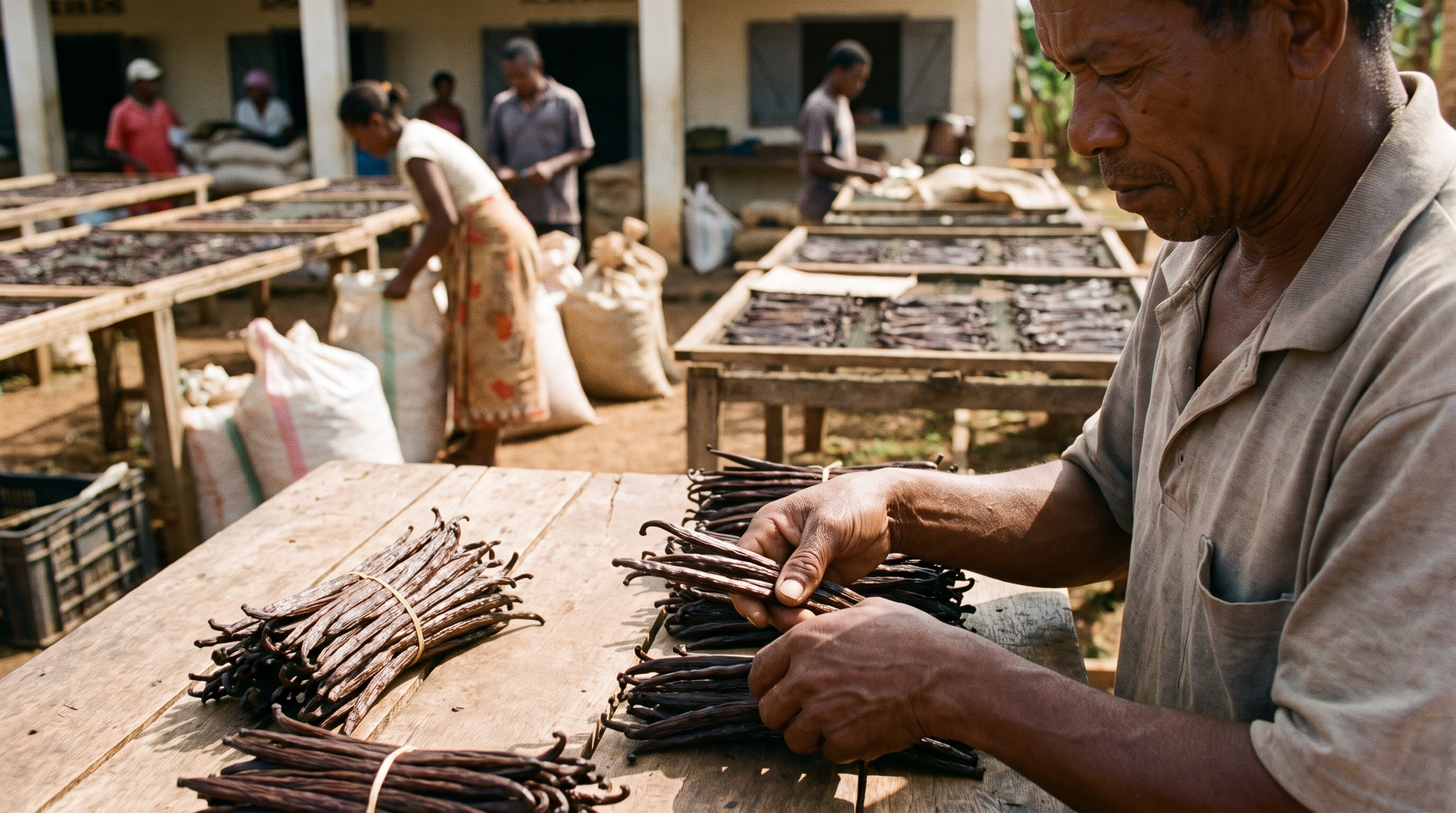
- Smallholder Farmers
- Growers who bear the brunt of the market's volatility and are struggling to survive the price crash.
- Global Flavor Conglomerates
- Industrial buyers who prioritize supply chain stability and cost-efficiency.
- Market Analysts
- Commodity experts who track the cyclical nature of agricultural markets.
Why this matters
Vanilla is the world's most popular flavor, and its dramatic price crash means food companies can afford to use real vanilla extract instead of synthetic alternatives. However, the collapse threatens the livelihoods of hundreds of thousands of smallholder farmers, setting the stage for future supply shortages.
Key points
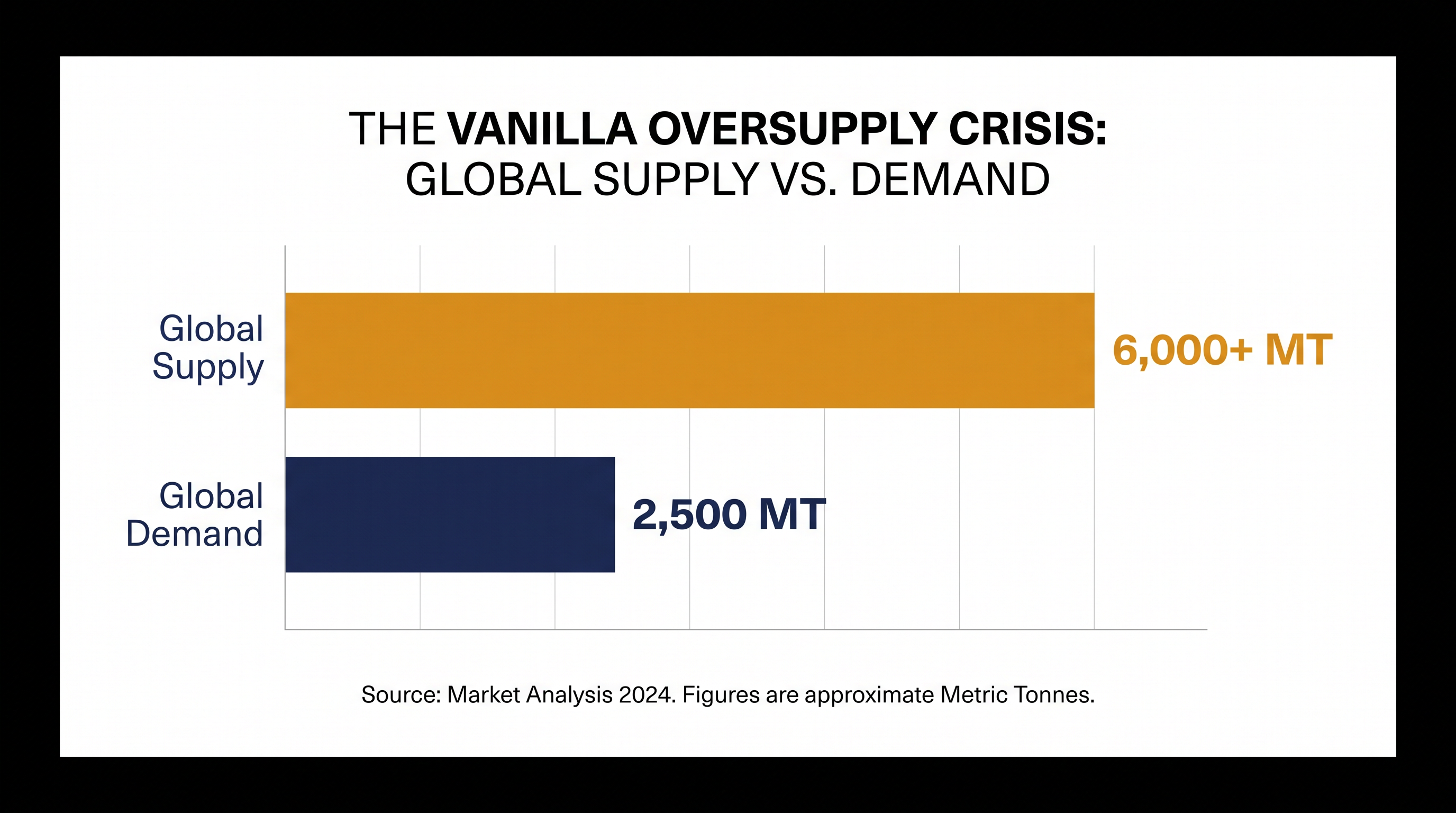
- Global vanilla supply has reached over 6,000 metric tons, more than double the annual demand of 2,500 metric tons.
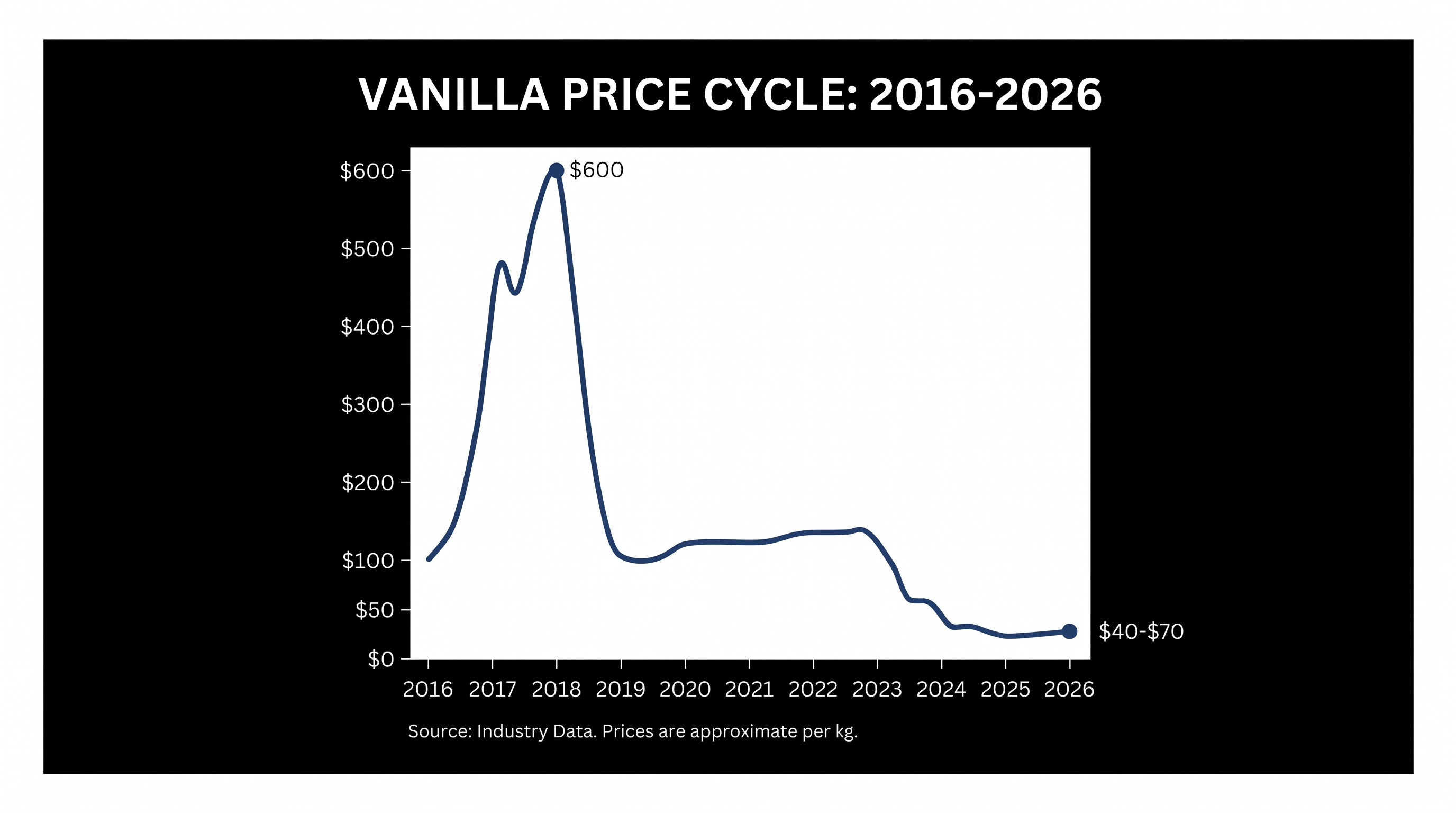
- Extraction-grade vanilla prices have plummeted to $40–$70 per kilogram, down from peaks of over $600.
- The oversupply stems from aggressive vine planting following the 2017 price spikes.
- Madagascar's attempt to enforce a $250/kg minimum export price failed, leading to a market collapse in 2023.
- Low prices are prompting food manufacturers to switch back to natural vanilla from synthetic alternatives.
- Farmers are beginning to abandon their vines, which will eventually trigger the next global supply shortage.
Less than a decade ago, vanilla was dubbed "black gold." A devastating cyclone in Madagascar had wiped out crops, sending the price of cured vanilla beans soaring past $600 per kilogram. Today, the global vanilla market has swung violently in the opposite direction, entering a prolonged phase of massive oversupply that has driven prices to historic lows.[1]
The sheer volume of vanilla currently flooding the market is staggering. Madagascar, which historically produces about 80% of the world's natural vanilla, exported an enormous 4,300 metric tons in a single recent season. When combined with output from emerging competitors like Uganda, Indonesia, and Papua New Guinea, global supply now exceeds 6,000 metric tons. Yet, global demand for natural vanilla hovers at only about 2,500 metric tons annually.
This immense surplus has crushed prices. Extraction-grade beans, the workhorse of the commercial food industry, are now trading in the $40 to $70 per kilogram range. At the farm level, the situation is even more dire. In Madagascar's Sava region, the farmgate price for raw, green vanilla has plummeted to as low as $1.50 per kilogram, leaving many smallholder farmers struggling to survive.[1]
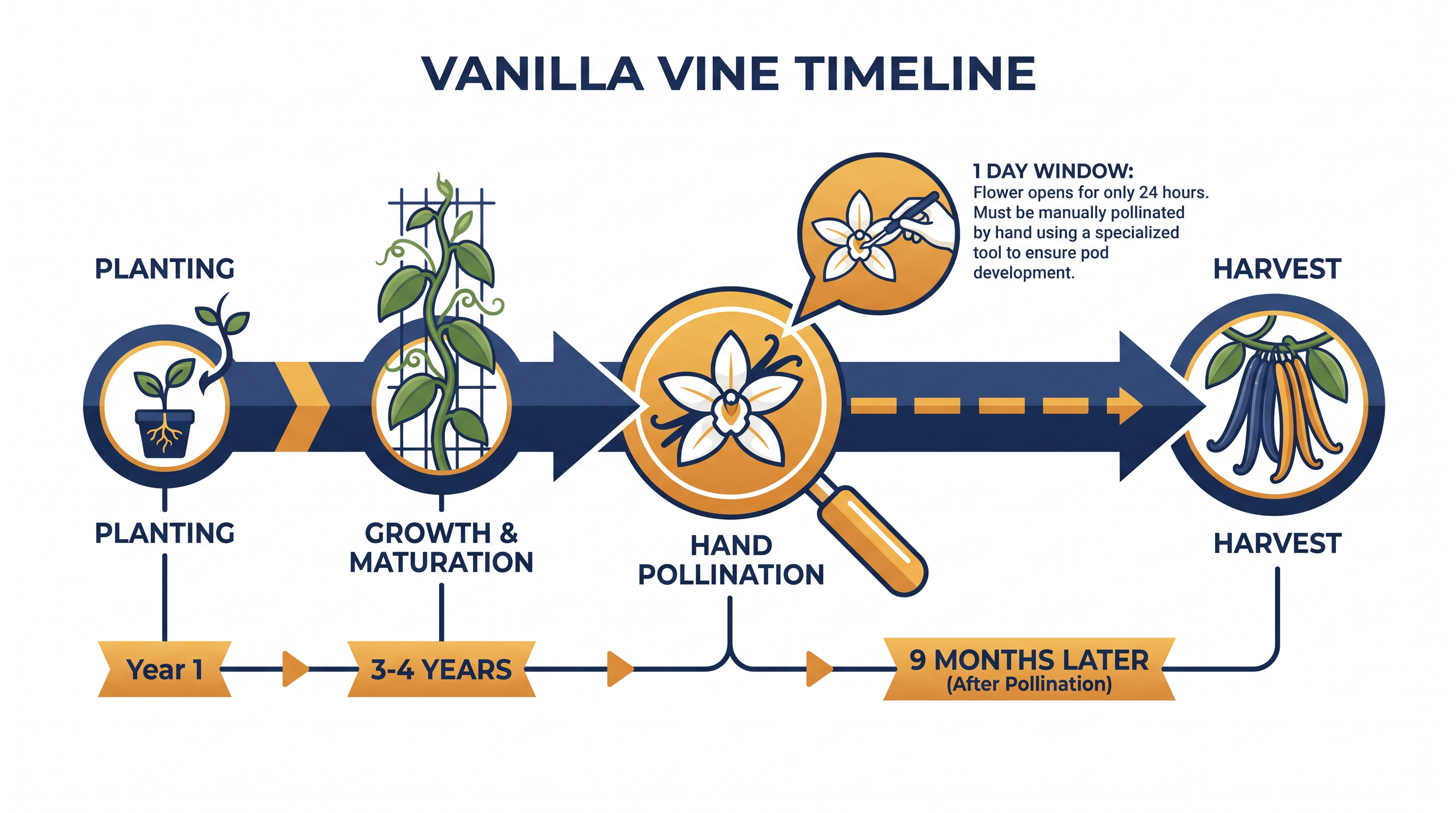
To understand the current glut, one must look back to the price spikes of 2016 and 2017. When prices hit record highs, farmers across the tropics rushed to plant vanilla vines. Because vanilla orchids take three to four years to mature and produce viable pods, the market did not immediately feel the impact of this aggressive expansion.[1]
By 2020, these new plantations began yielding massive harvests. Ordinarily, this would have triggered an immediate price correction. However, the COVID-19 pandemic intervened. Lockdowns sparked a global home-baking boom, temporarily surging demand for vanilla extract and artificially propping up prices for another two years.[1]
When pandemic baking habits faded, the delayed tsunami of vanilla beans finally crashed over the market. The Malagasy government attempted to shield its economy by imposing a strict minimum export price of $250 per kilogram. The policy backfired spectacularly. International buyers simply refused to pay the inflated rate, turning instead to cheaper beans from Uganda and Indonesia, or pivoting to synthetic vanillin.[1]
When pandemic baking habits faded, the delayed tsunami of vanilla beans finally crashed over the market.
Under mounting international pressure and sitting on mountains of unsold inventory, Madagascar abruptly canceled the $250 minimum export price in April 2023. The market collapsed almost overnight. Prices dropped from the artificial $250 floor to below $20 per kilogram for the lowest grades, unleashing chaos among exporters and desperate sellers.
Today, the Malagasy government is attempting a new intervention. A government-backed industry alliance recently approved a $38 million initiative to purchase 600 tonnes of processed vanilla directly from exporters. The goal is to absorb excess inventory and stabilize prices, but industry analysts warn that the structural oversupply is too vast for a single buyout to fix.
The crisis is not confined to Madagascar. In Uganda, which has emerged as a high-quality alternative source with two harvest seasons per year, farmers are experiencing the same whiplash. Farmgate prices for green vanilla in Uganda fell to roughly 5,000 Ugandan shillings (about $1.35) per kilo, frustrating growers who had invested heavily during the boom years.
For global food and beverage conglomerates, the price crash is a massive windfall. The global vanilla market, valued at nearly $3.9 billion, is heavily driven by the bakery, dairy, and cosmetics sectors. With natural vanilla now highly affordable, manufacturers are quietly reformulating products to replace synthetic flavorings with real vanilla extract, capitalizing on consumer demand for "clean label" ingredients.[2]
However, the threat of synthetic alternatives remains potent. Advances in biotechnology have allowed flavor companies to produce vanillin—the primary flavor compound in vanilla—from cheaper sources like clove oil, rice bran, and even wood pulp. When natural vanilla prices spike, multinationals quickly switch to these synthetics, permanently eroding a portion of natural vanilla's market share.
The current low prices are already sowing the seeds of the next crisis. Vanilla cultivation is incredibly labor-intensive; every single orchid must be hand-pollinated on the specific day it blooms. With prices barely covering the cost of labor, farmers in Madagascar and Uganda are beginning to abandon their vines.
Market historians note that this boom-and-bust cycle is a permanent feature of the vanilla trade. As vines are neglected or ripped out to make way for more profitable crops, global production capacity will quietly shrink. It will likely take several years to burn through the current stockpiles, but the fundamental mechanics of a future shortage are already in motion.[1]
For now, the world is awash in cheap vanilla. Consumers can expect premium ice creams, baked goods, and natural extracts to remain abundant and affordable. But for the farming communities that rely on the "black gold" for their survival, the wait for the next market upswing will be long and painful.[1][2]
How we got here
March 2017
Cyclone Enawo devastates Madagascar's vanilla crop, sending global prices soaring toward $600 per kilogram.
2017–2019
Farmers across Madagascar, Uganda, and Indonesia aggressively plant new vanilla vines in response to record prices.
2020–2022
New vines mature just as the COVID-19 pandemic sparks a home-baking boom, temporarily sustaining high demand.
April 2023
Madagascar abandons its $250/kg minimum export price floor, causing global vanilla prices to collapse.
Mid-2024
Madagascar exports a record 4,300 metric tons in a single season, confirming a massive global oversupply.
June 2026
Madagascar's vanilla alliance approves a $38 million plan to buy excess stock in an attempt to stabilize crashing prices.
Viewpoints in depth
Smallholder Farmers
Growers who bear the brunt of the market's volatility and are struggling to survive the price crash.
For the farmers in Madagascar and Uganda, the current market is devastating. During the boom years, many invested heavily in expanding their vanilla plots, relying on the crop as their primary path out of poverty. With farmgate prices now hovering near $1.50 per kilogram for green beans, the revenue barely covers the intense labor required for hand-pollination and security against crop theft. Consequently, many are abandoning their vines or switching to alternative cash crops, arguing that the global supply chain unfairly forces all the price risk onto the producers at the very bottom.
Global Flavor Conglomerates
Industrial buyers who prioritize supply chain stability and cost-efficiency.
Multinational food and flavor companies view the current oversupply as a necessary market correction. After years of paying exorbitant prices that forced them to reformulate products with synthetic vanillin, they are now capitalizing on the buyer's market to secure multi-year contracts for natural vanilla at rock-bottom rates. While they acknowledge the hardship faced by farmers, these conglomerates argue that artificial price floors—like Madagascar's failed $250/kg mandate—only distort the market and accelerate the industry's shift toward cheaper, lab-grown alternatives.
Market Analysts
Commodity experts who track the cyclical nature of agricultural markets.
Analysts see the vanilla crisis as a textbook example of a commodity boom-and-bust cycle. They point out that the 2017 price spikes made overplanting inevitable, and the subsequent crash was merely delayed by the pandemic's temporary demand boost. From their perspective, government interventions like stock-buying programs or export taxes are largely ineffective against fundamental supply-and-demand math. They predict that the market will only balance itself once enough farmers abandon the crop, setting the stage for the next inevitable shortage and price spike.
What we don't know
- Whether Madagascar's $38 million stock-buying initiative will successfully stabilize local prices or simply delay a further crash.
- Exactly how many farmers in Madagascar and Uganda have permanently abandoned vanilla cultivation this season.
- How long the current stockpiles of cured vanilla will last before global supply tightens again.
Key terms
- Farmgate Price
- The price paid directly to the farmer for raw, unprocessed crops, before any transport or export fees are added.
- Green Vanilla
- Raw, freshly harvested vanilla pods that have not yet undergone the lengthy curing and drying process.
- Cured Vanilla
- Vanilla beans that have been blanched, sweated, and dried over several months to develop their dark color and signature flavor.
- Vanillin
- The primary chemical compound responsible for the characteristic flavor and aroma of vanilla.
- Extraction-Grade
- Lower-moisture vanilla beans primarily sold to industrial manufacturers to be processed into liquid vanilla extract.
Frequently asked
Why is natural vanilla so expensive to produce?
Vanilla orchids must be hand-pollinated on the single day they bloom, and the vines take three to four years to mature. After harvest, the beans require months of labor-intensive curing.
Will vanilla prices go back up?
Yes. Because current prices are too low to sustain farmers, many are abandoning their crops. This will eventually lead to a supply shortage and a subsequent price spike.
What is synthetic vanilla made from?
Synthetic vanillin is often synthesized from cheaper, more abundant raw materials, including clove oil, rice bran, pine bark, and petrochemicals.
Why did Madagascar's price floor fail?
When Madagascar mandated a $250/kg minimum price, international buyers simply refused to pay it, opting to buy from cheaper countries like Uganda or switch to synthetic flavors.
Sources
Source coverage
2 outlets
3 viewpoints surfaced


[1]Aust & HachmannMarket Analysts
Vanilla Market Report: A Market in Prolonged Decline
Read on Aust & Hachmann →[2]Fortune Business InsightsGlobal Flavor Conglomerates
Global Vanilla Market Size, Share & Industry Analysis
Read on Fortune Business Insights →
Comments
Every angle. Every day.
Get food drink stories with full source coverage and perspective breakdowns delivered to your inbox.