
Global Recorded Music Revenue Projected to Hit $121 Billion by 2033, Driven by 'Fan Economy' and Expanded Rights
A new forecast from MIDiA Research projects the global recorded music market will surge to $121.1 billion by 2033, fueled by superfan monetization and subscriber growth in the Global South. While streaming remains the primary engine, labels are increasingly turning to merchandise, live events, and alternative platforms to capture the $18.5 billion "fan economy."
By Jana Rami

If you ask the average listener how the music industry makes its money, they will likely point to the $10.99 they pay Spotify or Apple Music every month. It is a reasonable assumption—subscription streaming rescued the business from the depths of the piracy era and still dominates the balance sheet today.
But the real growth engine of the next decade is not just about convincing more casual listeners to sign up for a monthly plan. According to a sweeping new forecast from MIDiA Research, the future of the music business lies in the "fan economy"—the merchandise, the social media integrations, and the superfan experiences that happen entirely outside the traditional streaming app.[1]
The numbers behind this shift are staggering. MIDiA projects that global recorded music retail revenue will surge by nearly 63 percent over the next eight years, climbing from $74.3 billion in 2025 to a record-breaking $121.1 billion by 2033. While traditional streaming will remain the industry's largest foundational pillar, the most rapid expansion is happening elsewhere. As mature markets in North America and Western Europe approach subscription saturation, record labels and artists are aggressively diversifying their portfolios to capture the premium that superfans are willing to pay.[2]
This emerging "fan economy" is expected to generate $18.5 billion annually by 2033. The category is a catch-all for the ways music is consumed and monetized beyond standard digital service providers (DSPs).
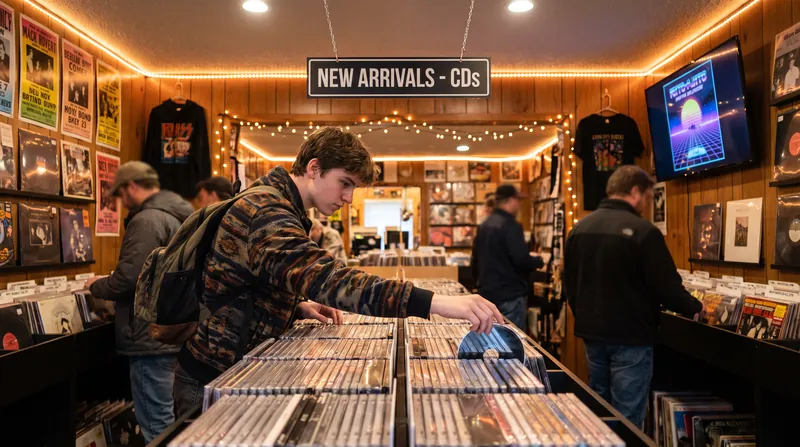
It encompasses the ongoing resurgence of physical media like vinyl and CDs, as well as streaming revenue generated through social media networks, fitness applications, and video games. Crucially, it also includes "expanded rights"—a growing practice where record labels take a calculated cut of an artist's branding deals, merchandise sales, and live event revenues in exchange for broader upfront investment.
"As streaming comes of age, the music industry's next growth phase will come from pulling new levers both within and beyond the subscription model," noted Tatiana Cirisano, MIDiA's vice president of music strategy, in the report's release. "A growing fan economy is illuminating opportunities outside of traditional streaming. Expanded rights will be central to this." For the major labels, this represents a fundamental pivot from simply distributing audio files to actively managing and monetizing the holistic brand of an artist across every conceivable consumer touchpoint.[1]
The broader industry data supports this accelerated trajectory. The International Federation of the Phonographic Industry (IFPI) recently reported that global trade revenues—the money that actually flows back to the record companies—crossed the $30 billion threshold for the first time in 2025, reaching $31.7 billion. That marked the eleventh consecutive year of growth, with physical formats outpacing digital growth for only the second time on record. Investment banks are similarly bullish, with industry models consistently highlighting superfan monetization as a multi-billion-dollar untapped opportunity that could dramatically uplift industry margins.[3]
However, the MIDiA forecast also highlights a growing structural tension between the retail platforms and the rightsholders. While total retail revenue is projected to hit $121.1 billion by 2033, the trade revenue flowing back to record companies is expected to grow at a slower pace, reaching $62.7 billion.
This widening gap reflects the reality that digital streaming services are keeping a larger share of the pie. DSPs are increasingly relying on bundle discounts, algorithmic discovery modes, and new audio-entertainment formats like audiobooks and podcasts—revenue streams that are not traditionally shared with music labels.[2]
Geographically, the map of the music industry is undergoing a profound realignment. The vast majority of new subscriber growth over the next decade will not come from the United States or the United Kingdom, but from the Global South. Markets across the Asia Pacific region, Latin America, and Sub-Saharan Africa already account for the majority of global music subscribers, and they are projected to capture an additional 8.5 percentage points of worldwide market share by 2033.
India, in particular, is positioned as a massive catalyst for this international expansion. The MIDiA report expects India to gain more overall recorded music revenue share than any other single market between 2025 and 2033, eventually becoming the third-largest market by total subscriber count, trailing only China and the United States. However, because subscription prices in emerging markets are significantly lower than in the West, the top five countries for actual revenue generation—the US, China, the UK, Germany, and Japan—are expected to remain unchanged.
To counter the lower average revenue per user in these booming international markets, streaming platforms in the West are preparing to test the limits of consumer pricing. The report anticipates a steady cadence of price increases across major DSPs, alongside the introduction of new premium subscription tiers and add-ons designed to extract more value from dedicated listeners.
Where opinion splits
Industry Analysts
Focuses on the structural shift from user acquisition to superfan monetization.
Market analysts argue that the music industry's next growth phase depends entirely on diversifying revenue streams. With subscription streaming reaching a saturation point in North America and Europe, the $18.5 billion fan economy represents the necessary next step. Analysts emphasize that platforms and labels must innovate with new premium tiers and non-DSP integrations to maintain their current growth trajectories.
Record Labels & Rightsholders
Emphasizes the importance of expanded rights to offset the growing share of revenue kept by digital platforms.
For major labels, the widening gap between retail revenue and trade revenue is a critical concern. As digital service providers keep a larger share of the pie through bundle discounts and algorithmic discovery modes, rightsholders are aggressively pursuing 'expanded rights.' By taking a stake in an artist's merchandise, branding, and live events, labels aim to capture a larger share of the fan economy and maximize their long-term returns.
Independent Creators
Values direct fan relationships and specialized CRM tools over platform-dependent streaming metrics.
Independent artists view the rise of the fan economy as a democratizing force. Rather than relying solely on algorithmic streaming payouts—which require millions of plays to generate a livable wage—creators are turning to direct-to-consumer tools and dedicated CRM platforms. By cultivating a direct, paying relationship with a smaller group of superfans, independent musicians can build sustainable careers outside the traditional major-label ecosystem.
Key points
- Global recorded music retail revenue is projected to reach $121.1 billion by 2033, a nearly 63 percent increase from 2025.
- The 'fan economy'—including physical media, merchandise, and non-DSP streaming—is expected to generate $18.5 billion annually.
- Expanded rights will become the industry's second-fastest-growing revenue category as labels diversify beyond traditional subscriptions.
- The Global South, led by India and Latin America, will drive the vast majority of new subscriber growth over the next decade.
- Industry Analysts
- Argues that the music industry's next growth phase depends on diversifying revenue streams and monetizing superfans as traditional streaming matures.
- Record Labels & Rightsholders
- Focuses on capturing a larger share of the fan economy through expanded rights and direct investments in artist branding.
- Independent Creators
- Values direct fan relationships and specialized CRM tools over platform-dependent streaming metrics to build sustainable careers.
Perspectives this story doesn't cover
- Casual listeners who may be priced out of superfan tiers
- Live music venue operators affected by expanded rights deals
Sources
Source coverage
3 outlets
3 viewpoints surfaced



- [1]HITS Daily DoubleIndustry Analysts
MIDiA Forecasts $121b Global Music Market by 2033
Read on HITS Daily Double → - [2]CelebrityAccessIndustry Analysts
Global Recorded Music Retail Revenue to Top $121 Billion by 2033, MIDiA Report Says
Read on CelebrityAccess → - [3]IFPIRecord Labels & Rightsholders
Global Music Report 2026: Global Recorded Music Revenues Grow 6.4%
Read on IFPI →

More in Entertainment
See all →Music Copyright
The 50/50 Split: How Music Publishing Rights Differ from Master Recording Rights
6 sources

Music Industry
US Recorded Music Revenue Hits $6 Billion in H1 2026, Driven by 58% Surge in CD Sales
5 sources
Virtual Production
How LED Volumes and Virtual Production Rewrote the Economics of Filmmaking
3 sources

Music History
Duane 'Keffe D' Davis Found Guilty of Orchestrating Tupac Shakur's 1996 Murder
3 sources

Comments
Every angle. Every day.
Get Entertainment stories with full source coverage and perspective breakdowns, free every day.