
France Test-Fires Upgraded M51.3 Ballistic Missile From Submarine for First Time
France successfully launched its latest-generation M51.3 ballistic missile from the nuclear-powered submarine Le Vigilant, marking the weapon's first test from a submerged vessel. The unarmed firing validates the submarine's strategic readiness following an extensive overhaul and reinforces Paris's nuclear deterrent amid heightened European security tensions.
By Hunter Cole

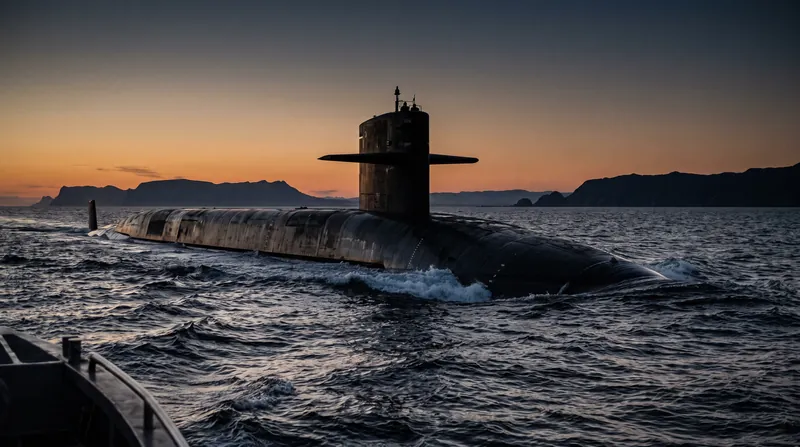
On October 6, the French Navy launched an M51.3 strategic ballistic missile from the submerged nuclear-powered submarine Le Vigilant off the coast of Brittany. The unarmed test flight crossed the North Atlantic on a suborbital trajectory, marking the first time the upgraded weapon has been fired from a vessel at sea. The missile impacted several hundred kilometers from any coastline.[1][2][3]
The Directorate General of Armaments tracked the missile throughout its hypersonic flight using coastal radar stations and the specialized tracking ship Monge. Operating in the Atlantic, the Monge utilizes massive radar arrays to capture telemetry and monitor the terminal phase of the reentry vehicles. The test was conducted under Operation SMERTRIOS to verify the complete submerged launch sequence.[3][4]
The launch represented the thirteenth overall flight of an M51 variant since the program began, and the seventh time the weapon has been fired from a French submarine. The M51 program was initiated to replace older missiles, bringing a massive leap in payload capacity. Every major overhaul of a French ballistic missile submarine is followed by a live acceptance test.[2]
The primary objective of the October 6 launch was an acceptance test for Le Vigilant itself, rather than a developmental flight. The submarine recently completed a periodic maintenance and repair availability, which involved extensive upgrades to its strategic weapons system. The successful firing validates those modifications and clears the vessel to return to active deterrence patrols.[2][3][4]
Technical Enhancements
Manufactured by ArianeGroup, the M51.3 is the third iteration of France's submarine-launched ballistic missile family. The weapon officially entered operational service on October 24, 2025, following a successful land-based test flight from the Biscarrosse launch site in southwestern France in 2023. Until the October 6 launch, however, the modernized variant had not been proven in a fully operational maritime environment.[2][3][4]
The upgraded variant introduces significant enhancements over the previous M51.2, extending the weapon's estimated range from 9,000 kilometers to more than 9,500 kilometers. The third stage of the missile has been redesigned to improve accuracy and accommodate advanced penetration aids. These modifications are specifically engineered to defeat modern, increasingly capable anti-ballistic missile shields deployed by potential adversaries.[2][3][4]
When deployed on active patrol, the M51.3 will carry the new TNO-2 oceanic nuclear warhead. The missile utilizes a multiple independently targetable reentry vehicle configuration, allowing a single launch to deliver several stealth-optimized warheads to different targets simultaneously. The Ministry of the Armed Forces emphasized that the October 6 test was conducted strictly without a nuclear payload.[1][3][4]
French President Emmanuel Macron observed the firing firsthand from the deck of a French Navy vessel. “This is a very important moment for our strategic credibility,” Macron told troops onboard following the launch. “Everything that has happened recently and what is happening today will be closely scrutinized by both our allies and our competitors alike, and it already is.”[2]
The European Umbrella
France currently spends approximately €5.6 billion annually to maintain its stockpile of 290 submarine- and air-launched warheads, making it the world's fourth-largest nuclear arsenal. As the European Union's sole nuclear-armed state, Paris has increasingly positioned its deterrent as a foundational element of continental security. Macron has recently proposed expanding France's nuclear posture to offer extended deterrence to European partners.[1]
The modernization of the sea-based arsenal reinforces that offer by ensuring the core of the French deterrent remains viable against evolving Russian air defenses. The Kremlin quickly responded to the launch, characterizing the test as part of a "dead end" anti-Russia strategy. Russian officials accused Europe of an obsession with militarization that undermines diplomatic dialogue.[1]
For European defense planners, the successful test serves as a tangible reminder of the continent's indigenous military capabilities. As debates continue in Brussels over the necessity of strategic autonomy, the M51.3 provides a concrete example of a European nation fielding a top-tier strategic asset entirely independent of American technology or command structures.[1][2]
The M51.3 integration is only one component of a broader overhaul of the French nuclear apparatus. The Ministry of the Armed Forces is concurrently funding the development of a next-generation hypersonic nuclear cruise missile, which will eventually equip upgraded variants of the Rafale fighter jet. This ensures both legs of the deterrent remain technologically relevant.[2]
Fleet Transition
Le Vigilant is one of four Triomphant-class ballistic missile submarines that form the backbone of the Strategic Oceanic Force. French doctrine dictates that at least one of these vessels is on active patrol at all times, guaranteeing a retaliatory strike capability. The M51.3 will eventually equip the entire class as the remaining submarines cycle through maintenance.[4]
The maintenance process is a massive industrial undertaking that requires millions of hours of labor from Naval Group and its subcontractors. Beyond stripping down and recertifying the sixteen vertical launch tubes, the overhaul involves refueling the submarine's nuclear reactor and upgrading its sonar systems. Validating the missile tubes with a live fire is the final hurdle before certification.[3][4]
The successful deployment of the M51.3 bridges the gap between the current fleet and the next generation of French submarines. The Ministry of the Armed Forces has already initiated the construction of new ballistic-missile submarines to eventually replace the Triomphant class. These next-generation vessels are being designed from the keel up to carry the M51 family deep into the century.[2][4]
Until those future submarines arrive, the upgraded Triomphant-class boats and their modernized payloads will carry the full weight of the oceanic deterrent. The successful flight from Le Vigilant confirms that the interim architecture is now fully operational. The French Navy has demonstrated that its second-strike capability remains intact and ready to deploy.[3][4]
Key points
- The French Navy launched the unarmed M51.3 missile from the SSBN Le Vigilant off the coast of Brittany.
- The test validates the submarine's strategic weapons system following a major three-year maintenance overhaul.
- The M51.3 variant features an extended range of over 9,500 kilometers and is designed to penetrate advanced anti-ballistic missile defenses.
- President Emmanuel Macron observed the launch, framing it as a demonstration of France's strategic credibility amid tensions with Russia.
What we don’t know
- The exact apogee and flight path of the test remain classified by the French Ministry of the Armed Forces.
- It is unclear exactly how rapidly the M51.3 will be retrofitted across the remaining three Triomphant-class submarines.
How we got here
Jan 2010
The first submarine launch of the original M51 missile takes place from the SSBN Le Terrible.
2023
ArianeGroup and the DGA complete the first land-based flight test of the modernized M51.3 from Biscarrosse.
Oct 2025
The M51.3 missile officially enters operational service within the French nuclear deterrent forces.
Oct 2026
The French Navy conducts the first submarine-launched acceptance test of the M51.3 from Le Vigilant.
- French Strategic Command
- Argues that continuous modernization of the sea-based deterrent is essential to guarantee a credible second-strike capability against evolving missile defenses.
- European Defense Advocates
- Views the French nuclear umbrella as a necessary and stabilizing force for continental security amid US political uncertainty.
- Russian State View
- Characterizes the missile test and France's broader military modernization as an escalatory strategy that undermines diplomatic dialogue.
Perspectives this story doesn't cover
- Non-proliferation advocates
- Local environmental groups in Brittany
Sources
Source coverage
5 outlets
3 viewpoints surfaced





- [1]ReutersRussian State View
France tests upgraded nuclear missile against backdrop of Russia tensions
Read on Reuters → - [2]Defense NewsFrench Strategic Command
France fires upgraded nuclear-capable missile from submarine for first time
Read on Defense News → - [3]Naval NewsEuropean Defense Advocates
French Navy Conducts Acceptance Firing of M51.3 missile From Le Vigilant SSBN
Read on Naval News → - [4]Army Recognition
France Fires New M51.3 Ballistic Missile From Nuclear Submarine Le Vigilant to Restore Readiness
Read on Army Recognition → - [5]Ministère des ArméesFrench Strategic Command
Tir d'acceptation d'un missile M51.3 depuis le SNLE Le Vigilant
Read on Ministère des Armées →
More in Defense & Security
See all →Autonomous Warfare
Pentagon Unveils Four-Star Autonomous Warfare Command to Scale Military Robotics and Drone Integration
6 sources

Next-Gen Fighters
Boeing Wins $20 Billion US Navy Contract to Build F/A-XX Sixth-Generation Strike Fighter
4 sources
Russian Economy
Russia Plans Record $202 Billion Defense Budget for 2027, a 27% Increase Over Original Estimate
5 sources

Nuclear Modernization
US Navy Advances W93 Nuclear Warhead into Full-Scale Engineering Development
5 sources
Comments
Every angle. Every day.
Get Defense & Security stories with full source coverage and perspective breakdowns, free every day.