
Federal Home Distilling Ban Faces Supreme Court Review After Circuit Courts Split
A 158-year-old federal law prohibiting the home distillation of spirits is heading toward a likely Supreme Court showdown after two federal appeals courts issued contradictory rulings.
By Kabir Mehra

- Home Distilling Advocates
- Argues that hobbyist distilling is a personal liberty and that the federal ban oversteps congressional taxing authority.
- Federal Regulators
- Maintains that the ban is a necessary and proper tool to prevent tax evasion and regulate the production of high-proof spirits.
- Legal Constitutionalists
- Focuses on the broader implications of the circuit split and the limits of federal power over in-home activities.
How we got here
July 1868
Congress passes a sweeping law banning the placement of distilling equipment in residential dwellings to thwart post-Civil War tax evasion.
1978
The federal government legalizes the home production of beer and wine for personal use, but leaves the ban on distilled spirits in place.
July 2024
A federal district court in Texas rules the home distilling ban unconstitutional, prompting a government appeal.
April 10, 2026
The 5th U.S. Circuit Court of Appeals strikes down the ban, declaring it an overreach of congressional taxing power.
April 21, 2026
The 6th U.S. Circuit Court of Appeals upholds the ban in a separate case, creating a direct circuit split.
Why it matters
If the Supreme Court strikes down the federal ban, it could pave the way for a grassroots distilling movement similar to the craft beer boom of the 1980s, allowing enthusiasts to legally experiment with homemade whiskeys, gins, and vodkas.
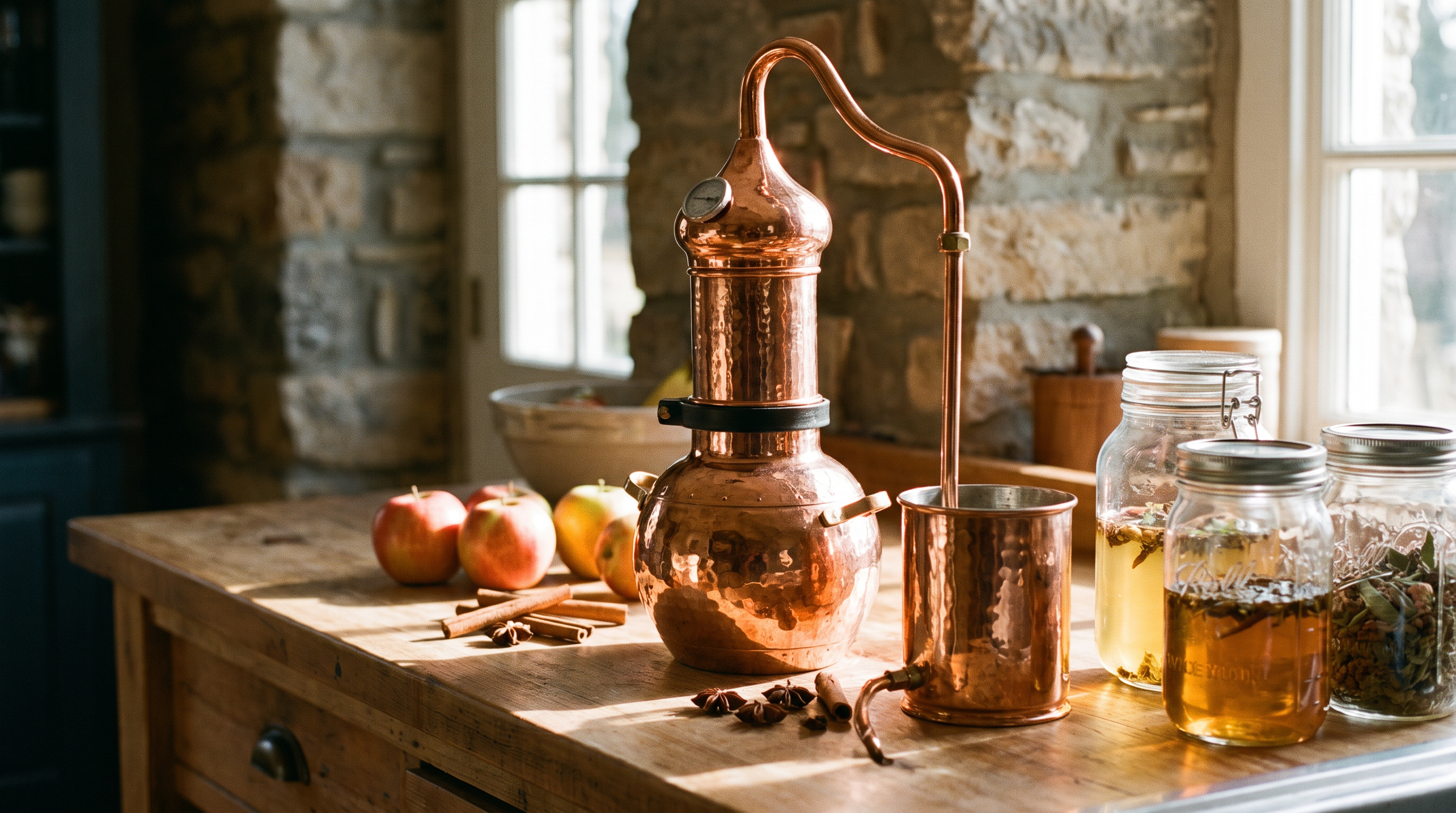
Imagine the scent of warm apple mash and the gleam of a copper still resting on your kitchen counter. For decades, culinary hobbyists have legally brewed beer and fermented wine at home, filling glass carboys with custom IPAs and rich pinot noirs. But the moment you apply heat to separate alcohol from water—attempting to craft your own whiskey, gin, or apple-pie vodka—you cross a hard line into a federal felony.[1]
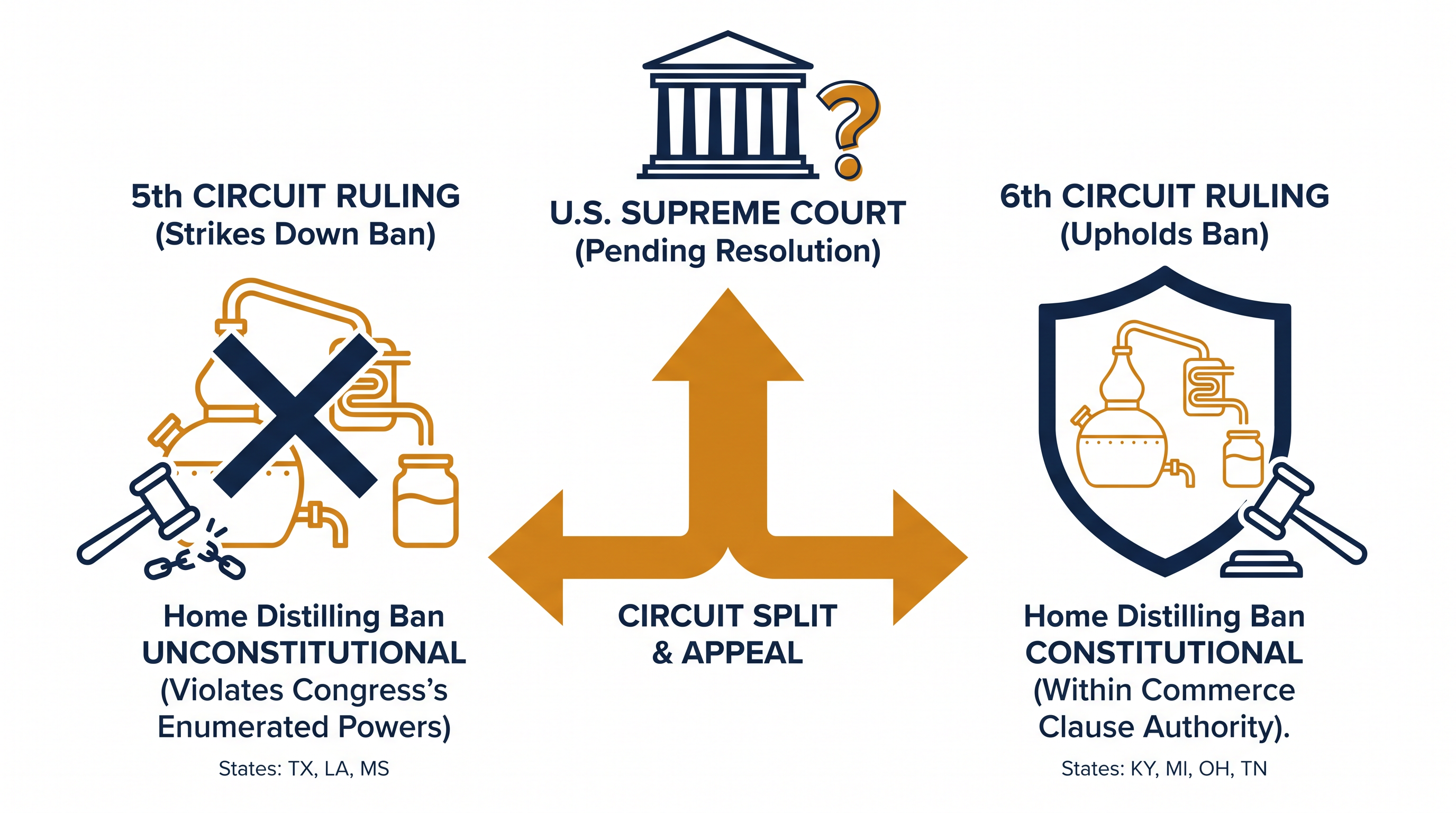
That 158-year-old boundary is now fracturing, opening a tantalizing possibility for home mixologists. In April 2026, the U.S. Court of Appeals for the 5th Circuit struck down the federal ban on home distilling, declaring it an unconstitutional overreach of Congress's taxing power.[1][2]
Yet, just eleven days later, the 6th Circuit reached the exact opposite conclusion in a separate case. That court upheld the ban, ruling that it remains a necessary tool for the government to collect excise taxes on alcohol.[4]
This rare and rapid circuit split has set the stage for a likely Supreme Court showdown. For cocktail enthusiasts who dream of dialing in their own botanical gin recipes, the legal landscape is currently suspended in a bizarre, high-stakes limbo.[4]
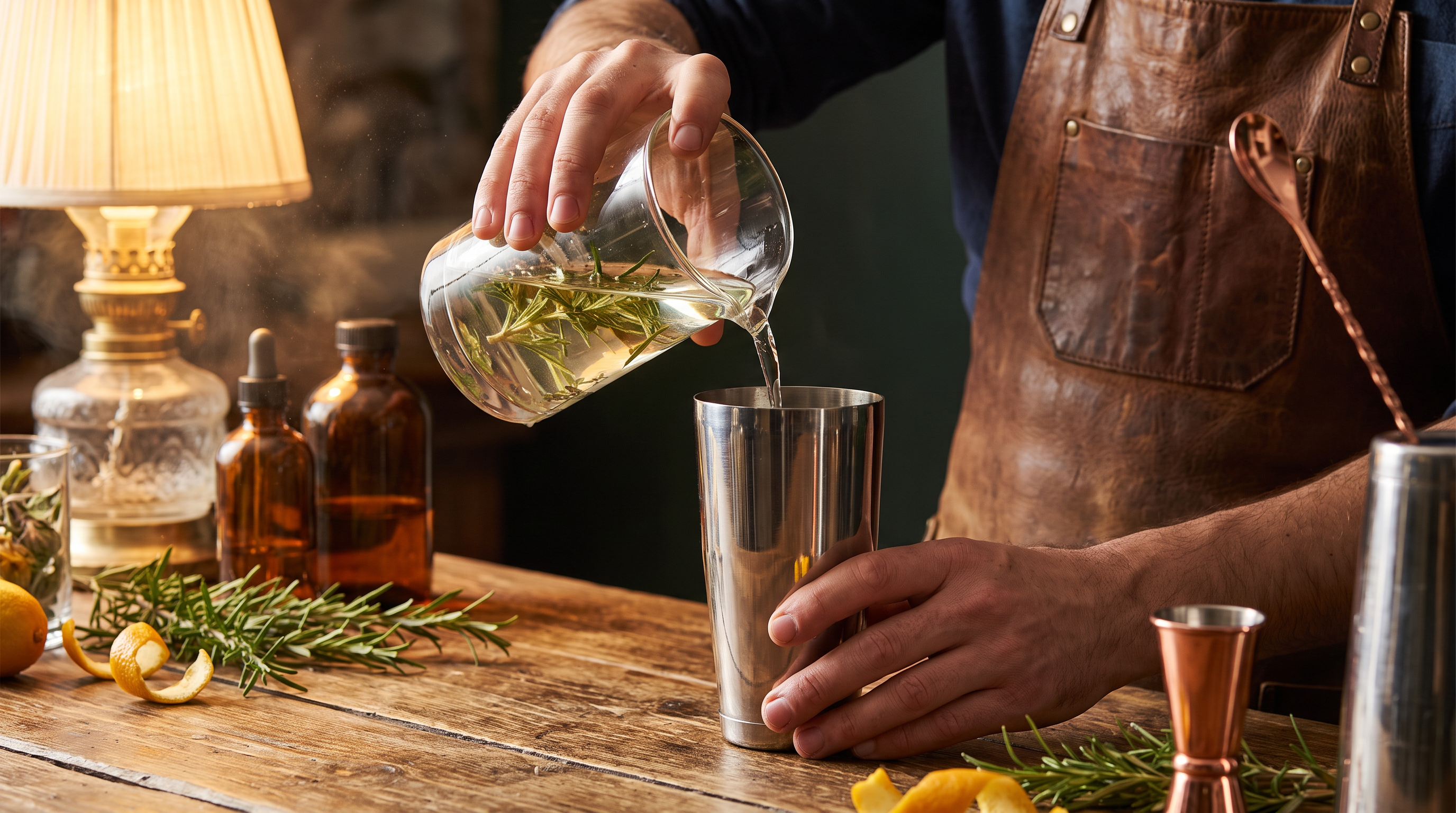
To understand why making a small batch of bathtub gin carries a potential $10,000 fine and up to five years in prison, you have to look back to the Reconstruction era. In 1868, Congress passed a sweeping law designed specifically to thwart liquor tax evasion in the wake of the Civil War.[2][3]
The statute explicitly banned the placement of distilling equipment in any dwelling house, shed, or yard connected to a residence. The government's logic was straightforward: if federal tax collectors couldn't easily see and monitor the still, they couldn't reliably tax the spirits flowing out of it.[1]
The statute explicitly banned the placement of distilling equipment in any dwelling house, shed, or yard connected to a residence.
Fast forward to today, where the Hobby Distillers Association—a passionate group of 1,300 enthusiasts who simply want to craft personal-use spirits—decided to challenge the law. In the 5th Circuit case, McNutt v. U.S. Department of Justice, the plaintiffs argued they were perfectly willing to pay taxes on their homemade liquor, but the government simply refused to grant them residential permits.[1][2]
Circuit Judge Edith Hollan Jones agreed with the hobbyists' plight. She wrote that the ban actually operates as an "anti-revenue provision." By forbidding the activity entirely, she argued, the government prevents the taxable spirits from ever coming into existence, fundamentally failing to raise revenue.[3]
Furthermore, Judge Jones warned that under the government's logic, Congress could theoretically criminalize any at-home activity—from remote work to small businesses—simply because it might conceal taxable income.[2][5]
But the 6th Circuit, deciding Ream v. U.S. Department of Treasury, viewed the constitutional landscape differently. They ruled that banning home stills is a "necessary and proper" method to enforce federal excise taxes, arguing that untaxed home liquor could undermine the broader commercial tax base.[4]
For the home cocktail enthusiast, this legal tug-of-war means you should hold off on firing up that copper alembic just yet. While the 5th Circuit injunction protects specific plaintiffs in its jurisdiction, the federal ban remains largely intact across the rest of the country.[2]
Furthermore, even if the Supreme Court eventually strikes down the federal prohibition nationwide, state laws remain a formidable patchwork. Many states have their own strict bans on residential distilling that would require separate, localized legislative battles to overturn.[1][2]
Still, the momentum is undeniable. Just as the federal legalization of homebrewing in 1978 sparked the American craft beer revolution, a victory for home distillers could unleash a massive new wave of grassroots cocktail innovation.[4]
If the Supreme Court takes the case and sides with the hobbyists, the art of the spirit could finally move from the shadows of illicit moonshining into the bright, creative space of the modern home kitchen.[4]
What to know
- Two federal appeals courts issued contradictory rulings in April 2026 regarding the 158-year-old federal ban on home distilling.
- The 5th Circuit struck down the ban as unconstitutional, while the 6th Circuit upheld it as a necessary tax enforcement tool.
- The resulting circuit split makes it highly likely that the U.S. Supreme Court will review the issue.
- Home distilling currently remains a federal felony punishable by up to five years in prison and a $10,000 fine.
- Even if the federal ban is lifted, enthusiasts will still have to navigate a patchwork of strict state-level prohibitions.
Where opinion splits
The Hobbyist's View
Enthusiasts argue they simply want the same rights as homebrewers and winemakers.
For the 1,300 members of the Hobby Distillers Association and countless other cocktail enthusiasts, the federal ban feels like an arbitrary relic. They point out that homebrewing beer and fermenting wine have been legal since 1978, fostering a massive culture of culinary experimentation. Hobbyists argue they are perfectly willing to pay federal excise taxes on their small-batch spirits, but the government's refusal to issue residential permits forces a passionate community into the shadows.
The Federal Government's View
Regulators maintain the ban is essential for protecting the excise tax base.
The Department of Justice and the Treasury Department argue that the 1868 law remains a 'necessary and proper' mechanism for tax collection. Because distilling equipment can rapidly produce high volumes of high-proof alcohol, regulators fear that allowing unregulated home stills would create a massive blind spot for tax evasion. They argue that striking down the ban undermines the government's ability to monitor and tax the broader commercial spirits industry.
The Constitutional Law View
Legal scholars are focused on the limits of congressional power over private homes.
Beyond the world of whiskey and gin, constitutional analysts see this case as a major test of federal overreach. The 5th Circuit's ruling highlighted a slippery slope: if the government can ban a harmless at-home hobby simply because it might conceal taxable activity, what stops Congress from criminalizing remote work or home-based businesses? The impending Supreme Court review will likely hinge on defining the exact boundaries of the Constitution's Taxation and Necessary and Proper clauses.
Key terms
- Excise Tax
- A legislated tax on specific goods or services at purchase, such as fuel, tobacco, and alcohol.
- Circuit Split
- A situation where two or more federal circuit courts of appeals issue contradictory rulings on the same legal issue, often prompting Supreme Court intervention.
- Necessary and Proper Clause
- A provision in the U.S. Constitution that allows Congress to make laws required to execute its other specific powers, such as the power to collect taxes.
- Alembic Still
- A traditional type of distilling apparatus, often made of copper, used to separate alcohol from a fermented mixture through boiling and condensation.
Unanswered questions
- Whether the U.S. Supreme Court will officially agree to hear the case in its upcoming term.
- How the federal government would regulate and tax home distilling permits if the outright ban is permanently struck down.
- Which states would move to legalize home distilling locally if the federal prohibition is lifted.
Reader questions
Can I legally distill whiskey at home right now?
No. Despite the 5th Circuit ruling, the federal ban remains largely intact across the country, and violating it carries a potential $10,000 fine and up to five years in prison.
Why is making beer legal but distilling illegal?
Congress legalized the home production of beer and wine for personal use in 1978. However, because distilled spirits are subject to a different, historically stricter excise tax structure, the 1868 ban on residential stills was never repealed.
What happens next with the circuit split?
Because the 5th and 6th Circuits issued contradictory rulings on the constitutionality of the ban, legal experts expect the U.S. Supreme Court to take up the case to establish a single national standard.
If the Supreme Court strikes down the ban, can I start distilling?
Not necessarily. Even if the federal prohibition is lifted, many individual states have their own strict laws banning home distilling that would still need to be overturned locally.
Sources
Source coverage
5 outlets
3 viewpoints surfaced





[1]The Spirits BusinessHome Distilling Advocates
US court strikes down 158-year home distilling ban
Read on The Spirits Business →[2]The Washington TimesFederal Regulators
Federal appeals court strikes down 158-year-old ban on home distilling
Read on The Washington Times →[3]The GuardianLegal Constitutionalists
US appeals court declares 158-year-old home distilling ban unconstitutional
Read on The Guardian →[4]Brew and BeyondHome Distilling Advocates
Circuit Split Complicates Federal Home Distilling Ban
Read on Brew and Beyond →[5]Fox6NowFederal Regulators
Federal court strikes down 158-year-old ban on home distilling
Read on Fox6Now →
Comments
Every angle. Every day.
Get food drink stories with full source coverage and perspective breakdowns delivered to your inbox.