
Explainer: Inside Oracle's $638 Billion Backlog and the High-Stakes Economics of AI Compute
Oracle's record-breaking $638 billion cloud backlog is driven by a massive $300 billion compute contract with OpenAI, highlighting the unprecedented scale—and financial risk—of the AI infrastructure boom.

Share this story
Oracle's fiscal fourth-quarter 2026 earnings report delivered a number that temporarily broke Wall Street's models: a $638 billion backlog of contracted future revenue. This metric, known as Remaining Performance Obligations (RPO), represents a staggering 363 percent year-over-year increase.
To put the scale into perspective, Oracle's backlog now exceeds the entire gross domestic product of many developed nations and surpasses the disclosed backlogs of its largest cloud competitors. The surge was driven by a 93 percent jump in cloud infrastructure revenue, signaling that Oracle's aggressive pivot from legacy database software to high-performance AI computing has fundamentally reshaped the company's trajectory.[1]
However, peeling back the layers of this unprecedented backlog reveals a highly concentrated bet on the future of artificial intelligence. Financial analysts estimate that more than half of this $638 billion figure—roughly $300 billion—is tied to a single, massive five-year compute contract with OpenAI.
This agreement, widely associated with the ambitious "Stargate" AI infrastructure initiative, requires Oracle to provide up to 4.5 gigawatts of cloud compute capacity annually. The deal cements Oracle's status as a premier provider of the specialized infrastructure required to train and serve frontier AI models, but it also tethers the company's financial future to the success of a single, highly scrutinized startup.[3]
To understand why a single company requires $300 billion in computing power, one must look at the evolving economics of generative AI. As models scale from billions to trillions of parameters, the computational cost of both training (teaching the model) and inference (running the model for users) grows exponentially.
OpenAI's transition toward continuous, agentic AI systems that perform complex, multi-step reasoning tasks requires an uninterrupted supply of high-bandwidth, low-latency compute. Oracle has positioned itself to capture this demand by architecting its cloud infrastructure specifically for AI workloads, utilizing advanced RDMA (Remote Direct Memory Access) networking that allows tens of thousands of GPUs to function as a single, unified supercomputer without data bottlenecks.
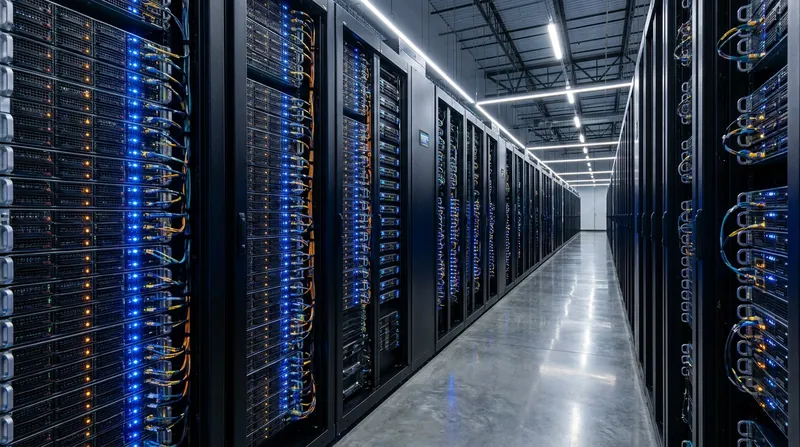
Fulfilling a contract of this magnitude requires physical infrastructure on a scale rarely seen outside of national public works projects. Oracle is currently developing massive data centers across the United States, effectively acting as the general contractor for the AI boom. This build-out is extraordinarily expensive. In fiscal year 2026, Oracle's capital expenditures skyrocketed 162 percent to $55.7 billion.
Because the company is building the infrastructure today for revenue that will be recognized over the next five to seven years, Oracle reported a negative free cash flow of $23.7 billion for the year. To bridge this gap, the company raised $43 billion in debt and $5 billion in equity, with plans to raise an additional $40 billion in fiscal 2027.[1]
Despite the record-breaking revenue and backlog numbers, Wall Street reacted to the earnings report with severe apprehension. Oracle's stock tumbled significantly in the weeks following the disclosure, dropping as much as 35 percent in June 2026. Investors are not doubting the demand for AI; rather, they are digesting the sheer scale of the capital Oracle must deploy to service that demand.
The market is increasingly concerned about the "cash conversion timeline"—the reality that only about 12 percent of the $638 billion backlog is expected to translate into actual revenue over the next twelve months. The rest remains locked in multi-year commitments that require immediate, massive upfront spending to fulfill.[2]
The primary source of investor anxiety is counterparty risk. OpenAI, despite its massive valuation and recent $122 billion funding round, remains deeply unprofitable. The ChatGPT maker is projected to lose approximately $14 billion in 2026 as it races to achieve artificial general intelligence.
If OpenAI's revenue growth stalls, or if the broader venture capital market tightens and prevents future fundraising, the startup could struggle to pay its colossal cloud computing bills. Because Oracle's data centers are being custom-built for these specific, high-density AI workloads, a default by a major client would leave Oracle holding extremely expensive, highly specialized assets that cannot be easily repurposed for traditional enterprise cloud customers.[1]
Oracle has been remarkably transparent about these vulnerabilities. In its annual 10-K financial filing submitted to the Securities and Exchange Commission, the company explicitly outlined the risks associated with its infrastructure binge. Management warned that if major clients fail to perform under their contracts, Oracle could be locked into multi-year commitments for excess data center space and related financings without receiving the corresponding revenue.
Furthermore, the filing highlighted that the terms and pricing adjustments in Oracle's long-term data center leases do not perfectly align with the duration of its customer contracts, creating a structural duration mismatch that could squeeze profit margins if demand suddenly cools.[2][3]
Beyond financial risks, Oracle faces severe physical constraints in executing its $638 billion backlog. The company noted in its filings that the construction of gigawatt-scale data centers is increasingly delayed by supply chain bottlenecks for specialized components like advanced cooling systems and power transformers.
More critically, the sheer electricity required to power these facilities—often equivalent to the draw of a mid-sized city—has triggered pushback from local governments and utility providers. Securing the necessary permits and grid connections has become the primary bottleneck in the AI arms race, forcing cloud providers to explore alternative energy sources, including co-locating data centers directly adjacent to nuclear power plants.[2]
Oracle is not alone in taking these massive, concentrated bets. The broader technology sector has entered an unprecedented infrastructure supercycle. According to industry data, six major technology companies—including Oracle, Microsoft, Amazon, and Meta—have collectively pledged over $850 billion for data center leases that have not yet commenced.
The top four hyperscalers are projected to invest nearly $725 billion in AI infrastructure in 2026 alone. This collective spending spree underscores a shared industry consensus: the risk of under-investing and missing the AI revolution is viewed as an existential threat, whereas the risk of over-building is merely a financial penalty.[2]
To mitigate the immense capital burden, Oracle has begun restructuring how it finances these mega-projects. The company reported that the prepaid and customer-supplied hardware portions of its large AI contracts now total $75 billion.
By requiring clients like OpenAI to supply their own GPUs or pay significant sums upfront, Oracle substantially reduces the amount of external debt it must raise to build out the physical data center shells and power infrastructure. This co-investment model shifts a portion of the hardware depreciation risk back onto the AI developers, though Oracle remains on the hook for the long-term real estate and energy leases.[1]
If the current trajectory of AI scaling holds, Oracle's strategy will likely be remembered as a masterclass in infrastructure positioning. By securing the largest workloads from the most prominent AI developers, Oracle is effectively building the foundational utility grid for the 21st-century digital economy.
The $638 billion backlog guarantees a steady, massive stream of revenue through the early 2030s, provided the underlying clients remain solvent. In this scenario, the short-term cash flow deficits and debt accumulation are necessary growing pains for a company transitioning from a software vendor into a foundational pillar of global computing infrastructure.
Ultimately, Oracle's $638 billion backlog serves as the most concrete metric available for the scale of the generative AI transition. It moves the conversation away from theoretical model capabilities and grounds it in the hard reality of concrete, steel, silicon, and electricity.
The success or failure of this massive capital deployment will not only determine Oracle's corporate fate but will also serve as the ultimate stress test for the AI industry's economic viability. If the intelligence generated by these gigawatt-scale data centers can produce trillions of dollars in economic value, the $300 billion compute contracts will be viewed as bargains. If not, the tech sector faces a historic reckoning.
Key points
- Oracle reported a record $638 billion in remaining performance obligations, up 363% year-over-year.
- Over $300 billion of this backlog is reportedly tied to a single five-year compute contract with OpenAI.
- To meet this demand, Oracle's capital expenditures surged 162% to $55.7 billion, resulting in negative free cash flow.
- The company plans to raise an additional $40 billion in fiscal 2027 to fund further data center construction.
What we don’t know
- Whether OpenAI can generate enough revenue—or secure enough continuous venture funding—to honor its $300 billion commitment over the next five years.
- How quickly Oracle can actually convert its massive backlog into recognized revenue given supply chain and power grid constraints.
- Whether the AI industry's demand for compute will continue to grow exponentially, or if algorithmic efficiencies will eventually reduce the need for gigawatt-scale data centers.
How we got here
September 2025
Reports first emerge of a massive $300 billion, five-year cloud compute agreement between Oracle and OpenAI for the Stargate project.
March 2026
OpenAI closes a $122 billion funding round, bolstering its ability to finance its massive infrastructure commitments.
June 2026
Oracle reports a record $638 billion backlog but reveals $55.7 billion in capital expenditures, sending its stock tumbling.
July 2026
Oracle's annual 10-K filing explicitly outlines the financial and supply chain risks associated with its massive data center build-out.
- Financial Skeptics
- Market analysts concerned about counterparty risk and the sheer scale of debt required.
- Infrastructure Bulls
- Investors who view the massive capex as a necessary moat-building exercise for the AI era.
- Industry Analysts
- Technology researchers focused on the physical and logistical constraints of the data center build-out.
Perspectives this story doesn't cover
- Local Municipalities
- Environmental Advocates
Sources
Source coverage
3 outlets
3 viewpoints surfaced



- [1]The Motley FoolInfrastructure Bulls
Oracle Just Revealed a Massive $638 Billion Backlog. Here's Why the Stock Fell Anyway.
Read on The Motley Fool → - [2]Seeking AlphaFinancial Skeptics
Most large tech companies list data center-related risks in their financial filings
Read on Seeking Alpha → - [3]Fierce NetworkIndustry Analysts
Oracle's massive OpenAI deal raises equally big questions
Read on Fierce Network →

More in Artificial Intelligence
See all →AI Infrastructure
OpenAI Unveils 'Jalapeño' Inference Chip With Broadcom to Control Full Stack and Cut Compute Costs
3 sources

AI Infrastructure
Michael Burry Warns of Systemic Contagion Risk in $573 Billion AI Financing Web
5 sources
AI Safety
ByteDance and Alibaba Pull AI Companion Features Ahead of China's New Rules on 'Emotional Dependency'
2 sources

Federal AI Policy
U.S. Government Mandates 'Eyes Off' Data Privacy and Domestic Hosting for All Federal AI Contracts
3 sources

Comments
Every angle. Every day.
Get Artificial Intelligence stories with full source coverage and perspective breakdowns, free every day.