
EU to Launch Formal Accession Talks with Ukraine and Moldova as Hungary Lifts Veto
The European Union will officially open membership negotiations with Ukraine and Moldova on Monday after Hungary's new government dropped a 17-month veto. The breakthrough marks a major step in the bloc's eastward expansion and provides a critical security boost for Kyiv and Chisinau.
By Factlen Editorial Team
- European Union Leadership
- Views enlargement as a strategic necessity to ensure stability and security in a world marked by growing uncertainty.
- Ukrainian and Moldovan Governments
- Sees formal EU integration as a critical validation of their domestic reforms and a vital security guarantee against Russian aggression.
- Hungarian Government
- Supports integration conditionally, prioritizing the protection of ethnic minorities and demanding strict adherence to standard, lengthy accession procedures.
What's not represented
- · Russian Federation leadership
- · Euroskeptic political factions within other EU member states
Why this matters
Formal EU accession talks transition Europe's support for Ukraine and Moldova from symbolic solidarity to concrete institutional integration. The grueling, years-long process will fundamentally reshape the continent's economic and security architecture while testing the bloc's unity against Russian opposition.
Key points
- EU ambassadors agreed to officially open membership talks with Ukraine and Moldova on June 15 in Luxembourg.
- Hungary's new Prime Minister Peter Magyar lifted the 17-month veto imposed by his predecessor, Viktor Orban.
- Budapest dropped its opposition after securing expanded language and cultural rights for the ethnic Hungarian minority in Ukraine.
- Magyar stressed there will be no fast-track procedure, projecting a 10-to-15-year timeline for Ukraine's accession.
- Hungary also lifted its veto on the European Peace Facility, unlocking billions in weapons reimbursements for EU states.
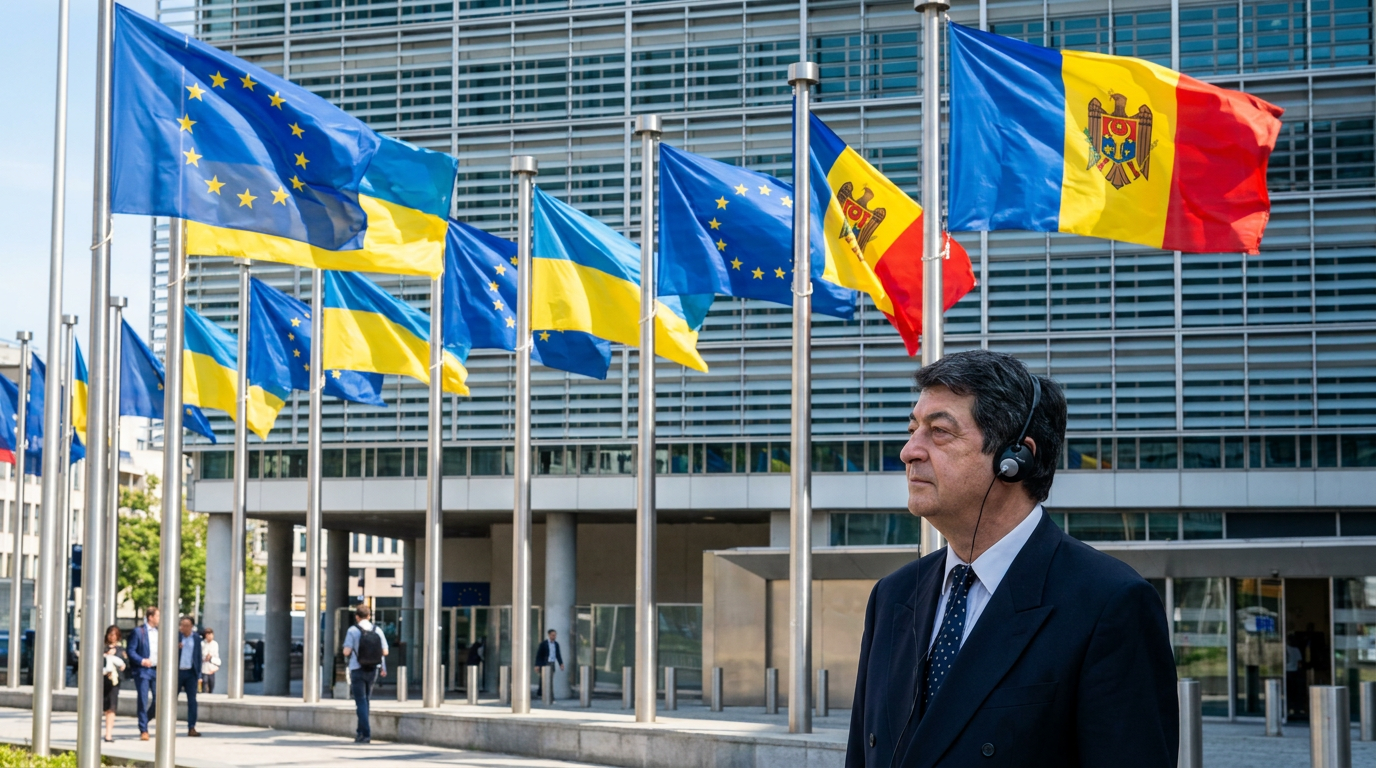
The European Union will officially launch membership negotiations with Ukraine and Moldova next week, marking a historic milestone in the bloc's eastward expansion. At a meeting in Brussels on Friday, ambassadors from the 27 EU member states agreed to convene an intergovernmental conference in Luxembourg on Monday to formally open the talks.[1][3]
The diplomatic breakthrough comes after Hungary's newly elected government lifted a 17-month veto that had frozen Kyiv's integration process. The blockade was originally imposed by former nationalist Prime Minister Viktor Orban, who maintained close ties with Moscow and bitterly opposed Ukrainian accession before his government was ousted in April 2026.[3][4]
European Council President Antonio Costa and European Commission President Ursula von der Leyen confirmed the agreement in a joint statement, framing the expansion as a strategic necessity. "This is a recognition of the determination, courage and hard work shown by both countries in advancing reforms, even in the face of immense challenges," the leaders noted, adding that a larger union is in Europe's common interest amid growing global uncertainty.[1][3]
Monday's proceedings will initiate the "fundamentals" section of the accession process. This first phase focuses on aligning the candidate countries' foundational legislation with EU standards, particularly concerning the rule of law, democratic institutions, and anti-corruption measures. It represents the first of six negotiating clusters that collectively encompass 33 distinct policy areas.[3][4]

The path to Monday's summit was cleared after intensive negotiations between Kyiv, Brussels, and Budapest. Hungary's new Prime Minister, Peter Magyar, who took office in May, agreed to drop the veto in exchange for a comprehensive agreement regarding the ethnic Hungarian minority living in Ukraine's western Zakarpattia region.[1][5]
Magyar had previously insisted that his government would not support the launch of negotiations until the rights of the Hungarian community were fully restored. The resulting compromise provides expanded guarantees for language rights, education, and cultural preservation, resolving an issue that had long been a primary friction point between the neighboring nations.[3][4][5]
Magyar had previously insisted that his government would not support the launch of negotiations until the rights of the Hungarian community were fully restored.
Despite lifting the immediate blockade, Magyar has made it clear that Budapest will not support any expedited timeline for Kyiv's membership. The Hungarian leader emphasized that the standard, rigorous accession procedures must be followed without exception.[3]

Furthermore, Magyar has projected that successfully closing all 33 accession chapters will likely take Ukraine between 10 and 15 years. He has also indicated that Hungary intends to hold a national referendum on Ukraine's final admission to the bloc once the negotiation process concludes.[3]
For Ukraine and Moldova, the formal opening of talks represents far more than economic integration; both capitals view EU membership as a critical, long-term security guarantee against Russian aggression. The two nations were granted candidate status in June 2022, a largely symbolic gesture of solidarity following Russia's full-scale invasion, but the transition to formal negotiations signals concrete institutional alignment.[1][3][4]
Moscow has consistently opposed the eastward expansion of Western institutions. The Kremlin maintains that exerting influence over its "near abroad"—a term it uses for post-Soviet states—is a fundamental requirement for Russian national security.[1]
The diplomatic thaw in Budapest is also yielding immediate material benefits for Kyiv's defense. Alongside the accession agreement, Hungary's new government has lifted its veto on the European Peace Facility (EPF), a mechanism used to reimburse EU member states for weapons supplied to Ukraine.[2][6]

The EPF blockade had previously trapped billions of euros in unpaid reimbursements. Unlocking these funds is expected to provide positive reinforcement for member states that have depleted their own military stockpiles to support Ukraine, potentially accelerating the procurement of critical air defense systems.[2][6]
While Monday's conference in Luxembourg will be celebrated as a historic victory in Kyiv and Chisinau, European diplomats caution that the hardest work lies ahead. The accession process is notoriously complex, requiring candidate countries to overhaul vast sectors of their economies and legal systems, from agricultural regulations to judicial independence.[3]
How we got here
June 2022
Ukraine and Moldova are officially granted EU candidate status following Russia's full-scale invasion.
December 2023
EU leaders agree in principle to open accession talks, but progress is stalled by Hungarian opposition.
April 2026
Hungarian Prime Minister Viktor Orban is ousted in national elections, paving the way for a policy shift.
May 2026
Peter Magyar takes office as Hungary's new Prime Minister and begins negotiations with Kyiv over minority rights.
June 12, 2026
EU ambassadors officially agree to launch the accession process after Hungary drops its veto.
Viewpoints in depth
European Union Leadership
Views enlargement as a strategic necessity to ensure stability and security in a world marked by growing uncertainty.
For Brussels, the formal integration of Ukraine and Moldova is both a moral imperative and a geopolitical necessity. EU leaders argue that leaving Eastern European democracies in an institutional gray zone only invites further Russian aggression. By opening formal accession talks, the bloc aims to anchor Kyiv and Chisinau firmly within the Western democratic and economic sphere. Officials emphasize that while the process will be long and rigorous, the ultimate goal of a larger, more unified European Union is essential for the continent's long-term security and economic resilience.
Hungarian Government
Supports integration conditionally, prioritizing the protection of ethnic minorities and demanding strict adherence to standard accession procedures.
Under Prime Minister Peter Magyar, Budapest has shifted from outright obstruction to conditional cooperation. The Hungarian government's primary stated concern has been the protection of the ethnic Hungarian minority in Ukraine's Zakarpattia region, securing guarantees for language and cultural rights before agreeing to lift its veto. However, Magyar remains staunchly opposed to any 'fast-track' accession for Kyiv. Hungarian officials argue that the integrity of the EU requires Ukraine to meet every standard across all 33 policy chapters, a process they project will take over a decade, and they reserve the right to hold a national referendum on the final membership decision.
Ukrainian and Moldovan Governments
Sees formal EU integration as a critical validation of their domestic reforms and a vital security guarantee against Russian aggression.
For Kyiv and Chisinau, the transition from symbolic candidate status to formal negotiations is a monumental victory. Both governments view EU membership not just as an economic opportunity, but as an existential security guarantee that permanently removes them from Moscow's sphere of influence. Ukrainian officials argue that their citizens are literally fighting and dying for European values, making their accession a unique historical case. They acknowledge the grueling bureaucratic work ahead but view the opening of the 'fundamentals' cluster as proof that their anti-corruption and institutional reforms are yielding tangible diplomatic results.
What we don't know
- How quickly Ukraine and Moldova can implement the sweeping domestic reforms required to close the 33 negotiating chapters.
- Whether Hungary will follow through on its threat to hold a national referendum on Ukraine's final admission to the bloc.
- How Russia might retaliate politically or militarily as Kyiv and Chisinau formally integrate into European institutions.
Key terms
- Accession Chapters
- The 33 specific policy areas, ranging from agriculture to the rule of law, that a candidate country must align with EU standards before joining the bloc.
- European Peace Facility (EPF)
- An EU funding mechanism used to reimburse member states for the cost of weapons and military equipment supplied to Ukraine.
- Intergovernmental Conference
- A formal meeting between the EU and a candidate country that marks the official opening of membership negotiations.
Frequently asked
Why were the talks delayed?
Negotiations were paused for 17 months due to a veto by former Hungarian Prime Minister Viktor Orban, who opposed Ukraine's membership and maintained close ties with Russia.
What changed Hungary's position?
Hungary's new Prime Minister, Peter Magyar, agreed to lift the veto after securing a comprehensive deal with Kyiv to protect the language and cultural rights of the ethnic Hungarian minority in Ukraine.
Does this mean Ukraine is joining the EU immediately?
No. The formal negotiations are a complex, bureaucratic process that requires aligning national laws with EU standards. Hungarian leadership estimates the process could take 10 to 15 years.
Sources
Source coverage
6 outlets
3 viewpoints surfaced





[1]Al JazeeraEuropean Union Leadership
EU agrees launch of accession process for Ukraine and Moldova
Read on Al Jazeera →[2]RBC UkraineHungarian Government
Hungary's Magyar lifts Orbán's veto on EU arms funds for Ukraine
Read on RBC Ukraine →[3]RTLEuropean Union Leadership
EU says to resume membership talks with Ukraine on Monday
Read on RTL →[4]The New Voice of UkraineUkrainian and Moldovan Governments
Hungary lifts veto, clearing way for Ukraine-EU talks to open on June 15
Read on The New Voice of Ukraine →[5]AzerNEWSHungarian Government
Hungary lifts veto on Ukraine's EU membership talks
Read on AzerNEWS →[6]Ukrainska PravdaUkrainian and Moldovan Governments
European Commission cannot confirm reports that Hungary unblocked €6.6 billion from the European Peace Facility
Read on Ukrainska Pravda →
Every angle. Every day.
Get news politics stories with full source coverage and perspective breakdowns delivered to your inbox.