
EU's CSDDD Forces Global Firms to Map and Monitor Supply Chain Human Rights and Environmental Risks
The European Union’s Corporate Sustainability Due Diligence Directive shifts supply chain ethics from voluntary goals to legally binding mandates. Large companies now face strict liability for the environmental and labor practices of their deepest supplier tiers.

- Corporate Compliance Officers
- Focuses on the immense data challenge, legal liability, and the administrative burden of mapping deep supply chain tiers.
- Supply Chain Partners & SMEs
- Highlights the cascade effect and advocates for shared responsibility and fair contracting rather than risk-shifting.
- Human Rights & Environmental Advocates
- Views the directive as a historic victory that ends plausible deniability and establishes crucial civil liability.
- Strategic Business Leaders
- Sees the mandate as an opportunity to overhaul operations and gain a competitive advantage through resilient partnerships.
Why this matters
Any company doing business in Europe—or supplying a multinational that does—will soon face strict legal and financial liability for the actions of their subcontractors, fundamentally rewiring global procurement and ending the era of plausible deniability.
Key points
- The CSDDD requires large companies to actively prevent and mitigate human rights and environmental risks in their supply chains.
- Following the Omnibus I update, the rules apply to firms with over 5,000 employees and €1.5 billion in turnover.
- Non-EU companies generating over €1.5 billion within the EU are directly subject to the mandate.
- Penalties for non-compliance include fines of up to 5% of global net turnover and civil liability.
- In-scope companies must share the cost of compliance with their smaller suppliers rather than shifting the risk.
The era of plausible deniability in global supply chains is officially over. For decades, multinational corporations could rely on voluntary sustainability pledges and supplier codes of conduct to manage their environmental and human rights footprints. If a subcontractor three tiers down was found using forced labor or illegally dumping toxic waste, the lead firm could claim ignorance. The European Union’s Corporate Sustainability Due Diligence Directive (CSDDD) permanently dismantles that defense, shifting supply chain ethics from a voluntary public relations exercise to a strict legal mandate.[4][6]
Adopted into EU law and recently refined by the "Omnibus I" legislative package in early 2026, the CSDDD is a conduct-based regulation. It requires large companies to actively identify, prevent, mitigate, and remediate adverse human rights and environmental impacts across their entire "chain of activities." This means a company is now legally accountable not just for its own direct operations and subsidiaries, but for its upstream suppliers and downstream distribution networks.[1][5][8]
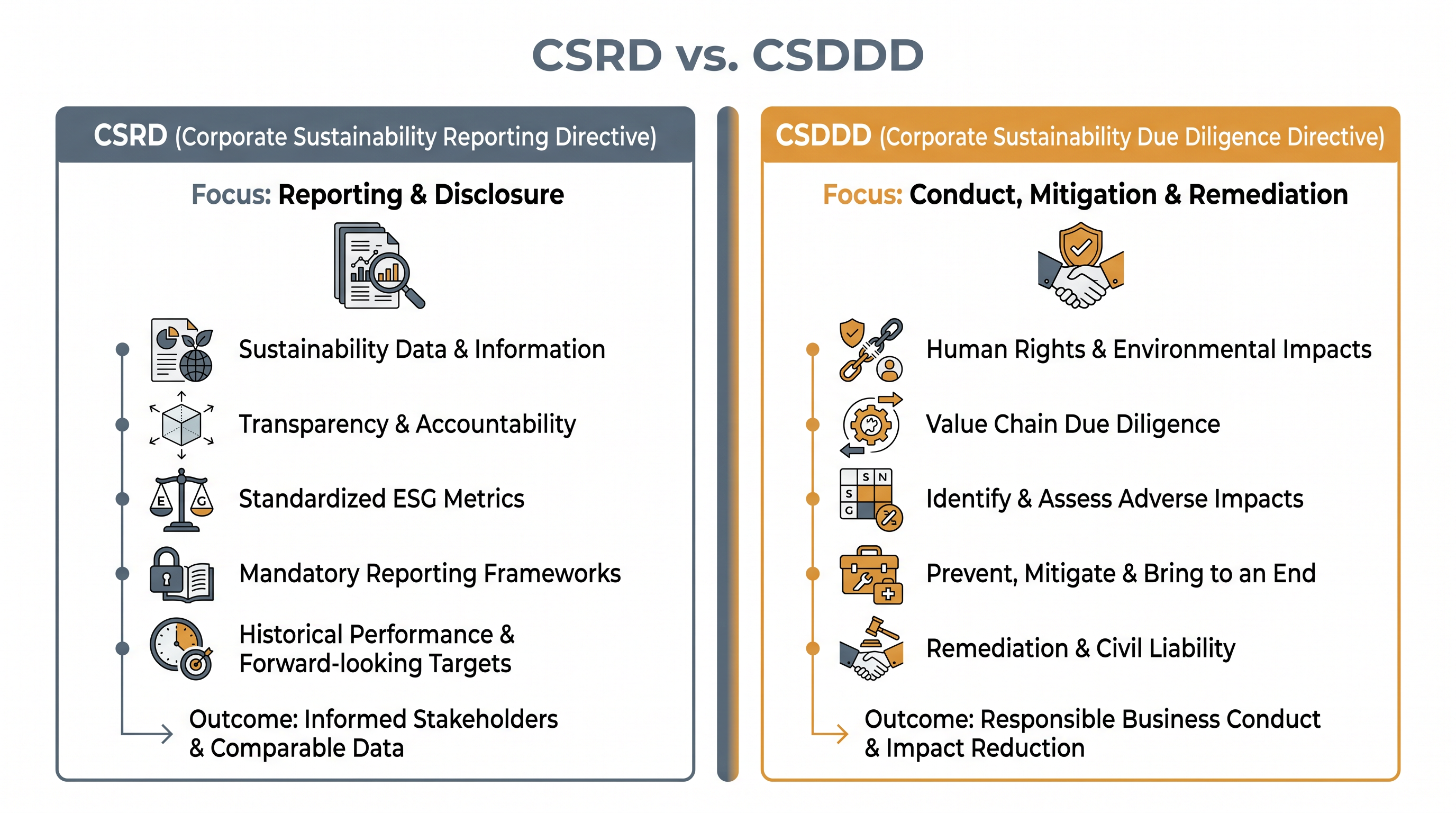
Unlike the EU’s Corporate Sustainability Reporting Directive (CSRD), which focuses strictly on expanding and standardizing ESG disclosures, the CSDDD is fundamentally about action. While the CSRD forces companies to report on their impacts, the CSDDD forces them to fix them. It is not a reporting rule; it is a behavioral mandate that requires companies to build an ongoing, auditable due-diligence program and prove with defensible evidence that they are addressing harms.[1][7]
The scope of the directive is massive, driven by a powerful extraterritorial mechanism. Following the Omnibus I amendments, the regulation applies directly to EU-based companies with more than 5,000 employees and a net worldwide turnover exceeding €1.5 billion. Crucially, it also captures non-EU companies—including major US and Asian multinationals—that generate more than €1.5 billion in net turnover within the EU market, regardless of their global employee count.[1][2][4]
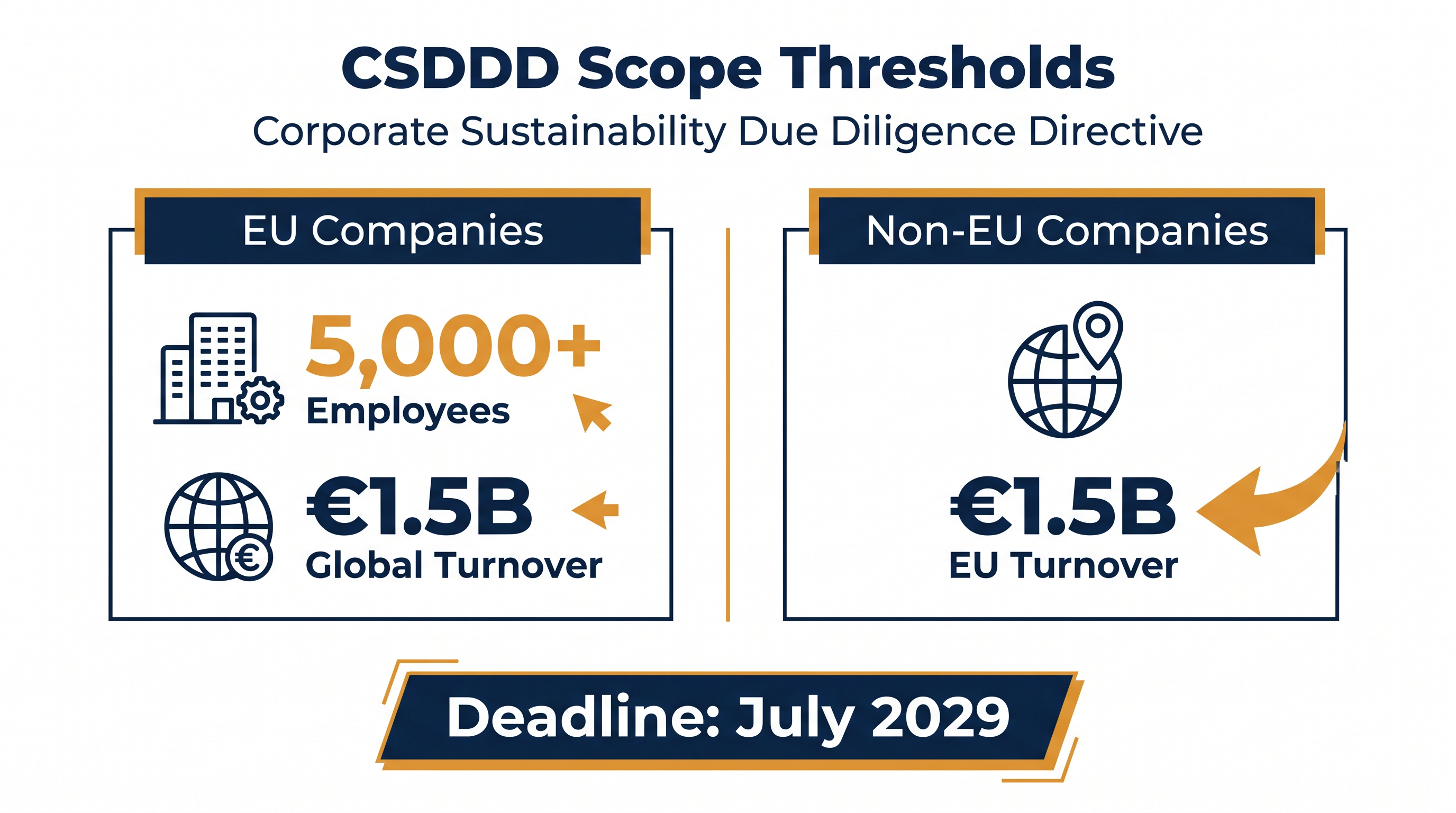
For these in-scope companies, compliance is mandatory by July 2029. The financial stakes for failure are severe. Non-compliance can trigger administrative fines of up to 5% of a company’s global net turnover. Furthermore, the directive introduces civil liability, allowing affected communities, workers, or NGOs to sue corporations in EU Member State courts for damages caused by a failure to meet due diligence obligations.[1][2][4][8]
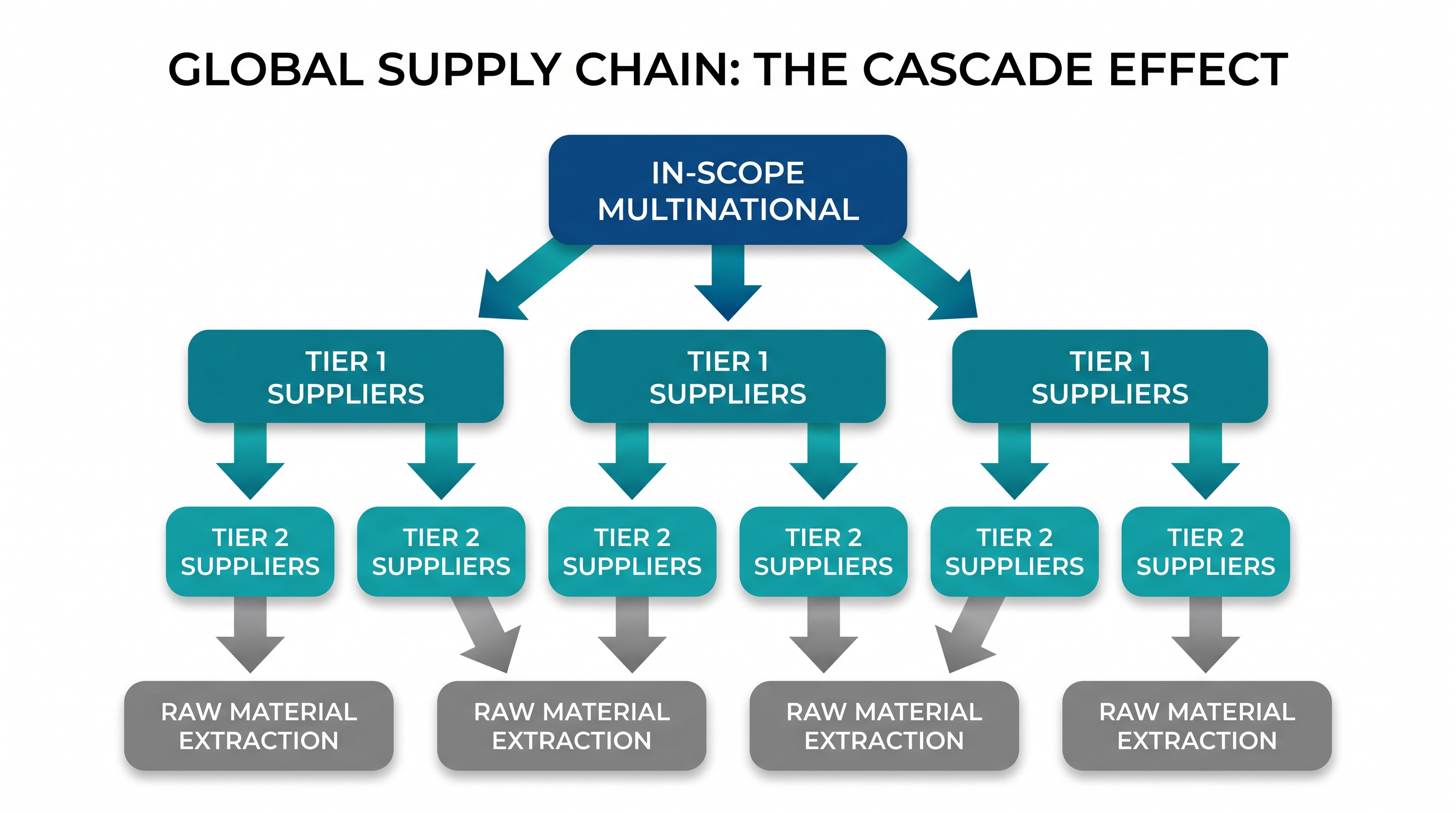
However, the true impact of the CSDDD extends far beyond the estimated 1,000 to 2,000 mega-corporations directly in scope. The directive relies on a "cascade effect" to regulate the global economy. Because in-scope companies are legally liable for their value chains, they must force their smaller, out-of-scope suppliers to comply with strict environmental and labor standards in order to maintain commercial relationships.[1][2][4]
However, the true impact of the CSDDD extends far beyond the estimated 1,000 to 2,000 mega-corporations directly in scope.
This means that a mid-sized manufacturer in Ohio or a logistics provider in Vietnam will inevitably face CSDDD requirements if they supply an in-scope European or multinational buyer. These smaller suppliers will be required to provide contractual assurances, submit to independent third-party audits, and share granular data on their own sourcing and emissions.[4][8]
Historically, lead firms managed supply chain risk through a practice known as "risk-shifting"—using their superior bargaining power to push all compliance burdens and costs onto their suppliers via rigid contracts. The CSDDD explicitly targets this adversarial dynamic. The directive mandates that contractual assurances obtained from small and medium-sized enterprises (SMEs) must be fair, reasonable, and non-discriminatory.[3][8]
Furthermore, the law requires lead firms to actively support their suppliers. If an in-scope company demands independent third-party verification from an SME, the lead firm must bear the cost of that audit. This shift toward shared responsibility forces buyers to collaborate with their suppliers to fix problems, rather than simply terminating contracts at the first sign of trouble, which often drives abuses further underground.[3][8]
Operationalizing these requirements presents a monumental data and governance challenge. Procurement and compliance teams can no longer rely on self-reported supplier questionnaires. They must deploy sophisticated mapping tools to gain visibility into deep supply chain tiers—often down to the raw material level. Companies are increasingly turning to forensic science, isotopic testing, and advanced carbon accounting platforms to verify the origin of materials and track supplier-level emissions.[4][5][6]
The directive also elevates the role of stakeholder engagement. High-quality due diligence under the CSDDD cannot be conducted in a corporate vacuum. Companies are legally expected to engage directly with affected stakeholders—including local communities, workers, and civil society organizations—to identify risks and design effective mitigation strategies. This engagement must be integrated into core business functions, from product development to strategic planning.[2]
As the 2029 enforcement deadline approaches, legal and business analysts are observing a divergence in corporate responses. Some firms are adopting a "tactical compliance" approach, doing the bare minimum to mitigate legal risk and satisfy regulatory checklists. Others are pursuing "strategic compliance," using the CSDDD mandate as a catalyst to completely overhaul their supply chains, build resilient supplier partnerships, and gain a competitive advantage in a market increasingly driven by sustainable practices.[9]
Ultimately, the CSDDD represents the end of global regulatory consensus and the beginning of a fragmented, high-stakes compliance environment. While it overlaps with national laws like Germany’s Supply Chain Act and the US Uyghur Forced Labor Prevention Act, the EU directive sets a new, unified ceiling for corporate accountability. For global businesses, the mandate is clear: map the supply chain, share the burden of compliance, and prepare to prove every claim.[1][10]
How we got here
February 2022
The European Commission first adopts the proposal for the CSDDD.
July 2024
The original text of the directive is published in the EU Official Journal.
December 2025
The EU Parliament approves the Omnibus I package, narrowing the scope and adjusting timelines.
March 2026
The Omnibus I amendments officially take effect, collapsing the phased rollout into a single tier.
July 2029
The final deadline for all in-scope companies to fully comply with the due diligence requirements.
Viewpoints in depth
Corporate Compliance Officers
Focuses on the immense data challenge and legal liability.
For compliance and procurement teams, the CSDDD represents a monumental administrative and operational hurdle. They emphasize that mapping deep supply chain tiers—often down to the raw material level—requires sophisticated tracking software and forensic science that many companies do not yet possess. Their primary concern is the sheer volume of data required to prove compliance to EU regulators and the severe financial penalties associated with administrative failures.
Supply Chain Partners & SMEs
Highlights the cascade effect and the need for fair contracting.
Smaller suppliers globally are acutely aware that they will bear the brunt of the directive's operational demands through the 'cascade effect.' They advocate strongly for the CSDDD's provisions that mandate shared responsibility. From their perspective, lead firms must pay for the independent audits they demand and offer fair, non-discriminatory contracts, rather than simply using their market power to shift all legal and financial risks downstream.
Human Rights & Environmental Advocates
Views the CSDDD as a historic victory that ends plausible deniability.
Civil society organizations and environmental advocates celebrate the directive as the end of voluntary, toothless ESG pledges. They place immense value on the introduction of civil liability, which finally provides a legal pathway for affected communities and workers in developing nations to sue European buyers in EU courts for damages. For this camp, the law's success hinges on strict enforcement and the total elimination of corporate 'risk-shifting.'
What we don't know
- How strictly individual EU Member States will enforce civil liability claims in their national courts.
- Whether the €1.5 billion threshold will be lowered in future legislative sessions to capture more mid-sized firms.
- How non-EU jurisdictions will retaliate or align their own trade policies in response to the directive's extraterritorial reach.
Key terms
- CSDDD
- The Corporate Sustainability Due Diligence Directive, an EU law requiring large firms to mitigate environmental and human rights risks in their supply chains.
- CSRD
- The Corporate Sustainability Reporting Directive, a separate EU law focused on standardizing how companies disclose their ESG data.
- Extraterritoriality
- The legal principle allowing the EU to enforce its regulations on non-EU companies based on their economic activity within the European market.
- Risk-Shifting
- The traditional corporate practice of using strict contracts to push all compliance burdens and liabilities onto smaller suppliers.
- Omnibus I
- A late-2025/early-2026 EU legislative package that narrowed the scope and extended the timeline of the CSDDD.
Frequently asked
Who is directly required to comply with the CSDDD?
EU companies with over 5,000 employees and €1.5 billion in global turnover, and non-EU companies generating over €1.5 billion in revenue within the EU.
When do the CSDDD rules take effect?
Following the Omnibus I amendments, the requirements will officially apply to in-scope companies starting July 26, 2029.
What happens if a company violates the directive?
Companies face administrative fines of up to 5% of their global net turnover, alongside civil liability that allows victims to sue for damages in EU courts.
How does this affect small and medium-sized enterprises (SMEs)?
While not directly in scope, SMEs in the supply chains of larger companies will be forced to comply via contractual assurances and audits demanded by their buyers.
Sources
Source coverage
10 outlets
4 viewpoints surfaced










[1]Certainty SoftwareCorporate Compliance Officers
CSDDD: The Complete Guide to the Corporate Sustainability Due Diligence Directive
Read on Certainty Software →[2]BSRHuman Rights & Environmental Advocates
EU CSDDD Finalized: Key Due Diligence Expectations Remain Intact
Read on BSR →[3]Oxford UniversityHuman Rights & Environmental Advocates
What Does the EU CSDDD Say About Contracts
Read on Oxford University →[4]OritainSupply Chain Partners & SMEs
The era of plausible deniability in global supply chains is at an end
Read on Oritain →[5]IntegrityNextCorporate Compliance Officers
CSDDD Scope, Thresholds, And Timeline
Read on IntegrityNext →[6]SedexHuman Rights & Environmental Advocates
Corporate Sustainability Due Diligence Directive
Read on Sedex →[7]NormativeCorporate Compliance Officers
CSDDD compliance guide
Read on Normative →[8]Danish Institute for Human RightsSupply Chain Partners & SMEs
What is the Corporate Sustainability Due Diligence Directive (CSDDD)?
Read on Danish Institute for Human Rights →[9]University of MichiganStrategic Business Leaders
The Impact of the EU Corporate Sustainability Due Diligence Directive on US Companies
Read on University of Michigan →[10]Factlen Editorial TeamStrategic Business Leaders
Synthesis by Factlen editorial team
Read on Factlen Editorial Team →
Comments


Every angle. Every day.
Get meta stories with full source coverage and perspective breakdowns delivered to your inbox.