
Discovery of Massive Bronze Age City in Kazakhstan Shatters 'Nomadic Only' Steppe Theory
Archaeologists have mapped a 140-hectare Bronze Age settlement on the Kazakh steppe, revealing a sophisticated urban center with industrial-scale metallurgy that challenges long-held assumptions about ancient nomadic societies.
By Factlen Editorial Team
- Eurasian Archaeologists
- Argue that the steppe hosted complex urban centers capable of industrial-scale metallurgy.
- Metallurgical Historians
- Focus on Semiyarka as the missing industrial link in the Eurasian tin-bronze supply chain.
- Traditional Steppe Theorists
- Previously maintained that the harsh climate of the Eurasian grasslands necessitated a highly mobile lifestyle.
What's not represented
- · Modern Kazakh Cultural Historians
- · Indigenous Steppe Communities
Why this matters
For decades, history books have portrayed the ancient Eurasian steppe as a barren highway for nomads. The discovery of Semiyarka rewrites this narrative, proving that indigenous steppe communities engineered sophisticated, permanent cities and managed complex industrial supply chains that rivaled the recognized cradles of early civilization.
Key points
- Archaeologists have mapped Semiyarka, a 140-hectare Bronze Age settlement in northeastern Kazakhstan.
- The discovery challenges the long-held theory that ancient steppe societies were exclusively nomadic.
- The site features a kilometer of rectilinear earthworks, multi-room households, and a massive central building.
- A dedicated industrial zone provides the first evidence of large-scale tin-bronze production on the Kazakh steppe.
- The city's strategic location near the Irtysh River and Altai Mountains suggests it was a major regional trade hub.
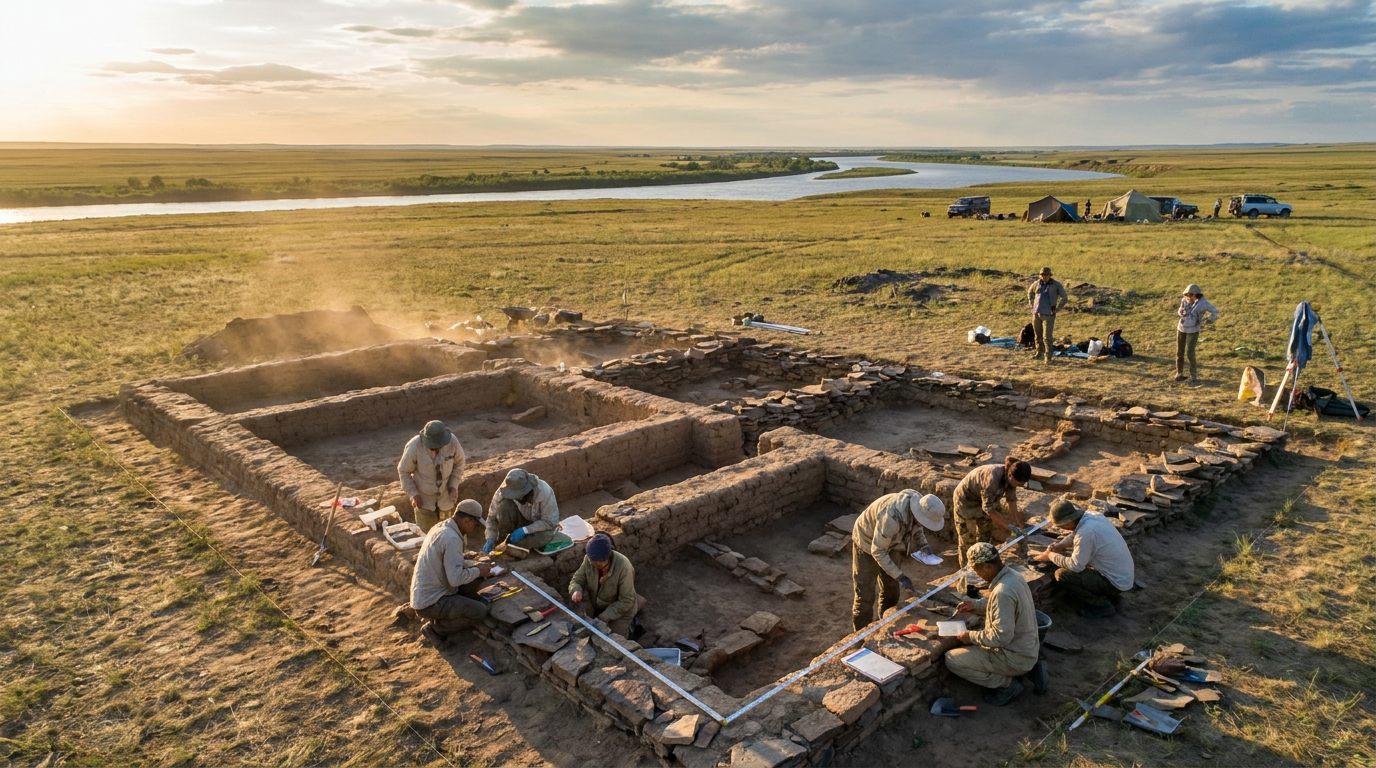
For decades, the vast grasslands of the Eurasian steppe were thought to be the exclusive domain of nomadic pastoralists during the Bronze Age. But the formal survey of Semiyarka—a 140-hectare settlement in northeastern Kazakhstan—has shattered that assumption. Known as the "City of Seven Ravines," the site reveals a level of urban sophistication and industrial capacity previously considered impossible for mobile steppe communities. The discovery provides compelling evidence that the ancient inhabitants of Central Asia were capable of engineering genuine urban centers and managing complex supply chains.[1][3][4][5]
The primary evidence anchoring this paradigm shift comes from a landmark study published in the journal Antiquity, which details the first comprehensive geophysical survey and excavation of the site since its initial discovery in the early 2000s. Researchers from University College London, Durham University, and Kazakhstan's Toraighyrov University mapped a sprawling urban footprint that dwarfs typical Bronze Age steppe camps, which rarely exceeded 30 hectares. Dating to approximately 1600 B.C., Semiyarka now stands as the largest known ancient site of its kind in the region.[1][2][6][7]
The strongest evidence for permanent urban planning lies in the site's architectural remains. Drone surveys and magnetometry revealed two distinct rows of rectilinear earthworks stretching for over a kilometer. Inside these earthen banks, archaeologists found the foundations of multi-room households constructed with mud-brick walls. This highly structured layout indicates a sedentary population that invested heavily in permanent infrastructure, a stark departure from the seasonal campsites traditionally associated with the era.[1][3][4][5]

At the intersection of these residential rows sits a massive central structure, measuring twice the size of the surrounding households. While the physical footprint is undeniable, the evidence regarding its exact function remains circumstantial. Researchers hypothesize that it may have served as a communal gathering space, a ceremonial center, or the residence of a powerful ruling family. Further excavation is required to confidently determine the political or religious hierarchy that governed the city.[2][3][4][8]
Beyond its architecture, Semiyarka's most paradigm-shifting feature is its dedicated industrial zone. On the southeastern edge of the settlement, archaeologists uncovered a dense concentration of crucibles, metallic slag, copper ores, and finished bronze artifacts, including a remarkably preserved axehead. This sector provides the first concrete evidence of an organized, large-scale production chain for tin-bronze on the Kazakh steppe.[1][2][7][8]
Beyond its architecture, Semiyarka's most paradigm-shifting feature is its dedicated industrial zone.
The presence of this metallurgical hub solves a long-standing archaeological puzzle. Museums hold hundreds of thousands of tin-bronze artifacts from the Eurasian Bronze Age, yet evidence of where and how they were manufactured has remained elusive. Semiyarka demonstrates that steppe communities possessed the organizational capacity to manage complex supply chains, likely importing raw copper and tin from the nearby Altai Mountains to forge a highly sought-after alloy.[3][4][5][8]

The city's strategic geography further supports its role as a regional powerhouse. Perched on a promontory overlooking the Irtysh River, Semiyarka would have controlled a vital artery for movement and trade across Central Asia. Excavated pottery shards suggest the site was predominantly inhabited by the Alekseevka-Sargary culture, but researchers also found artifacts linked to the more nomadic Cherkaskul people. This points to a dynamic economy where urban metallurgists traded manufactured goods with mobile pastoralists.[1][2][3][6]
Despite these robust findings, areas of transparent uncertainty remain. The exact population size of Semiyarka at its peak is still unknown, as only surface-level surveys and limited trench excavations have been completed. Additionally, while the site clearly demonstrates a transition toward sedentary urbanism, it is unclear what environmental or social pressures triggered this shift around 1600 B.C., or why the city was eventually abandoned.[1][4][5][6]
What is certain is that the "nomadic only" theory of the Eurasian steppe requires a fundamental rewrite. The evidence from Semiyarka proves that the ancient inhabitants of Central Asia were not merely wandering herdsmen on the margins of civilization. Instead, they were capable of engineering genuine urban centers, managing industrial-scale metallurgy, and laying the foundations for complex societies that rivaled their contemporaries in the more traditionally recognized cradles of the ancient world.[2][4][5][7]

The implications of this discovery extend far beyond the borders of modern-day Kazakhstan. For generations, historical narratives have framed the steppe as a vast, empty highway used primarily by migrating hordes to transport ideas and technologies between the "civilized" urban centers of Europe and East Asia. Semiyarka forces a reevaluation of the steppe itself as an independent crucible of innovation, where indigenous populations developed their own unique models of urbanization and industrial production.[2][4][6][8]
The metallurgical evidence is particularly compelling because tin-bronze requires a sophisticated understanding of alloy ratios and temperature control. Unlike pure copper, which is relatively soft, adding tin creates a durable metal essential for advanced weaponry, tools, and status symbols. The sheer volume of slag and crucibles found at the site indicates that Semiyarka's metalworkers were not just producing for local consumption, but were likely supplying a vast trade network that spanned the Eurasian continent.[1][3][5][7]
As excavations continue under the European Research Council's DREAM project, archaeologists hope to unearth absolute dating materials and deeper stratigraphic layers. These future discoveries will be critical for mapping the full lifecycle of the "City of Seven Ravines." Until then, Semiyarka stands as a monumental testament to the ingenuity of Bronze Age steppe societies, permanently altering the archaeological map of human history.[1][2][3][8]
How we got here
Early 2000s
Researchers from Toraighyrov University first identify the Semiyarka site in northeastern Kazakhstan.
2018
A joint UK-Kazakh team initiates the first comprehensive geophysical investigations of the settlement.
Nov 2025
The full scale of the 140-hectare city and its metallurgical zone is revealed in a landmark study published in Antiquity.
Viewpoints in depth
Eurasian Archaeologists
Researchers who argue the steppe hosted complex urban centers capable of industrial-scale metallurgy.
This camp points to the undeniable physical evidence at Semiyarka—140 hectares of planned earthworks, multi-room households, and a dedicated industrial zone—as proof that steppe societies were not exclusively nomadic. They argue that the sheer volume of tin-bronze artifacts found across Eurasia could only have been produced by highly organized, sedentary communities that managed complex supply chains and controlled strategic trade routes.
Traditional Steppe Theorists
Historians who previously maintained that the harsh climate of the Eurasian grasslands necessitated a highly mobile lifestyle.
For decades, this perspective dominated the archaeological consensus. Proponents argued that the ecological constraints of the steppe—extreme temperatures and limited agricultural potential—made permanent urban settlements unviable. While the discovery of Semiyarka challenges this view, some traditionalists caution that such 'proto-cities' may have been rare exceptions or seasonal hubs rather than year-round metropolises, pending further stratigraphic evidence.
Metallurgical Historians
Experts focused on Semiyarka as the missing industrial link in the Eurasian tin-bronze supply chain.
This viewpoint emphasizes the technological sophistication required to smelt and alloy tin-bronze. They highlight the concentration of crucibles, slag, and ores at Semiyarka as evidence of a specialized artisan class. For these historians, the site is crucial not just for its urban planning, but because it finally provides a physical origin point for the advanced metallurgy that fueled the broader Bronze Age economy across Central Asia.
What we don't know
- The exact population size of Semiyarka at its peak, as only surface-level surveys and limited trenching have been completed.
- The specific purpose of the massive central building located at the intersection of the residential earthworks.
- The environmental or social catalysts that prompted these traditionally nomadic groups to establish a permanent urban center.
Key terms
- Steppe
- A large area of flat, unforested grassland in southeastern Europe or Siberia, characterized by extreme temperatures.
- Tin-bronze
- An alloy made by combining copper with tin, creating a harder and more durable metal than pure copper.
- Magnetometry
- A geophysical survey technique used to map spatial variations in the Earth's magnetic field, allowing archaeologists to find buried structures without digging.
- Slag
- The stony waste matter separated from metals during the smelting or refining of ore.
- Earthworks
- Large artificial banks of soil, often used in ancient times as fortifications or foundations for buildings.
Frequently asked
What is Semiyarka?
Semiyarka is a 140-hectare Bronze Age settlement in northeastern Kazakhstan, also known as the "City of Seven Ravines."
Why is this discovery important?
It proves that ancient steppe societies built permanent, planned cities and managed large-scale metallurgy, challenging the long-held belief that they were strictly nomadic.
What were they manufacturing at the site?
The city had a dedicated industrial zone for producing tin-bronze, a highly valuable alloy used for tools, weapons, and status symbols.
How old is the city?
Researchers date the settlement to approximately 1600 B.C., making it over 3,500 years old.
Sources
Source coverage
8 outlets
3 viewpoints surfaced








[1]AntiquityEurasian Archaeologists
Semiyarka: a newly identified Late Bronze Age settlement in north-eastern Kazakhstan
Read on Antiquity →[2]University College LondonEurasian Archaeologists
Vast Bronze Age 'proto-city' discovered in Kazakhstan
Read on University College London →[3]Live ScienceEurasian Archaeologists
'Sophisticated' Bronze Age city unearthed in Kazakhstan 'transforms our understanding of steppe societies'
Read on Live Science →[4]Smithsonian MagazineMetallurgical Historians
Archaeologists Find Evidence of a Bronze Age City in Kazakhstan
Read on Smithsonian Magazine →[5]CBS NewsMetallurgical Historians
Bronze Age 'City of Seven Ravines' unearthed after 3,500 years
Read on CBS News →[6]Discover MagazineTraditional Steppe Theorists
A grand Bronze Age settlement in today's Kazakhstan tells one of humanity's most important stories
Read on Discover Magazine →[7]Archaeology MagazineTraditional Steppe Theorists
Bronze Age Metalworking Center Studied in Kazakhstan
Read on Archaeology Magazine →[8]ScienceDailyMetallurgical Historians
A massive Bronze Age city hidden for 3,500 years just surfaced
Read on ScienceDaily →
Every angle. Every day.
Get science stories with full source coverage and perspective breakdowns delivered to your inbox.