
Community Land Trusts Hit Major Milestones in 2026, Securing Permanent Affordability Across the US
From a historic commercial purchase in Brooklyn to a 150-home pipeline in Virginia, the Community Land Trust model is rapidly scaling to combat the housing crisis.
By Factlen Editorial Team
- Community Organizers
- View CLTs primarily as a tool to build local power, prevent displacement, and keep neighborhoods intact against speculative real estate forces.
- Housing Policy Experts
- Focus on the structural mechanics of CLTs, emphasizing how 99-year leases and resale formulas guarantee permanent affordability compared to expiring subsidies.
- Municipal Partners
- See CLTs as highly efficient vehicles for public investment, utilizing tax revenues and zoning incentives to scale affordable housing development.
What's not represented
- · Traditional Real Estate Developers
- · Private Landlords
- · Market-Rate Homebuyers
Why this matters
As traditional real estate markets increasingly price out working-class families and legacy small businesses, Community Land Trusts offer a proven, scalable mechanism to lock in permanent affordability and build localized economic power.
Key points
- The East New York Community Land Trust is purchasing a $2.3 million warehouse, marking NYC's first commercial CLT acquisition.
- The building will serve as a deeply affordable hub for local businesses, nonprofits, and cultural groups.
- Nationwide, CLTs are scaling rapidly, with the Maggie Walker CLT in Virginia advancing a pipeline of over 150 homes.
- Municipalities are increasingly funding CLTs, including a $60 million trust fund in Henrico County generated by data center revenues.
- New state laws, such as Illinois' SB 1261, are removing barriers by opening state-backed mortgages to CLT homebuyers.
- The CLT model ensures permanent affordability by separating land ownership from building ownership via 99-year leases.
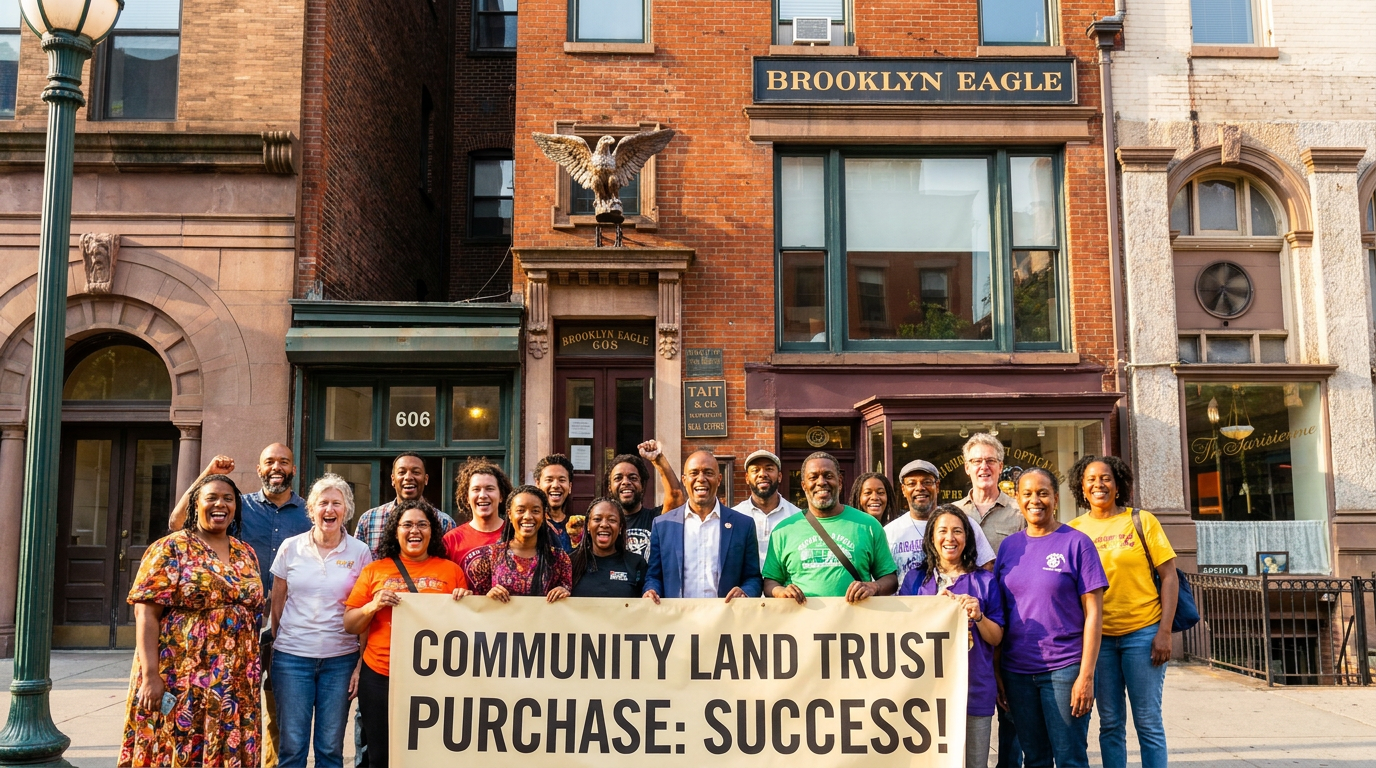
In June 2026, the East New York Community Land Trust (ENYCLT) is finalizing the purchase of a $2.3 million historic industrial building on Jamaica Avenue in Brooklyn. This acquisition marks a significant milestone: it is the first time in New York City history that a community land trust has successfully purchased a commercial property directly off the private speculative market. For the residents and organizers who pooled grassroots donations and secured low-interest cooperative loans, the purchase represents a tangible victory against the rapid gentrification that has swept through the neighborhood since its controversial 2016 rezoning.[1][2]
The 9,500-square-foot, two-story brick warehouse will be transformed into the "East Brooklyn Liberation Center." Rather than being converted into luxury lofts or corporate retail, the space will serve as a permanent, deeply affordable hub for the community. The ground floor is slated to house local small businesses, worker cooperatives, and the ENYCLT's own headquarters, while the upper level will provide flexible event and meeting spaces for cultural groups and neighborhood associations. By removing the property from the speculative real estate market entirely, the trust ensures that legacy institutions will not be priced out of their own neighborhood.[1][2]
The Brooklyn milestone is part of a much broader, nationwide surge in the Community Land Trust movement throughout 2026. Once viewed as a niche, experimental approach to affordable housing, CLTs have rapidly matured into a mainstream, highly effective tool utilized by both grassroots organizers and municipal governments. From urban centers facing extreme displacement pressures to suburban counties grappling with skyrocketing home prices, communities are increasingly turning to the CLT model to lock in permanent affordability and build localized economic power.[3]
At the core of the CLT model is a structural separation between the ownership of the land and the ownership of the building that sits upon it. A community-controlled nonprofit organization acquires a parcel of land and holds it in perpetuity for the benefit of the neighborhood. A prospective homeowner—or in the case of commercial spaces, a business or nonprofit—then purchases the physical building at a significantly reduced, affordable price. The buyer then enters into a long-term, typically 99-year renewable ground lease with the trust for the use of the land.[3][6]

This dual-ownership structure achieves affordability primarily by removing the cost of the land itself from the purchase price of the home. However, the true power of the model lies in its resale restrictions. When a CLT homeowner eventually decides to move, they are required to sell the home back to the trust or to another income-qualified buyer at a restricted price. This resale formula is written directly into the ground lease, capping the property's appreciation to ensure it remains affordable for the next generation of buyers, regardless of how hot the surrounding real estate market becomes.[6]
This dual-ownership structure achieves affordability primarily by removing the cost of the land itself from the purchase price of the home.
While the resale restrictions prevent owners from reaping massive windfalls from market speculation, the model still functions as a vital wealth-building tool for families who would otherwise be locked out of homeownership entirely. CLT homeowners pay down their mortgages, build modest equity, and recoup their initial investments upon sale. According to housing data, the model frequently serves as a highly successful stepping stone; historically, roughly sixty percent of individuals who purchase a CLT home are eventually able to leverage their built equity to transition into purchasing a traditional, market-rate home.[3]
The momentum of the CLT movement in 2026 is highly visible in Richmond, Virginia, where the Maggie Walker Community Land Trust is currently advancing a robust pipeline of more than 150 permanently affordable homes. The organization is actively developing properties across the city and surrounding counties, focusing on providing homeownership opportunities for working professionals—such as educators, healthcare workers, and public sector employees—who earn between 80 and 115 percent of the area's median income but are still priced out of the traditional housing market.[7]
The rapid expansion of the Maggie Walker CLT has been supercharged by innovative municipal partnerships. In neighboring Henrico County, local officials established a $60 million affordable housing trust fund financed entirely by previously undesignated tax revenues generated by the region's booming data center industry. By directing these corporate tax windfalls into the CLT, the county covers the cost of land acquisition and infrastructure fees, allowing the trust to sell newly constructed townhomes to first-time buyers for nearly $100,000 less than the standard market rate.[4]

State legislatures are also stepping in to remove historical bureaucratic barriers that have previously hindered CLT buyers. In Illinois, a new law—Senate Bill 1261—was recently enacted to explicitly open up state-backed mortgage assistance programs to properties located on community land trusts. By allowing CLT buyers to access the Illinois Housing Development Authority's forgivable and deferred mortgage products, the state is providing crucial financial flexibility that makes the initial purchase even more attainable for low- and moderate-income families.[5]
As the residential side of the movement scales with government support, the push into commercial real estate represents the next major frontier for community land trusts. Projects like the East Brooklyn Liberation Center demonstrate that the same mechanisms used to keep families in their homes can be deployed to protect the cultural and economic fabric of a neighborhood. By securing commercial spaces, CLTs prevent the displacement of legacy small businesses, local artists, and community services that often fall victim to the rising commercial rents that accompany residential gentrification.[1][2]
Despite these widespread successes, scaling the CLT model remains a formidable challenge, primarily due to the immense upfront capital required to acquire property in highly competitive real estate markets. Because government grants can be slow to materialize, organizations often have to rely on creative financing. The East New York Community Land Trust, for instance, managed to secure their $2.3 million warehouse through a complex patchwork of grassroots crowdfunding, private donations, and low-interest loans provided by national cooperative lenders and community development financial institutions.[2]

Looking ahead, the continued growth of the Community Land Trust model signifies a profound shift in how neighborhoods approach the housing crisis. Rather than fighting defensive, block-by-block battles against displacement after speculation has already begun, communities are proactively taking land off the market to secure their own futures. By locking in permanent affordability and democratic control, the 2026 CLT movement is proving that housing and commercial spaces can be successfully managed as essential community infrastructure rather than purely speculative financial assets.[1][3]
How we got here
2016
East New York undergoes a controversial neighborhood rezoning, sparking rapid land speculation and gentrification.
2020
The East New York Community Land Trust is founded by local residents to combat displacement.
March 2024
ENYCLT purchases its first residential property, a 21-unit apartment building, taking it off the speculative market.
June 2026
ENYCLT closes on a $2.3 million historic warehouse, marking the first commercial CLT purchase in New York City history.
Viewpoints in depth
Community Organizers
Advocates view CLTs as a critical defense against gentrification and a means to build local power.
For neighborhood organizers, the primary value of a Community Land Trust is its ability to permanently remove property from the speculative real estate market. By placing land under democratic, community control, residents can dictate what gets built and who gets to stay. Organizers argue that traditional affordable housing programs—which often rely on tax credits that expire after 15 or 30 years—merely delay displacement rather than preventing it. The CLT model, conversely, ensures that legacy residents, local businesses, and cultural institutions can remain in their neighborhoods indefinitely, regardless of how aggressively surrounding property values spike.
Housing Policy Experts
Economists and policy analysts focus on the structural efficiency and long-term sustainability of the CLT model.
Housing experts highlight the mechanical brilliance of the 99-year ground lease and its accompanying resale formulas. By separating the cost of the land from the cost of the physical structure, CLTs drastically lower the barrier to entry for first-time homebuyers. Furthermore, policy analysts point out that public subsidies invested in a CLT home are retained within the property itself, rather than walking out the door when the first owner sells. This means a single municipal grant can subsidize a home for multiple generations of low-income buyers, making it a highly efficient use of taxpayer dollars compared to traditional down-payment assistance programs.
Municipal Partners
Local governments increasingly see CLTs as reliable partners for executing large-scale affordable housing strategies.
For city and county officials, partnering with established Community Land Trusts offers a reliable mechanism to meet aggressive affordable housing targets. Municipalities are increasingly willing to donate vacant city-owned land, alter zoning regulations, or redirect corporate tax revenues—such as Henrico County's data center funds—directly to CLTs. Local governments appreciate that the trusts take on the complex, long-term stewardship of the properties, ensuring that the homes remain well-maintained and that homeowners receive ongoing financial counseling to prevent foreclosures, thereby stabilizing the broader municipal tax base.
What we don't know
- Whether commercial CLTs can generate enough revenue to sustain their operations without continuous philanthropic support.
- How rapidly traditional mortgage lenders will adapt their underwriting standards to accommodate the unique structure of CLT ground leases.
- The extent to which rising interest rates might impact the ability of low-income buyers to purchase even heavily subsidized CLT homes.
Key terms
- Community Land Trust (CLT)
- A community-based nonprofit organization designed to ensure community stewardship of land by maintaining permanent affordability for housing and commercial spaces.
- Ground Lease
- A long-term agreement (typically 99 years) where a tenant owns the building but leases the land underneath it from the CLT.
- Area Median Income (AMI)
- The midpoint of a region's income distribution, frequently used by housing programs to determine eligibility for affordable housing.
- Deed Restriction
- A legal provision attached to a property's title that limits how the property can be used or sold, often utilized by CLTs to cap resale prices.
Frequently asked
What is a Community Land Trust?
A nonprofit organization that acquires and holds land in perpetuity to provide permanently affordable housing and commercial spaces for the community.
Do CLT homeowners build equity?
Yes. While resale formulas cap the maximum sale price to keep the home affordable for the next buyer, current owners still build modest equity and recoup their principal.
How long do CLT leases last?
Most Community Land Trusts utilize a 99-year renewable ground lease, which separates the ownership of the building from the ownership of the land.
Can CLTs be used for commercial businesses?
Yes. While traditionally used for residential housing, CLTs are increasingly purchasing commercial properties to provide affordable office and retail space for local businesses and nonprofits.
Sources
Source coverage
7 outlets
3 viewpoints surfaced







[1]Next CityCommunity Organizers
Community Land Trust Purchases First Piece of Property in New York City
Read on Next City →[2]BrownstonerCommunity Organizers
Community Land Trust Plans 'Liberation Center' in East New York Warehouse
Read on Brownstoner →[3]TIMEHousing Policy Experts
A Look at Community Land Trusts and How They Combat the Affordable Housing Crisis
Read on TIME →[4]Urban InstituteMunicipal Partners
Turning Data Center Revenues into Affordable Homes
Read on Urban Institute →[5]Illinois Senate DemocratsMunicipal Partners
Guzmán plan to incentivize purchase of community land trusts signed into law
Read on Illinois Senate Democrats →[6]North Carolina Housing Finance AgencyHousing Policy Experts
Finding Affordable Housing through the Community Land Trust Model
Read on North Carolina Housing Finance Agency →[7]WRICMunicipal Partners
Single mother realizes dreams of becoming homeowner with Maggie Walker Community Land Trust
Read on WRIC →

Every angle. Every day.
Get community stories with full source coverage and perspective breakdowns delivered to your inbox.