
CMBS Office Delinquency Rate Hits Record 12.34%: The Mechanics of the Commercial Real Estate Reset
The delinquency rate for office loans bundled into commercial mortgage-backed securities has reached an all-time high, driven not by operational collapse, but by a massive wall of maturing debt meeting higher interest rates.

Share this story
The commercial real estate market has officially crossed a historic threshold, confirming what many analysts have anticipated since the widespread adoption of remote work. The delinquency rate for office loans bundled into Commercial Mortgage-Backed Securities (CMBS) reached an unprecedented 12.34% in early 2026.
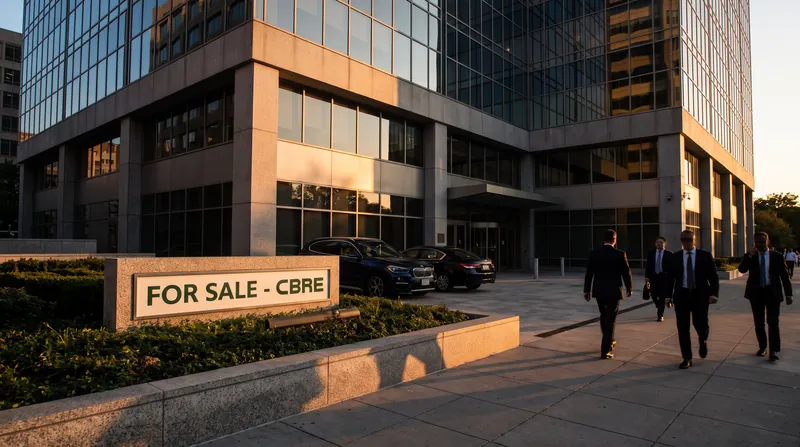
This milestone shatters previous records and signals a profound structural shift in how corporate America utilizes physical space. Rather than a sudden collapse, this figure represents the slow accumulation of pressure within the financial system, as the reality of half-empty downtown towers finally catches up with the balance sheets that financed them.[1]
This new high-water mark, tracked extensively by real estate data firm Trepp, represents a staggering climb from the negligible 1.60% delinquency rate recorded in mid-2022, just before the Federal Reserve began its aggressive cycle of interest rate hikes.
It also eclipses the prior cycle peak of roughly 10.7%, which was set in late 2012 during the long, painful tail of the Great Financial Crisis. However, industry experts are quick to point out that the underlying causes of today's distress are fundamentally different from those that drove the market down over a decade ago.[3]
Unlike the 2008 crash, which was driven by widespread economic collapse, plummeting consumer demand, and immediate operational failures across all sectors, today’s commercial real estate distress is largely a mechanical issue. It is a crisis of refinancing, driven by a massive 'maturity wall' colliding head-on with a transformed macroeconomic environment.
The buildings themselves are not necessarily abandoned, and many still host daily workers, but the financial structures holding them up are no longer viable under current market conditions. This distinction is crucial for understanding why the distress is so concentrated and why it is unfolding at a seemingly glacial pace compared to previous financial shocks.
To understand the mechanism behind this record delinquency rate, one must look at how large commercial buildings are financed. Many massive office towers are funded through CMBS—a system where hundreds of commercial mortgages are pooled together, sliced into various risk tranches, and sold to institutional investors as bonds.
These loans typically feature five- to ten-year terms, meaning they do not amortize fully like a standard 30-year residential mortgage. Instead, they eventually reach a maturity date where the entire remaining principal must be paid off in one massive balloon payment, usually by taking out a brand-new loan.[2]
During the peak optimism of 2018 through 2021, borrowers secured these massive loans at historically low interest rates. Underwriting standards during this period were often aggressive, based on the assumption that property values would continue their uninterrupted upward trajectory and that office space would remain a non-negotiable requirement for every growing business.
Today, those exact same loans are coming due in an environment where borrowing costs have effectively doubled, and the fundamental valuation of office properties has plummeted due to persistently high vacancy rates. The math that made these buildings profitable five years ago has completely evaporated.
The result of this collision is a phenomenon known across the industry as a 'maturity default.' In a significant portion of these newly delinquent cases, the building is still generating cash flow, and the landlord is still collecting rent from a roster of existing tenants.
However, because the property's appraised value has dropped significantly and the cost of capital is so high, the landlord simply cannot secure a new loan large enough to pay off the expiring one. They are trapped in a financial paradox: operating a functional building that is technically insolvent on paper.[2]
This refinancing friction is about to be tested on an unprecedented scale. Approximately $875 billion in commercial real estate loans are scheduled to mature in 2026 alone, creating a bottleneck of borrowers all seeking fresh capital at the exact same time. When these property owners reach the end of their term without a viable refinancing option, they default.
They do not default because the building is entirely empty or because they forgot to pay the monthly interest, but because the sheer mathematics of securing a new loan at a 7% interest rate to replace a 3.5% loan simply do not work.
Crucially, this dynamic is heavily concentrated in the office sector, creating a stark bifurcation within the broader commercial real estate market. While office delinquencies soar past the 12% mark, industrial property delinquencies sit at a microscopic 0.62%, buoyed by the relentless demand for e-commerce logistics and warehousing.
Similarly, the lodging and retail sectors have actually seen their delinquency rates stabilize or even improve in recent months. This divergence proves that the current distress is not a generalized economic failure, but a highly specific reaction to the structural decline in office demand.[1][2]
Even within the office sector itself, the financial pain is not distributed evenly. The headline CMBS delinquency rate is highly sensitive to a small number of massive, concentrated failures in major metropolitan hubs.
For instance, the transition of just two massive New York City assets—Worldwide Plaza, carrying a $940 million loan, and One New York Plaza, burdened with an $835 million loan—into delinquency was enough to meaningfully spike the national percentage in a single month. These mega-defaults obscure the fact that many smaller, well-positioned properties are still managing to navigate the turbulence.
Market analysts consistently note a 'flight to quality' among commercial tenants. Newer, highly amenitized 'Class A' buildings continue to command premium rents and attract companies desperate to entice their employees back to the office with state-of-the-art facilities, gyms, and premium locations.
The vast majority of the current financial distress is concentrated in older, functionally obsolete buildings—often referred to as Class B or Class C properties. These aging structures require massive capital expenditures just to remain competitive, an investment that landlords are increasingly unwilling or unable to make when the building's underlying value has already been wiped out.
When a CMBS loan officially defaults, it is transferred out of standard administration and handed over to a 'special servicer'—a specialized third-party firm tasked with working out a solution to recover as much value as possible for the bondholders. The workload for these firms has exploded. The office CMBS special servicing rate has surged to an alarming 17.11%, a massive leap from the sub-3% levels seen in late 2020. This metric is often viewed as a leading indicator, suggesting that the headline delinquency rate still has room to grow.[2]
In previous economic cycles, lenders often employed a strategy colloquially known as 'extend and pretend.' They would grant struggling borrowers short-term loan extensions, hoping that market conditions would miraculously improve and property values would rebound. However, legal and financial analysts note that this era of leniency is largely coming to an end. Lenders and special servicers are increasingly demanding meaningful concessions—such as fresh, multi-million-dollar capital injections from the borrower—before agreeing to any extensions. Without new equity, lenders are more willing to simply take the keys.
Because CMBS structures involve thousands of bondholders and rigid legal frameworks, resolutions are notoriously complex and slow-moving. Data shows that the timeline from an initial delinquency to a final resolution—whether that comes through a modified loan, a discounted payoff, or a full foreclosure—often stretches anywhere from 14 to 18 months. This long, drawn-out runway means that the rising delinquency rate has not yet translated into a sudden, chaotic flood of distressed building sales hitting the open market. Instead, the distress is being digested slowly, one painful negotiation at a time.
For the broader economy, the slow-moving nature of this real estate reset is a double-edged sword. On one hand, the protracted timeline prevents a sudden, catastrophic shock to the financial system, allowing institutions time to build reserves.
On the other hand, it means that regional and community banks—which hold significant concentrations of traditional commercial real estate debt outside of the CMBS market—face a prolonged period of intense balance sheet pressure. As these assets are slowly marked down to their true post-pandemic reality, it could constrain the ability of these banks to lend to other sectors of the economy.
As these assets are slowly marked down to their true post-pandemic reality, it could constrain the ability of these banks to lend to other sectors of the economy.
Despite the grim headline numbers, many market experts view the rising delinquency rate as a necessary, if painful, step toward long-term market health. The forced resolutions driven by special servicers are finally bringing true price discovery back to the commercial real estate sector, breaking the stalemate between buyers and sellers.
As properties are officially repriced to reflect their current value, new capital can confidently enter the market. This reset paves the way for adaptive reuse projects, ambitious residential conversions, and a stabilized, right-sized office footprint that reflects how the modern workforce actually operates.
Key points
- The CMBS office delinquency rate reached a record 12.34% in early 2026, surpassing the 2012 peak.
- Distress is primarily driven by 'maturity defaults,' where borrowers cannot refinance expiring loans due to higher interest rates.
- The crisis is highly concentrated in the office sector, while industrial and retail properties remain relatively stable.
- A massive $875 billion wall of commercial real estate debt is scheduled to mature in 2026, compounding refinancing pressures.
What we don’t know
- How many regional banks will face severe liquidity crises as they are forced to mark down their commercial real estate portfolios.
- Whether the recent stabilization in sublease availability signals a true bottom for office demand or just a temporary pause.
- How quickly local governments will adapt zoning laws to facilitate the conversion of obsolete office buildings into residential spaces.
How we got here
Mid-2022
Office CMBS delinquency sits at a negligible 1.60% before the Federal Reserve begins its aggressive interest rate hikes.
Late 2023
The 'extend and pretend' era begins to wane as lenders demand more capital for loan extensions.
October 2025
The office delinquency rate hits 11.76%, surpassing the previous Great Financial Crisis peak.
January 2026
The rate reaches an all-time high of 12.34%, driven by massive maturity defaults in major metropolitan markets.
- Commercial Lenders
- Focused on mitigating losses and forcing market-clearing valuations as loans mature.
- Office Property Owners
- Emphasizing the structural impossibility of refinancing in a high-rate environment.
- Systemic Risk Analysts
- Monitoring the spillover effects of commercial real estate distress on regional bank balance sheets.
Perspectives this story doesn't cover
- Small business tenants operating in distressed buildings who face uncertain lease renewals and declining property maintenance.
- Municipal tax authorities bracing for significant revenue shortfalls as commercial property assessments are revised downward.
Sources
Source coverage
3 outlets
3 viewpoints surfaced



- [1]Connect CREOffice Property Owners
Office CMBS Delinquencies Reach New All-Time High to Start 2026
Read on Connect CRE → - [2]CREFCCommercial Lenders
CREFC's January 2026 Monthly CMBS Loan Performance Report
Read on CREFC → - [3]MBA NewslinkSystemic Risk Analysts
Trepp: CMBS Delinquency Rate Increases
Read on MBA Newslink →
More in Real Estate
See all →Real Options Theory
How Price Volatility Defers Urban Construction by Destroying the Real Option to Wait
3 sources
Behavioral Economics
Loss Aversion Freezes Housing Liquidity: Why Transaction Volumes Collapse Months Before Nominal Prices Drop
5 sources
CMBS Market
US Commercial Real Estate Losses Breach AAA-Rated CMBS Tranches as Treasury Yields Surge
7 sources
REIT Liquidation
DWS to Liquidate RREEF Property Trust Following Redemption Pressures
7 sources
Comments
Every angle. Every day.
Get Real Estate stories with full source coverage and perspective breakdowns, free every day.