
Beyond the Ballot: How 'Deliberative Polling' is Curing Community Polarization
Cities worldwide are abandoning traditional surveys in favor of citizens' assemblies and deliberative polls, proving that everyday people can solve complex policy issues when given the right tools.
By Factlen Editorial Team
- Deliberative Democracy Advocates
- Argue that structured deliberation cures polarization and produces superior, evidence-based policy outcomes.
- Local Governance Reformers
- Focus on rebuilding trust between citizens and city halls through direct participatory power and transparent budgeting.
- Implementation Skeptics
- Warn that assemblies can be expensive, slow, or used as political window-dressing if leaders ignore the final recommendations.
What's not represented
- · Elected officials who feel deliberative assemblies undermine their representative mandate
- · Taxpayer advocacy groups concerned about the administrative costs of hosting assemblies
Why this matters
Traditional polling often captures snap judgments that fuel political polarization. Deliberative models offer a proven blueprint for communities to bypass partisan gridlock, make informed decisions, and restore trust in local government.
Key points
- Traditional polls capture uninformed snap judgments, often fueling political polarization.
- Deliberative polling measures what citizens think after receiving balanced information and time to discuss.
- The process consistently reduces extreme partisanship and helps communities find pragmatic consensus.
- Over 750 citizens' assemblies have been held globally to tackle complex, divisive issues.
- Participatory budgeting allows residents to directly allocate municipal funds, increasing civic trust.
- New AI-assisted platforms are making it cheaper and easier to host deliberative events online.
Modern democracy is suffering from a crisis of trust, and traditional polling often exacerbates the problem. Standard surveys capture snap judgments, measuring what a distracted public thinks about complex issues they may have spent only seconds considering. The result is a feedback loop of polarization, where politicians react to uninformed outrage, further alienating the electorate.[8]
But a quiet revolution in community decision-making is proving that citizens are highly capable of nuanced governance when given the right tools. Known broadly as "deliberative democracy," this movement shifts the focus from asking people what they think right now, to asking what they would think if they had the time, resources, and environment to deeply understand an issue.[1][3]
The gold standard of this approach is Deliberative Polling, a method pioneered in 1988 by political scientist James Fishkin, who now directs the Deliberative Democracy Lab at Stanford University. Unlike a standard survey, a deliberative poll is a multi-day civic intervention designed to extract a community's highest-quality consensus.[1][2]

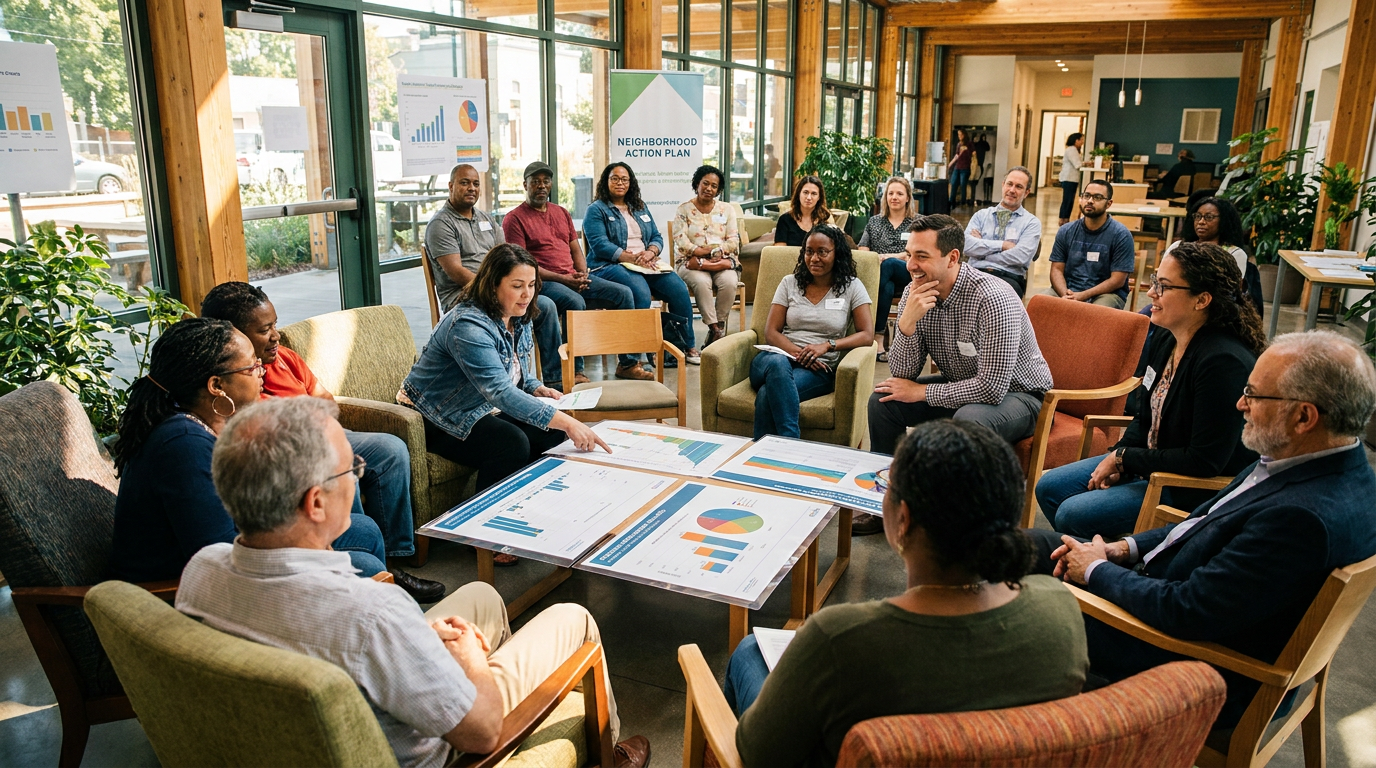
The process begins with stratified random sampling, ensuring the participant pool is a true microcosm of the community across age, race, income, and political ideology. These citizens take a baseline poll to record their initial, unfiltered opinions. Then, they are invited to a weekend-long assembly—often paid for their time to ensure working-class participation—where they are provided with carefully vetted, balanced briefing materials.[2][3]
During the assembly, participants break into small groups led by trained, neutral moderators. They do not debate to win; they deliberate to understand. They identify gaps in their knowledge and collaboratively draft questions to pose to a plenary panel of competing experts and policymakers, ensuring that all factual claims are rigorously tested.[2][4]
At the end of the weekend, the citizens take the exact same poll again. The delta between the first and second poll represents the community's "considered opinion." Researchers consistently find that this process produces dramatic, statistically significant shifts in public views, often melting away partisan polarization in favor of pragmatic, evidence-based consensus.[1][3]

While Stanford incubated the polling methodology, the broader concept of "Citizens' Assemblies" has exploded into a global governance tool. Over the past decade, more than 750 successful assemblies have been convened worldwide to tackle issues that conventional politics finds too radioactive to touch, from climate change infrastructure to urban zoning.[6][7]
While Stanford incubated the polling methodology, the broader concept of "Citizens' Assemblies" has exploded into a global governance tool.
Ireland famously used national citizens' assemblies to break decades of political deadlock, finding citizen-led consensus on highly sensitive constitutional issues like abortion rights and drug policy. In the United Kingdom, local councils have embraced the model to bypass partisan gridlock. By the end of 2021, dozens of UK municipalities had hosted assemblies. The London borough of Newham even established a permanent standing citizens' assembly, recruiting 50 new residents per phase to tackle the borough's most pressing challenges.[6]
In the United States, deliberative democracy often takes the form of Participatory Budgeting (PB). Originating in Porto Alegre, Brazil, in 1989, PB gives everyday residents direct control over a portion of municipal funds. Rather than just advising, the community deliberates on local needs, drafts project proposals, and votes on the final spending allocations.[4][5]
The Democracy Collaborative notes that at least 64 U.S. cities and counties—alongside hundreds of schools—have utilized participatory budgeting, allocating over $360 million to community-designed projects. In New York City's "The People's Money" initiative, residents who participated in the budgeting process were found to be seven percent more likely to vote in future general elections, proving that deliberation builds long-term civic muscle.[5]

The model's resilience extends far beyond stable Western democracies. In Eastern Europe, local mayors in Hungary and Poland have utilized citizens' assemblies to build transparent governance and counteract national democratic backsliding. Most remarkably, deliberative processes have been successfully deployed in Ukraine amidst the ongoing war. Supported by the Council of Europe, Ukrainian municipalities held assemblies where citizens deliberated on local recovery efforts—sometimes moving their small-group discussions into underground shelters during air-raid sirens.[7]
Historically, the primary barrier to deliberative democracy has been cost and logistics. Gathering hundreds of people in a hotel, feeding them, and paying expert moderators is expensive, often limiting the process to well-funded municipalities or major national questions.[1]
To solve this, Stanford's Deliberative Democracy Lab has developed an AI-assisted Online Deliberation Platform. Designed to facilitate structured, equitable conversations for groups of 8 to 15 people, the platform uses automated moderation tools to ensure no single voice dominates the discussion. This technology has already been deployed to host over 11,500 hours of group discussion globally, allowing cities to scale deliberative polling to thousands of participants without the prohibitive overhead of in-person events.[1]

Despite the success stories, the deliberative wave faces genuine hurdles. The most significant is political follow-through. A citizens' assembly is only as effective as the government's willingness to implement its recommendations. If local councils treat these assemblies as mere public relations exercises—listening politely but ignoring the output—they risk breeding deeper cynicism than if they had never asked the public at all.[3][6]
Yet, when executed with genuine political commitment, deliberative polling and citizens' assemblies offer a powerful antidote to the toxicity of modern politics. They prove that polarization is not an inherent trait of the public, but a byproduct of how the public is engaged. By treating citizens as capable decision-makers rather than passive consumers of political messaging, communities are discovering that their hardest problems might just be solvable.[8]
How we got here
1988
Political scientist James Fishkin pioneers the concept of Deliberative Polling.
1989
The first major Participatory Budgeting process is launched in Porto Alegre, Brazil.
2004
The British Columbia Citizens' Assembly on Electoral Reform brings the model to mainstream North American governance.
2016
Ireland's national Citizens' Assembly successfully builds consensus on highly sensitive constitutional issues.
2021
The London borough of Newham establishes the UK's first permanent standing citizens' assembly.
Viewpoints in depth
Deliberative Democracy Advocates
Argue that structured deliberation cures polarization and produces superior, evidence-based policy outcomes.
Researchers and civic organizations in this camp argue that the public is entirely capable of understanding complex policy—if given the right environment. They point to decades of data showing that when citizens are provided with balanced briefing materials and protected from the performative outrage of social media, they consistently abandon extreme partisan positions. By focusing on shared values and pragmatic trade-offs, advocates believe deliberative democracy produces better, more durable legislation than traditional partisan lawmaking.
Local Governance Reformers
Focus on rebuilding trust between citizens and city halls through direct participatory power and transparent budgeting.
For municipal leaders and transparency advocates, the primary value of citizens' assemblies is institutional trust. In an era where voters feel increasingly disconnected from their representatives, giving the public direct control over decisions—such as through Participatory Budgeting—proves that the government is listening. Reformers note that when citizens see their own proposals funded and built in their neighborhoods, they are significantly more likely to vote in future elections and engage positively with civic institutions.
Implementation Skeptics
Warn that assemblies can be expensive, slow, or used as political window-dressing if leaders ignore the final recommendations.
While generally supportive of the concept, skeptics caution against treating citizens' assemblies as a magic bullet. They highlight the high financial and logistical costs of recruiting, housing, and paying a representative sample of citizens for multi-day events. More critically, they warn of the "lip service" risk: if a government convenes an assembly only to ignore its final recommendations because they are politically inconvenient, the process can actually generate more civic cynicism than if the assembly had never been held at all.
What we don't know
- Whether online deliberation platforms can fully replicate the empathy and consensus-building of in-person assemblies.
- How to compel elected officials to legally bind themselves to the recommendations produced by citizens' assemblies.
- The long-term impact of permanent standing assemblies on traditional city council dynamics.
Key terms
- Deliberative Polling
- A polling method that measures how public opinion changes after citizens are given balanced information and time to deeply discuss an issue.
- Citizens' Assembly
- A representative group of citizens convened by a government to learn about, deliberate on, and make recommendations regarding a specific policy challenge.
- Participatory Budgeting
- A democratic process in which community members directly decide how to allocate part of a municipal or public budget.
- Stratified Random Sampling
- A selection method used to ensure that a small group of participants perfectly mirrors the demographic makeup of the larger population.
Frequently asked
What is the difference between a regular poll and a deliberative poll?
A regular poll captures snap judgments based on what people already know. A deliberative poll measures what a representative sample of people think after they have been given balanced information and time to discuss the issue with experts.
How are participants chosen for a citizens' assembly?
Participants are selected through a process called stratified random sampling. This ensures the group accurately reflects the broader community's demographics, including age, gender, race, income, and political affiliation.
Do politicians have to listen to the results?
Usually, the results are advisory, meaning politicians are not legally bound to enact them. However, the most successful assemblies occur when local governments publicly commit in advance to implementing the citizens' recommendations.
What is participatory budgeting?
Participatory budgeting is a democratic process where community members directly decide how to spend a portion of a public budget, rather than leaving the decision entirely to elected officials.
Sources
Source coverage
8 outlets
3 viewpoints surfaced








[1]Stanford Deliberative Democracy LabDeliberative Democracy Advocates
Research about democracy and public opinion obtained through Deliberative Polling
Read on Stanford Deliberative Democracy Lab →[2]ParticipediaDeliberative Democracy Advocates
Deliberative Polling: Process, Interaction, and Decision-Making
Read on Participedia →[3]Involve UKImplementation Skeptics
Deliberative Polling: Engaging on complex issues
Read on Involve UK →[4]Brennan Center for JusticeLocal Governance Reformers
Participatory Budgeting and Civic Trust
Read on Brennan Center for Justice →[5]Democracy CollaborativeLocal Governance Reformers
Participatory Budgeting, Locally Rooted Finance, and the Community Wealth Building Wedge
Read on Democracy Collaborative →[6]Constitution Unit, UCLLocal Governance Reformers
Local citizens' assemblies in the UK: an early report card
Read on Constitution Unit, UCL →[7]FIDE North AmericaDeliberative Democracy Advocates
Deliberative Democracy in Action: From Hungary to Ukraine
Read on FIDE North America →[8]Factlen Editorial TeamImplementation Skeptics
Synthesis by Factlen editorial team
Read on Factlen Editorial Team →
Every angle. Every day.
Get community stories with full source coverage and perspective breakdowns delivered to your inbox.