
Apple Unveils 'Siri AI' Rebuild Powered by Google Gemini at WWDC 2026
Apple has completely overhauled its voice assistant with a 1.2-trillion-parameter generative AI model, bringing cross-app context and multi-step reasoning to newer devices.
By Factlen Editorial Team
- Tech Enthusiasts & Reviewers
- Focuses on the end of Siri's 'dumb' era and the practical usability improvements of the new Gemini-powered engine.
- Ecosystem Developers
- Focuses on the underlying architecture, the shift to App Intents, and the strict hardware requirements for on-device processing.
- Market & Industry Observers
- Focuses on Apple's competitive positioning, privacy safeguards, and the geopolitical hurdles of launching AI features globally.
What's not represented
- · Older Device Owners
- · Privacy Advocates
Why this matters
For over a decade, Siri has been a notoriously limited tool that struggled with complex commands. This massive upgrade fundamentally changes how users will interact with their iPhones, turning the device into a proactive, context-aware assistant rather than a simple search bar.
Key points
- Apple unveiled 'Siri AI' at WWDC 2026, completely rebuilding the assistant with a 1.2-trillion-parameter Google Gemini model.
- The new Siri can handle multi-step requests and synthesize information across different apps like Messages, Mail, and Photos.
- Siri now lives in the Dynamic Island, features a glowing interface, and includes a dedicated app for reviewing conversation history.
- Due to on-device processing requirements, Siri AI will only be available on the iPhone 15 Pro line and newer, as well as M1/A18 Pro Macs and iPads.
- A public beta will launch this fall in U.S. English, though regulatory hurdles will delay its release in mainland China.
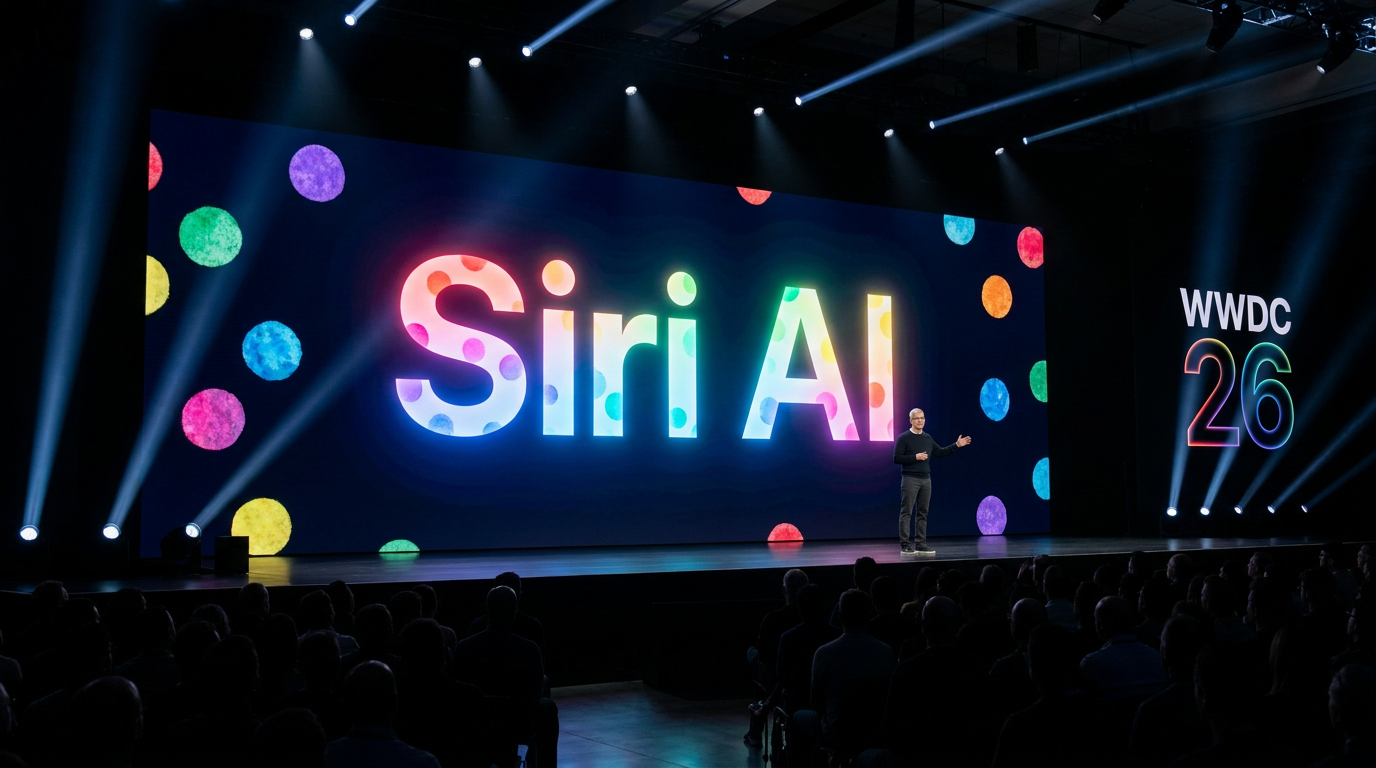
For a decade and a half, Apple's voice assistant has occupied a frustrating middle ground in the tech ecosystem: useful for setting kitchen timers, but notoriously prone to misunderstanding anything more complex. That era of low expectations appears to have ended. At the 2026 Worldwide Developers Conference (WWDC) in Cupertino, Apple unveiled "Siri AI," a top-to-bottom rebuild of the assistant that transforms it from a rigid command-and-control tool into a fluid, context-aware conversational agent.[1][2][4]
The transformation is driven by a massive shift in underlying technology. Abandoning its older, preprogrammed response architecture, the new Siri is powered by a custom 1.2-trillion-parameter Google Gemini generative AI model. This integration, born from a reported billion-dollar partnership between the two tech giants, allows the assistant to handle chained, multi-step requests and draw on real-time world knowledge.[2][4][6][7]
Visually, Siri is no longer just a disembodied voice or a glowing orb at the bottom of the screen. The assistant has been embedded directly into the iPhone's Dynamic Island, accessible via a swipe, a button press, or a voice command, and features a new glowing interface. For the first time, Siri also has its own dedicated app across iOS, iPadOS, and macOS, allowing users to scroll through past conversations and seamlessly resume them across different devices via iCloud syncing.[2][3][6]

During the WWDC keynote, Apple executives demonstrated the assistant's newfound conversational depth. In one sequence, a presenter asked Siri about a Suki Waterhouse concert, learned that tickets required entering a lottery, and immediately asked the assistant to set a reminder for when the lottery opened—a multi-turn interaction that Siri handled without losing context.[2]
The most significant leap, however, is Siri's new cross-app awareness. The assistant can now synthesize information from across a user's personal ecosystem. A keynote demo showed Siri pulling details about a dessert from a user's Messages history, compiling those details into a watch-party menu, and drafting an email to contacts with the menu included. This level of integration aims to make the AI disappear into the operating system rather than forcing users to open a separate chatbot app.[2][4][5][8]
The most significant leap, however, is Siri's new cross-app awareness.
Apple is also introducing "Visual Intelligence" to the assistant. On the iPhone, Siri's multimodal capabilities are integrated directly into the Camera app. Users can point their phone at a restaurant to pull up menus, scan a landmark for historical context, or point the camera at food to retrieve instant nutritional information.[4]
For software developers, the update represents a seismic architectural shift. Apple has formally deprecated SiriKit, the framework developers have used for years to integrate with the assistant. Moving forward, third-party apps must use the expanded App Intents framework, which serves as the mandatory bridge for Siri to execute actions within external applications.[6]

However, the profound leap in capability comes with strict hardware requirements. Because Siri AI relies heavily on on-device processing to minimize latency and protect privacy, it will only be available on newer Apple devices. The compatibility list includes the iPhone 15 Pro line, the iPhone 16 and 17 series, and iPads and Macs equipped with M1 chips or the newer A18 Pro processors. Older devices will not receive the AI-powered overhaul.[7]
Privacy remains a central pillar of Apple's pitch. While the assistant leverages Google's cloud-based Gemini models for complex queries, Apple emphasized that its new architecture is uniquely designed to protect user data. Cloud requests are anonymized, and the company insists that AI request data is deleted immediately after a task is executed, ensuring personal context isn't absorbed into broader training models.[4][6]
The launch of Siri AI is a critical catch-up maneuver for Apple. Over the past two years, as OpenAI, Microsoft, and Google raced ahead with advanced chatbots, Apple's perceived lag in the AI space raised questions among investors and consumers alike. The pressure was compounded in May 2026 when Apple agreed to a $250 million class-action settlement over allegations that it had previously falsely advertised Siri's AI capabilities.[4][6][8]

The global rollout of Siri AI will be staggered. A public beta is slated for release this fall alongside iOS 27, initially restricted to U.S. English. Other languages will follow, but the world's largest smartphone market—mainland China—will have to wait. Regulatory hurdles and restrictions on foreign AI models mean that Apple's Gemini-powered assistant remains walled off from Chinese consumers for the foreseeable future.[5][8]
Despite the regional limitations and hardware cutoffs, the tech industry's reaction has been overwhelmingly positive. Analysts note that if Apple successfully makes generative AI feel natural, private, and genuinely useful for mainstream consumers, it could redefine baseline expectations for every smart device on the market. For iPhone users who have spent years repeating themselves to a confused digital assistant, the upgrade promises a future where Siri finally lives up to its original promise.[1][3][8]
How we got here
Oct 2011
Apple introduces the original Siri voice assistant alongside the iPhone 4S.
Late 2022
The generative AI boom begins, leaving traditional voice assistants looking outdated.
May 2026
Apple settles a $250 million class-action lawsuit regarding past claims about Siri's AI capabilities.
Jun 2026
Apple officially unveils the rebuilt, Gemini-powered 'Siri AI' at WWDC, slated for a fall release.
Viewpoints in depth
Tech Enthusiasts & Reviewers
Celebrating the end of Siri's rigid, preprogrammed era.
For years, tech reviewers have lamented Siri's inability to maintain conversational context or execute complex commands. This camp views the WWDC 2026 announcement as a watershed moment. By integrating a 1.2-trillion-parameter generative model, Apple has finally delivered the fluid, context-aware assistant that was promised over a decade ago. Reviewers highlight the cross-app synthesis—like pulling a recipe from Messages to draft an email—as the killer feature that elevates Siri from a basic search tool to a genuine digital companion.
Ecosystem Developers
Preparing for a massive architectural shift in iOS app development.
While consumers focus on the glowing new interface, developers are bracing for a fundamental rewrite of how their apps interact with iOS. Apple's formal deprecation of the SiriKit framework means developers must rapidly migrate to App Intents to remain compatible with Siri AI. Furthermore, this camp is closely analyzing the strict hardware cutoffs; because the new AI features require an M1 or A18 Pro chip, developers must now design dual experiences for users on older hardware versus those with access to the new generative capabilities.
Market & Industry Observers
Analyzing Apple's catch-up play and global regulatory hurdles.
Industry analysts view Siri AI as Apple's most critical strategic move in years, designed to close the perceived gap with rivals like OpenAI and Microsoft. However, observers note that Apple's reliance on Google's Gemini model highlights the difficulty of building state-of-the-art AI entirely in-house. Additionally, this camp points to the geopolitical realities of the rollout: because foreign AI models face strict regulations in mainland China, Apple's most advanced software features are currently walled off from its largest international market, creating a fragmented global ecosystem.
What we don't know
- Exactly how much battery life the new on-device AI processing will consume during heavy daily use.
- When Apple will secure regulatory approval to launch Siri AI in mainland China.
- How seamlessly third-party developers will transition from SiriKit to the new App Intents framework.
Key terms
- Apple Intelligence
- Apple's overarching suite of artificial intelligence features integrated across its operating systems.
- Generative AI
- Artificial intelligence capable of creating new text, images, or code, rather than just retrieving pre-written responses.
- Dynamic Island
- The pill-shaped interactive area at the top of newer iPhone screens that houses the front camera and displays system alerts.
- App Intents
- A developer framework that allows Siri to understand and execute specific actions inside third-party applications.
Frequently asked
Will the new Siri work on my current iPhone?
It depends on your model. Siri AI requires an iPhone 15 Pro or newer, or any of the upcoming iPhone 16 and 17 models. Older iPhones lack the necessary processing power.
Do I need to download a separate app to use Siri AI?
No. While there is a new dedicated Siri app for reviewing past conversations, the assistant remains deeply integrated into the operating system and can be summoned via voice or the Dynamic Island.
Is Apple using my personal data to train its AI?
Apple states that it does not use personal requests to train its broader models. Cloud-based queries are anonymized, and request data is deleted immediately after the task is completed.
When will Siri AI be available?
A public beta will launch in the fall of 2026 alongside iOS 27, initially available only in U.S. English.
Sources
Source coverage
8 outlets
3 viewpoints surfaced








[1]The VergeTech Enthusiasts & Reviewers
Siri is good now??
Read on The Verge →[2]MacRumorsTech Enthusiasts & Reviewers
Apple Announces 'Siri AI' at WWDC 2026
Read on MacRumors →[3]PCMagTech Enthusiasts & Reviewers
The New Siri App in iOS 27 Will Change the iPhone Forever
Read on PCMag →[4]The GuardianMarket & Industry Observers
Apple debuts revamped 'Siri AI' and new child safety features for iPhones and iPads
Read on The Guardian →[5]South China Morning PostMarket & Industry Observers
WWDC 2026: Apple gives Siri an AI makeover, but China must wait
Read on South China Morning Post →[6]LushbinaryEcosystem Developers
WWDC 2026: iOS 27, New Siri & Dev Tools
Read on Lushbinary →[7]9to5MacEcosystem Developers
Siri AI is coming to newer Apple devices only, here's the full list
Read on 9to5Mac →[8]NPRMarket & Industry Observers
Hey, Siri: Apple just announced a long-awaited AI update
Read on NPR →
Every angle. Every day.
Get technology stories with full source coverage and perspective breakdowns delivered to your inbox.