
Apple Previews AI-Powered Accessibility Features Coming to iOS 27 and Vision Pro
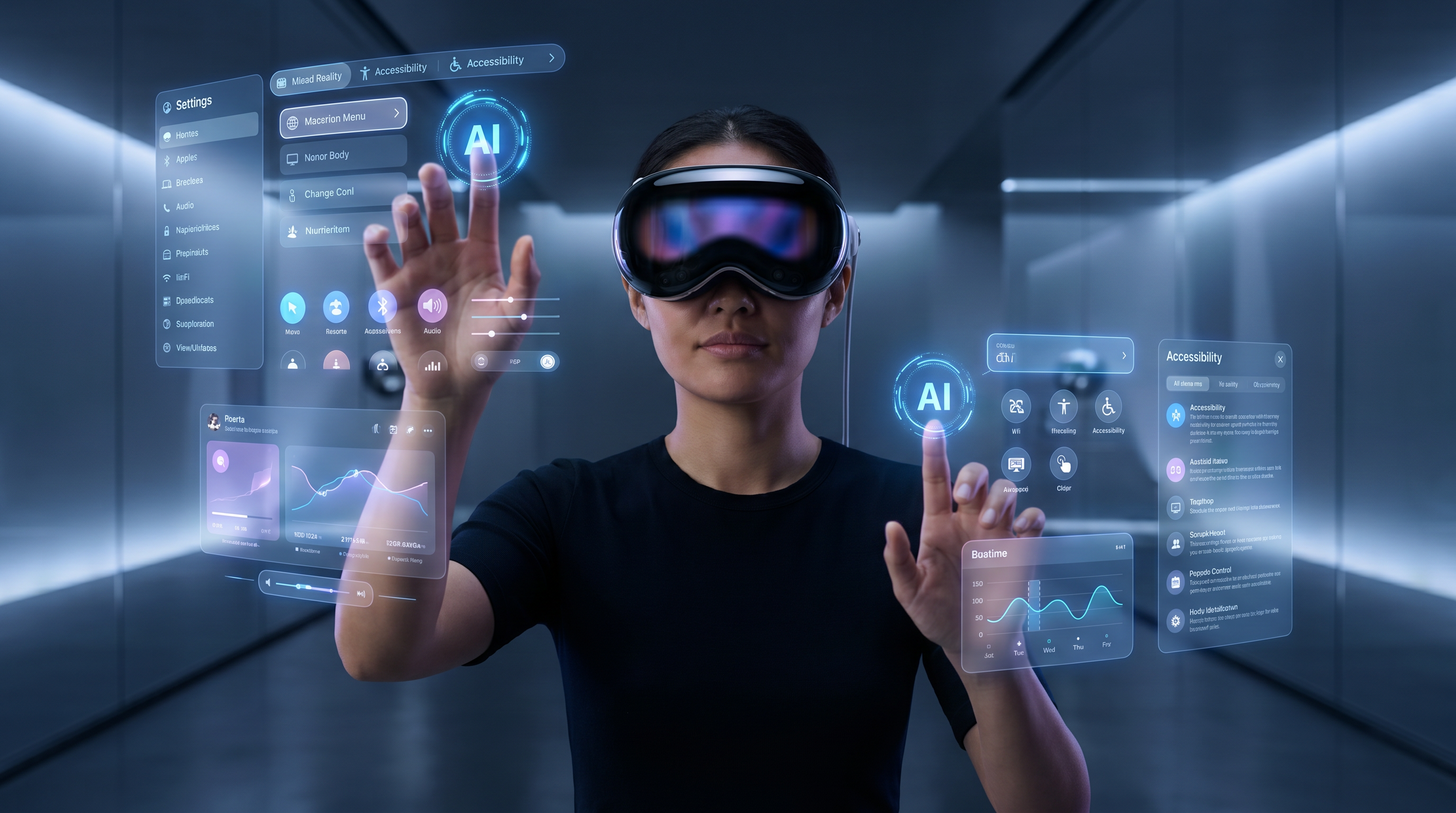
Apple has unveiled a suite of new accessibility updates powered by Apple Intelligence, including natural language navigation, AI-generated video subtitles, and eye-tracking wheelchair controls for the Vision Pro.
By Factlen Editorial Team
- Disability Advocates
- Celebrate the innovation but warn that high hardware costs will limit real-world impact.
- Privacy Experts
- Applaud the localized, on-device processing architecture that protects sensitive user data.
- Market Analysts
- View the features as a strong ecosystem lock-in strategy that pressures rivals to adapt.
What's not represented
- · Wheelchair manufacturers, whose proprietary control systems and business models might be disrupted by Apple's universal headset integration.
- · Users in developing nations, where high-end Apple hardware is financially inaccessible and localized language support often lags.
Why this matters
Apple's integration of generative AI into core operating systems shifts accessibility from rigid, rule-based menus to dynamic, context-aware assistance. For users with severe mobility or sensory impairments, features like eye-tracked wheelchair navigation and conversational interface control could drastically reduce reliance on physical interfaces and expensive third-party medical devices.
Key points
- Apple previewed AI-driven accessibility features for iOS 27 and Vision Pro.
- Natural language navigation allows users to control devices using conversational commands rather than rigid syntax.
- New AI subtitles provide real-time, context-aware captions, including speaker identification, across all video apps.
- Vision Pro will support eye-tracking controls for compatible motorized wheelchairs using a secure wireless protocol.
- Processing relies heavily on on-device Apple Intelligence to protect user privacy and ensure offline functionality.
Apple has outlined a sweeping overhaul of its accessibility ecosystem, previewing a suite of features for the upcoming iOS 27 and Vision Pro operating systems that deeply integrate generative artificial intelligence. Moving away from static, rules-based accessibility menus, the company is leveraging its Apple Intelligence framework to create dynamic, context-aware tools designed to adapt to individual user needs in real-time. The announcement marks a significant pivot in how operating systems handle assistive technology, shifting the computational burden from the user—who previously had to memorize complex command structures or navigate labyrinthine settings—to the device's onboard neural processing units. By embedding these capabilities at the foundational level of the operating system, Apple aims to make its hardware more intuitive for users with severe motor, visual, or auditory and cognitive disabilities.[1][2][3][4]
The cornerstone of the iOS 27 update is Natural Language Navigation, a feature that fundamentally alters how users with limited mobility interact with their smartphones. Traditional voice control systems require users to speak exact, pre-programmed phrases to execute commands, which can be cognitively taxing and prone to failure if the user misremembers the syntax. Natural Language Navigation replaces this rigid structure with a large language model capable of parsing conversational intent. A user can simply say, "Make the text on this page bigger and summarize the second paragraph," and the system will execute the multi-step process autonomously. This semantic understanding extends across first- and third-party applications, allowing users to navigate complex interfaces without needing to know the specific names of buttons or menus.[1][2][3][4][5]
To address the inherent privacy concerns of a system that constantly monitors screen content and audio input, Apple is heavily emphasizing its on-device processing architecture. The natural language models powering these new accessibility features run locally on the iPhone's silicon, ensuring that sensitive user data—such as personal messages, banking interfaces, or health records—is not transmitted to cloud servers for processing. This localized approach not only secures user data but also guarantees that the accessibility features remain fully functional in environments with poor or non-existent cellular connectivity. For users who rely entirely on voice navigation to operate their devices, this offline reliability is a critical safety requirement rather than a mere convenience.[1][3][4][6]

For users who are deaf or hard of hearing, iOS 27 introduces a sophisticated upgrade to system-wide captioning through AI-generated video subtitles. While live captioning has existed in previous iterations, the new system utilizes multimodal AI to provide a much richer contextual understanding of the audio environment. Rather than simply transcribing spoken dialogue, the Apple Intelligence model analyzes the audio track to identify distinct speakers, note their emotional tone, and describe significant non-verbal sounds. The resulting subtitles might read "[Upbeat music fades in] John (whispering): I think we're safe here," providing a level of narrative immersion previously restricted to meticulously hand-crafted closed captions.[1][2][5][6]
Crucially, this advanced subtitling engine operates at the operating system level, meaning it can overlay context-aware captions onto any media playing on the device. This includes live video calls on platforms like Zoom or FaceTime, uncaptioned social media videos, and even locally stored home movies. By utilizing the device's neural engine, Apple claims to have reduced the latency of these live transcriptions to near-zero, a historical pain point for users trying to follow fast-paced conversations or live broadcasts. The system can also translate spoken audio from one language into localized subtitles in real-time, further breaking down communication barriers for users interacting with international content.[3][4][5]
Crucially, this advanced subtitling engine operates at the operating system level, meaning it can overlay context-aware captions onto any media playing on the device.
The most technologically ambitious feature previewed is the introduction of eye-tracking wheelchair controls for the Vision Pro headset. This integration represents a major leap in assistive hardware, allowing users with severe physical disabilities, such as ALS or high-level spinal cord injuries, to navigate their physical environment using only their gaze. By establishing a secure, low-latency wireless protocol between the headset and compatible motorized wheelchairs, the Vision Pro translates the user's eye movements into directional commands. Looking at a specific point on the ground initiates forward movement, while prolonged blinks or specific gaze patterns can be mapped to braking, turning, or adjusting the chair's speed.[1][2][3][4]
Developing a gaze-based control system for heavy, motorized mobility equipment requires extraordinary precision and fail-safes. Apple has reportedly collaborated closely with major medical device manufacturers and regulatory bodies to ensure the system's reliability. The Vision Pro's internal cameras track the user's pupils at a high refresh rate, filtering out involuntary micro-movements or saccades to prevent accidental inputs. Furthermore, the interface features a customizable "dwell time" setting, requiring the user to intentionally hold their gaze on a digital directional node overlaid in their field of view before the wheelchair engages its motors, thereby minimizing the risk of unintended acceleration.[1][2][4][5][6]

To mitigate the physical risks associated with navigating a wheelchair via a headset, Apple is leveraging the Vision Pro's extensive array of external sensors. The headset's LiDAR scanner and spatial mapping cameras continuously monitor the user's surroundings, creating a real-time 3D mesh of the environment. If the system detects an impending collision with a wall, piece of furniture, or a sudden drop-off like a staircase, it will automatically override the user's eye-tracking input and engage the wheelchair's braking system. This autonomous emergency braking functions similarly to advanced driver-assistance systems in modern vehicles, providing a crucial layer of safety for users who may not be able to react quickly to physical hazards.[2][3][4][5]
Accessibility advocates and disability rights organizations have largely praised the announcement, noting that Apple's deep integration of generative AI sets a new benchmark for the tech industry. By moving these advanced tools out of niche, third-party applications and into the core operating system, Apple is democratizing access to cutting-edge assistive technology. Advocates highlight that features like natural language navigation not only improve efficiency but also reduce the physical and cognitive fatigue associated with operating digital devices. The shift from requiring users to adapt to the machine, to having the machine adapt to the user's natural communication style, is viewed as a paradigm shift in inclusive design.[2][5][6]
Despite the technological praise, industry analysts and advocates alike have raised concerns regarding the financial accessibility of these new tools. The Vision Pro, which houses the flagship wheelchair control feature, carries a prohibitive price tag that places it far out of reach for the majority of disabled users, many of whom already face significant financial burdens related to their healthcare and mobility equipment. Furthermore, the advanced Apple Intelligence features in iOS 27 are expected to require the latest iPhone hardware, forcing users to upgrade their devices to access the new natural language and subtitling capabilities. This dynamic creates a stark digital divide, where the most transformative accessibility features are gated behind premium hardware costs.[3][4][5][6]
How we got here
May 2023
Apple introduces Personal Voice and Live Speech for iOS 17, laying the groundwork for advanced audio accessibility.
February 2024
Apple releases the Vision Pro headset with initial eye- and hand-tracking accessibility features.
June 2024
Apple Intelligence is officially unveiled, focusing on generative AI integration across the ecosystem.
May 2026
Apple previews the iOS 27 and Vision Pro accessibility suite, featuring deep AI integration and wheelchair controls.
Viewpoints in depth
Accessibility Advocates
Praise for the technological leap, tempered by concerns over hardware costs.
Organizations dedicated to disability rights view the integration of generative AI into core OS functions as a monumental step forward. They argue that reducing the cognitive and physical load required to operate devices empowers users and fosters greater independence. However, these advocates consistently highlight the 'disability tax'—the reality that the most transformative features, particularly the Vision Pro wheelchair integration, are locked behind hardware that costs thousands of dollars, making them inaccessible to the majority of the global disabled population.
Privacy Watchdogs
Strong support for Apple's commitment to on-device AI processing.
Privacy experts emphasize that accessibility tools inherently require deep, continuous access to a user's most sensitive data, including screen contents, ambient audio, and physical location. Apple's decision to run its natural language models and multimodal audio analysis locally on the device's neural engine is seen as a crucial safeguard. By avoiding cloud processing, the company mitigates the risk of this highly personal data being intercepted, monetized, or used to profile users based on their disabilities.
Tech Competitors
Pressure to match system-level AI integration across rival platforms.
For competitors like Google and Microsoft, Apple's announcement sets a new baseline for operating system capabilities. Analysts note that relying on third-party accessibility apps is no longer sufficient; platform holders will be expected to bake generative AI deeply into Android and Windows. This pressures competitors to optimize their own large language models for low-power, on-device execution to match Apple's latency and privacy standards.
What we don't know
- Which specific motorized wheelchair brands and models will be compatible with the Vision Pro integration at launch.
- How severely the continuous on-device AI processing will impact the battery life of supported iPhones.
- Whether the natural language navigation will support languages other than English upon its initial release.
Sources
Source coverage
6 outlets
3 viewpoints surfaced






[1]iDrop News
Apple Previews AI-Powered Accessibility Features
Read on iDrop News →[2]Readers.id
Apple Previews AI Powered Accessibility Features for Ecosystem Devices
Read on Readers.id →[3]Investing.com
Apple previews AI-powered accessibility features for 2026
Read on Investing.com →[4]AppleKing Hungary
První skutečný pohled na iOS 27
Read on AppleKing Hungary →[5]AppleKing Slovakia
Prvý skutočný pohľad na iOS 27
Read on AppleKing Slovakia →[6]Smart Wearables
Apple Previews AI-Powered Accessibility Features for Apple Watch, AirPods, and Vision Pro
Read on Smart Wearables →

Every angle. Every day.
Get technology stories with full source coverage and perspective breakdowns delivered to your inbox.