
Anthropic Signs Record 20-Year, $19 Billion Lease for Kentucky AI Data Center
The AI startup behind the Claude models has secured a 401-megawatt facility at a former aluminum smelter, locking in decades of dedicated computing power.
By Mateo Ramos

Share this story
The artificial intelligence industry’s insatiable appetite for physical infrastructure reached a historic milestone on Monday, as Anthropic signed a 20-year, $19 billion lease for a massive data center campus in rural Kentucky. The agreement with infrastructure developer TeraWulf will provide the creator of the Claude AI models with a dedicated, purpose-built facility in Hawesville, a small city along the Ohio River.
The deal stands as one of the largest single-tenant data center leases ever publicly disclosed, locking in decades of computing capacity for one of the world's most highly valued AI startups. For TeraWulf, a publicly traded company that recently pivoted from cryptocurrency mining to AI hosting, the contract guarantees a staggering long-term revenue stream and immediately sent its stock surging by more than 16 percent in premarket trading.[1][2]
The sheer scale of the planned Justified DataPower campus illustrates the staggering physical footprint required to train and operate frontier artificial intelligence. Once fully operational, the facility will accommodate 401 megawatts of critical information technology load. To put that figure into perspective, 401 megawatts is roughly equivalent to the continuous electricity required to power 300,000 American homes.
Securing that volume of power in a single location has become the primary bottleneck for the AI industry, as the electrical grid in traditional data center hubs struggles to keep pace with the exponential growth of high-performance computing.[1][2]
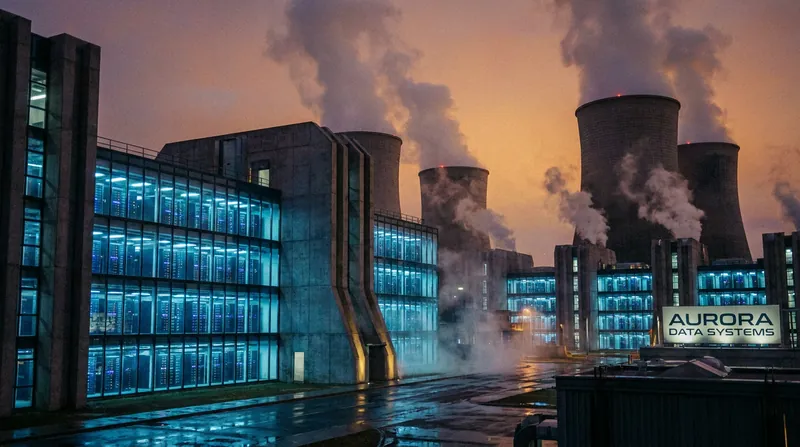
To bypass the years-long wait times typically associated with building new overhead power transmission lines, TeraWulf sought out existing heavy industrial infrastructure that had already solved the grid-connection problem. The new data center is being constructed on a 750-acre site that formerly housed a massive Century Aluminum smelter.
The smelting facility, which was idled in 2022 due to shifting global aluminum economics, left behind a highly valuable, ready-made asset: an energized electrical substation, multiple high-voltage transmission lines, and a direct, high-capacity connection to the regional electrical grid. By acquiring the dormant property for $200 million in February 2026, TeraWulf effectively skipped the grid-interconnection queue that is currently delaying AI expansion projects across the country.[2]
The timeline for the Hawesville campus reflects the urgency of the AI arms race. TeraWulf expects to bring the first tranche of computing capacity online in the second half of 2027, with the facility ramping up to its full 401-megawatt capacity by early 2028.
Anthropic’s financial obligations under the lease are backed by investment-grade credit, providing TeraWulf with the financial security needed to fund the massive construction effort. The agreement also includes two successive five-year renewal options, meaning Anthropic’s presence at the Kentucky site could ultimately extend to a 30-year commitment.[1]
Transforming a dormant aluminum smelter into a state-of-the-art artificial intelligence hub requires an immense outlay of capital. TeraWulf has indicated in corporate presentations that it expects to invest between $3 billion and $4 billion to fully build out the Justified DataPower campus.
While that figure is substantial, it represents less than one-fifth of the $19 billion in contracted revenue the company expects to receive from Anthropic over the life of the lease. To focus its resources entirely on this wholly owned mega-project, TeraWulf simultaneously announced the sale of its 50.1 percent stake in a separate Texas data center joint venture to its partner, FluidStack, for approximately $530 million.[1]
The Anthropic lease serves as the ultimate validation for a growing cohort of "neocloud" companies—infrastructure providers like TeraWulf, CoreWeave, and IREN that are rapidly repurposing their power assets to serve the AI boom. TeraWulf originally built its business model around Bitcoin mining, an industry that also requires massive amounts of electricity but yields highly volatile returns. By pivoting to artificial intelligence infrastructure, the company is trading the unpredictable swings of the cryptocurrency market for the stable, long-duration revenue streams provided by well-funded AI developers seeking guaranteed access to computing power.
Operating 401 megawatts of AI servers generates an extraordinary amount of thermal energy, presenting a significant engineering challenge. Traditional data centers often consume millions of gallons of local water to cool their equipment, a practice that has sparked environmental backlash in drought-prone regions.
To mitigate this impact, the Hawesville facility will utilize a closed-loop liquid cooling system designed specifically to dissipate the intense heat generated by densely packed graphics processing units. According to TeraWulf, this system does not draw continuous water from local reservoirs, but rather recycles the same cooling liquid indefinitely.
The mechanics of this closed-loop system rely on a specialized coolant mixture composed of water and propylene glycol, a non-toxic compound frequently used as a food additive. This liquid is continuously circulated through closet-like structures positioned directly behind the server racks, where it absorbs the thermal exhaust from the AI accelerators.
Industrial pumps then move the heated coolant outside the data center building, where massive fan arrays help radiate the trapped heat into the atmosphere. Once cooled, the liquid returns to the server racks, and the thermal management cycle repeats itself without requiring fresh water intake.
For Anthropic, securing a dedicated, half-gigawatt facility is a strategic necessity in the fiercely competitive race toward artificial general intelligence. Training successive generations of frontier models—like the company’s flagship Claude series—requires exponentially more computing power with each iteration. By locking in a 20-year lease, Anthropic is ensuring that its research and development pipeline will not be bottlenecked by a lack of physical infrastructure, insulating the company from the severe data center shortages that are currently forcing some AI developers to delay their product roadmaps.
The Kentucky deal lands at a moment of increasing friction between the artificial intelligence industry and local communities in established technology hubs. Just days before the Anthropic announcement, Blackstone’s QTS Data Centers abandoned a massive proposed campus in Virginia following years of intense local opposition over noise, power consumption, and land use.
As traditional data center corridors like Northern Virginia run out of available electricity and political goodwill, AI infrastructure developers are increasingly looking to the American heartland, seeking out stranded power at former industrial sites where large-scale development is welcomed rather than resisted.
The economic implications for Hawesville are profound. The city, which has a population of roughly 1,000 residents, suffered a significant economic blow when the Century Aluminum smelter was idled, taking hundreds of high-paying industrial jobs with it. The arrival of a $4 billion high-tech infrastructure project promises to revitalize the local tax base and create a new wave of specialized employment, transforming a relic of 20th-century heavy manufacturing into a critical node in the 21st-century digital economy.
While the physical shell and power delivery systems are now secured, the exact computational hardware that will populate the Justified DataPower campus remains a closely guarded secret. Anthropic relies heavily on industry-standard accelerators from Nvidia to train its models, but the AI developer is also exploring alternative silicon to reduce its dependency on a single supplier. Recent industry rumors suggest Anthropic may be partnering with Samsung Electronics to produce custom inference accelerators, leaving it an open question as to whose chips will ultimately draw the 401 megawatts of Kentucky power.
Ultimately, the unprecedented length of the lease agreement signals a profound shift in how the technology sector views the future of artificial intelligence. A 20-year commitment is an eternity in the fast-moving software industry, where product cycles are measured in months. By signing a contract that extends into the late 2040s, Anthropic and TeraWulf are betting that the massive energy requirements of large language models are not a temporary phase of initial training, but a permanent, foundational layer of the future global economy.
Key points
- Anthropic signed a 20-year, $19 billion lease for a 401-megawatt data center in Hawesville, Kentucky.
- The facility is being built by TeraWulf on the 750-acre site of a former Century Aluminum smelter.
- The site's existing high-voltage infrastructure allows TeraWulf to bypass years-long grid connection delays.
- Initial computing capacity will come online in late 2027, reaching full capacity by early 2028.
What we don’t know
- It remains unclear exactly which chips Anthropic will install in the facility, amid rumors of a custom silicon partnership with Samsung.
- The specific breakdown of how the 401 megawatts of electricity will be generated by the regional grid has not been detailed.
How we got here
2022
Century Aluminum idles its Hawesville smelter, leaving a 750-acre site with massive grid infrastructure vacant.
Feb 2026
TeraWulf acquires the dormant smelter property for $200 million to pivot toward AI infrastructure.
Jul 2026
Anthropic signs a 20-year, $19 billion lease for the entire 401-megawatt capacity of the planned campus.
H2 2027
Initial computing capacity is projected to come online and begin hosting Anthropic's AI workloads.
Early 2028
The Justified DataPower campus is expected to reach its full 401-megawatt operational capacity.
- AI Infrastructure Developers
- Focus on repurposing existing heavy industrial sites to bypass grid connection delays.
- Frontier AI Labs
- Prioritize securing dedicated, long-term compute capacity to guarantee future model training.
- Grid & Community Watchdogs
- Monitor the massive energy draw of AI facilities and their impact on local resources.
Perspectives this story doesn't cover
- Environmental advocates concerned about the generation source of the 401 megawatts of electricity.
- Local Hawesville residents reacting to the transition from heavy manufacturing to data storage.
Sources
Source coverage
2 outlets
3 viewpoints surfaced


- [1]QuartzAI Infrastructure Developers
Anthropic signed a 20-year lease on Monday for a data center campus in Hawesville
Read on Quartz → - [2]Kentucky.comGrid & Community Watchdogs
Anthropic signs $19 billion lease at a Kentucky data center
Read on Kentucky.com →
More in Artificial Intelligence
See all →AI Infrastructure
How NVLink Fusion Connects d-Matrix Inference Chips to Nvidia Server Racks
6 sources

AI Infrastructure
Pennsylvania Mandates AI Data Centers Must Provide Own Power and Grants Local Veto Power
7 sources
AI Infrastructure
Machine Traffic Surpasses Human Traffic on the Internet for the First Time at 57.4%
8 sources
AI Infrastructure
New York Enacts First-in-Nation Statewide Moratorium on New AI Data Center Construction
9 sources
Comments
Every angle. Every day.
Get Artificial Intelligence stories with full source coverage and perspective breakdowns, free every day.