
World's First Bespoke CRISPR Therapy Cures Infant With Rare Genetic Disease, Paving Way for 'N-of-1' Medicine
In a historic medical milestone, researchers developed and delivered a custom CRISPR base-editing therapy to an infant with a fatal metabolic disorder in just six months. The success of the 'N-of-1' treatment offers a scalable blueprint for curing ultra-rare genetic diseases.
Share this story
When KJ Muldoon was born, his parents had only a few days of normalcy before their world collapsed. The infant was diagnosed with severe carbamoyl phosphate synthetase 1 (CPS1) deficiency, an ultra-rare genetic disorder that affects just one in 1.3 million newborns. The condition is a urea cycle disorder, meaning KJ's liver lacked the essential enzyme required to break down proteins. Instead of being safely processed, the nitrogen from his diet converted into ammonia, a highly toxic compound that rapidly accumulates in the blood and attacks the brain.[1]
The prognosis for severe CPS1 deficiency is notoriously grim. Historically, the disease carries a 50 percent mortality rate in infancy. For those who survive the initial metabolic crises, the ammonia buildup often causes irreversible neurological damage. The only known cure is a liver transplant, but infants are frequently too small and fragile to survive the procedure, leaving them trapped in intensive care on highly restrictive diets and powerful nitrogen-scavenging drugs while they wait to grow.
KJ's diagnosis highlighted a brutal economic reality of modern medicine. Because his specific genetic mutation is so exceedingly rare, no pharmaceutical company could ever justify the hundreds of millions of dollars required to develop, test, and commercialize a traditional drug for it. Patients with "ultra-rare" diseases are often left behind by the standard drug development pipeline, relegated to palliative care.
But KJ's medical team at the Children's Hospital of Philadelphia (CHOP) and Penn Medicine refused to accept that paradigm. Instead of waiting for a commercial drug, they proposed a radical, unprecedented idea: they would build a custom-made genetic therapy from scratch, designed exclusively for KJ's unique DNA. It would be the ultimate test of "N-of-1" medicine—a clinical trial with a sample size of exactly one.[1]
To pull off the impossible, the physicians assembled a coalition of heavyweights in the gene-editing field. They partnered with the Innovative Genomics Institute at UC Berkeley—founded by CRISPR co-inventor and Nobel laureate Jennifer Doudna—alongside biotech manufacturing leaders Aldevron and Integrated DNA Technologies. Their goal was to design, test, manufacture, and secure regulatory clearance for a bespoke CRISPR therapy before KJ ran out of time.[1]
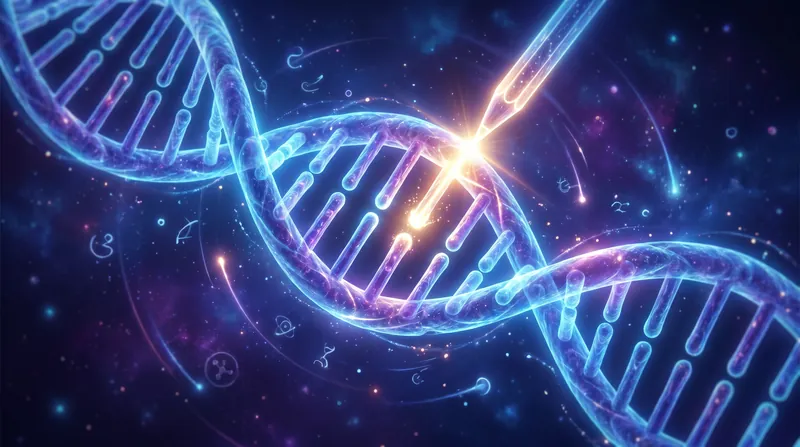
The team opted against using traditional CRISPR-Cas9, which acts as molecular scissors to cut both strands of DNA. While effective, double-strand breaks can sometimes lead to unintended genetic scrambling. Instead, they utilized a newer, more refined technology called "base editing." If traditional CRISPR is a pair of scissors, a base editor is a pencil and an eraser. It chemically converts a single misspelled DNA letter into the correct one without severing the DNA helix.
Delivering this molecular machinery into a living infant presented its own monumental challenge. The researchers encoded the base editor and a custom "guide RNA"—the GPS that tells the editor exactly where to go—into messenger RNA (mRNA). They then packaged these fragile instructions inside lipid nanoparticles (LNPs), the same microscopic fat bubbles famously used to deliver COVID-19 vaccines. When infused into KJ's bloodstream, the LNPs would naturally home in on his liver, enter the cells, and deploy the base editor to fix the CPS1 mutation.
What followed was a sprint unlike anything in the history of genomic medicine. The consortium moved from genetic sequencing to in-vitro testing, mouse models, and finally manufacturing a clinical-grade drug in just six months. This timeline was roughly three times faster than the industry standard for gene-editing products. The FDA, recognizing the dire nature of KJ's condition, granted emergency clearance for the experimental protocol.[1]
In February 2025, at just seven months old, KJ received his first intravenous infusion of the bespoke therapy. The medical world watched with bated breath. Over the next two months, he received two additional doses. The results were nothing short of miraculous. KJ tolerated the infusions perfectly, with no serious adverse events or signs of dangerous off-target genetic edits.
Almost immediately, the infant's biochemistry began to transform. His blood ammonia levels plummeted to safe ranges. For the first time in his life, KJ was able to tolerate increased amounts of dietary protein without suffering a metabolic crisis. He even successfully weathered several routine childhood viral infections—events that would normally trigger life-threatening ammonia spikes in a child with CPS1 deficiency.[1]
By May 2025, the groundbreaking results were published in The New England Journal of Medicine, sending shockwaves through the scientific community. But the true measure of success came a year later. In February 2026, CHOP provided a highly anticipated update: KJ was not only surviving, but thriving. The toddler was walking, talking, and hitting developmental milestones that once seemed entirely out of reach.
While doctors are cautious to declare him permanently "cured" so early in his life, the durability of the base-editing therapy suggests a profound, long-lasting correction of his liver function. More importantly, KJ's survival has officially validated a blueprint that could save thousands of other children born with fatal, ultra-rare genetic typos.
The true genius of the therapy lies in its modularity. The lipid nanoparticles and the mRNA base editor are essentially a universal delivery truck. To treat a completely different genetic disease, scientists don't need to reinvent the truck; they simply need to swap out the guide RNA—the address programmed into the GPS. This platform approach fundamentally changes the economics of rare disease treatment.
Industry experts project that while the first bespoke therapy cost upwards of $2 million and required a massive collaborative effort, a streamlined platform could eventually drop the cost of subsequent N-of-1 therapies to around $100,000, with a development timeline of just one month. This efficiency could finally entice for-profit biotech companies to invest in personalized genetic medicines.
The FDA has already signaled its willingness to adapt to this new era. Regulators are exploring frameworks where the underlying CRISPR platform receives a blanket approval, allowing doctors to rapidly swap guide RNAs for individual patients without enduring years of red tape. Baby KJ's legacy is not just his own survival; he has opened the door to a future where a devastating genetic diagnosis is no longer a tragedy, but merely a typo waiting to be erased.[1]
Key points
- An infant with a fatal metabolic disorder received the world's first bespoke CRISPR therapy.
- The custom treatment was designed, manufactured, and administered in just six months.
- The therapy used a base editor delivered via lipid nanoparticles to correct a liver mutation.
- One year later, the child is thriving, walking, and tolerating dietary protein.
What we don’t know
- Whether the genetic correction in the liver will remain permanent as the child grows into adulthood.
- Exactly how the FDA will structure the regulatory approval process for future platform-based N-of-1 therapies.
- Who will ultimately bear the financial cost of developing these bespoke treatments for individual patients.
How we got here
Late 2024
Baby KJ is born and quickly diagnosed with severe CPS1 deficiency, an ultra-rare metabolic disorder.
Early 2025
A coalition of researchers and biotech firms design and manufacture a custom CRISPR base-editing therapy in record time.
Feb 2025
KJ receives his first intravenous infusion of the bespoke gene therapy at seven months old.
May 2025
The landmark case is published in The New England Journal of Medicine, validating the N-of-1 approach.
Feb 2026
One year post-treatment, doctors report KJ is thriving, walking, talking, and tolerating dietary protein.
- Clinical Innovators
- Physicians and researchers focused on the medical milestone of successfully editing a human genome on demand.
- Biotech & Manufacturing
- Industry experts emphasizing the scalable platform and the potential to drastically reduce the cost of custom gene therapies.
- Patient Advocates
- Voices highlighting the life-saving impact on families who previously had no hope for ultra-rare diagnoses.
Perspectives this story doesn't cover
- Health Insurance Providers
- Medical Ethicists
Sources
Source coverage
1 outlets
3 viewpoints surfaced

- [1]Innovative Genomics InstituteClinical Innovators
Leaders of the gene-editing field join forces to develop and administer the first on-demand CRISPR therapy
Read on Innovative Genomics Institute →
More in Health
See all →Regulatory Policy
FDA Uses Machine Learning on Standard Lab Results to Replace Missing Biomarker Tests
3 sources
Immune Aging
Study Finds Adult Thymus is Not 'Defunct,' Plays Profound Role in Longevity and Cancer Defense
8 sources
Epigenetic Reprogramming
First Human Dosed With Cellular Reprogramming Injection in Landmark 'Reverse-Aging' Trial
6 sources

Medical Breakthrough
Genetically Modified Pig Organs Successfully Transplanted into Humans, Ending Decades-Long Xenotransplantation Barrier
3 sources
Comments
Every angle. Every day.
Get Health stories with full source coverage and perspective breakdowns, free every day.