
When Private Equity Can Expense a $250 Million Fine, Does Antitrust Enforcement Become a Joke?
The DOJ levied the largest premerger filing penalty in history against KKR, but the private equity giant's outside counsel will reimburse the entire amount, raising questions about the mechanics of corporate deterrence.
By Deniz Kaya

Share this story
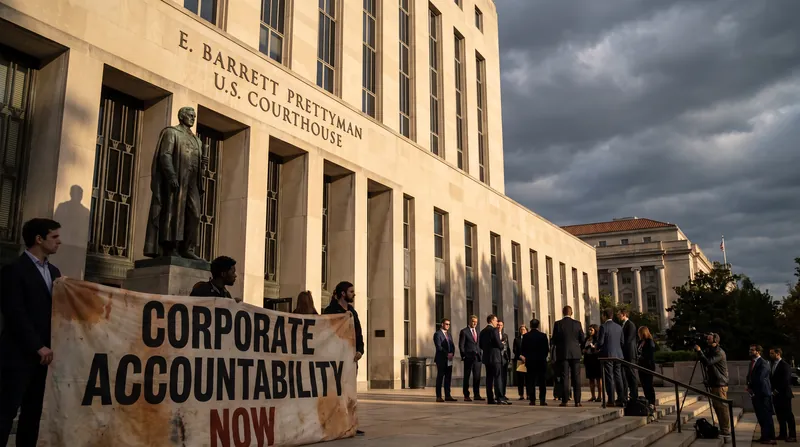
The Department of Justice wanted to send a historic message to Wall Street. By levying a $250 million civil penalty against private equity giant KKR for repeatedly flouting premerger antitrust rules, the government shattered the previous record by a factor of twenty.
Associate Attorney General Stanley Woodward declared the fine a powerful signal of vigorous enforcement. But the message received by the market was entirely different: KKR immediately announced that the penalty would have zero financial impact on the firm or its investors, because its outside law firms would reimburse the entire amount.[1][2]
This dynamic sits at the heart of a growing debate over the mechanics of corporate deterrence. If a $250 million fine—the largest ever assessed under the Hart-Scott-Rodino (HSR) Act—can simply be expensed to external legal counsel, does antitrust enforcement actually change corporate behavior? The answer requires looking past the headline dollar figure to the structural friction the DOJ is quietly imposing on KKR's future operations.[3][4]
The allegations against KKR are extensive. According to the DOJ's complaint, the firm evaded antitrust scrutiny on at least 16 separate transactions during 2021 and 2022. The government claims KKR systematically omitted required documents in ten filings, altered documents in eight others before submitting them, and completed two acquisitions without filing any paperwork at all.[1]
For a sophisticated dealmaker managing over $744 billion in assets, these are not minor administrative oversights. The HSR Act is the bedrock of US antitrust enforcement, requiring companies to notify the FTC and DOJ before completing large mergers so regulators can assess potential competitive harm. By allegedly altering and omitting documents, KKR bypassed the very mechanism designed to protect market competition.[1][4]
KKR strongly disputes the government's characterization. The firm maintains that it acted in good faith under its prior filing processes, which it argues were consistent with industry practice at the time. However, KKR chose to settle rather than engage in prolonged litigation that would distract from its core business. The settlement fully resolves the DOJ's claims without KKR admitting wrongdoing.[2]
The sheer scale of the penalty—dwarfing the previous $12 million record set just weeks earlier by Edwards Lifesciences—was designed to shock the private equity industry into compliance. Yet, the financial sting was instantly neutralized. KKR's recent quarterly net income was over $660 million, making the fine manageable even if the firm had paid it directly. With outside counsel covering the cost, investors treated the news as a non-event, and KKR's stock remained unaffected.[3]
The true cost to KKR, therefore, is not financial but regulatory. An established record of HSR violations fundamentally alters how the DOJ and FTC will treat the firm's future transactions. KKR currently holds an estimated $143 billion in dry powder waiting to be deployed. Every future deal will now likely face extended review periods, wider document requests, and intense skepticism from antitrust regulators.[4]
Furthermore, the settlement was meticulously drafted to avoid triggering collateral securities-law consequences. The agreement imposes only a monetary penalty, intentionally bypassing injunctions that could have disqualified KKR from serving as an investment adviser to registered funds under the Investment Company Act. This carve-out preserves KKR's core business model while allowing the DOJ to claim a historic enforcement victory.[3][4]
Critics argue this arrangement represents a failure of accountability, transforming a punitive measure into a mere indemnification claim against malpractice insurance. If the ultimate consequence of systematically altering federal filings is a bill paid by someone else, the deterrent effect on the actual corporate actor is severely diluted.[3][4]
Conversely, defenders of the settlement point out that the legal profession's strict liability standards functioned exactly as intended. If external counsel provided flawed advice or managed the filing process improperly, they should bear the financial burden. Meanwhile, KKR must navigate a permanently altered relationship with federal regulators, proving that while cash penalties can be outsourced, regulatory trust cannot.[3][4]
Key points
- The DOJ secured a $250 million civil penalty against KKR for allegedly altering and omitting required premerger antitrust filings.
- The penalty is more than 20 times larger than any previous fine issued under the Hart-Scott-Rodino Act.
- KKR announced the fine will have zero financial impact on the firm or its investors, as outside law firms will reimburse the full amount.
- Legal analysts suggest the true penalty is not financial, but the permanent regulatory friction KKR will face on future acquisitions.
How we got here
2021–2022
KKR allegedly fails to comply with HSR premerger notification requirements across at least 16 separate transactions.
January 2025
The Department of Justice files a civil lawsuit against KKR alleging systemic violations of the Hart-Scott-Rodino Act.
July 2026
The FTC secures a $12 million penalty against Edwards Lifesciences, briefly setting the record for an HSR violation.
August 2026
KKR and the DOJ agree to a record-breaking $250 million settlement, which KKR announces will be fully reimbursed by outside counsel.
- Legal Ethics Analysts
- Question whether indemnifying regulatory fines dilutes corporate deterrence, while noting that the true penalty lies in future regulatory friction.
- Antitrust Regulators
- Argue that record-breaking fines are necessary to force compliance and deter systemic violations of premerger notification rules.
- Corporate Defense Counsel
- Emphasize that settlements resolve distractions without admitting fault, and that outside counsel indemnification is a standard mechanism for managing legal risk.
Perspectives this story doesn't cover
- Outside Law Firms
- FTC Commissioners
Sources
Source coverage
4 outlets
3 viewpoints surfaced




- [1]ReutersAntitrust Regulators
KKR settles US antitrust case accusing it of merger filing violations for $250 million
Read on Reuters → - [2]BigGo FinanceCorporate Defense Counsel
KKR to Pay Record $250 Million Penalty to Settle US Antitrust Filing Claims
Read on BigGo Finance → - [3]AI EsquireLegal Ethics Analysts
KKR's $250 Million HSR Penalty and Outside Counsel Risk
Read on AI Esquire → - [4]Factlen Editorial TeamLegal Ethics Analysts
Synthesis by Factlen editorial team
Read on Factlen Editorial Team →
More in Perspectives
See all →AI Infrastructure
The AI Power Crisis Proves Data Centers Must Be Regulated as Public Utilities
6 sources

Labor Economics
The Structural Decoupling of American Productivity and Pay Since 1973
9 sources

Global Trade
The Prebisch-Singer Hypothesis: Why Developing Nations Are Mathematically Locked Into Commodity Dependence
8 sources

Grid Infrastructure
Senate Standoff Over AI Data Center Costs Exposes the Limits of the Coase Theorem
2 sources
Comments
Every angle. Every day.
Get Perspectives stories with full source coverage and perspective breakdowns, free every day.