
UN Security Council Holds Emergency Session After US-Israel Airstrikes on Iran and Tehran's Retaliation
The UN Security Council convened an emergency meeting to address escalating Middle East violence following coordinated US and Israeli strikes on Iran and subsequent Iranian retaliatory attacks.

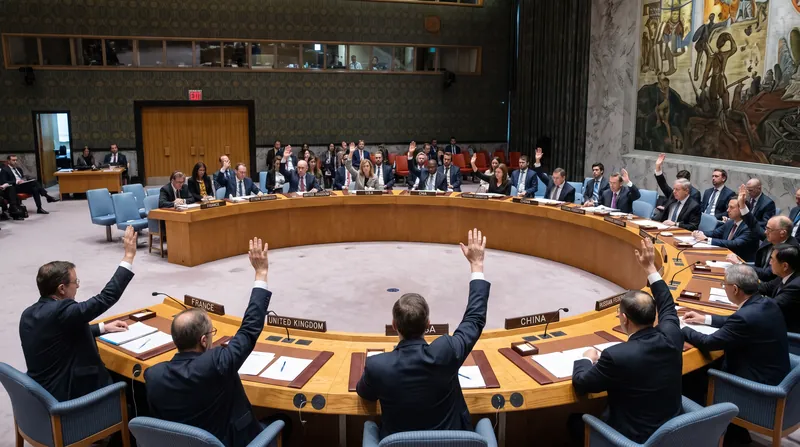
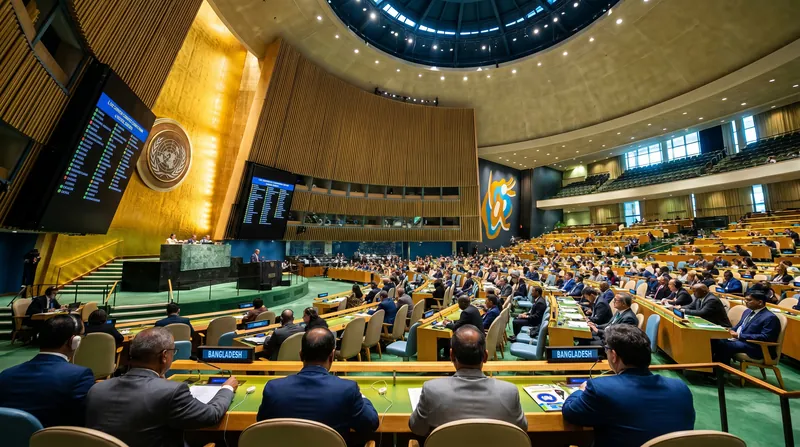
The United Nations Security Council convened an emergency session in New York to address a rapidly escalating military confrontation in the Middle East, following coordinated airstrikes by the United States and Israel against Iran, and Tehran's subsequent retaliatory attacks. The session, requested by Russia, China, France, Bahrain, and Colombia, laid bare deep international divisions over the conflict.[1][2][5]
The crisis intensified after US and Israeli forces launched strikes aimed at Iranian military and leadership targets, an offensive the US has dubbed 'Operation Epic Fury'. In response, Iran launched waves of drones and missiles targeting locations in Israel and several Gulf states, prompting airspace closures and widespread military alerts across the region.[2][5][6]
Addressing the 15-member Security Council, UN Secretary-General António Guterres delivered a stark warning, condemning the military actions of all involved parties. Guterres stated that the US and Israeli airstrikes violated international law and the UN Charter, while equally condemning Iran's retaliatory attacks for violating the sovereignty of neighboring Arab states. He urged an immediate cessation of hostilities to pull the world 'back from the brink'.[3][4]
The diplomatic exchange during the session was highly polarized. US Ambassador to the UN Mike Waltz defended the American military action as lawful and necessary for global security, asserting that 'Iran cannot have a nuclear weapon' and that the operation aims to dismantle missile capabilities and disrupt proxy militias. Israeli Ambassador Danny Danon echoed this stance, calling the strikes a preemptive measure against an 'existential threat' and dismissing the council's condemnation as 'hypocrisy'.[3][4][6]
Conversely, Iran's Permanent Representative to the UN, Amir Saeid Iravani, characterized the joint US-Israeli operation as a 'deliberate and unprovoked military attack'. Iravani accused the US and Israel of committing war crimes and violating the UN Charter, demanding that the Security Council take immediate action to halt the aggression.[2][3]
The Russian mission to the UN supported Tehran's position, formally requesting the session over what it termed an 'unprovoked act of armed aggression' by Washington and Jerusalem. China's representative also denounced the strikes, expressing shock that military action occurred while diplomatic negotiations were ostensibly ongoing.[1][5]
Meanwhile, European powers sought to navigate a middle path. In a joint statement, the leaders of Britain, France, and Germany condemned the Iranian retaliatory strikes but notably refrained from condemning the initial US-Israeli attacks. The European nations emphasized the need to resume negotiations regarding Tehran's nuclear program, a framework that has been largely defunct since the US withdrawal in 2018.[3][4]
The humanitarian toll of the escalation is already mounting. UN relief officials warned that the violence is exacerbating an increasingly daunting crisis, with strikes reportedly hitting civilian infrastructure across the region. As the Security Council debates its next steps, the international community remains deeply concerned that the cycle of retaliation could spiral beyond control, triggering a devastating region-wide war.[2][4]
Where opinion splits
US and Israeli Administrations
The US and Israel view the strikes as a necessary and lawful preemptive action.
Representatives from Washington and Jerusalem argue that Iran's pursuit of nuclear weapons and its support for regional proxy groups constitute an immediate and existential threat to global security. US Ambassador Mike Waltz and Israeli Ambassador Danny Danon maintained that the military operations were designed to dismantle this threat before it becomes unstoppable, framing their actions as a defense of international stability rather than an act of aggression.
Iran and Allied Nations
Iran, supported by Russia and China, characterizes the US-Israeli strikes as unprovoked aggression.
Tehran views the coordinated attacks as a blatant violation of its sovereignty and international law. Iranian Ambassador Amir Saeid Iravani argued that the strikes were a calculated attempt at regime change that caused significant civilian casualties. This perspective is bolstered by Russia and China, who condemned the US and Israeli actions as illegal and destabilizing, demanding an immediate halt to the military campaign.
European and UN Diplomats
European nations focus on de-escalation and a return to nuclear negotiations.
Britain, France, and Germany have adopted a nuanced position, strongly condemning Iran's retaliatory strikes on neighboring states while urging all parties to step back from the brink of war. The European leaders emphasize that a military solution is untenable and are pushing for a resumption of diplomatic talks regarding Iran's nuclear program, viewing a negotiated settlement as the only viable path to long-term regional stability.
Key points
- The UN Security Council held an emergency session requested by Russia, China, France, Bahrain, and Colombia.
- UN Secretary-General António Guterres condemned both the US-Israeli strikes and Iran's retaliatory attacks.
- US and Israeli ambassadors defended the strikes as necessary to prevent Iran from acquiring nuclear weapons.
- Iran's ambassador called the US-Israeli strikes a 'flagrant violation' of the UN Charter.
Unanswered questions
- Whether the US and Israel plan further military operations under Operation Epic Fury.
- How Iran will respond to the UN Security Council's debate and whether it will launch additional retaliatory strikes.
- If the European push for renewed nuclear negotiations can gain traction amid the current hostilities.
- US and Israeli Administrations
- Argues that the strikes were a lawful and necessary preemptive measure to stop Iran's nuclear program.
- Iran and Allied Nations
- Views the US-Israeli strikes as unprovoked aggression and a violation of international law, justifying retaliation.
- European and UN Diplomats
- Focuses on condemning regional escalation and pushing for a return to diplomatic negotiations over Iran's nuclear program.
Perspectives this story doesn't cover
- Civilian populations in the conflict zones
- Global energy market analysts
Sources
Source coverage
6 outlets
3 viewpoints surfaced






- [1]Times of IsraelIran and Allied Nations
Russia and others request special session over 'unprovoked act of armed aggression'
Read on Times of Israel → - [2]UN NewsEuropean and UN Diplomats
Violent escalation in the Middle East has entered a third day as coordinated US and Israeli strikes
Read on UN News → - [3]PBSUS and Israeli Administrations
UN chief condemns U.S.-Israeli attacks on Iran during emergency Security Council meeting
Read on PBS → - [4]LA TimesEuropean and UN Diplomats
U.N. Secretary-General António Guterres condemned both U.S.-Israeli airstrikes on Iran and Iran's retaliatory attacks
Read on LA Times → - [5]CGTNIran and Allied Nations
The United Nations Security Council has held an emergency meeting in response to US-Israeli strikes on Iran
Read on CGTN → - [6]US Mission to the UNUS and Israeli Administrations
Ambassador Mike Waltz U.S. Representative to the United Nations New York, New York
Read on US Mission to the UN →
More in News & Politics
See all →Global Development
The CPIA Score of 3.2 and the UN Mission Presence: How the World Bank Defines a Fragile State
6 sources
EU Governance
The 55% of Member States Representing 65% of the EU Population Threshold: How the European Union Passes Legislation
5 sources
International Law
The Complementarity Principle: How the International Criminal Court Defers to National Jurisdictions
6 sources
Peacekeeping Finance
The Five-Tiered Scale of Assessment: How the UN Apportions Peacekeeping Costs Based on Economic Capacity and P5 Status
8 sources
Comments
Every angle. Every day.
Get News & Politics stories with full source coverage and perspective breakdowns, free every day.