
U.S. Triggers USMCA Sunset Clause, Starting 10-Year Countdown to Trade Pact's Expiry
The United States has formally declined to extend the USMCA during its first joint review, activating a decade-long renegotiation window that sidelines Canada while Washington pursues strict bilateral manufacturing demands with Mexico.

Share this story
The United States has formally declined to grant a clean 16-year extension to the United States-Mexico-Canada Agreement (USMCA), fundamentally altering the architecture of North American trade. By withholding its confirmation during the pact's first mandatory joint review, Washington has officially triggered the agreement's "sunset clause." This maneuver does not dismantle the $1.93 trillion trilateral trade bloc overnight. Instead, it activates a structured, decade-long countdown that could see the agreement expire on July 1, 2036, unless all three nations reach a consensus on sweeping revisions.[1][2]
The activation of the sunset clause marks the end of the "set it and forget it" era of North American commerce. Under the rules established when the USMCA replaced NAFTA in 2020, the three member nations are required to meet every six years to assess the pact's performance.
A unanimous agreement extends the treaty's horizon to 2042. Because the United States has refused to provide that endorsement, the agreement now shifts from a stable, long-term framework into a state of perpetual renegotiation, requiring annual reviews by the Free Trade Commission for the next ten years.
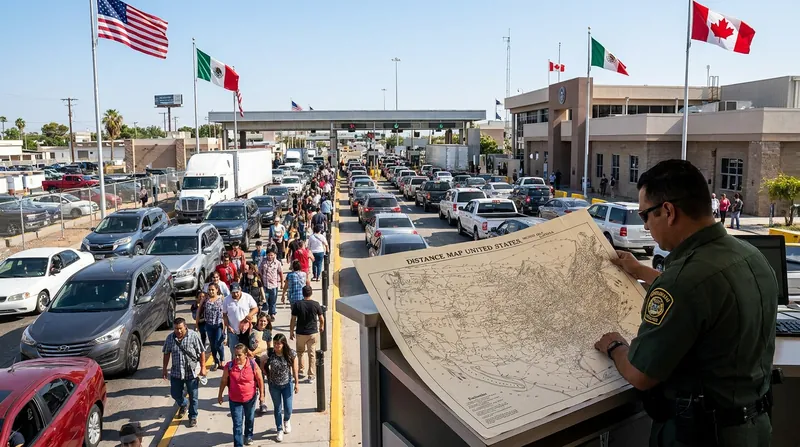
The immediate geopolitical casualty of this procedural trigger appears to be Canada. As the United States initiates this decade-long renegotiation window, Washington has aggressively pivoted toward bilateral talks with Mexico, effectively sidelining Ottawa from the most critical early discussions.
U.S. Trade Representative Jamieson Greer has already scheduled a third round of exclusive bilateral negotiations with Mexican officials for the week of July 20 in Mexico City. This two-party focus highlights a stark reality: the most pressing U.S. trade grievances are heavily concentrated on the southern border, leaving Canada to navigate the fallout from the periphery.[1][2]
Washington's decision to pull the sunset trigger is driven primarily by the automotive sector and the shifting dynamics of global manufacturing. U.S. negotiators are demanding a radical overhaul of the USMCA's rules of origin. Currently, passenger vehicles must contain 75 percent North American content to qualify for zero-tariff treatment. The United States is now pushing to elevate that threshold to 82 percent, while simultaneously introducing a highly contentious requirement that 50 percent of a vehicle's content be specifically manufactured within the United States.[1][2]
Beyond automotive manufacturing, the United States is using the sunset countdown to force Mexico's hand on Chinese trade triangulation. U.S. officials have expressed mounting alarm over the surge of Chinese steel and aluminum entering North America through Mexican Pacific ports, such as Manzanillo.
Much of this material is processed in industrial hubs like Nuevo León before crossing the U.S. border duty-free. By holding the survival of the entire USMCA hostage to a 10-year clock, Washington is demanding that Mexico implement strict "melted and poured" requirements and robust anti-circumvention mechanisms to block Chinese enterprises from exploiting the free trade zone.
For Canada, the bilateral nature of these early demands presents a complex strategic dilemma. While Ottawa shares some of Washington's concerns regarding Chinese overcapacity—having recently aligned with U.S. tariffs on Chinese electric vehicles—the Canadian automotive supply chain is deeply integrated with the U.S. Midwest.
A mandate requiring 50 percent U.S.-specific content would severely disrupt Canadian parts manufacturers in Ontario. Yet, because the U.S. is currently prioritizing its negotiations with Mexico over steel transshipment and labor value content, Canadian trade officials are finding it difficult to secure a seat at the primary negotiating table.[2]
It is crucial to distinguish the sunset clause from an outright withdrawal. Article 34.6 of the USMCA allows any member to exit the agreement entirely with just six months' notice—a nuclear option that would immediately shatter continental supply chains. The United States has not invoked this termination clause. By utilizing Article 34.7—the sunset provision—Washington is opting for leverage rather than destruction. The 10-year countdown is designed to apply continuous, compounding pressure on Mexico and Canada to make concessions, without triggering the immediate economic chaos of a sudden tariff cliff.[1]
Nevertheless, the activation of the sunset clause introduces profound operational challenges for the private sector. Supply chain managers and corporate strategists must now operate under a cloud of prolonged policy uncertainty. Major investments in manufacturing capacity, which typically require a 10-to-15-year amortization horizon, are now inherently riskier. A factory built in Mexico today to serve the U.S. market faces the distinct possibility that the rules governing its exports could change drastically—or disappear entirely—before the facility turns a profit.[3]
Logistics and compliance firms are already advising clients to abandon the assumption that North American trade rules are static. Companies are being urged to audit their supplier tiers down to the raw material level, ensuring they can prove the exact origin of every component. Automakers, in particular, are stockpiling USMCA-compliant parts and modeling scenarios where they may simply choose to pay the standard World Trade Organization "Most-Favored-Nation" tariffs rather than attempt to comply with increasingly labyrinthine regional value requirements.[3]
The financial markets are also reacting to the new reality of annual USMCA reviews. Foreign exchange analysts anticipate increased volatility for the Mexican peso and the Canadian dollar, as currency valuations become tightly tethered to the perceived success or failure of each yearly Free Trade Commission meeting. Corporate treasuries are being advised to implement comprehensive hedging strategies to protect against sudden currency swings triggered by negotiating rhetoric over the next decade.
Historically, the inclusion of the sunset clause was the most fiercely debated element of the 2018 NAFTA renegotiations. Trade purists argued that free trade agreements require permanence to foster investment, warning that a ticking clock would poison economic growth.
The architects of the USMCA, however, argued that permanence breeds complacency, pointing to how the original NAFTA failed to adapt to the digital economy or the rise of China. Today's developments suggest the architects' vision is playing out exactly as intended: the agreement is being forced to evolve under the threat of its own demise.
As the clock begins ticking toward 2036, the immediate focus will remain on the U.S.-Mexico bilateral track. If Washington and Mexico City can reach an accommodation on automotive rules and steel transshipment, the United States may eventually pivot back to a trilateral format to address Canadian dairy quotas and digital services taxes. Until then, the USMCA exists in a state of suspended animation—alive and functioning, but burdened by an expiration date that will dominate North American economic policy for the foreseeable future.[1]
Key points
- The U.S. has officially refused to grant a 16-year extension to the USMCA during its first mandatory joint review.
- This action triggers the pact's sunset clause, initiating a 10-year countdown to potential expiration in 2036.
- Washington is prioritizing bilateral negotiations with Mexico over automotive rules and Chinese steel, effectively sidelining Canada.
- The agreement remains in force, but shifts to a system of annual reviews that introduces long-term uncertainty for supply chains.
What we don’t know
- Whether the U.S. will formally publish its exact demands for the 82% automotive regional value content rule.
- How Canada will respond to being excluded from the primary U.S.-Mexico bilateral negotiations.
- If Mexico possesses the regulatory infrastructure to successfully enforce the 'melted and poured' steel requirements demanded by Washington.
How we got here
July 2020
The USMCA enters into force, replacing NAFTA and introducing the novel 16-year term and 6-year review mechanism.
June 2026
The U.S. and Mexico conclude their first bilateral negotiating round ahead of the formal joint review.
July 1, 2026
The first mandatory joint review occurs; the U.S. declines to extend the pact, triggering the 10-year sunset countdown.
July 2036
The potential expiration date of the USMCA if the three nations fail to reach a consensus during the decade of annual reviews.
- U.S. Trade Negotiators
- Argue that the sunset clause is a necessary mechanism to force continuous modernization of the pact and prevent foreign adversaries from exploiting North American supply chains.
- Supply Chain Operators
- View the 10-year countdown as a source of profound operational risk, forcing companies to delay investments and spend heavily on compliance auditing.
- Canadian & Mexican Officials
- Seek to preserve the stability of the trilateral trade bloc while navigating aggressive U.S. bilateral tactics that threaten their domestic manufacturing sectors.
Perspectives this story doesn't cover
- Labor unions in the automotive sector
- Asian component manufacturers
Sources
Source coverage
3 outlets
3 viewpoints surfaced



- [1]ReutersU.S. Trade Negotiators
U.S. to declare it will not extend USMCA trade pact, starting 10-year clock
Read on Reuters → - [2]Modern DiplomacyCanadian & Mexican Officials
US to begin USMCA exit process as trade talks continue
Read on Modern Diplomacy → - [3]GeodisSupply Chain Operators
The USMCA Clock is Ticking: What the July 1 Review Means for Your Supply Chain
Read on Geodis →
More in World
See all →Ecological Restoration
How Indigenous-Led Bison Reintroduction is Restoring the Great Plains
4 sources

EV Supply Chain
How the US, Canada, and Mexico Are Building the North American 'Battery Belt'
2 sources

High-Speed Rail
How North America is Finally Building True High-Speed Rail
4 sources
Wildlife Corridors
How North America is Engineering Nature Back Across Its Highways
2 sources
Comments
Every angle. Every day.
Get World stories with full source coverage and perspective breakdowns, free every day.