
Tipping Fatigue: The New 20% Baseline and Why Counter Service Tips Are Now Optional
As digital point-of-sale screens push gratuity requests into new environments, a growing majority of Americans are experiencing 'tipping fatigue.' Etiquette experts and economic data now clarify that while full-service dining baselines have risen to 20%, counter service tips remain entirely optional.
By Irina Belova

Share this story
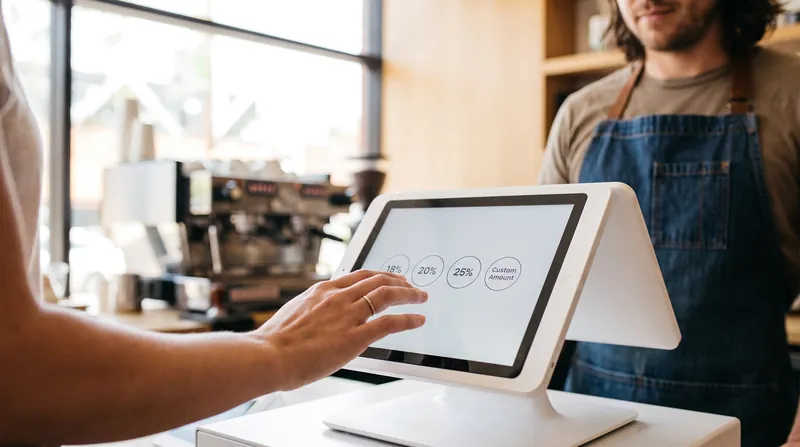
The iPad swings around. The barista smiles politely. The screen presents three pre-calculated options: 18%, 20%, or 25%. For a simple $5 drip coffee that took seconds to pour, the math feels aggressive, but the social pressure is heavy. You tap the lowest option, or perhaps the custom button to leave a single dollar, and walk away feeling a vague sense of coercion. This modern checkout ritual—often dubbed the 'guilt tap'—has become a defining friction point of daily American commerce, transforming a simple transaction into a complex moral calculation.[3]
The phenomenon now has a formal name: tipping fatigue. After years of expanding gratuity prompts, consumer exhaustion has reached a statistical boiling point in 2026. What began as a surge of pandemic-era generosity to support essential workers during lockdowns has calcified into a permanent, digitized expectation across the service industry. Today, Americans are actively pushing back, seeking clarity on when a tip is a genuine reward for personalized service and when it is simply a software default designed to maximize revenue.[1][2]
The data reveals a stark shift in public sentiment. According to a comprehensive 2025 survey by Bankrate, 63 percent of Americans now hold at least one negative view about tipping culture, representing a steady and significant increase from previous years. The frustration is not rooted in stinginess, but in the sheer ubiquity of the requests. Nearly 40 percent of consumers report feeling actively annoyed by pre-entered tip screens, and many admit that the aggressive prompts actually make them want to tip less out of sheer defiance.[1]
A parallel study by the Pew Research Center confirms the massive scale of this expansion. Roughly 72 percent of U.S. adults say tipping is expected in significantly more places today than it was just five years ago. Yet, despite this rapid proliferation of tip jars and digital screens, only about a third of Americans feel confident about when and how much to tip. This leaves the vast majority of the public navigating a daily maze of financial ambiguity, unsure of the modern rules of etiquette.[2]
The architecture of this 'tip creep' is largely technological rather than cultural. The widespread adoption of digital point-of-sale (POS) systems, such as those provided by Square, Toast, and Clover, made it entirely frictionless for businesses of all types to integrate gratuity screens into their standard checkout flows. Suddenly, bakeries, food trucks, self-serve frozen yogurt shops, and even airport retail boutiques were presenting customers with tip prompts that historically only existed in the domain of full-service, sit-down restaurants.[3][7]
These digital screens rely heavily on a behavioral economics principle known as anchoring. By presenting 18 or 20 percent as the lowest default option on the screen, the software artificially shifts the consumer's perception of what is considered a normal baseline. As Cornell University tipping expert Mike Lynn has noted, ignoring a physical cash tip jar is a passive 'sin of omission,' but actively tapping the 'No Tip' button on a bright screen while the cashier watches feels like a deliberate and uncomfortable 'sin of commission.'[3]
For business owners, however, the screens serve a vital and immediate economic function. Amid persistent inflation and rising labor costs, digital tip prompts offer a seamless way to increase workers' take-home pay without raising the baseline prices printed on the menu. In industries where profit margins are notoriously razor-thin, shifting a portion of labor compensation directly to the consumer has become a necessary survival tactic, even if owners recognize that it risks alienating their core customer base over time.[7]
This dynamic has created a fascinating generational divide in how Americans respond to the checkout counter. Bankrate's research indicates that Baby Boomers and Gen Xers are the most reliable tippers, yet they harbor the deepest resentment toward the new digital prompts. Conversely, Gen Z and Millennial consumers tip less frequently overall, but report feeling significantly more social pressure and guilt when confronted with a screen, often because their tighter discretionary budgets collide directly with their generational desire to support service workers.[1]
The resulting confusion has prompted etiquette experts and financial analysts to establish a new, formalized framework for 2026, offering consumers a much-needed psychological release. The most liberating consensus to emerge from this guidance is clear and definitive: counter service tips are entirely optional. If you order your food at a register, carry your own tray to a table, or pick up a takeout bag to bring home, there is absolutely no social or ethical obligation to leave a percentage-based gratuity.[4]
'Tipping is optional in counter-type service situations,' notes recent guidance from industry analysts, emphasizing that a zero-percent tip for a standard drip coffee or a pre-made pastry is perfectly acceptable etiquette. While leaving a spare dollar or rounding up the final bill remains a kind and welcome gesture for highly complex orders or exceptional friendliness, consumers are being actively encouraged to release the guilt associated with tapping the 'No Tip' button for basic, frictionless transactions.[4][5]
In fact, consumer behavior is already rapidly aligning with this new permission structure. Data from financial platforms like MoneyLion reveals that 64 percent of Americans do not tip at coffee shops, and among those who do, the average is closer to 10 percent rather than the inflated digital defaults. Similarly, data from major payment processors shows that average tips for quick-service and counter restaurants have steadily declined to around 14 to 15 percent, reflecting a public that is actively recalibrating its boundaries.[3][5]
However, while counter service expectations are visibly softening, the baseline for full-service dining has officially moved upward, creating a bifurcated tipping culture. The traditional standard of 15 percent for a sit-down meal is now widely considered outdated by industry professionals. Etiquette experts and economic data confirm that 18 to 20 percent is the new established normal for standard table service, with 20 to 25 percent reserved for truly excellent, highly attentive hospitality experiences.[4][5]
This upward shift in full-service dining is backed by hard, nationwide transaction data. According to Toast's comprehensive restaurant trends reporting, the average tip at full-service restaurants across the United States hovered around 19.4 percent in early 2025. This metric demonstrates that Americans remain highly generous and willing to pay a premium when traditional, personalized service is actually rendered. The public's frustration lies entirely in the context of the request, not in the absolute cost of rewarding good service.
The rules for delivery and gig economy workers also remain firm in the new etiquette framework. Because delivery drivers bear the direct costs of fuel, insurance, and vehicle maintenance, experts strongly recommend a 15 to 20 percent tip, or a flat minimum of $5 for smaller orders, to ensure the trip is economically viable for the worker. Similarly, personal care services—such as haircuts, massages, and salon treatments—still command a standard 15 to 20 percent gratuity for the dedicated time and skill involved.[3][5]
As tipping fatigue reshapes daily consumer habits, it is also influencing broader, seasonal economic indicators. Newsweek recently reported a measurable decline in end-of-year holiday tipping for ancillary service providers—such as trash collectors, landscapers, and mail carriers—as everyday Americans tightened their budgets in response to inflation and tip exhaustion. The finite pool of consumer generosity is being guarded more closely, reserved primarily for those who provide direct, highly visible services throughout the year.[6]
In response to the growing consumer backlash, a small but vocal minority of hospitality businesses are experimenting with alternative compensation models. Some restaurants have eliminated tipping entirely, opting instead to raise menu prices by 15 to 20 percent to fund equitable, living wages and healthcare benefits for all staff members. While this transparent pricing model eliminates the checkout friction entirely, it remains a tough sell for consumers who are psychologically accustomed to artificially lower menu prices.[7]
Ultimately, the 'gratuity crisis' of 2026 is not a rejection of service workers, but a collective demand for sensible boundaries. By clearly delineating between full-service labor and automated counter transactions, consumers can finally reclaim their financial agency. The iPad may still swing around at the local bakery, but the modern consumer is now equipped with the data, the expert permission, and the etiquette backing to tap 'No Tip' without a second thought.[1][4]
Key points
- A 2025 Bankrate survey found that 63% of Americans hold a negative view of modern tipping culture.
- The expansion of tip screens is largely driven by digital point-of-sale systems that make prompting for gratuity frictionless.
- Etiquette experts have formally clarified that tipping for counter service, takeout, and coffee is entirely optional.
- Despite counter service frustration, the baseline tip for full-service sit-down dining has increased to 18-20%.
Unanswered questions
- Whether the pushback against counter service tipping will eventually lower the 20% baseline at full-service restaurants.
- How legislative efforts to eliminate the sub-minimum wage for tipped workers might alter the fundamental structure of American gratuity.
How we got here
Pre-2020
The standard sit-down restaurant tip hovered around 15%, and counter service tipping was largely relegated to physical cash jars.
2020–2021
Pandemic-era generosity drove tipping averages higher as consumers sought to support struggling essential workers.
2022–2024
Digital point-of-sale systems proliferated, bringing pre-calculated tip screens to bakeries, food trucks, and self-checkout kiosks.
2025–2026
Consumer pushback solidifies into 'tipping fatigue,' prompting etiquette experts to formally declare counter service tips optional.
- Consumer Advocates
- Focuses on transparency, combating tip creep, and reducing checkout pressure.
- Etiquette & Service Experts
- Protects sit-down gratuities while clarifying that counter service rules are different.
- Hospitality Industry Operators
- Highlights the economic pressures of labor costs and inflation that drive the use of tip screens.
Perspectives this story doesn't cover
- Gig economy delivery drivers
- POS software developers
Sources
Source coverage
7 outlets
3 viewpoints surfaced







- [1]BankrateConsumer Advocates
Bankrate's Annual Tipping Survey
Read on Bankrate → - [2]Pew Research CenterConsumer Advocates
Tipping Culture in America: Public Sees a Changed Landscape
- [3]SplittyAppHospitality Industry Operators
Frequently asked questions about tipping fatigue
- [4]The Law CorpEtiquette & Service Experts
Tipping fatigue, confusion, and even resentment
- [5]MoneyLionEtiquette & Service Experts
What Americans Actually Tip in 2026 — From Coffee Shops to Cabs
- [6]NewsweekConsumer Advocates
Holiday Tipping Drops, Reflecting Financial Pressures
- [7]Westmoreland ChamberHospitality Industry Operators
Tipping Fatigue is Real
More in Lifestyle
See all →Tipping Culture
The Great Tipping Reversal: Why Consumers Are Ready to Pay Higher Menu Prices to End Gratuity
5 sources
Tipping Culture
The New Rules of Tipping in 2026: Navigating Digital Screens and Service Fees
3 sources
Aging Science
Landmark Study: How 'Hasslers' in Your Life Accelerate Biological Aging
6 sources

Behavioral Science
Landmark Study Finds Social Norms Spread by 'Commitment Threshold,' Not Simple Imitation
3 sources

Comments
Every angle. Every day.
Get Lifestyle stories with full source coverage and perspective breakdowns, free every day.