
The Structural Shift in Nile Water Law: Comparing the 1959 Volumetric Quotas to the 2015 Declaration of Principles
The legal architecture governing the Nile River has transitioned from fixed water allocations for downstream states to a principle-based framework accommodating upstream development. This shift replaces absolute volumetric guarantees with a variable risk-sharing model during multi-year droughts.

Share this story
In short
- The 1959 Nile Waters Agreement divided the river's entire 84-billion-cubic-meter flow between Egypt and Sudan, excluding upstream states.
- The 2015 Declaration of Principles replaces fixed volumetric quotas with the standard of 'equitable and reasonable utilization.'
- The GERD's 74-billion-cubic-meter capacity shifts the basin from a single-reservoir system to a dual-reservoir system.
The allocation of the Nile River's flow is determined the moment water is impounded behind a concrete wall, rather than when it crosses a national border. The legal right to build and fill those structures dictates which nation absorbs the deficit during a drought.
For over sixty years, the legal architecture governing the river relied on fixed volumetric quotas that guaranteed downstream supply. The 2015 Declaration of Principles (DoP) regarding the Grand Ethiopian Renaissance Dam (GERD) altered that structure, replacing absolute downstream guarantees with a framework of equitable utilization that forces all three nations to share the hydrological risk.[2][7]
The baseline for downstream water security was established by the 1929 Anglo-Egyptian Treaty and solidified by the 1959 Nile Waters Agreement. The 1959 framework divided the river's average annual yield of 84 billion cubic meters entirely between two states.
Egypt secured 55.5 billion cubic meters annually, while Sudan received 18.5 billion cubic meters. The remaining 10 billion cubic meters were allocated to evaporation at the Aswan High Dam. This bilateral treaty explicitly excluded the eight upstream riparian states, including Ethiopia, which supplies approximately 85% of the river's water from the Blue Nile.[1][6]
Beyond volumetric quotas, the 1929 and 1959 agreements granted Egypt a structural veto over any upstream construction that would alter the river's flow. This legal mechanism ensured that downstream agricultural and industrial planning could proceed without the variable of upstream impoundment. The LSU Journal of Energy Law and Resources notes that under this historical paradigm, downstream historical rights effectively superseded upstream development initiatives, locking the basin into a zero-sum legal framework where downstream security required upstream underdevelopment.[1][4]
Ethiopia's unilateral initiation of the GERD in 2011, designed to hold 74 billion cubic meters of water, forced a renegotiation of this architecture. The dam's primary function is hydroelectric generation rather than consumptive irrigation, but filling a reservoir of that scale fundamentally alters the timing of downstream flows.
"The controversy over the Grand Ethiopian Renaissance Dam," the Brookings Institution observes, stems from the fact that it represents a fundamental shift in the balance of power on the river. To manage this reality, Egypt, Sudan, and Ethiopia signed the Declaration of Principles in 2015.[3][5]
The DoP contains ten principles, but its structural core replaces the 1959 volumetric guarantees with the dual international law concepts of "equitable and reasonable utilization" and the "obligation not to cause significant harm." Unlike the 1959 treaty, the DoP does not assign a specific cubic-meter quota to any state. Instead, it requires the three nations to agree on guidelines for the first filling and annual operation of the GERD, effectively shifting the basin from a static allocation model to a dynamic, negotiated process.[2][6]
The trade-off between these two frameworks centers on predictability versus development rights. The 1959 model provides absolute certainty for Egyptian and Sudanese agriculture, which relies almost entirely on the Nile. However, it legally prohibits Ethiopia from utilizing the Blue Nile to electrify its economy, where over 50 million people lack reliable power. The DoP framework legitimizes Ethiopia's right to develop the river but introduces severe uncertainty for downstream states regarding how deficits will be managed during prolonged dry periods.[3][5]
The critical stress test for the DoP framework is a multi-year drought. Under the 1959 agreement, the Aswan High Dam's 162-billion-cubic-meter reservoir served as the sole buffer against low flows. Under the GERD framework, the basin now contains two massive reservoirs. The DoP requires cooperation, but it lacks a binding dispute resolution mechanism to dictate whether Ethiopia must release water from the GERD to maintain Egypt's 55.5-billion-cubic-meter baseline when the total river yield drops below average.[1][2][4]
The transition from the 1959 Agreement to the 2015 DoP represents a shift from a closed, downstream-dominated legal system to an open, multi-polar one. The text of the DoP establishes that water will be shared, but the absence of a quantified drought-mitigation protocol leaves the exact distribution of a deficit unresolved. The operational reality of the river now depends on whether the three states can translate the principle of equitable use into a binding release schedule before the next major hydrological shortfall occurs.[2][5][7]
How we did this
- Method
- A structural comparison of volumetric allocation versus principle-based utilization across the three treaties, normalizing the legal frameworks to determine how water risk is distributed during multi-year droughts.
- What we found
- The transition from the 1959 agreement to the 2015 DoP fundamentally shifted the Nile's legal architecture from a fixed volumetric guarantee for downstream states to a variable risk-sharing model, where the burden of drought is no longer borne solely by upstream impoundment limits but shared across all three nations' reservoirs.
- What we worked from
- 1959 downstream volumetric quotas (55.5 bcm Egypt / 18.5 bcm Sudan): 55.5 bcm / 18.5 bcm — IWA Publishing
- 2015 DoP equitable use standard without volumetric quotas: Equitable use / No significant harm — Brill
- Limits of this analysis
- This analysis relies on the legal texts of the treaties and cannot predict the ad-hoc political agreements the three states might reach outside the formal frameworks during an actual drought.
Analysis by camp
The 1959 Volumetric Framework
Prioritizes absolute predictability and historical usage rights for downstream states.
This framework argues that nations entirely dependent on a single water source require fixed, guaranteed quotas to sustain their populations and economies. Proponents point to Egypt's near-total reliance on the Nile for its 110 million citizens. The evidence supporting this model highlights that without a guaranteed 55.5 billion cubic meters, downstream states cannot maintain food security or industrial output. This model fits well when downstream states have the geopolitical leverage to enforce it, but fails when upstream states acquire the capital and engineering capacity to build unilateral infrastructure.
The 2015 Declaration of Principles Framework
Prioritizes equitable utilization and the right of upstream states to harness water for non-consumptive power generation.
This framework argues that historical treaties signed during the colonial and immediate post-colonial eras cannot permanently bind upstream states to zero allocation. Proponents emphasize that the GERD's 74-billion-cubic-meter reservoir is designed for hydroelectricity, meaning the water eventually flows downstream after spinning the turbines. The evidence supporting this model relies on the UN Watercourses Convention, which champions "equitable and reasonable utilization." This model fits well for integrating new infrastructure into a basin, but struggles to resolve disputes when the "no significant harm" principle directly conflicts with downstream historical quotas during severe droughts.
- Downstream Historical Rights Advocates
- Prioritizes absolute predictability and historical usage rights to ensure downstream food and economic security.
- Upstream Equitable Use Proponents
- Prioritizes the right of upstream states to harness water for non-consumptive power generation and economic development.
- International Water Law Scholars
- Focuses on the transition from static quotas to dynamic, negotiated frameworks based on mutual cooperation.
Perspectives this story doesn't cover
- Local agricultural communities in Egypt and Sudan facing potential water deficits
- Ethiopian citizens lacking electricity who stand to benefit from the GERD's power generation
Sources
Source coverage
7 outlets
3 viewpoints surfaced







- [1]IWA PublishingDownstream Historical Rights Advocates
The long shadow of the 1959 Nile Waters Agreement
Read on IWA Publishing → - [2]BrillInternational Water Law Scholars
Chapter 7 The Grand Ethiopian Renaissance Dam and Declaration of Principles
Read on Brill → - [3]Brookings InstitutionUpstream Equitable Use Proponents
The controversy over the Grand Ethiopian Renaissance Dam
Read on Brookings Institution → - [4]LSU Journal of Energy Law and ResourcesDownstream Historical Rights Advocates
The Grand Ethiopian Renaissance Dam: A Large Scale Energy Project in Violation of International Law?
Read on LSU Journal of Energy Law and Resources → - [5]International Water Law Project BlogUpstream Equitable Use Proponents
Sink or Swim: Alternatives for Unlocking the Grand Ethiopian Renaissance Dam Dispute
Read on International Water Law Project Blog → - [6]ResearchGateInternational Water Law Scholars
The Grand Ethiopian Renaissance Dam and water law in Africa
Read on ResearchGate → - [7]Factlen Editorial Team
Synthesis by Factlen editorial team
Read on Factlen Editorial Team →
More in World
See all →Petro-State Economics
The $67 per Barrel Fiscal Break-Even Price That Dictates Saudi Arabia's Budgetary Needs
6 sources
IRGC Economy
How Iran's Revolutionary Guard Uses Article 147 to Seize No-Bid Mega-Projects From Civilian Firms
7 sources
Kafala System
The Sponsorship Requirement and the Exit Permit: How the Kafala System Structures Migrant Labor in the Gulf
6 sources
Maritime Chokepoints
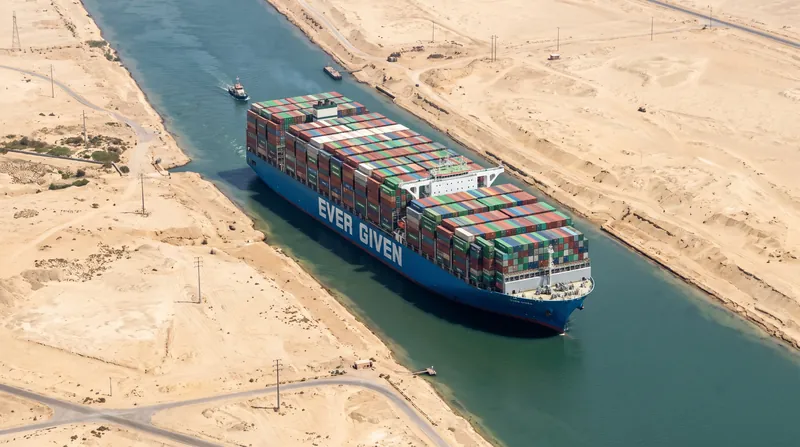
The 193.3-Kilometer Length and 205-Meter Width: How the Suez Canal's Physical Constraints Dictate Global Shipping Traffic
7 sources
Comments
Every angle. Every day.
Get World stories with full source coverage and perspective breakdowns, free every day.