
The Science of Sourdough: How Wild Microbes Transform Simple Flour into Complex Bread
A microscopic ecosystem of wild yeast and lactic acid bacteria is responsible for the lift, flavor, and enhanced digestibility of sourdough bread.
By Factlen Editorial Team
- Microbiologists & Food Scientists
- Focuses on the taxonomy, metabolic pathways, and genetic sequencing of the starter's microscopic ecosystem.
- Nutritional Researchers
- Focuses on the health impacts, mineral bioavailability, and gut microbiome benefits of long-fermented foods.
- Artisan & Home Bakers
- Focuses on the practical environmental management of the symbiotic culture to achieve optimal flavor and lift.
What's not represented
- · Commercial Yeast Manufacturers
- · Gluten-Free Advocates
Why this matters
Understanding the biology of fermentation empowers home cooks to troubleshoot their baking and highlights how traditional food preparation methods can unlock essential nutrients and improve digestion.
Key points
- A sourdough starter is a symbiotic ecosystem of wild yeast and lactic acid bacteria.
- Wild yeast produces carbon dioxide to leaven the bread, while bacteria produce flavor-enhancing acids.
- Bakers can manipulate temperature and hydration to control whether the bread tastes mildly lactic or sharply acetic.
- The highly acidic environment activates phytase, an enzyme that unlocks essential minerals in the flour.
- Long fermentation pre-digests complex carbohydrates and gluten, making the bread easier to digest for many people.
- Recent studies suggest the majority of a starter's microbiome originates from the flour, not the surrounding air.
Mixing flour and water seems like the most mundane culinary act imaginable. Yet, left to its own devices, this simple paste transforms into a bubbling, living ecosystem capable of leavening bread and producing extraordinarily complex flavors. This is the magic of the sourdough starter, a practice that dates back thousands of years to the Fertile Crescent and ancient Egypt.[1]
While the COVID-19 pandemic sparked a massive resurgence in home sourdough baking, the practice is far more than a culinary trend. It is a daily exercise in applied microbiology. Unlike commercial bread, which relies on a single industrially cultivated strain of yeast to force a rapid rise, sourdough relies on wild fermentation.[2][4]
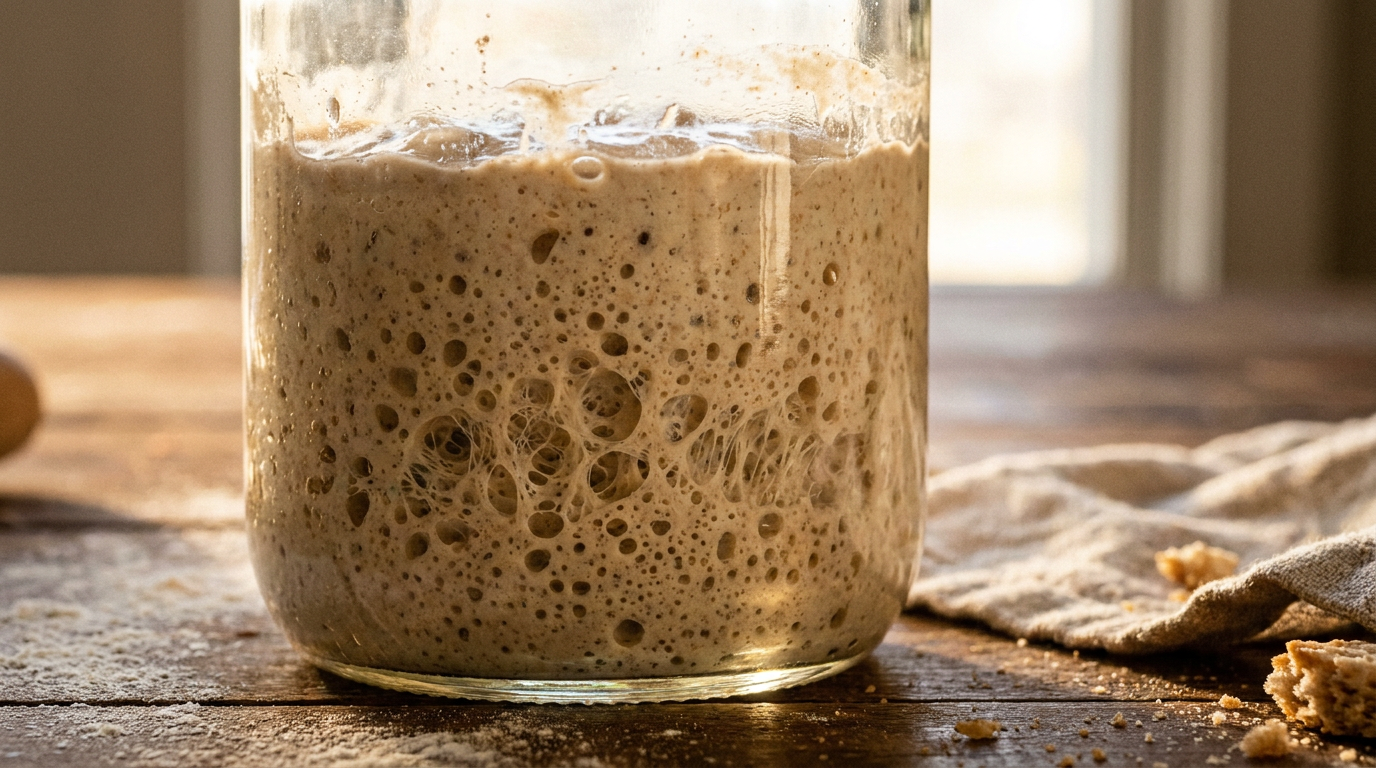
To understand sourdough is to understand a microscopic Serengeti. A mature starter is a symbiotic community of wild yeasts and lactic acid bacteria (LAB) that colonize the flour and water mixture. These microorganisms engage in a complex metabolic dance, breaking down starches, producing gases, and synthesizing the organic acids that give the bread its signature tang.[1][5][6]
The architecture of a sourdough starter relies on a staggering numerical imbalance. In a healthy culture, lactic acid bacteria typically outnumber yeast cells by a ratio of 100 to 1. Despite their smaller numbers, the wild yeasts—often hardy species like Saccharomyces exiguus or Kazachstania humilis—are the primary engines of the bread's rise.[1][5]

When flour hydrates, naturally occurring amylase enzymes begin cleaving complex starches into simple sugars like maltose and glucose. The wild yeast metabolizes these sugars through alcoholic fermentation. The primary byproducts of this biological process are ethanol and carbon dioxide.[1]
As the yeast exhales carbon dioxide, the gas becomes trapped within the dough's developing gluten network. This creates the tiny pockets of air that expand during baking, giving the bread its airy crumb and structural lift. The ethanol, meanwhile, largely evaporates in the intense heat of the oven, though it contributes subtle aromatic notes to the raw dough.[1]
If yeast provides the architecture, the lactic acid bacteria provide the character. Researchers have identified more than 50 distinct species of LAB in various sourdough starters around the world. These bacteria thrive in the highly acidic environment they create, dropping the pH of the starter to between 3.5 and 5.0—a level of acidity that actively prevents the growth of pathogenic microbes and spoilage fungi.[1][2][3]
The bacteria are broadly divided into two categories based on their metabolic pathways: homofermentative and heterofermentative. Homofermentative bacteria primarily produce lactic acid as they consume sugars, which imparts a mild, creamy, yogurt-like flavor to the resulting bread.[1][5]
The bacteria are broadly divided into two categories based on their metabolic pathways: homofermentative and heterofermentative.
Heterofermentative bacteria, on the other hand, produce both lactic acid and acetic acid (the primary component of vinegar). It is the acetic acid that delivers the sharp, pronounced tang characteristic of famous regional breads, such as San Francisco sourdough.[1][5]
The baker acts as the conductor of this microbial orchestra, manipulating the physical environment to favor certain flavors. A starter maintained at a warmer temperature with higher hydration (a wetter, liquid batter) tends to favor homofermentative bacteria, resulting in a milder, more lactic loaf.[1][6]
Conversely, a stiff, dry starter kept in a cooler environment slows down yeast activity and favors heterofermentative bacteria. This cooler, drier regimen boosts the production of acetic acid relative to lactic acid, yielding a much sourer final product.[1]

Beyond flavor and lift, the sourdough microbiome fundamentally alters the nutritional profile of the grain. The prolonged fermentation process and the highly acidic environment activate an enzyme called phytase.[5]
Phytic acid, naturally present in wheat bran, binds to essential minerals like calcium, magnesium, and iron, preventing the human digestive system from absorbing them. By activating phytase, the sourdough bacteria neutralize phytic acid, significantly increasing the bioavailability of these crucial nutrients.[5]
Furthermore, the bacteria pre-digest complex carbohydrates and begin breaking down gluten proteins during the long proofing times. While sourdough is not safe for individuals with celiac disease, many people with mild non-celiac gluten sensitivities report that long-fermented sourdough is much easier to digest than rapidly produced commercial bread.[3][4]

The potential health benefits of this microbial pre-digestion have caught the attention of the scientific community. The European Union's HealthFerm project, which runs through 2026, is currently utilizing citizen science to map the microbiomes of home sourdough starters across the continent.[4]
By analyzing hundreds of samples, researchers hope to identify specific microbial strains that maximize the production of beneficial short-chain fatty acids in the human gut, potentially reducing inflammation and improving metabolic health.[4]

Despite these advances, a central debate remains: where do the microbes actually come from? The romantic notion of 'terroir' suggests that a starter captures the unique wild yeasts floating in the baker's kitchen air or living on their hands.[5]
However, recent microbiological analyses suggest that the vast majority of the starter's initial microbiome actually comes directly from the flour itself. As the starter matures and is repeatedly fed, the environment selects for the most efficient microbes. In many mature starters worldwide, a highly adapted bacterium named Fructilactobacillus sanfranciscensis eventually dominates the ecosystem, regardless of where the starter was born.[1][5]
Ultimately, the science of sourdough reveals that baking is not merely a chemical reaction, but a biological partnership. By learning to read the signs of fermentation—the bubbles, the aromas, the changing viscosity—bakers are actively communicating with a microscopic world, transforming simple agricultural staples into one of humanity's oldest and most complex foods.[6]
How we got here
3700 BCE
The earliest known sourdough bread is baked in Switzerland, though the practice likely originated earlier in the Fertile Crescent.
1849
Sourdough becomes the primary bread of California Gold Rush prospectors, leading to the fame of San Francisco sourdough.
Late 19th Century
Industrially produced baker's yeast is introduced, largely replacing sourdough for commercial bread production.
2020
The COVID-19 pandemic sparks a massive global resurgence in home sourdough baking and starter cultivation.
2023
The EU launches the HealthFerm project, using citizen science to map the microbiomes of home sourdough starters across Europe.
Viewpoints in depth
Microbiologists & Food Scientists
Focuses on the taxonomy and metabolic pathways of the starter's ecosystem.
For microbiologists, a sourdough starter is a fascinating study in microbial succession and competition. Researchers focus on sequencing the DNA of these cultures to identify the exact species of yeast and bacteria present. They study how enzymes like amylase break down starches into maltose, and how highly adapted strains like Fructilactobacillus sanfranciscensis eventually outcompete other bacteria to dominate the ecosystem due to their highly efficient, specialized genomes.
Nutritional Researchers
Focuses on the health impacts and digestibility of long-fermented foods.
Nutritionists view sourdough fermentation as a vital process for unlocking the nutritional potential of grains. Their research highlights how the acidic environment activates phytase, neutralizing phytic acid and making minerals like iron, zinc, and magnesium bioavailable. Furthermore, they study how the pre-digestion of complex carbohydrates and the partial breakdown of gluten proteins can lower the bread's glycemic index and improve gastrointestinal comfort, potentially fostering a healthier human gut microbiome.
Artisan & Home Bakers
Focuses on the practical environmental management of the symbiotic culture.
For the baker, the microbiome is a tool to be managed through environmental pressures. Bakers are less concerned with the exact genetic sequencing of their starter and more focused on how manipulating hydration, temperature, and feeding schedules alters the final product. By understanding that a warm, wet environment favors mild lactic acid and a cool, dry environment favors sharp acetic acid, the baker acts as an evolutionary pressure, steering the culture toward the desired flavor profile and structural lift.
What we don't know
- The exact degree to which a baker's local environment ('terroir') influences the final microbial makeup of a mature starter compared to the flour used.
- Whether specific strains of sourdough bacteria can survive the baking process or if their health benefits are strictly derived from their pre-baking metabolic byproducts.
- The precise mechanisms by which sourdough consumption alters the human gut microbiome long-term.
Key terms
- Sourdough Starter
- A stable, symbiotic culture of wild yeast and lactic acid bacteria in a mixture of flour and water, used to leaven bread.
- Lactic Acid Bacteria (LAB)
- Microorganisms that ferment sugars into lactic acid (and sometimes acetic acid), providing sourdough with its characteristic tangy flavor and preserving the dough.
- Homofermentative
- A type of bacterial fermentation that produces almost exclusively lactic acid, resulting in milder, yogurt-like flavors.
- Heterofermentative
- A type of bacterial fermentation that produces both lactic acid and acetic acid, creating a sharper, more vinegary tang.
- Phytic Acid
- A naturally occurring compound in wheat bran that binds to minerals, making them difficult for the human body to absorb until broken down by fermentation.
- Amylase
- An enzyme naturally present in flour that breaks down complex starches into simple sugars that wild yeast can consume.
Frequently asked
Can I make a sourdough starter from scratch?
Yes. By mixing equal parts flour and water and feeding it daily, you can cultivate a stable colony of wild yeast and bacteria within one to two weeks.
Why is sourdough bread sour?
The sour flavor comes from lactic and acetic acids produced by the lactic acid bacteria during the long fermentation process.
Is sourdough bread gluten-free?
No. While the fermentation process breaks down some gluten proteins, making it easier to digest for some, it still contains gluten and is not safe for those with celiac disease.
Does the yeast come from the air or the flour?
While some microbes come from the environment, scientific analysis shows that the vast majority of the yeast and bacteria in a starter originate from the flour itself.
Sources
Source coverage
6 outlets
3 viewpoints surfaced






[1]WikipediaArtisan & Home Bakers
Sourdough
Read on Wikipedia →[2]American Society for MicrobiologyMicrobiologists & Food Scientists
The Sourdough Microbiome
Read on American Society for Microbiology →[3]National Institutes of HealthMicrobiologists & Food Scientists
Sourdough Microbiome Comparison and Benefits
Read on National Institutes of Health →[4]Horizon MagazineNutritional Researchers
The science of sourdough – how citizens are helping shape the future of fermented foods
Read on Horizon Magazine →[5]Knowable MagazineMicrobiologists & Food Scientists
Microbial secrets of sourdough
Read on Knowable Magazine →[6]Factlen Editorial TeamArtisan & Home Bakers
Synthesis by Factlen editorial team
Read on Factlen Editorial Team →
Every angle. Every day.
Get food drink stories with full source coverage and perspective breakdowns delivered to your inbox.