
The Science of Joint Articulation: How 'CARs' Are Redefining Mobility Training
Functional Range Conditioning and Controlled Articular Rotations (CARs) are replacing passive stretching by training the nervous system to actively control and expand joint mobility.
By Factlen Editorial Team
- Joint-First Mobility Specialists
- Focus on expanding the joint capsule's capacity through active neurological control.
- Traditional Rehabilitation Therapists
- Focus on functional movement patterns and passive mobilizations for symptom relief.
- Longevity & Aging Researchers
- Focus on joint preservation, synovial fluid dynamics, and delaying osteoarthritis.
What's not represented
- · Rheumatologists treating advanced autoimmune joint diseases
- · Yoga practitioners advocating for passive flexibility
Why this matters
As populations age, joint degeneration and loss of mobility are becoming ubiquitous, leading to chronic pain and a loss of independence. Understanding how to actively train the joint capsule rather than just passively stretching muscles offers a science-backed pathway to lifelong, pain-free movement.
Key points
- Flexibility is passive tissue length, while mobility is the active, usable range of motion controlled by the nervous system.
- Functional Range Conditioning (FRC) focuses on expanding the capacity of the joint capsule rather than simply stretching muscles.
- Controlled Articular Rotations (CARs) use high systemic tension to move a joint through its maximum rotational workspace.
- CARs act like a sponge, forcing nutrient-dense synovial fluid into avascular articular cartilage to maintain joint health.
- Advanced isometric techniques (PAILs and RAILs) convince the brain to release protective stiffness, expanding the joint's degrees of freedom.
- Mobility training is increasingly viewed as a daily hygiene practice to prevent age-related joint degeneration and osteoarthritis.
The fitness industry has long equated the simple act of touching your toes with being fundamentally healthy. For decades, the standard prescription for physical stiffness has been passive stretching—holding a hamstring or calf stretch for thirty seconds, breathing deeply, and hoping the connective tissue magically lengthens. Yet, as populations age and sedentary lifestyles dominate modern society, joint pain and severe mobility loss remain ubiquitous. The traditional model of flexibility has failed to prevent the structural degradation that plagues millions of adults, prompting sports scientists and physical therapists to fundamentally rethink how the human body maintains its range of motion over a lifespan.[5]
The fundamental flaw in the traditional stretching model is its exclusive focus on passive flexibility rather than active, neurological control. Flexibility is simply the passive length of a tissue, often achieved by using gravity, momentum, or an external force to push a joint into a specific position. Mobility, however, is a completely different biological mechanism. Mobility is defined as the amount of that range of motion you can actively control using your own muscular strength and nervous system. It is the difference between having someone lift your leg to a ninety-degree angle and being able to lift and hold it there yourself.[5]
Dropping into a full split might demonstrate impressive passive flexibility, but if the nervous system cannot generate muscular force in that extreme end-range position, the brain perceives the range as a structural threat. The human brain is hardwired for survival; when the body encounters a physical position it cannot actively control, it relies on deeply ingrained neurological safeguards. It creates a painful stiffness, signaling the muscles to contract and halt the movement to prevent a catastrophic tear. This protective tension is often misdiagnosed as tight muscles, when in reality, it is the brain refusing to grant access to a range of motion it does not trust.[6]

To bridge the critical gap between passive flexibility and active control, modern sports science has increasingly turned to Functional Range Conditioning (FRC). Developed by musculoskeletal expert and chiropractor Dr. Andreo Spina, FRC is a comprehensive, evidence-based joint training system that fundamentally shifts the focus away from stretching individual muscles. Instead, the system is entirely dedicated to expanding the load-bearing capacity of the joint capsule itself. By targeting the deepest layers of connective tissue, FRC aims to progressively convince the brain to release its protective stronghold at the cellular level, converting useless flexibility into highly functional mobility.[3]
The joint capsule is a dense, fibrous sac that surrounds a synovial joint, providing critical structural stability and housing the synovial fluid that keeps the joint lubricated. Crucially, this capsule is heavily innervated with mechanoreceptors—specialized sensory receptors that constantly relay multidirectional and rotatory information back to the central nervous system. These receptors act as the body's internal surveillance system, providing the brain with continuous afferent feedback about exactly what is happening within the joint space. The more stimulus these mechanoreceptors receive, the more control the nervous system exerts over the surrounding musculoskeletal structures.[3]
When a joint is not regularly moved through its full, rotational range of motion, the nervous system begins to systematically prune its access to those outer limits. This is the harsh biological reality of the use it or lose it principle. Over time, as a person spends hours locked in seated positions, the joint capsule physically tightens, the functional workspace of the joint shrinks, and the brain forgets how to access the lost ranges. As the primary joint loses its degrees of freedom, the body is forced to create movement compensations in adjacent areas—often the lower back or knees—leading directly to chronic pain and overuse injuries.[2]
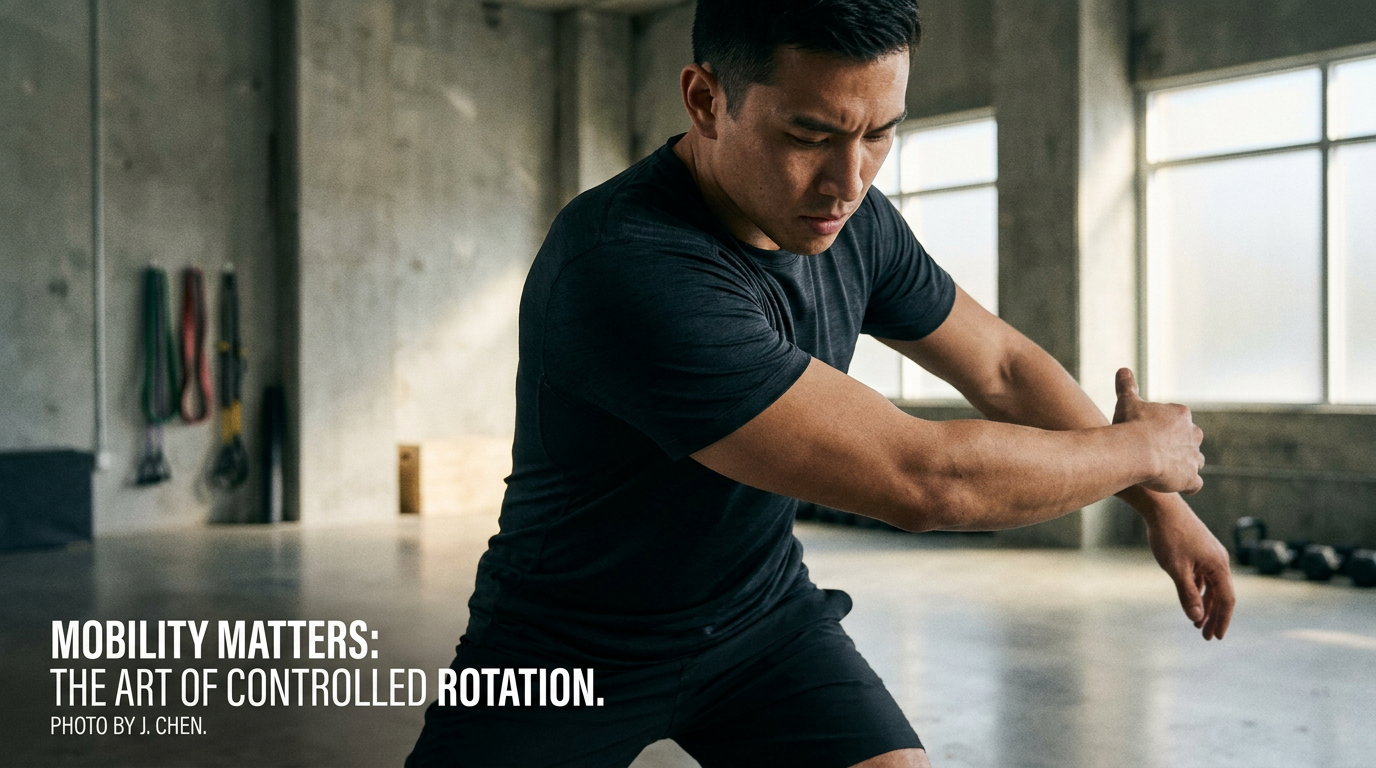
To counteract this neurological pruning, the FRC system relies on a foundational daily practice known as Controlled Articular Rotations (CARs). CARs are active, deliberate, and highly focused rotational movements designed to take a single joint through its absolute outer limits of motion. Unlike a casual, swinging warm-up circle, a proper CAR is executed at a painstakingly slow pace, ensuring that the joint explores every millimeter of its available workspace. The goal is not to increase the range of motion immediately, but to maintain the current capacity and remind the nervous system that these outer limits still exist and are safe to access.[4]
The defining characteristic of a proper CAR is the application of high systemic tension. Practitioners utilize a physiological concept called irradiation, creating full-body muscular tension to strictly isolate the target joint and force it to work against intense internal resistance. If you are performing a shoulder CAR, your core, glutes, and opposite arm are tightly flexed to prevent the spine or ribcage from assisting the movement. Each repetition becomes a slow, controlled physical battle against yourself. You are actively fighting to carve out the largest possible circle, creating the teaching tension required to force neurological adaptations.[4]
The defining characteristic of a proper CAR is the application of high systemic tension.
This high-tension rotational practice serves multiple vital physiological purposes for the human body. First, it acts as an unparalleled daily assessment tool. By slowly sweeping a joint through its entire circumference, individuals can immediately detect subtle restrictions, impingements, or closing-angle joint pain. This daily self-audit allows athletes and everyday practitioners to identify warning signs of joint dysfunction long before they manifest as severe, debilitating injuries. It provides real-time feedback on which joints require more targeted intervention and which are functioning optimally.[2]
Second, and perhaps most importantly for longevity, CARs physically nourish the joint architecture. Articular cartilage—the smooth tissue that covers the ends of bones—does not have a direct blood supply. Instead, it relies entirely on the movement of synovial fluid to deliver essential nutrients and remove metabolic waste. By taking the joint through its maximum rotational workspace under tension, CARs act exactly like a mechanical sponge. The movement squeezes old, stagnant fluid out of the tissues and pulls fresh, nutrient-dense synovial fluid deep into the cartilage, ensuring the joint remains lubricated and healthy.[2][4]

The underlying science of this restorative process is rooted in mechanotransduction—the biological mechanism by which cells convert mechanical stimulus into chemical activity. In the realm of tissue remodeling, force is the literal language of cells. When the joint capsule is subjected to controlled, multidirectional mechanical loads at its extreme end ranges, specialized cells called fibroblasts are heavily stimulated. These fibroblasts respond to the mechanical tension by laying down new tissue and remodeling the existing extracellular matrix, making the joint capsule physically stronger, thicker, and vastly more resilient to future physical stress.[1][6]
Once a joint's current capacity is secured and maintained through daily CARs, the FRC system utilizes advanced isometric techniques to actively expand that workspace. These specific techniques, known as Progressive and Regressive Angular Isometric Loading (PAILs and RAILs), involve taking a joint into a passive stretch and then intensely contracting the tissues on either side of the joint. Instead of just holding the stretch and relaxing, the practitioner ramps up to a maximum-effort isometric contraction, pushing against an immovable object or their own body weight to generate extreme force at the absolute end-range of motion.[6]
By generating maximum muscular force at the absolute end-range, PAILs and RAILs effectively hack the nervous system. The intense isometric contraction convinces the central nervous system that the body possesses the necessary strength to safely control this new, extreme position. Once the brain realizes it can generate force there, it releases its protective neurological stronghold. The stiffness dissipates, and the brain grants the body access to a few more degrees of usable mobility, permanently converting a passive, unusable stretch into an active, highly functional range of motion.[6]
Clinical research and biomechanical studies indicate that these intense isometric contractions affect joint control within a specific 10-to-15-degree window of the exact angle being trained. By systematically applying these techniques to various angles, practitioners can incrementally expand the joint's total degrees of freedom. As the joint gains a larger movement vocabulary, the entire body becomes more adaptable. It gains the ability to absorb unexpected physical forces, recover from awkward positions, and find optimal, pain-free movement pathways during complex athletic endeavors or simple daily tasks.[6]
The implications of this joint-first approach for human longevity and aging are profoundly significant. According to data from the National Health Interview Survey, the prevalence of arthritis jumps dramatically from just 3.6 percent in young adults to nearly 54 percent in adults over the age of 75. Much of this age-related joint degeneration is not simply inevitable wear-and-tear, but is actively exacerbated by a shrinking joint workspace. As the capsule tightens and synovial fluid stagnates, the cartilage starves and degrades, accelerating the onset of osteoarthritis and chronic joint pain.[2]

By treating joint mobility as a non-negotiable daily hygiene practice—conceptually identical to brushing your teeth to prevent cavities—older adults can actively maintain their articular capacity. Regular CARs preserve synovial fluid dynamics and can significantly delay the onset of degenerative joint diseases. Clinical applications of these techniques have proven remarkably successful across all age groups; mobility specialists routinely help elderly patients reclaim the lost ability to squat, reach overhead, and navigate their daily lives without the constant burden of joint pain.[2]
In the elite athletic realm, this joint-first philosophy is rapidly replacing the traditional, outdated pre-game static stretch. From professional cyclists who require exactly 30 to 45 degrees of internal hip rotation to generate maximum pedal power, to major league baseball pitchers who demand extreme, bulletproof shoulder resilience, athletes are prioritizing active joint control over passive muscle length. They understand that a muscle can only perform as well as the joint it crosses, and that expanding the joint's capacity is the ultimate prerequisite for high-level force production and injury mitigation.[2]

Ultimately, the science of joint articulation represents a massive paradigm shift in how modern science views human movement. It aggressively moves the fitness industry away from the purely aesthetic, passive pursuit of flexibility and toward the biological, functional necessity of active mobility. By learning to speak the cellular language of force and tension, and by treating joint health as an active daily practice, individuals can train their nervous systems to support a lifetime of resilient, capable, and entirely pain-free movement.[7]
How we got here
19th Century
Swedish Medical Gymnastics introduces the concept that systematic movement and mechanical loading can restore joint function.
Late 20th Century
Physical therapy heavily adopts passive stretching and flexibility protocols as the standard for treating joint stiffness.
Early 2010s
Dr. Andreo Spina develops Functional Range Conditioning (FRC), shifting the focus from passive flexibility to active joint control.
2020s
FRC and CARs become widely adopted across professional sports and longevity clinics as a primary tool for joint preservation.
Viewpoints in depth
Joint-First Mobility Specialists
Advocates of FRC who prioritize expanding the joint capsule's capacity before strengthening muscles.
This camp argues that a muscle can only function as well as the joint it crosses. By focusing on the joint capsule—the deepest layer of tissue—practitioners believe they can fundamentally alter the body's movement vocabulary. They rely on mechanotransduction and high-tension isometrics to convince the central nervous system to release protective stiffness, arguing that passive stretching is a waste of time if the brain doesn't 'own' the new range.
Traditional Rehabilitation Therapists
Clinicians who focus on functional movement patterns and symptom management.
While increasingly adopting active mobility concepts, traditional physical therapy often emphasizes functional, multi-joint movements (like squats and lunges) over isolated joint articulations. This perspective values passive mobilizations and targeted stretching for acute pain relief, arguing that while expanding joint capacity is useful, patients primarily need to restore the specific movement patterns required for their daily lives.
Athletic Performance Coaches
Trainers utilizing active mobility to prevent injury and maximize power output.
In the strength and conditioning world, mobility is viewed through the lens of force production and injury mitigation. These coaches utilize CARs and FRC principles not just for joint health, but to ensure athletes have the prerequisite degrees of freedom to absorb unexpected forces on the field. They argue that expanding a joint's usable range directly translates to better biomechanics and higher athletic performance.
What we don't know
- While mechanotransduction is well-documented at the cellular level, the exact threshold of mechanical load required to optimally remodel human joint capsules remains highly individualized.
- Long-term longitudinal studies tracking the decades-long impact of daily CARs on the prevention of osteoarthritis in otherwise sedentary populations are still ongoing.
- The precise neurological mechanisms by which the brain decides to release its protective stiffness during isometric loading are still being mapped by neuroscientists.
Key terms
- Functional Range Conditioning (FRC)
- A science-based joint training system focused on improving mobility, joint resilience, and neurological control.
- Controlled Articular Rotations (CARs)
- Active, deliberate rotational movements that take a single joint through its absolute outer limits of motion to maintain joint health.
- Mechanotransduction
- The biological process by which cells convert mechanical stimulus, such as tension or load, into chemical activity to remodel tissue.
- Synovial Fluid
- A thick liquid located between joints that cushions the ends of bones and provides essential nutrients to avascular cartilage.
- Irradiation
- The practice of creating full-body muscular tension to isolate a specific joint and force it to work against internal resistance.
- PAILs and RAILs
- Progressive and Regressive Angular Isometric Loading; techniques used to expand a joint's range of motion by generating maximum force at the end-range.
Frequently asked
What is the difference between flexibility and mobility?
Flexibility is the passive length of a muscle, often achieved by holding a stretch. Mobility is the amount of that range of motion you can actively control using your nervous system and muscular strength.
How often should I perform Controlled Articular Rotations (CARs)?
Mobility specialists recommend performing CARs daily. They are viewed as a routine joint hygiene practice, similar to brushing your teeth, to maintain the joint's workspace and move synovial fluid.
Can CARs help with osteoarthritis?
Yes. By actively moving the joint through its full range, CARs help circulate synovial fluid, which nourishes the cartilage. This can reduce stiffness, alleviate pain, and help delay further age-related joint degeneration.
Do I need special equipment to do Functional Range Conditioning?
No. The foundational movements of FRC, such as CARs, rely entirely on internal muscular tension and active body control, requiring no external weights or equipment.
Sources
Source coverage
7 outlets
3 viewpoints surfaced







[1]National Institutes of HealthLongevity & Aging Researchers
Mechanotherapy in Rehabilitation: From Mechanotransduction to Tissue Remodeling
Read on National Institutes of Health →[2]BicyclingLongevity & Aging Researchers
How Controlled Articular Rotations (CARs) Can Improve Your Joint Health
Read on Bicycling →[3]The Prehab GuysJoint-First Mobility Specialists
Understanding Functional Range Conditioning
Read on The Prehab Guys →[4]Physio InqJoint-First Mobility Specialists
Controlled Articular Rotations (CARs) - What They Are and Why You Should Do Them
Read on Physio Inq →[5]Saunders PhysiotherapyTraditional Rehabilitation Therapists
Controlled Articular Rotations (CARs) for Hip and Shoulder Mobility
Read on Saunders Physiotherapy →[6]Post Competitive InsightJoint-First Mobility Specialists
Functional Range Conditioning: The Science of Joint Control
Read on Post Competitive Insight →[7]Factlen Editorial TeamJoint-First Mobility Specialists
Synthesis by Factlen editorial team
Read on Factlen Editorial Team →
Every angle. Every day.
Get fitness stories with full source coverage and perspective breakdowns delivered to your inbox.