
The 'Physical Deterioration' and 'Economic Disuse' Criteria That Legally Define Blight for Urban Renewal
To seize private property for redevelopment, municipalities must legally prove a neighborhood suffers from structural decay or severe economic stagnation. These statutory thresholds prevent cities from using eminent domain solely to generate higher tax revenues.
By Nabil Faris

Share this story
In short
- Blight is legally defined by two main criteria: physical deterioration of structures and economic disuse of the land.
- Physical blight includes severe code violations, structural decay, and inadequate utilities that threaten public safety.
- Economic blight involves stagnant property values, high commercial vacancies, and a lack of necessary neighborhood services.
The legal definition of blight—the threshold that allows a local government to seize private property for urban renewal—hinges on two specific criteria: the physical deterioration of structures and the economic disuse of the land. When a municipality wants to redevelop a neighborhood, it cannot simply declare that a new shopping center would generate more tax revenue than the existing homes. It must prove that the current state of the property actively harms the community's health, safety, or economic viability.[5]
This distinction forms the bedrock of eminent domain law across the United States. While the Fifth Amendment to the U.S. Constitution allows the government to take private property for public use provided it pays "just compensation," the definition of public use expanded dramatically in the mid-20th century to include the eradication of urban decay. Today, state statutes dictate exactly what constitutes a blighted area, and those definitions serve as the primary defense for property owners facing forced relocation.[3][4]
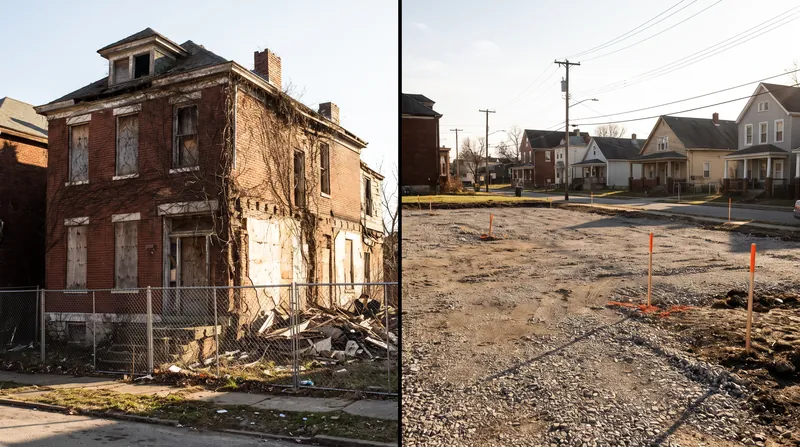
Physical deterioration is the most visible and traditional marker of blight. State laws, such as the California Health and Safety Code, define this as "buildings in which it is unsafe or unhealthy for persons to live or work." This category encompasses serious building code violations, severe dilapidation caused by long-term neglect, vulnerability to seismic hazards, and faulty or inadequate water and sewer utilities.[1]
It is not enough for a building to simply be old or aesthetically unpleasing. The physical decay must reach a level where it presents a tangible threat to public safety or substantially hinders the viable use of the lot. For example, a neighborhood of well-maintained historic homes built in 1920 cannot be declared physically blighted simply because the houses lack modern open floor plans or central air conditioning.[1][5]
The second criterion, economic disuse—often termed economic underutilization or economic liability—is more complex and frequently contested. This factor addresses properties that may be structurally sound but are economically stagnant or actively dragging down the surrounding area's financial health.[2][5]
Economic blight is characterized by depreciated or stagnant property values, abnormally high business vacancies, abnormally low lease rates, or an excess of abandoned buildings. It can also include a serious lack of necessary commercial facilities, such as grocery stores and banks, or the presence of hazardous environmental contamination that prevents private investment.[1][2]
The requirement to prove economic disuse prevents municipalities from seizing perfectly functional neighborhoods just because a developer promises a more lucrative project. As legal scholars in the Fordham Urban Law Journal have noted, the definition of blight must be carefully constrained to prevent the abuse of eminent domain for purely private economic development, ensuring that the government's extraordinary power is reserved for genuine public necessity.[2]
Different states apply these criteria with varying levels of strictness. In Colorado, for instance, the Urban Renewal Law lists 11 specific factors of blight. To declare an area blighted, a municipality must prove the existence of at least four of these factors. However, if the city intends to use eminent domain to acquire the properties, the threshold increases to five factors.
California requires a dual-pronged approach. To declare a redevelopment zone blighted, local officials must demonstrate the presence of at least one physical blight factor and at least one economic blight factor. This ensures that a purely economic downturn cannot trigger eminent domain without accompanying physical decay, and vice versa.[1]
The process of declaring blight begins with a comprehensive conditions survey, typically conducted by an independent urban planning consultant. This survey maps the proposed urban renewal area parcel by parcel, documenting code violations, vacancy rates, infrastructure deficiencies, and crime statistics. A typical conditions survey for a mid-sized commercial corridor can cost a municipality between $50,000 and $150,000 to commission.[5]
Once the survey is complete, the local urban renewal authority or city council holds public hearings. Property owners have the right to review the findings and contest the blight designation. If the council votes to adopt the urban renewal plan, it establishes a boundary within which the city can use tax increment financing and, if authorized, eminent domain.[5]
Tax increment financing is the primary economic engine of urban renewal. When a blighted area is designated, the current property tax revenues are locked in as a baseline. As the area is redeveloped and property values rise, the additional tax revenue—the increment—is captured by the urban renewal authority to pay off the bonds used to finance the infrastructure improvements. These districts typically have a statutory lifespan of 20 to 25 years.[4]
The stakes in these designations are incredibly high. For property owners, a blight designation can mean the forced sale of their homes or businesses, even if their specific parcel is well-maintained. The law allows for the inclusion of non-blighted properties within a larger blighted area if their acquisition is deemed necessary for the overall redevelopment plan.[3][5]
Conversely, for city planners, the ability to designate blight is often the only tool available to assemble the large, contiguous tracts of land required for modern commercial or mixed-use developments. Without the threat of eminent domain, a single holdout property owner could block a revitalization project that would benefit thousands of residents.[4][5]
Without the threat of eminent domain, a single holdout property owner could block a revitalization project that would benefit thousands of residents.
The tension between these competing interests ensures that the definitions of physical deterioration and economic disuse remain heavily litigated. As cities continue to evolve and the demand for urban land intensifies, the precise legal boundaries of what constitutes a blighted neighborhood will dictate who gets to decide the future of the American city.[2][5]
Key terms
- Eminent Domain
- The legal power of a government to take private property for public use, provided it pays the owner just compensation.
- Tax Increment Financing (TIF)
- A public financing method that subsidizes redevelopment by capturing the future increase in property tax revenues generated by the project.
- Conditions Survey
- A formal, parcel-by-parcel study conducted by urban planners to document the specific physical and economic factors of blight in a proposed renewal area.
- Economic Disuse
- A legal condition where a property, while potentially structurally sound, suffers from high vacancy, stagnant value, or environmental contamination that prevents investment.
Frequently asked
Can my property be seized if it is not physically deteriorating?
Yes, in many states, if your property is located within a larger area that meets the statutory definition of economic or physical blight, it can be included in the urban renewal zone and potentially acquired if deemed necessary for the overall redevelopment plan.
Who decides if an area is legally blighted?
A local city council or designated urban renewal authority makes the formal declaration, usually based on the findings of an independent conditions survey conducted by urban planning consultants.
Does a blight designation automatically mean eminent domain will be used?
No. A blight designation is required to establish an urban renewal area and use tax increment financing, but many projects are completed through voluntary property sales and private development without ever forcing a sale.
Viewpoints in depth
Municipal Planners
City officials view blight designations as essential tools for assembling land and financing necessary public improvements.
For municipal planners, the ability to declare an area blighted is often the only practical mechanism to revitalize decaying commercial corridors. Modern mixed-use developments require large, contiguous parcels of land that are nearly impossible to assemble through private, piece-by-piece purchases. By utilizing blight designations, cities can unlock tax increment financing to pay for upgraded sewers, wider sidewalks, and environmental remediation that private developers refuse to fund on their own. Planners argue that without these tools, cities would be powerless to stop the downward spiral of disinvestment.
Property Rights Advocates
Advocates argue that broad definitions of economic disuse allow cities to seize functional properties for private gain.
Property rights organizations contend that the criteria for economic disuse are often intentionally vague, allowing local governments to declare perfectly viable neighborhoods blighted simply because they are not generating maximum tax revenue. They point out that terms like "underutilization" or "stagnant property values" can be applied to almost any older, working-class neighborhood. These advocates argue that eminent domain should be strictly limited to traditional public uses—like roads and schools—and that forcing the sale of a small business to make way for a corporate retailer violates the core protections of the Fifth Amendment.
Urban Developers
Developers rely on blight declarations to mitigate the high financial risks of building in distressed areas.
Private developers emphasize that rebuilding in a deteriorating urban core carries massive financial risks that do not exist in greenfield suburban construction. Unforeseen costs, such as removing buried hazardous waste or upgrading century-old water mains, can instantly bankrupt a project. For developers, a formal blight designation provides the legal and financial certainty needed to secure bank loans. The accompanying tax increment financing offsets the extraordinary costs of site preparation, making it economically feasible to bring new housing and retail to areas that have been ignored by the private market for decades.
- Municipal Planners
- City officials view blight designations as essential tools for assembling land and financing necessary public improvements.
- Property Rights Advocates
- Advocates argue that broad definitions of economic disuse allow cities to seize functional properties for private gain.
- Urban Developers
- Developers rely on blight declarations to mitigate the high financial risks of building in distressed areas.
Perspectives this story doesn't cover
- Displaced Residents
- Historic Preservationists
Sources
Source coverage
5 outlets
3 viewpoints surfaced




- [1]California Legislative InformationUrban Developers
Health and Safety Code Section 33031: Physical and Economic Conditions That Cause Blight
Read on California Legislative Information → - [2]Fordham Urban Law JournalProperty Rights Advocates
Blighting the Way: Urban Renewal, Economic Development, and the Elusive Definition of Blight
Read on Fordham Urban Law Journal → - [3]WikipediaMunicipal Planners
Eminent domain in the United States
Read on Wikipedia → - [4]WikipediaMunicipal Planners
Urban renewal
Read on Wikipedia → - [5]Factlen Editorial TeamMunicipal Planners
Synthesis by Factlen editorial team
Read on Factlen Editorial Team →

More in Community
See all →Governance Frameworks
How Consent Decision-Making Replaces Consensus by Asking What is Safe Enough to Try
4 sources

Quantum Computing
IBM Quantum Processor Completes 110-Year Supercomputer Task in 19 Seconds
4 sources

Health Metrics
The Combination of Years of Life Lost and Years Lived with Disability That Quantifies the Global Burden of Disease
7 sources

Land Banking
Land Banks Clear Accumulated Tax Liens to Unlock Blighted Properties for Redevelopment
6 sources
Comments
Every angle. Every day.
Get Community stories with full source coverage and perspective breakdowns, free every day.