
The Mechanics of the Vanishing Coast: How a National Erosion Crisis Is Reshaping Beach Access and Threatening Coastal Infrastructure
As severe erosion forces indefinite beach closures and threatens coastal infrastructure, municipalities are shifting from rigid seawalls to massive renourishment and nature-based living shorelines.
By Lan Xu

- Municipal Planners
- Focuses on maintaining public access and protecting critical infrastructure through active interventions like renourishment.
- Coastal Ecologists
- Advocates for nature-based solutions and living shorelines that work with natural sediment transport rather than against it.
- Federal Land Managers
- Prioritizes public safety and environmental remediation when retreating from indefensible coastal infrastructure.
Why this matters
As extreme weather and rising seas accelerate shoreline loss, the traditional methods of protecting coastal property are failing. Understanding the mechanics of erosion and the shift toward nature-based solutions is critical for communities facing billions in infrastructure threats and the permanent loss of public beach access.
Key points
- Severe coastal erosion forced the indefinite closure of access roads and facilities at Malibu's Point Dume Beach in August 2026.
- Traditional hard armoring, like concrete seawalls, often accelerates sand loss by deflecting wave energy downward.
- Municipalities are increasingly relying on expensive beach renourishment projects, dredging millions of cubic yards of offshore sand.
- Living shorelines offer a nature-based alternative, using native vegetation and cobble to absorb wave energy and accrete new land.
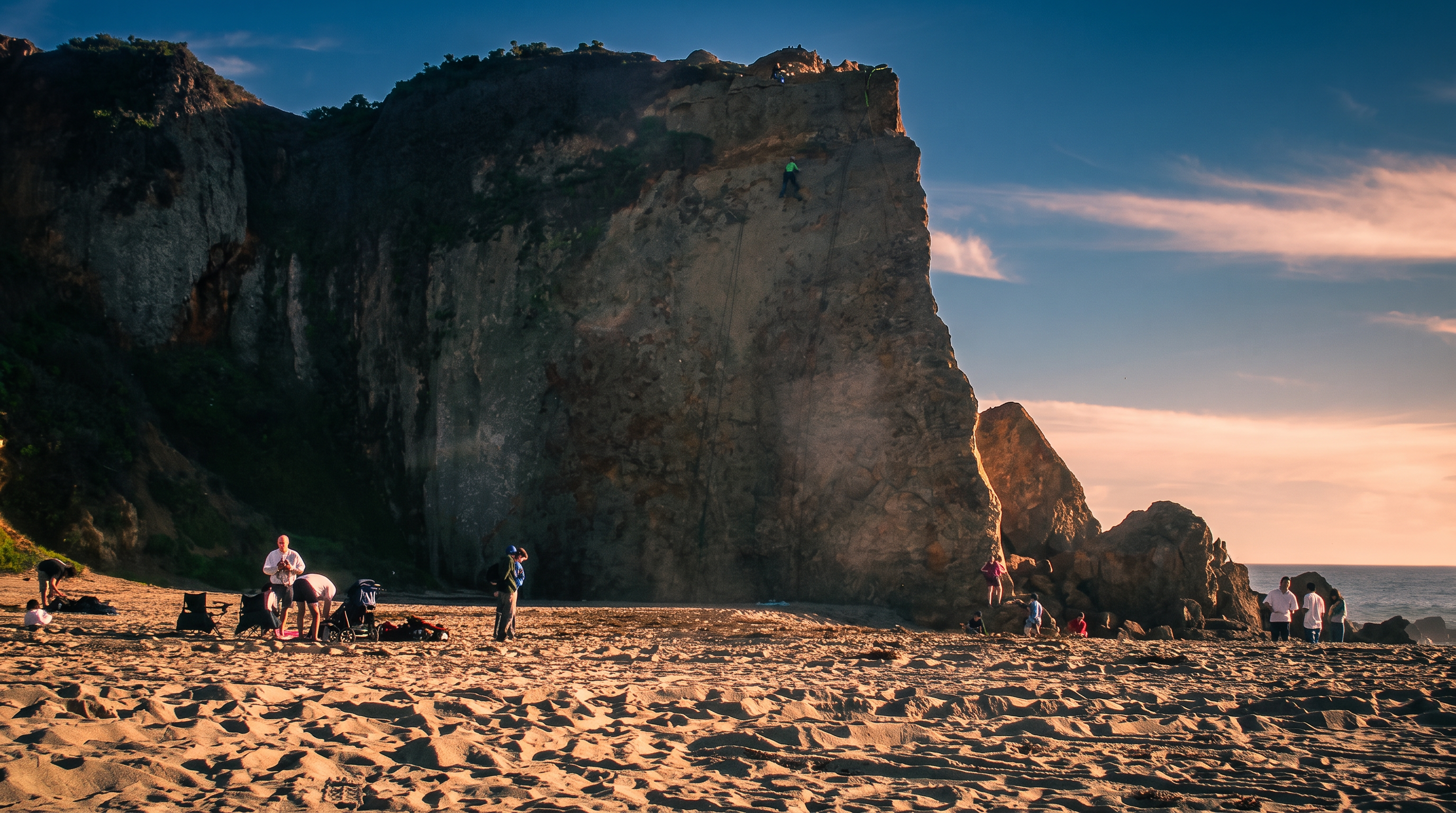
The collapse of the coastline is no longer a slow-motion threat reserved for future generations; it has become an immediate infrastructure crisis. In early August 2026, Los Angeles County officials were forced to indefinitely close the primary access road, a 373-spot parking lot, and several public restrooms at Malibu's popular Point Dume Beach. The sudden closure was triggered by severe, rapid coastal erosion that sheared away the sand, creating highly unstable bluff edges and sheer drop-offs of up to eight feet in areas where visitors normally walk. Safety personnel cordoned off the area, warning that the ground could give way without notice.[1][2]
The devastating damage at Point Dume followed days of exceptionally high tides and heavy surf generated by distant Pacific storms, including massive swells radiating from Hurricane Genevieve. The relentless wave action systematically scoured the sand away from the shoreline, undermining the asphalt foundation of Westward Beach Road and severing the underground water lines that served the beach's public facilities. With the utility infrastructure compromised and the roadway actively crumbling into the surf, county officials acknowledged they have no estimated timeline for when the beach access might be safely restored for the public.[3][4]
Malibu's predicament is not an isolated incident, but rather the visible edge of a national crisis reshaping how coastal municipalities manage the volatile boundary between land and sea. From the vulnerable stretches of the Pacific Coast Highway in California to the shifting barrier islands of the Carolinas, accelerating coastal erosion is threatening billions of dollars in public infrastructure. The crisis is fundamentally altering public beach access, forcing local governments to reckon with the reality that the coastline they have built upon is rapidly moving inland.[3]
To understand the scale of the crisis, one must first examine the underlying mechanics of coastal erosion. Beaches are naturally dynamic, highly mobile systems, constantly shifting as wave energy moves sand along the coast in a continuous process known as longshore drift. During intense winter storms, powerful waves pull sand offshore into submerged sandbars, creating a flatter beach profile that helps dissipate wave energy. In a natural cycle, this sand is typically pushed back onto the beach by the gentler, rolling waves of the summer months.[8]
However, this natural equilibrium is currently being disrupted by a potent combination of rising baseline sea levels and increasingly intense, frequent storm systems. As the baseline water level rises, storm surges are able to reach much further inland, attacking protective dunes and coastal bluffs that were previously out of reach of the surf zone. When these natural buffers are compromised or entirely washed away, the rate of erosion accelerates exponentially, leaving the infrastructure built behind them entirely exposed to the raw power of the ocean.[2][4]
The human response to this encroaching threat has historically worsened the underlying problem. For decades, the default engineering solution to coastal erosion was 'hard armoring'—the construction of rigid concrete seawalls, heavy rock revetments, and wooden bulkheads designed to draw a literal line in the sand and protect inland property. While these hardened structures temporarily defend the land immediately behind them, they fundamentally alter the physics of the shoreline, often to the detriment of the beach itself. By interrupting the natural movement of sediment, hard armoring starves adjacent beaches of the sand they need to replenish themselves after storm events.[8]
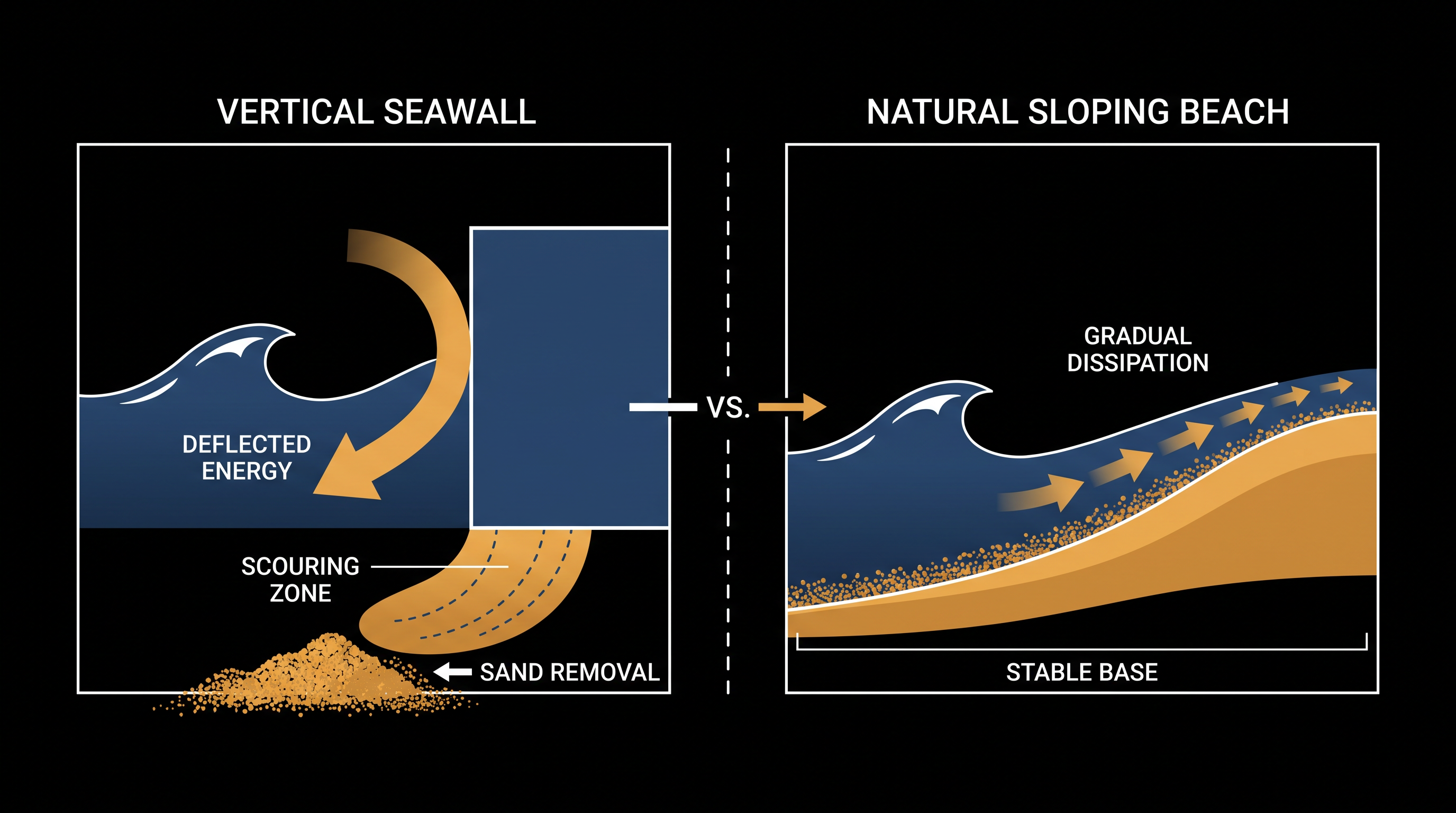
The mechanism of this failure lies in how wave energy is distributed. When a wave hits a natural, gently sloping beach, its energy dissipates gradually as it rolls up the sand. Conversely, when a wave strikes a rigid, vertical seawall, that immense energy is violently deflected downward and sideways. This downward deflection scours the sand directly from the base of the wall, deepening the water and allowing even larger, more powerful waves to strike the structure. Over time, the beach in front of the seawall completely disappears, a destructive phenomenon coastal geologists refer to as 'coastal squeeze.'[8]
The mechanism of this failure lies in how wave energy is distributed.
The consequences of unchecked erosion and coastal squeeze extend far beyond the loss of recreational space. In North Carolina, the shifting sands at the Cape Hatteras National Seashore recently exposed a distinctly hazardous legacy. The Buxton Beach Access was forced into an extended closure after severe erosion uncovered abandoned military facilities, dangerous construction debris, and compromised septic systems from a former Navy and Coast Guard base. The receding shoreline transformed a pristine public beach into an environmental hazard zone, illustrating how erosion can unearth decades-old infrastructure.[5]
Faced with the long-term failure of hard armoring and the immediate loss of critical infrastructure, coastal managers are increasingly turning to a massive, industrial-scale intervention known as beach renourishment. This process involves artificially rebuilding the beach profile by importing massive quantities of sand to widen the shoreline and restore the natural buffer between the ocean and the built environment. It is currently the primary defense mechanism for highly developed coastal economies that cannot afford to retreat, serving as a vital, albeit temporary, lifeline for tourism-dependent municipalities.[6]
The mechanics of a modern renourishment project are complex, highly engineered, and exceptionally expensive. Coastal engineers must first identify an offshore 'borrow site' containing sand that closely matches the specific color, density, and grain size of the native beach. Massive hydraulic dredges are then deployed to excavate the sand from the ocean floor. These specialized vessels pump a thick slurry of sand and seawater through miles of submerged and floating pipeline, delivering the material directly onto the eroded shoreline where it is needed most.[6]
Once the slurry reaches the shore, heavy machinery takes over. In May 2026, the Town of Palm Beach completed a massive mid-town renourishment project, pumping nearly 600,000 cubic yards of sand onto its shoreline to protect local infrastructure and real estate. During such operations, bulldozers work around the clock to shape the newly deposited sand into a wide, sloping berm that mimics a natural beach profile. The sheer volume of material moved during these projects can temporarily transform a quiet beach into a major industrial construction site.[6]
While highly effective in the short term, beach renourishment is ultimately a temporary fix rather than a permanent cure. The newly placed sand is subject to the exact same erosive forces and wave dynamics that removed the original beach. Without addressing the underlying causes of the erosion, municipalities must commit to a perpetual cycle of dredging and pumping. For many coastal cities, this means returning every five to ten years to replace the lost sand, often at a staggering cost of tens of millions of dollars per decade.[8]
Recognizing the financial limitations of perpetual dredging and the ecological damage caused by seawalls, a growing number of communities are pioneering an alternative approach known as 'living shorelines.' Rather than trying to rigidly block wave energy with concrete, living shorelines use nature-based solutions to absorb and dampen the ocean's force. This approach mimics the protective functions of natural coastal ecosystems, integrating biological elements with strategic engineering to create a dynamic, resilient barrier that can adapt to changing conditions rather than simply degrading under pressure.[7][8]
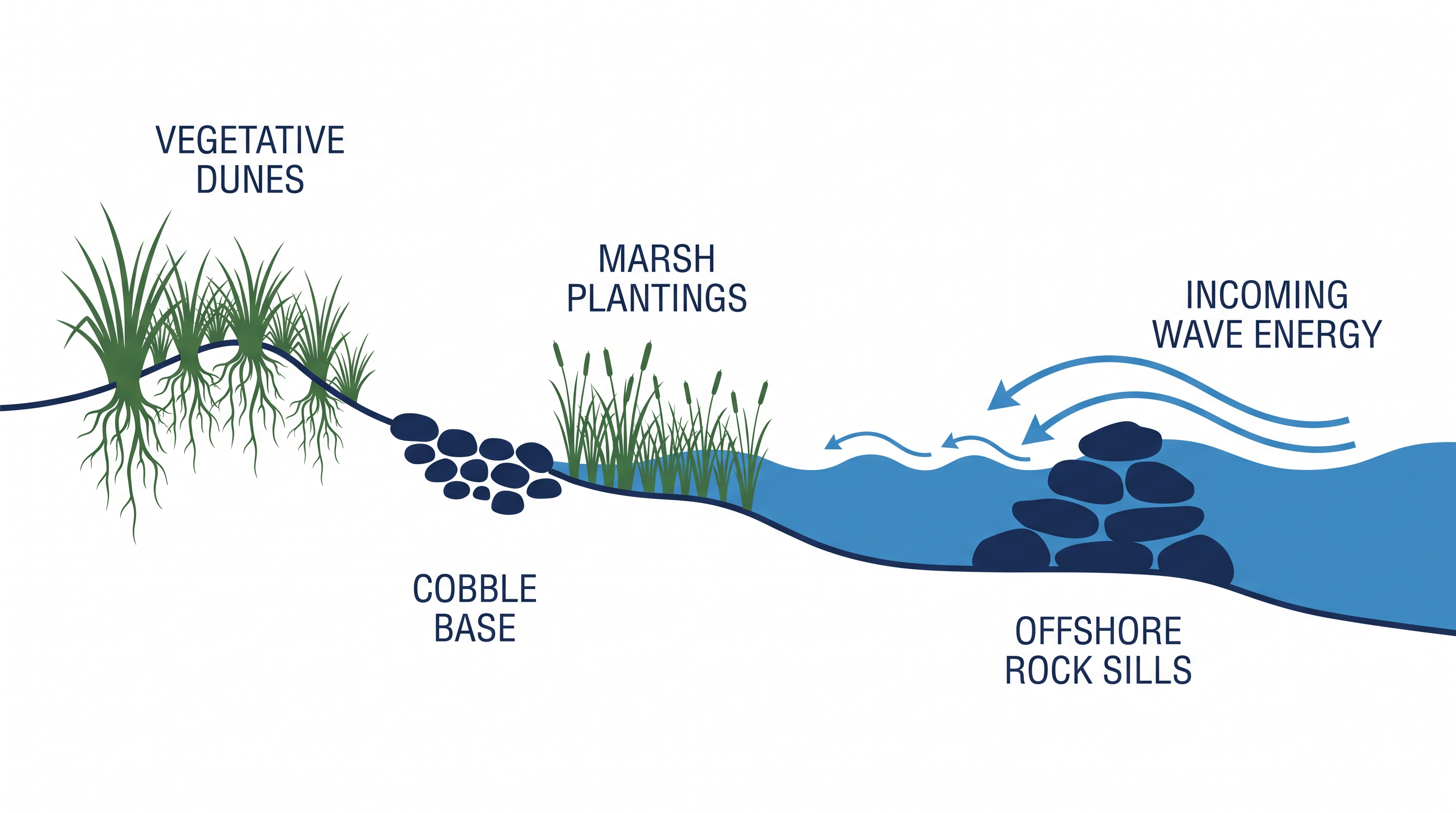
A typical living shoreline incorporates a carefully designed combination of native vegetation, strategically placed cobble, and offshore rock sills. In Carpinteria, California, the city recently advanced a comprehensive shoreline management plan, securing a $1.62 million grant to replace its temporary, bulldozed winter sand berms with a permanent living shoreline. The Carpinteria project features a foundational cobble base topped with a vegetated dune system, designed to serve as the first line of defense during large storm events while maintaining the natural aesthetic of the coast.[7]
The mechanics of a living shoreline rely on biology just as much as they rely on engineering. The deep, complex root systems of native coastal grasses physically bind the sand together, making the dunes highly resistant to scouring from storm surges. Meanwhile, the offshore rock sills or oyster reefs break the raw energy of incoming waves before they ever reach the shore. This creates a calmer, lower-energy environment behind the sill where suspended sediment can settle out of the water column, allowing the shoreline to actually accrete new land over time.[8]
The accelerating transition from gray infrastructure to green, nature-based solutions represents a fundamental shift in the philosophy of coastal management. As the ocean continues to rise and storms grow more intense, the prevailing strategy is evolving from rigid defense to dynamic adaptation. For communities facing the reality of the vanishing coast, the long-term survival of their beaches—and the vital infrastructure built behind them—will increasingly depend on working in tandem with the mechanics of the ocean, rather than fighting a losing battle against them.[8]
How we got here
September 2023
Buxton Beach Access in North Carolina closes after severe erosion exposes abandoned military infrastructure and fuel hazards.
April 2026
Carpinteria, California, advances a $1.62 million living shoreline project to replace temporary sand berms with vegetative dunes.
May 2026
The Town of Palm Beach completes a massive renourishment project, pumping nearly 600,000 cubic yards of sand onto its shoreline.
August 2026
Los Angeles County indefinitely closes Point Dume Beach access roads and restrooms following extreme erosion and 8-foot drop-offs.
Viewpoints in depth
Municipal Planners' View
Focuses on maintaining public access and protecting critical infrastructure through active interventions.
For city managers and coastal planners, the primary directive is protecting the local economy and public safety. When critical infrastructure like the Pacific Coast Highway or municipal water lines are threatened by sudden drop-offs, planners often have no choice but to deploy immediate, large-scale interventions. This perspective argues that while beach renourishment is expensive and temporary, it is a necessary investment to preserve the billions of dollars in real estate and tourism revenue that fund local governments. They view managed retreat as a last resort, prioritizing engineered defense to buy time.
Coastal Ecologists' View
Advocates for nature-based solutions that work with natural sediment transport rather than against it.
Environmental scientists and coastal ecologists emphasize that traditional hard armoring fundamentally breaks the mechanics of a beach. They argue that seawalls and revetments create a 'coastal squeeze' that inevitably destroys the very beaches they were built adjacent to. This camp strongly advocates for living shorelines, dune restoration, and ultimately, managed retreat. They point to the ecological benefits of native vegetation and offshore rock sills, which not only dampen wave energy but also restore critical marine habitats that are destroyed by perpetual hydraulic dredging.
What we don't know
- How quickly sea level rise will outpace the design limits of current living shoreline projects.
- Whether federal and state funding can sustain the escalating costs of perpetual beach renourishment cycles.
- The exact timeline for when major coastal arteries, like the Pacific Coast Highway, will require permanent inland relocation.
Key terms
- Coastal Squeeze
- The loss of coastal habitat that occurs when rising sea levels push the high-water mark inland, but natural migration is blocked by fixed infrastructure like seawalls.
- Beach Nourishment
- The artificial addition of massive quantities of sand or sediment to a beach to combat erosion and increase beach width.
- Living Shoreline
- A shoreline management practice that uses natural materials such as plants, sand, or rock to stabilize the coast and absorb wave energy.
- Hard Armoring
- The use of rigid, engineered structures like concrete seawalls or rock revetments to protect shorelines from wave action.
- Hydraulic Dredge
- A specialized maritime vessel that uses suction to excavate underwater sand and pump it through pipelines onto an eroded beach.
Frequently asked
Why do seawalls sometimes make beach erosion worse?
Hardened structures like seawalls deflect wave energy downward and sideways. This violently scours the sand from the base of the wall, accelerating erosion and eventually destroying the beach in front of it.
What is beach renourishment?
It is the process of dredging massive quantities of sand from offshore borrow sites and pumping it onto a beach to artificially widen the shoreline and protect inland structures.
How does a living shoreline differ from a seawall?
A living shoreline uses natural elements like native vegetation, cobble, and offshore rock sills to absorb and dampen wave energy, whereas a seawall uses rigid concrete to aggressively deflect it.
Sources
Source coverage
8 outlets
3 viewpoints surfaced






[1]Los Angeles TimesMunicipal Planners
L.A. County closes road access, restrooms at Point Dume Beach due to extreme erosion
Read on Los Angeles Times →[2]SFGATEMunicipal Planners
Popular Malibu beach closed indefinitely due to severe erosion
Read on SFGATE →[3]CBS NewsMunicipal Planners
Malibu officials warn of accelerating coastal erosion threatening PCH
Read on CBS News →[4]The IndependentFederal Land Managers
Malibu's Point Dume Beach closed indefinitely after severe coastal erosion
Read on The Independent →[5]National Park ServiceFederal Land Managers
FAQs for Buxton Beach Access
Read on National Park Service →[6]Town of Palm BeachMunicipal Planners
Palm Beach Mid-Town Beach Renourishment Project
Read on Town of Palm Beach →[7]Santa Barbara IndependentCoastal Ecologists
Carpinteria Looks to ‘Living Shoreline’ to Combat Coastal Erosion
Read on Santa Barbara Independent →[8]University of FloridaCoastal Ecologists
Addressing Shoreline Erosion with Living Shorelines
Read on University of Florida →
Comments
Every angle. Every day.
Get travel stories with full source coverage and perspective breakdowns delivered to your inbox.