
The Mechanics of the Small Ship: How Millennial Demand for Luxury Expedition Cruises Reshapes the Global Cruise Market
As millennial travelers prioritize authentic, remote experiences over traditional mega-resort amenities, the luxury expedition cruise market is experiencing unprecedented growth. This demographic shift is driving billions in new investments toward smaller, high-yield vessels designed for global exploration.
By Irina Belova

In short
- The luxury expedition cruise market reached $9.4 billion in 2025 and is projected to double by 2034.
- Millennials are the fastest-growing demographic in the sector, holding nearly 20% of the market share.
- Expedition vessels are generating a 10.12% compound annual growth rate, outpacing traditional ocean cruises.
The era of the floating mega-resort is making room for something much smaller, much more expensive, and decidedly more adventurous. Millennial travelers are rapidly reshaping the global cruise industry, trading casinos and waterslides for Zodiac landings and marine biologists. This demographic shift is driving an unprecedented boom in the luxury expedition cruise market, a sector now valued at $9.4 billion and projected to double over the next decade.
For decades, the cruise industry's growth strategy relied on economies of scale. Ships grew larger, passenger counts swelled past 5,000, and onboard amenities evolved to include roller coasters and surf simulators. But a lucrative and growing segment of the market is pulling in the exact opposite direction. Today's emerging luxury cruisers want intimacy over scale, authenticity over artificial entertainment, and access to the world's most remote coastlines.[1]
The numbers reveal a stark generational transition. According to industry data, millennials are now the fastest-growing age group in the luxury expedition market. Their share of the sector has climbed from roughly 14 percent in 2020 to nearly 20 percent in 2025. This isn't the budget-conscious backpacker crowd of the early 2010s; these are established professionals in their 30s and early 40s entering their peak earning years.
Factlen's analysis of market valuations and demographic shifts indicates that millennial travelers now account for approximately $1.88 billion of the annual luxury expedition cruise market. This figure has more than doubled since the turn of the decade, fundamentally shifting how operators invest their capital. Instead of pouring billions into mega-ships, brands are commissioning agile, ice-class vessels designed for fewer than 200 guests.[5]
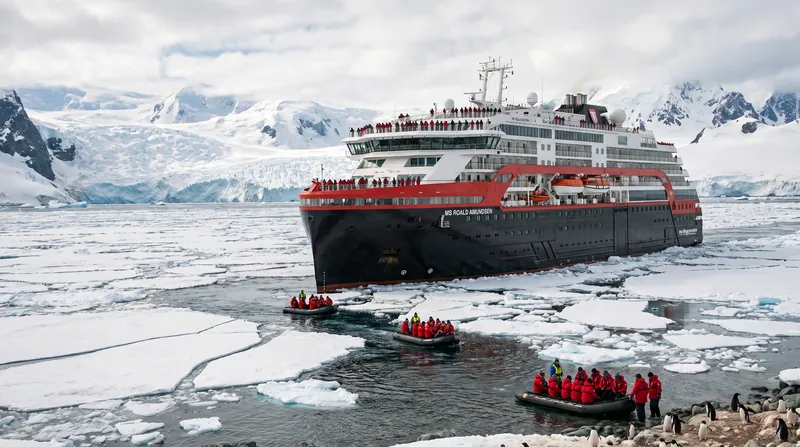
The appeal of the small ship lies in its mechanics and its reach. A vessel carrying 150 passengers can navigate the narrow fjords of Svalbard, anchor in secluded Indonesian archipelagos, or slip into the protected marine reserves of the Galápagos Islands. These are environments where a traditional 3,000-passenger ship is legally barred or physically incapable of entering.[3]
For the millennial luxury traveler, this exclusivity is the ultimate amenity. They are digital natives who have grown up saturated with travel content, making them highly selective about their vacation time. They seek out experience-driven travel that is socially connected, prioritizing authentic encounters over passive lounging. Hovering at the waterline in an inflatable Zodiac while a humpback whale breaches nearby offers a visceral thrill that no onboard theater production can match.[1]
This shift in preference is reflected in the broader cruise market's growth metrics. While traditional ocean cruises still dominate the industry's total revenue, expedition vessels are generating a remarkable 10.12 percent compound annual growth rate. The overall luxury expedition market is expanding at an 8.7 percent clip, on track to reach $19.8 billion by 2034.[2]
To capture this younger, affluent demographic, operators are entirely rethinking the onboard experience. The heavy, formal dining rooms and rigid schedules of legacy luxury cruising have been replaced by flexible, wellness-oriented programming. Integration of yoga, meditation, healthy cuisine, and premium spa services has become standard on new expedition builds.
Wellness cruise pricing commands significant premiums, often adding $600 to $1,400 to the cost of a standard itinerary. Yet, demand remains robust. Industry surveys indicate that more than half of passengers express interest in wellness-focused itineraries, viewing their time at sea as an opportunity for physical and mental restoration rather than mere indulgence.
Time is another critical factor reshaping the market. Because most millennial and Gen Z travelers are still actively in the workforce, they face stricter limits on their available vacation days compared to retired baby boomers. As a result, there is a surging demand for shorter, highly concentrated expedition itineraries.[4]
Voyages lasting fewer than five days are becoming increasingly popular as test runs for younger cruisers. These abbreviated trips offer a taste of the luxury expedition experience without requiring a two-week commitment away from the office. Operators are adapting by offering fly-in Antarctica itineraries that skip the notoriously rough, multi-day crossing of the Drake Passage, cutting travel time and easing logistics for time-strapped professionals.[1][4]
The financial mechanics of the small ship model are highly attractive to operators, despite the massive initial capital required to build specialized, eco-friendly vessels. Because capacity is strictly limited, scarcity drives up the price. Expedition itineraries routinely benefit from per-passenger yields exceeding $1,000 daily.[2]
This high-yield environment has sparked an arms race in expedition ship design. Modern vessels are equipped with dynamic positioning systems that allow them to hover in place without dropping anchor and damaging fragile seabeds. They feature onboard science lounges, submarine bays, and fleets of kayaks. The goal is to blend the rugged capability of a research vessel with the refined comfort of a five-star boutique hotel.
The demographic shift is also changing the geographic focus of the industry. While polar regions—Antarctica and the Arctic—remain the crown jewels of expedition cruising, there is surging interest in warm-water destinations. Operators are expanding their footprints in the Amazon, the South Pacific, and along the remote coastlines of Africa, catering to travelers who want adventure without the sub-zero temperatures.[3]
Traditional mega-ship lines are not ignoring this trend. Recognizing the massive capital flowing into the luxury expedition space, mainstream brands are launching their own high-end, small-ship subsidiaries. Others are creating exclusive ship-within-a-ship enclaves on their larger vessels, offering dedicated dining rooms, private lounges, and enhanced service to retain affluent guests who might otherwise defect to boutique operators.[1]
Sustainability is perhaps the most defining characteristic of the millennial luxury cruiser. This generation is acutely aware of the environmental impact of global tourism, and they expect their travel providers to share those concerns. Expedition operators are responding by investing in hybrid-electric propulsion, advanced wastewater treatment systems, and partnerships with marine conservation organizations.[2]
Some operators are even launching conservation-focused cruises that combine wildlife education with environmental activism, commanding pricing premiums that sit substantially above baseline rates. For the modern luxury traveler, knowing that their voyage contributes to the preservation of the destination is a crucial part of the value proposition.
For the modern luxury traveler, knowing that their voyage contributes to the preservation of the destination is a crucial part of the value proposition.
As the definition of luxury continues to evolve, the global cruise market is being permanently altered. The focus is shifting from what a ship has onboard to where a ship can take its passengers. By prioritizing access, authenticity, and environmental stewardship, the expedition sector has unlocked a new era of maritime exploration.[1]
The mechanics of the small ship have proven that less can indeed be more. As millennial demand continues to mature, the luxury expedition cruise will likely cement its status not just as a niche alternative, but as the pinnacle of modern, high-end travel.[5]
How we did this
- Method
- Factlen derived the generational revenue shift by cross-referencing the 2025 global luxury expedition market valuation with the demographic share growth of millennial passengers, calculating the absolute dollar value of millennial spending in this sector compared to 2020.
- What we found
- Millennial travelers now account for approximately $1.88 billion of the annual luxury expedition cruise market—a figure that has more than doubled since 2020, fundamentally shifting operator investments from traditional mega-ship amenities toward bespoke, small-vessel experiential infrastructure.
- What we worked from
- 2025 Global luxury expedition cruise market value: $9.4 billion
- Millennial market share in 2025: 20%
- Limits of this analysis
- This analysis relies on aggregate demographic booking data and market projections, which may not capture private charter revenues or off-book luxury yacht rentals.
Competing readings
Luxury Expedition Operators
Focusing on high-yield, bespoke experiences and smaller environmental footprints.
For boutique cruise operators, the shift toward smaller vessels is a highly lucrative mechanical advantage. By limiting capacity to under 200 passengers, these brands create artificial scarcity that drives per-passenger yields well above $1,000 per day. This revenue model justifies the massive capital expenditure required to build ice-class hulls and integrate dynamic positioning systems, allowing them to offer unparalleled access to protected marine reserves while maintaining robust profit margins.
Millennial Travelers
Seeking authenticity, wellness integration, and shorter, high-impact itineraries.
Younger affluent travelers view their vacation time as a scarce resource that must deliver maximum experiential return. They are driving the demand for 'fly-in' polar itineraries that skip multi-day ocean crossings, and they heavily favor vessels that integrate wellness programming and active exploration. For this demographic, true luxury is defined by exclusive access to remote environments and the ability to engage in socially connected, environmentally conscious travel.
Traditional Mega-Ship Lines
Adapting to the small-ship threat by launching luxury enclaves and bespoke subsidiaries.
Mainstream cruise corporations recognize the existential threat posed by the expedition boom. To prevent their most affluent clients from defecting to boutique operators, legacy brands are investing heavily in 'ship-within-a-ship' concepts that offer private dining and dedicated butler service on 3,000-passenger vessels. Simultaneously, major holding companies are acquiring or launching their own dedicated expedition fleets to capture a share of the high-margin adventure market.
- Boutique Expedition Operators
- Prioritize high-yield, low-capacity vessels that offer exclusive access to remote destinations.
- Millennial Luxury Travelers
- Value authentic, sustainable, and time-efficient travel experiences over traditional resort amenities.
- Legacy Cruise Corporations
- Seek to retain affluent market share by blending mega-ship scale with premium, expedition-style offerings.
Perspectives this story doesn't cover
- Environmental Conservation Organizations
- Local Port Communities
Sources
Source coverage
5 outlets
3 viewpoints surfaced





- [1]Cruise Lines International AssociationMillennial Luxury Travelers
Why Has Expedition Cruising Become Travel's Hottest Ticket?
Read on Cruise Lines International Association → - [2]Mordor IntelligenceBoutique Expedition Operators
Cruise Tourism Market Size & Share Analysis
Read on Mordor Intelligence → - [3]Credence ResearchLegacy Cruise Corporations
Global Cruise Ship Expedition Market
Read on Credence Research → - [4]Voyagers TravelMillennial Luxury Travelers
Demand for Luxury and Expedition Cruises Surges for 2026
Read on Voyagers Travel → - [5]Factlen Editorial Team
Synthesis by Factlen editorial team
Read on Factlen Editorial Team →
More in Travel
See all →Polar Conservation
The Mechanics of the Ethical Exodus: How Antarctic Guides Are Abandoning Cruise Tourism Over Climate 'Farce'
7 sources
Travel Economy
Adventure Travel Reaches $1.16 Trillion as Cultural Immersion Replaces Extreme Sports
5 sources
Regenerative Travel
Beyond Sustainability: How Regenerative Travel is Reshaping Global Tourism in 2026
4 sources
Heritage Sites
Bipartisan Bill to Designate Quindaro Townsite a National Historic Landmark Advances in Congress
5 sources

Comments
Every angle. Every day.
Get Travel stories with full source coverage and perspective breakdowns, free every day.